木材加工及家具

Search documents
国家统计局服务业调查中心高级统计师赵庆河解读2025年8月中国采购经理指数
Guo Jia Tong Ji Ju· 2025-08-31 01:36
Group 1: Manufacturing PMI Insights - In August, the Manufacturing PMI rose to 49.4%, indicating an improvement in economic conditions compared to the previous month [2] - The production index reached 50.8%, up by 0.3 percentage points, marking four consecutive months above the critical point, suggesting accelerated manufacturing production [2] - The new orders index increased to 49.5%, reflecting a slight rise in demand [2] - Large enterprises showed a PMI of 50.8%, up by 0.5 percentage points, indicating sustained expansion, while medium and small enterprises experienced declines [3] - High-tech manufacturing and equipment manufacturing PMIs were 51.9% and 50.5%, respectively, indicating strong performance in these sectors [3] Group 2: Non-Manufacturing PMI Insights - The Non-Manufacturing Business Activity Index was 50.3%, up by 0.2 percentage points, continuing its expansion [4] - The service sector's business activity index reached 50.5%, the highest point of the year, with significant growth in capital market services and transportation sectors [4] - The construction sector's business activity index fell to 49.1%, down by 1.5 percentage points, due to adverse weather conditions [4] Group 3: Comprehensive PMI Insights - The Comprehensive PMI Output Index stood at 50.5%, up by 0.3 percentage points, indicating overall expansion in production and business activities [5] - The manufacturing production index and non-manufacturing business activity index were 50.8% and 50.3%, respectively, contributing to the comprehensive index's growth [5]
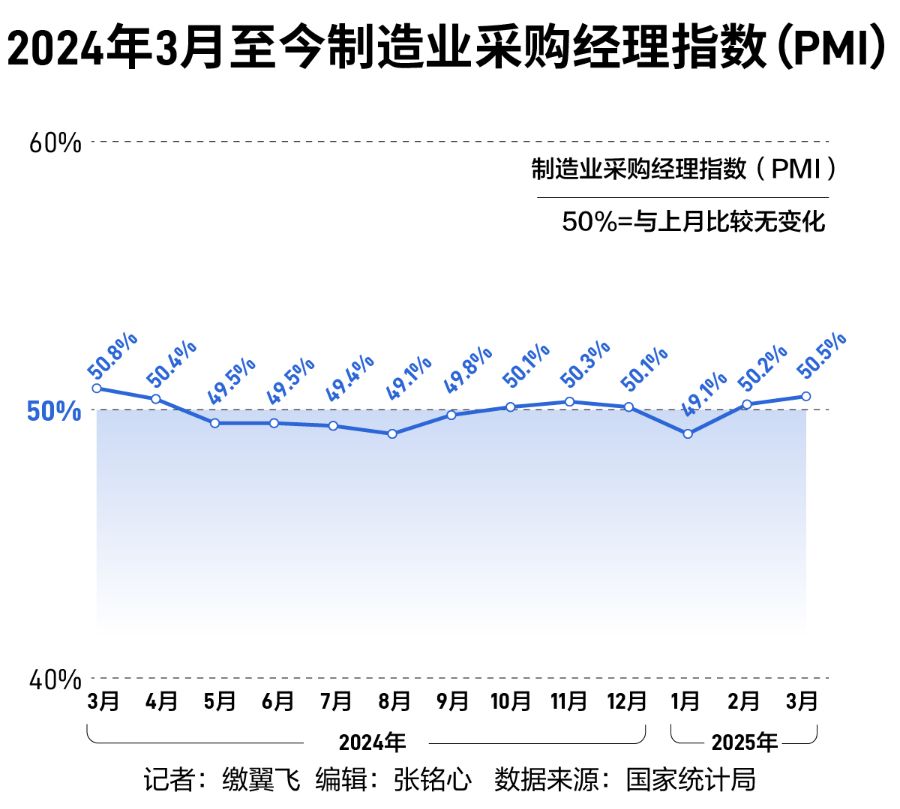
3月制造业PMI回升至50.5%,需求回暖提振企业生产意愿
2 1 Shi Ji Jing Ji Bao Dao· 2025-03-31 12:09
Core Viewpoint - The manufacturing Purchasing Managers' Index (PMI) in March rose to 50.5%, indicating a slight improvement in manufacturing activity compared to February, driven by seasonal factors, policy support, and technological innovations [1][4]. Manufacturing PMI Analysis - The production index, new orders index, new export orders index, and raw materials inventory index all increased, with rises between 0.1 to 0.7 percentage points [1]. - The new orders index reached 51.8%, up 0.7 percentage points from February, indicating sustained demand [4]. - The production index was at 52.6%, reflecting a continuous upward trend for two months [4]. Sector Performance - High-tech manufacturing sectors, such as railway, aerospace, and electronics, showed strong performance with production and new orders indices above 55.0% [6]. - Conversely, industries like wood processing and coal showed indices below the critical point, indicating supply-demand imbalances [6]. - The consumer goods manufacturing PMI rose to 50.0%, driven by policies promoting consumption [6]. Price Indices and Market Dynamics - The main raw materials purchase price index fell to 49.8%, while the factory price index dropped to 47.9%, indicating a supply surplus [7][8]. - The decline in prices is attributed to weak demand and increased production, particularly in the basic raw materials sector [7][8]. Future Outlook - The manufacturing sector is expected to continue its stable recovery in the second quarter, supported by government policies aimed at expanding domestic demand and promoting new urbanization [9]. - The manufacturing production and business activity expectation index was at 53.8%, indicating optimism among enterprises [9]. - However, potential challenges include the impact of increased tariffs on exports and the need for further stabilization in the real estate market [9].