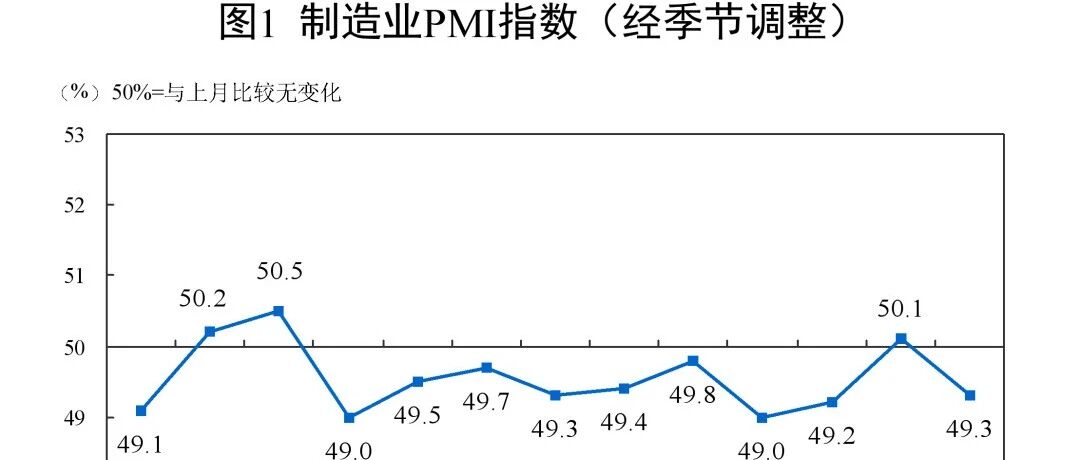
采购经理指数

Search documents
【数据发布】2026年3月中国采购经理指数运行情况
中汽协会数据· 2026-03-31 09:13
Group 1: Manufacturing PMI Overview - The Manufacturing Purchasing Managers' Index (PMI) for March is 50.4%, an increase of 1.4 percentage points from the previous month, indicating a recovery in manufacturing sentiment [1][4] - Large enterprises have a PMI of 51.6%, while small and medium enterprises have PMIs of 49.0% and 49.3%, respectively, both below the critical point [4] - The production index is at 51.4%, up 1.8 percentage points, indicating accelerated manufacturing activity, while the new orders index is at 51.6%, up 3.0 percentage points, showing improved market demand [5] Group 2: Manufacturing Sub-Indices - The raw materials inventory index is at 47.7%, indicating a narrowing decline in inventory levels, while the employment index is at 48.6%, suggesting a slight recovery in employment sentiment [5][6] - The supplier delivery time index is at 49.5%, indicating extended delivery times for raw materials compared to the previous month [7] Group 3: Non-Manufacturing PMI Overview - The Non-Manufacturing Business Activity Index for March is 50.1%, an increase of 0.6 percentage points, indicating an improvement in non-manufacturing sentiment [10] - The construction industry activity index is at 49.3%, up 1.1 percentage points, while the services industry index is at 50.2%, up 0.5 percentage points [11] Group 4: Non-Manufacturing Sub-Indices - The new orders index for non-manufacturing is at 45.0%, down 0.2 percentage points, indicating a decline in market demand [14] - The input price index is at 52.3%, up 1.4 percentage points, indicating rising costs for non-manufacturing enterprises [14] - The employment index for non-manufacturing is at 45.2%, down 0.8 percentage points, indicating a decline in employment sentiment [14] Group 5: Composite PMI Overview - The Composite PMI Output Index for March is 50.5%, an increase of 1.0 percentage points, indicating an overall improvement in production and business sentiment across sectors [21]

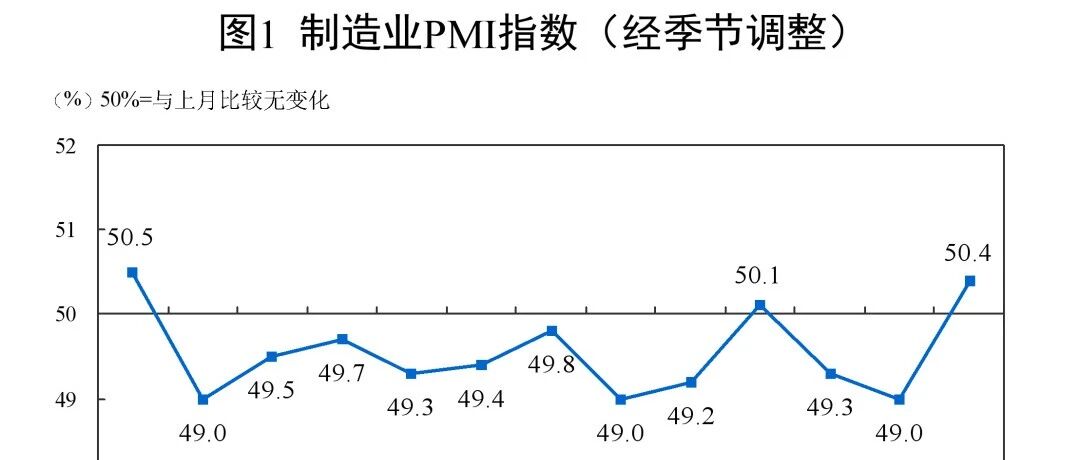
【权威解读】3月份中国采购经理指数重回扩张区间
中汽协会数据· 2026-03-31 09:13
Core Viewpoint - In March 2026, China's Purchasing Managers' Index (PMI) returned to the expansion zone, indicating a recovery in economic sentiment with manufacturing PMI at 50.4%, non-manufacturing business activity index at 50.1%, and composite PMI output index at 50.5% [1]. Group 1: Manufacturing PMI - The manufacturing PMI rose to 50.4% in March, reflecting increased market activity as companies resumed operations post-Spring Festival [2]. - Both production index and new orders index improved, reaching 51.4% and 51.6% respectively, indicating accelerated production activities and improved market demand [2]. - Large, medium, and small enterprises all saw a rise in PMI, with large enterprises at 51.6%, medium at 49.0%, and small at 49.3%, showing significant improvement in sentiment for smaller firms [2]. Group 2: Key Industries - High-tech manufacturing PMI stood at 52.1%, marking 14 consecutive months above the critical point, indicating a positive development trend [3]. - Equipment manufacturing and consumer goods industries also showed expansion with PMIs of 51.5% and 50.8% respectively [3]. - The price index for major raw materials surged, with purchasing price index at 63.9% and factory price index at 55.4%, reflecting a significant increase in market prices [3]. Group 3: Non-Manufacturing PMI - The non-manufacturing business activity index rose to 50.1%, indicating an improvement in the non-manufacturing sector [5]. - The service sector's business activity index reached 50.2%, with certain industries like telecommunications and financial services showing strong growth [5]. - The construction industry also saw an improvement, with a business activity index of 49.3%, reflecting a recovery in construction projects post-holiday [5]. Group 4: Composite PMI - The composite PMI output index increased to 50.5%, indicating an overall positive trend in production and business activities across sectors [6]. - The manufacturing production index and non-manufacturing business activity index contributed to this increase, standing at 51.4% and 50.1% respectively [6].

【宏观经济】一周要闻回顾(2026年3月25日-3月31日)
乘联分会· 2026-03-31 08:21
Core Insights - China's e-commerce sector showed stable growth in January and February 2026, with digital consumption improving and industrial e-commerce driving digital transformation [3] - The "Silk Road E-commerce" initiative enhanced global brand effects and achieved a strong start for high-quality development [3] E-commerce Development - Digital consumption remained active, with national online retail sales of goods and services increasing by 9.2% year-on-year in January and February [5] - Notable growth in smart products was observed, with smart glasses and window-cleaning robots seeing increases of 183.5% and 130.8% respectively [5] - The tourism and catering sectors experienced significant online retail growth, with increases of 36.1% and 27.3% respectively [5] Industrial E-commerce - Industrial e-commerce facilitated enterprise connections and deepened digital empowerment for industrial transformation [5] - Online retail of agricultural products grew by 17.6%, while industrial e-commerce transactions for metals and industrial goods increased by 63.8% and 8.8% respectively [5] - The logistics and AI sectors benefited from industrial e-commerce, with daily express delivery volumes exceeding 590 million packages in January [5] Silk Road E-commerce - The "Silk Road E-commerce" initiative linked domestic and international markets, showcasing products from Central Asia and ASEAN countries [6] - Key e-commerce import platforms reported a 7.6% increase in global product sales, with Icelandic salmon, Thai durian, and Brazilian beef seeing growth rates of 510.9%, 443.6%, and 156% respectively [6] Power Market Transactions - In January and February 2026, the total electricity market transaction volume reached 11,925 billion kilowatt-hours, marking a year-on-year increase of 25.5% [8] - Intra-provincial transactions accounted for 9,543 billion kilowatt-hours, up 29.2%, while inter-provincial transactions reached 2,382 billion kilowatt-hours, increasing by 12.7% [8] Industrial Profit Growth - Profits of large-scale industrial enterprises totaled 10,245.6 billion yuan in January and February, reflecting a year-on-year growth of 15.2% [11] - The manufacturing sector saw profits rise by 18.9%, while the mining industry reported a profit increase of 9.9% [11] - Notable profit growth was recorded in the computer and electronic equipment manufacturing sector, which saw a 200% increase [12] Purchasing Managers' Index (PMI) - The manufacturing PMI for March 2026 was reported at 50.4%, indicating a recovery in manufacturing activity [15] - The production index rose to 51.4%, and the new orders index increased to 51.6%, suggesting improved market demand [17][18] - The non-manufacturing PMI was at 50.1%, indicating a slight improvement in the non-manufacturing sector [21]

3月PMI数据解读
清华金融评论· 2026-03-31 08:00
Group 1: Manufacturing PMI Insights - In March, the Manufacturing Purchasing Managers' Index (PMI) rose to 50.4%, indicating a return to the expansion zone, driven by increased market activity post-Spring Festival [4] - Both production index and new orders index improved, reaching 51.4% and 51.6% respectively, reflecting accelerated production activities and improved market demand [4] - Large, medium, and small enterprises all showed PMI increases, with large enterprises at 51.6%, medium at 49.0%, and small at 49.3%, indicating a general improvement in economic conditions [4][5] Group 2: Sector-Specific Performance - High-tech manufacturing PMI reached 52.1%, marking 14 consecutive months above the critical point, indicating a positive development trend [5] - The equipment manufacturing and consumer goods sectors also saw PMIs of 51.5% and 50.8%, respectively, both entering the expansion zone [5] - The price indices for major raw materials and factory prices significantly increased to 63.9% and 55.4%, respectively, due to rising commodity prices and increased procurement activities [5] Group 3: Non-Manufacturing PMI Insights - The Non-Manufacturing Business Activity Index rose to 50.1%, showing an improvement in the non-manufacturing sector's economic conditions [7] - The service sector's business activity index reached 50.2%, with significant growth in sectors like rail transport and financial services, while retail and hospitality lagged behind [7] - The construction sector's business activity index improved to 49.3%, with a positive outlook for future activities as indicated by a business activity expectation index of 50.5% [7] Group 4: Comprehensive PMI Overview - The Comprehensive PMI Output Index increased to 50.5%, indicating an overall improvement in production and business activities across sectors [8] - The manufacturing production index and non-manufacturing business activity index contributed to this increase, standing at 51.4% and 50.1% respectively [8]

PMI三大指数重返扩张区间!
证券时报· 2026-03-31 05:55
Economic Recovery - The economic sentiment in China is recovering, with the manufacturing PMI rising to 50.4% in March, an increase of 1.4 percentage points from the previous month, indicating a return to expansion after two months below 50% [1][3] - All 13 sub-indices of the manufacturing PMI showed improvement, with increases ranging from 0.2 to 9.1 percentage points, reflecting enhanced production and market activity [2][3] Manufacturing Sector - High-tech manufacturing PMI reached 52.1%, up 0.6 percentage points, marking 14 consecutive months above the threshold, indicating a positive development trend [6] - Equipment manufacturing and consumer goods PMIs were 51.5% and 50.8%, respectively, both rising into the expansion zone, with significant increases of 1.7 and 2.0 percentage points [6] - The proportion of manufacturing companies reporting insufficient demand fell to 48.5%, a decrease of 6.6 percentage points, the first time below 50% since July 2022 [6] Non-Manufacturing Sector - The non-manufacturing business activity index rose to 50.1%, up 0.6 percentage points, marking two consecutive months of increase [8] - The transportation sector, including rail, road, and water transport, showed significant improvement, while the financial sector maintained a strong performance with an index above 60% for four consecutive months [8] - The construction sector's business activity index was at 49.3%, still below 50 but up 1.1 percentage points, indicating a recovery in construction activities, particularly in civil engineering [9] Cost Pressures - Rising costs in raw materials and logistics, influenced by geopolitical tensions, have increased the proportion of companies facing high costs, which may erode profit margins [4][9]

【宏观经济】一周要闻回顾(2026年3月4日-3月10日)
乘联分会· 2026-03-10 08:44
Group 1: Manufacturing PMI Overview - In February, the Manufacturing Purchasing Managers' Index (PMI) was 49.0%, a decrease of 0.3 percentage points from the previous month, indicating a decline in manufacturing activity [3] - Large enterprises had a PMI of 51.5%, up 1.2 percentage points, while medium and small enterprises had PMIs of 47.5% and 44.8%, down 1.2 and 2.6 percentage points respectively, both below the critical point [3] - All five sub-indices of the manufacturing PMI, including production index, new orders index, raw material inventory index, employment index, and supplier delivery time index, were below the critical point [3] Group 2: Non-Manufacturing PMI Overview - The Non-Manufacturing Business Activity Index was 49.5%, an increase of 0.1 percentage points from the previous month, indicating slight improvement in non-manufacturing activity [5] - The construction industry business activity index was 48.2%, down 0.6 percentage points, while the service industry index was 49.7%, up 0.2 percentage points [5] - The new orders index for non-manufacturing was 45.2%, down 0.9 percentage points, indicating a decline in market demand [6] Group 3: Price Trends - In February, the Producer Price Index (PPI) for industrial producers decreased by 0.9% year-on-year, with a narrowing decline of 0.5 percentage points compared to the previous month [4][9] - The Consumer Price Index (CPI) rose by 1.3% year-on-year, with urban areas increasing by 1.4% and rural areas by 0.9% [14][15] - Food prices increased by 1.7%, while non-food prices rose by 1.3%, indicating inflationary pressures in consumer goods [15][16]

富时中国A50指数将调整……盘前重要消息还有这些
证券时报· 2026-03-05 00:32
Group 1 - The State Council will hold a press conference on March 5, 2026, to interpret the "Government Work Report" [2] - The Ministry of Foreign Affairs emphasized the importance of maintaining security in the Strait of Hormuz for global economic stability [2] - FTSE Russell announced adjustments to the FTSE China Index Series, effective March 20, 2026, including the inclusion of China Shipbuilding and others [2] - The manufacturing PMI for February fell to 49.0%, while the non-manufacturing business activity index slightly increased to 49.5% [2] Group 2 - The Shanghai Futures Exchange announced adjustments to trading margin ratios and price limits for fuel oil futures, effective March 4, 2026 [3] - The Zhengzhou Commodity Exchange adjusted trading margin standards and price limits for methanol futures, effective March 4 and March 5, 2026 [3] - European natural gas futures prices exceeded €56 per MWh, marking a 60% increase due to geopolitical tensions [3] - The U.S. Treasury Secretary announced a new 15% global import tariff expected to take effect soon [3] Group 3 - E Fund will suspend trading of its crude oil LOF from March 5 until 10:30 AM [5] - Far Eastern New Century clarified it does not engage in "special optical fibers" or "fiber sensing" businesses [6] - Huayuan New Materials' controlling shareholder plans to transfer 6% of company shares, which will not affect actual control [7] - Xiamen Tungsten's revenue is expected to grow by 60% to 110% year-on-year for January to February [8] - Muxi Co., Ltd. anticipates a revenue increase of 24.84% to 87.26% year-on-year for the first quarter [9] - Shuangxin Environmental Protection will change its stock name to "Shuangxin Materials" starting March 5 [10] - COSCO Shipping has suspended new bookings for related routes due to escalating conflicts in the Middle East [11] - Huafeng Superfiber plans to raise prices for super fiber base cloth starting March 9 due to rising crude oil costs [12]
【环球财经】2026年1月标普全球澳大利亚综合PMI增至55.7点
Xin Hua Cai Jing· 2026-02-04 02:09
Group 1 - The S&P Global Australia Composite PMI increased from 51 to 55.7 in January 2026, indicating the overall output of the Australian private economy has risen for the 16th consecutive month, with the highest growth rate in 45 months [1] - The manufacturing output and service business activity in Australia both saw an increase in January 2026, with new business growth reaching the highest level since April 2022 [2] - The Australian services business activity index rose significantly from 51.1 in December 2025 to 56.3 in January 2026, marking the highest level since February 2022 and indicating continuous expansion for 24 months above the 50-point threshold [2] Group 2 - The increase in domestic and external demand contributed to the significant improvement in the Australian services sector, with the expansion rate in January reaching the highest level in nearly four years [2] - Despite the growth in new business leading to increased hiring, the business confidence level among private enterprises fell to the lowest point since October 2024 [2] - Input cost pressures eased for service sector businesses in January, allowing them to reduce the pace of price increases, which is beneficial for future demand growth [2]

【宏观经济】一周要闻回顾(2026年1月28日-2月3日)
乘联分会· 2026-02-03 10:48
Fiscal Expenditure - In 2025, the national general public budget expenditure is projected to be 28.74 trillion yuan, representing a year-on-year increase of 1% [5] - Key areas of expenditure include social security and employment (up 6.7%), education (up 3.2%), health (up 5.7%), science and technology (up 4.8%), and energy conservation and environmental protection (up 6.1%) [5] Cultural Industry Revenue - In 2025, the revenue of large-scale cultural and related industry enterprises is expected to grow by 7.4%, reaching 1521.35 billion yuan, an increase of 104.51 billion yuan from the previous year [6][8] - The cultural core sector's revenue is projected to be 1031.81 billion yuan, up 11.5%, while related sectors are expected to see a slight decline of 0.4% [9] Investment and Economic Cooperation - In 2025, China's non-financial direct investment abroad is expected to reach 145.66 billion USD, a growth of 1.3% year-on-year [22] - The scale of foreign contracting projects is anticipated to increase, with a completed turnover of 178.82 billion USD, up 7.7%, and new contract amounts reaching 289.22 billion USD, up 8.2% [22] - Labor exports are projected to grow, with 428,000 workers sent abroad, an increase of 4.6% [22] Purchasing Managers' Index (PMI) - In January 2026, the manufacturing PMI is reported at 49.3%, indicating a decline of 0.8 percentage points from the previous month, suggesting a slight contraction in manufacturing activity [12] - The non-manufacturing business activity index is at 49.4%, also down by 0.8 percentage points, reflecting a decrease in market demand [16] - The comprehensive PMI output index stands at 49.8%, down 0.9 percentage points, indicating a general slowdown in production and business activities [18]

【数据发布】2026年1月中国采购经理指数运行情况
中汽协会数据· 2026-02-02 05:03
Group 1: Manufacturing PMI Overview - In January, the Manufacturing Purchasing Managers' Index (PMI) was 49.3%, a decrease of 0.8 percentage points from the previous month, indicating a decline in manufacturing activity [1] - Large enterprises had a PMI of 50.3%, down 0.5 percentage points, while medium and small enterprises had PMIs of 48.7% and 47.4%, down 1.1 and 1.2 percentage points respectively, both below the critical point [3] - The production index was 50.6%, down 1.1 percentage points, indicating continued expansion in manufacturing production [3] - The new orders index was 49.2%, down 1.6 percentage points, suggesting a slowdown in market demand [3] - The raw materials inventory index was 47.4%, down 0.4 percentage points, indicating a continued decrease in major raw material inventories [3] - The employment index was 48.1%, down 0.1 percentage points, reflecting a slight decline in employment conditions within manufacturing [3] - The supplier delivery time index was 50.1%, down 0.1 percentage points, indicating that supplier delivery times continued to accelerate [4] Group 2: Non-Manufacturing PMI Overview - In January, the Non-Manufacturing Business Activity Index was 49.4%, a decrease of 0.8 percentage points from the previous month [6] - The construction industry business activity index was 48.8%, down 4.0 percentage points, while the service industry business activity index was 49.5%, down 0.2 percentage points [8] - The new orders index for non-manufacturing was 46.1%, down 1.2 percentage points, indicating a decline in market demand [13] - The input prices index was 50.0%, down 0.2 percentage points, indicating stable input prices for non-manufacturing enterprises [13] - The sales prices index was 48.8%, up 0.8 percentage points, suggesting a narrowing decline in sales prices [13] - The employment index was 46.1%, stable from the previous month, indicating stable employment conditions in non-manufacturing [13] - The business activity expectation index was 56.0%, down 0.5 percentage points, remaining in a high optimism range [14] Group 3: Comprehensive PMI Overview - In January, the Comprehensive PMI Output Index was 49.8%, a decrease of 0.9 percentage points, indicating a general slowdown in production and business activities compared to the previous month [18]