
计算机通信电子设备

Search documents
2026年1-2月工业企业利润和库存数据解读:利润超预期增长,关注高技术设备制造、出口、涨价景气
ZHESHANG SECURITIES· 2026-03-29 03:08
Group 1: Profit Growth and Drivers - In January-February 2026, industrial enterprises achieved a total profit of 10,245.6 billion yuan, a year-on-year increase of 15.2%, the highest since 2022[1] - The profit growth is driven by three main factors: increased bargaining power of high-end equipment manufacturers, strong production investment willingness from local governments and state-owned enterprises, and a significant decrease in operating cost rates[1] - The manufacturing sector's profit totaled 7,322 billion yuan, up 18.9% year-on-year, while mining profits reached 1,556 billion yuan, up 9.9%[1] Group 2: Sector Performance and Trends - High-tech manufacturing profits surged by 58.7%, contributing 7.9 percentage points to the overall profit growth of industrial enterprises[4] - Notable profit increases were seen in the computer and communication equipment sector (+203%), non-ferrous metals (+148%), and chemicals (+36%) during the same period[1] - The profit margin for industrial enterprises reached 4.92%, the highest in nearly four years, reflecting improved pricing power and reduced cost rates[3] Group 3: Future Outlook and Risks - The forecast for 2026 indicates an annual profit growth rate of 5.7%, supported by domestic demand policies and potential order returns due to global energy crises[7] - Risks include insufficient domestic economic recovery, escalating geopolitical conflicts affecting external demand, and the possibility of policy implementation falling short of expectations[9][34] - The Producer Price Index (PPI) showed a year-on-year decline of 1.2%, but there is potential for upward pressure due to geopolitical tensions[3]
国泰海通|宏观:假期扰动:PMI季节性回落——2026年2月PMI数据点评
国泰海通证券研究· 2026-03-05 14:13
Core Viewpoint - The manufacturing PMI has marginally declined due to seasonal disruptions from the longest Spring Festival holiday in history, with input inflation being a key concern moving forward [1][2]. Manufacturing Sector - In February 2026, the manufacturing PMI stood at 49.0%, down 0.3 percentage points from the previous month, indicating a lower-than-average performance for this time of year due to the holiday disruption [2]. - The production index was notably affected, particularly impacting small and medium-sized enterprises, while high-tech manufacturing remains in the expansion zone [2]. - The consumer goods sector's PMI increased to 48.8%, up 0.5 percentage points from last month, driven by consumption policies [2]. Supply and Demand Index - The supply and demand index experienced a seasonal decline, with new export orders showing a significant drop, although domestic demand remains relatively stable when seasonal factors are excluded [3]. - Industries such as agricultural processing and computer communication equipment are expanding, while textiles and automotive sectors remain below the critical point [3]. - The purchasing price index for raw materials has slightly decreased, while factory prices remain stable, potentially improving revenue expectations for businesses [3]. Non-Manufacturing Sector - The service sector showed stable performance with a slight increase in the business activity index, although there is significant structural differentiation [3]. - Industries related to consumer travel, such as accommodation and dining, are experiencing rapid growth, while capital market services and real estate are operating at low levels [3]. - The construction sector's business activity index has marginally declined due to the holiday, with some projects temporarily halted [3]. Future Outlook - The macroeconomic policy is expected to be more proactive, with a focus on supporting overall demand [4]. - The Central Political Bureau has indicated a commitment to more active fiscal policies and moderately loose monetary policies, with potential for further interest rate cuts [4]. - There will be an emphasis on boosting consumption and expanding investment, including infrastructure projects like parking lots and charging stations [4].


2026年2月PMI点评:经济“开门红”仍较温和
Orient Securities· 2026-03-05 06:42
Economic Overview - The manufacturing PMI for February 2026 decreased by 0.3 percentage points to 49%, indicating a contraction in the manufacturing sector[7] - Despite the decline, the actual performance is considered better than seasonal expectations due to the impact of the Spring Festival[7] - The construction sector's business activity index fell to 48.2%, down 0.6 percentage points, reflecting reduced activity during the holiday period[7] Supply and Demand Dynamics - The overall supply exceeds demand, with production and new orders PMI at 49.6% and 48.6% respectively, indicating no significant improvement in the supply-demand balance[7] - The gap between raw material purchase prices PMI and factory prices PMI is narrowing, but it remains uncertain if this indicates improved bargaining power for downstream enterprises[7] Sector Performance - High-tech manufacturing PMI recorded at 51.5%, remaining a key driver of economic growth, while consumer goods PMI rose to 48.8% but still below the expansion threshold[7] - Service sector activity index increased to 49.7%, with growth driven by hospitality and entertainment sectors during the Spring Festival[7] External Factors and Risks - Risks include slower-than-expected transmission of counter-cyclical policies, uncertainties in trade policies from other countries, and potential impacts of geopolitical conflicts on commodity prices[4]
兼评2月PMI数据:春节效应拖累PMI,复工略快于往年
KAIYUAN SECURITIES· 2026-03-05 03:14
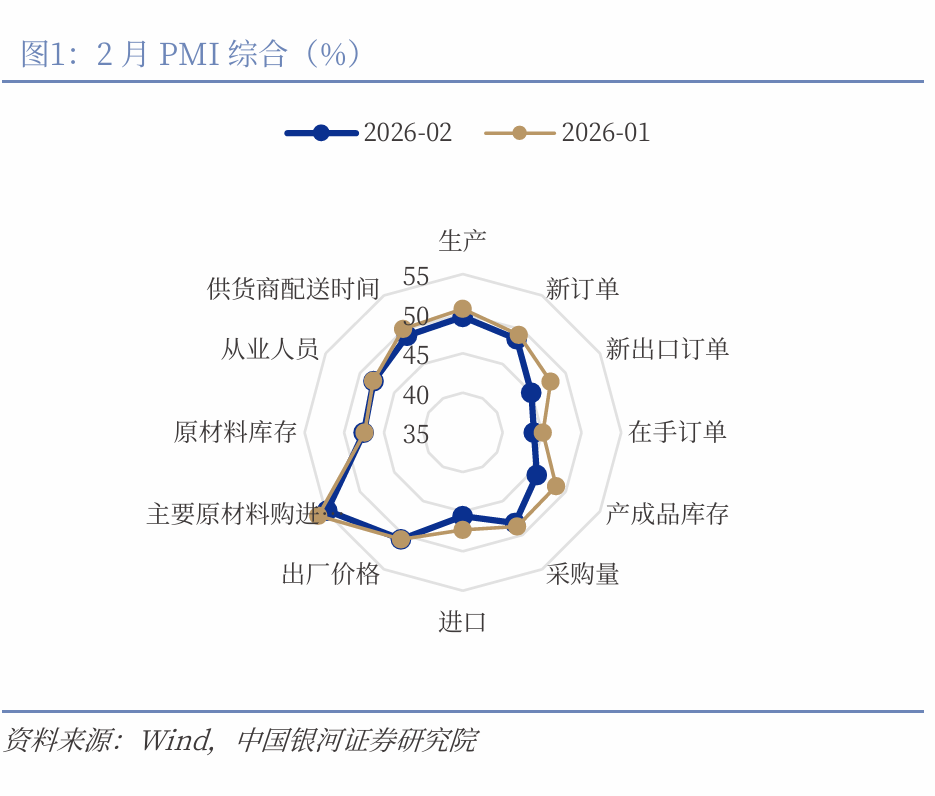
Group 1: Manufacturing Sector - The manufacturing PMI for February is 49.0%, down 0.3 percentage points month-on-month, indicating continued weakness influenced by the Spring Festival effect[1] - The production PMI decreased by 1.0 percentage points to 49.6%, while new orders, new export orders, and import PMIs fell by 0.6, 2.8, and 1.7 percentage points to 48.6%, 45.0%, and 45.6% respectively[12] - Large enterprises showed improvement with a PMI increase of 1.2 percentage points, while medium and small enterprises saw declines of 1.2 and 2.6 percentage points respectively[20] Group 2: Non-Manufacturing Sector - The construction PMI fell by 0.6 percentage points to 48.2%, with new orders index slightly improving by 2.1 percentage points to 42.2%[25] - The service sector PMI increased to 49.7%, up 0.2 percentage points, but new orders remain weak[32] - The issuance progress of special bonds reached approximately 18.7%, better than 13.0% in the same period of 2025[25] Group 3: Economic Outlook - The resumption of work is slightly faster than in previous years, with a construction resumption rate of 8.9% as of February 25, 2026, an increase of 1.5 percentage points year-on-year[37] - Economic fundamentals in Q1 are expected to remain under pressure, necessitating stronger growth stabilization policies, including additional policy financial tools and accelerated fiscal spending[37] - Risks include unexpected policy changes and potential downturns in the U.S. economy affecting domestic exports[42]
【权威解读】2月份制造业采购经理指数有所回落 非制造业商务活动指数小幅回升
中汽协会数据· 2026-03-04 07:53
Group 1: Manufacturing Purchasing Managers Index (PMI) - In February, the manufacturing PMI decreased to 49.0%, down by 0.3 percentage points from the previous month, indicating a decline in economic activity [2][3] - Both production index and new orders index fell to 49.6% and 48.6% respectively, showing a slowdown in production and market demand [3] - Large enterprises maintained expansion with a PMI of 51.5%, while small and medium-sized enterprises faced significant impacts from the Spring Festival, with PMIs of 47.5% and 44.8% respectively [3] Group 2: Non-Manufacturing Business Activity Index - The non-manufacturing business activity index rose slightly to 49.5%, an increase of 0.1 percentage points from the previous month, indicating an overall improvement in the non-manufacturing sector [6] - The service sector's business activity index increased to 49.7%, driven by growth in travel-related industries, with hospitality and entertainment sectors showing indices above 60.0% [6] - The construction sector's business activity index fell to 48.2%, reflecting a decline due to the Spring Festival, although the market expectation index for construction improved to 50.9% [6] Group 3: Comprehensive PMI Output Index - The comprehensive PMI output index decreased to 49.5%, down by 0.3 percentage points from the previous month, indicating a general slowdown in production and business activities [7] - The manufacturing production index and non-manufacturing business activity index were recorded at 49.6% and 49.5% respectively, contributing to the overall decline in the comprehensive PMI [7]

2026年2月PMI分析:PMI季节性回落,一季度力争开门稳
Yin He Zheng Quan· 2026-03-04 07:37
Group 1: PMI Overview - In February 2026, the Manufacturing Purchasing Managers' Index (PMI) was 49.0%, a decrease of 0.3 percentage points from the previous month[1] - The Construction Business Activity Index was 48.2%, down from 48.8%[1] - The Services Business Activity Index was 49.7%, slightly up from 49.5%[1] Group 2: Seasonal Factors and Trends - The decline in PMI is attributed to seasonal factors such as the Spring Festival, with both supply and demand showing temporary slowdowns[2] - The production index fell to 49.6% from 50.6%, and the new orders index dropped to 48.6% from 49.2%[3] - The operating rate decreased by 3.49 percentage points to 39.51%, while the electric furnace capacity utilization rate fell by 17.41 percentage points to 36.34%[3] Group 3: Price and Inventory Dynamics - The factory price index remained stable at 50.6%, while the purchasing price index decreased by 1.3 percentage points to 54.8%[4] - The gap between purchasing prices and factory prices narrowed to 4.2 percentage points, indicating some relief in cost pressures for enterprises[4] - Finished goods inventory index decreased by 2.8 percentage points to 45.8%, while raw materials inventory increased slightly by 0.1 percentage points to 47.5%[4] Group 4: Future Outlook - Manufacturing production activity is expected to recover in March as the effects of the Spring Festival dissipate, with production and new orders indices anticipated to rise[2] - External demand remains resilient, supported by OECD leading indicators pointing to a mild upward trend in exports through June[2] - Domestic demand relies on further policy support and improvements in terminal consumption and investment needs[2]
从PMI和BCI数据看当前内需特征
GF SECURITIES· 2026-03-04 06:47
Group 1: PMI and Economic Indicators - February manufacturing PMI was 49.0, down from 49.3, indicating a seasonal decline consistent with historical trends[3] - The BCI index for February recorded 52.4, down from 53.7 in January, but still above the 49.8 level from December last year[3] - The estimated actual GDP growth for February is 4.81%, with nominal GDP at 4.70%[4] Group 2: Manufacturing and Business Conditions - The production index in February was 49.6, down 1.0 points, while the new orders index was 48.6, down 0.6 points[5] - Large enterprises showed a PMI of 51.5, up 1.2 points, while small enterprises had a PMI of 44.8, down 2.6 points[5] - The production expectation index rose to 53.2, indicating positive future production plans despite current slowdowns[6] Group 3: Price Indices and Industry Performance - The raw material purchase price index decreased to 54.8, while the factory price index remained stable at 50.6[8] - High-tech manufacturing PMI was 51.5, while consumer goods industry PMI improved to 48.8, indicating sector-specific growth[7] - The construction business activity index fell to 48.2, but the expectation index rose to 50.9, suggesting optimism for future activity[8] Group 4: Consumer and Service Sector Insights - The service sector PMI increased slightly to 49.7, with hospitality and entertainment sectors showing strong performance, indices above 60[9] - The long holiday effect positively influenced consumer spending, particularly in retail and services, indicating potential for future policy impacts[11]
【中国银河宏观】PMI季节性回落,一季度力争开门稳——2026年2月PMI分析
Xin Lang Cai Jing· 2026-03-04 06:33
Core Viewpoint - The overall decline in February PMI is primarily influenced by seasonal factors such as the Spring Festival holiday, with both supply and demand experiencing a temporary slowdown. Production activities and order indicators have declined in tandem, but the extent of the decline is consistent with historical seasonal patterns. [2] Group 1: PMI and Economic Activity - The manufacturing PMI for February is reported at 49.0%, a decrease of 0.3 percentage points from the previous month. The construction business activity index is at 48.2% (previously 48.8%), and the service business activity index is at 49.7% (previously 49.5%) [1] - The production index for February is at 49.6% (previously 50.6%), and the new orders index is at 48.6% (previously 49.2%), indicating a decline in both supply and demand [3] - The operating rate has decreased due to the holiday impact, with the high-frequency data showing a drop in the rebar operating rate by 3.49 percentage points to 39.51%, and the electric furnace capacity utilization rate declining by 17.41 percentage points to 36.34% [3] Group 2: Price and Cost Dynamics - The factory price index remains unchanged at 50.6%, while the raw material purchase price has decreased by 1.3 percentage points to 54.8%, indicating a reduction in upstream cost pressures [4] - The gap between purchase prices and factory prices is currently 4.2 percentage points, suggesting that corporate profits are still under some cost pressure, although this gap has shown signs of narrowing [4] Group 3: Inventory Trends - The finished goods inventory index has decreased by 2.8 percentage points to 45.8%, while the raw material inventory has increased slightly by 0.1 percentage points to 47.5%. The purchasing index has declined by 0.5 percentage points to 48.2% [4] - Companies are adopting a cautious "production based on sales" strategy, leading to a relatively tight balance in overall inventory levels [4] Group 4: Future Outlook - As the effects of the Spring Festival gradually dissipate, manufacturing production activities are expected to recover in March, with both the production index and new orders index anticipated to rise [2] - External demand remains resilient, as indicated by the OECD composite leading indicators pointing towards a mild upward trend in exports year-on-year until June [2]

透过数据看2025年中国中小企业经济运行总体平稳 展现出较强发展韧性
Yang Shi Wang· 2026-02-25 03:39
Group 1 - The overall economic operation of small and medium-sized enterprises (SMEs) in China is stable in 2025, demonstrating strong development resilience and becoming an important support for industrial economic growth [1] - The added value of industrial SMEs above designated size increased by 6.9% year-on-year, surpassing the growth rate of all industrial enterprises by 1.0 percentage points, marking three consecutive years of higher growth [1] - Revenue reached 83.8 trillion yuan, with a year-on-year growth of 2.6%, and total profits increased by 1.4%, particularly in the equipment manufacturing sector, which saw a profit growth of 11.4% [1] Group 2 - Specialized and innovative SMEs showed remarkable performance, with the added value of "little giant" enterprises increasing by 9.0% year-on-year and total profits rising by 7.0%, achieving a profit margin of 7.9% [3] - The comprehensive competitiveness of these specialized SMEs has further strengthened, outperforming the overall industrial sector [3] Group 3 - The export sector remains robust, with the SME export index at 52.4% in December 2025, indicating expansion for 21 consecutive months [5] - The export delivery value of specialized "little giant" enterprises increased by 13.3% year-on-year, exceeding the overall industrial growth by 11.1 percentage points, significantly contributing to export performance [5] Group 4 - The next steps include the formulation of the "14th Five-Year" plan to promote SME development, enhancing the cultivation system for characteristic industrial clusters, and providing targeted services in market expansion and digital empowerment [7]
2025年我国中小企业经济运行总体平稳 专精特新表现亮眼
Xin Lang Cai Jing· 2026-02-25 00:29
Core Viewpoint - The Ministry of Industry and Information Technology indicates that by 2025, China's small and medium-sized enterprises (SMEs) will show strong resilience and play a crucial role in supporting stable industrial economic growth [1] Group 1: Economic Performance of SMEs - In 2025, the added value of industrial SMEs above designated size is expected to grow by 6.9% year-on-year, surpassing the growth rate of all industrial enterprises by 1.0 percentage points, marking three consecutive years of higher growth [1] - The operating revenue of these SMEs is projected to reach 83.8 trillion yuan, reflecting a year-on-year increase of 2.6% [1] - Total profits are anticipated to grow by 1.4% year-on-year, with the equipment manufacturing sector showing a notable profit increase of 11.4% [1] Group 2: Performance of Specialized and Innovative SMEs - In 2025, the added value of specialized and innovative "little giant" enterprises is expected to grow by 9.0% year-on-year, with total profits increasing by 7.0% [1] - The revenue profit margin for these specialized SMEs is projected to reach 7.9%, which is higher than the overall industrial average, indicating enhanced competitive strength [1]