厨卫电器

Search documents
荣膺“粤港澳大湾区臻质奖”,“链主”华帝正引领湾区厨电产业发展
和讯· 2025-12-31 09:13
Core Viewpoint - The article highlights the recognition of Vatti as the only recipient of the "2025 Guangdong-Hong Kong-Macao Greater Bay Area Quality Award," emphasizing its leadership in the kitchen appliance industry and its role in the region's economic ecosystem [1][4]. Group 1: Industry Position and Recognition - The Guangdong-Hong Kong-Macao Greater Bay Area is a key strategic region in China's development, characterized by a "market-driven, government-guided, and cross-regional collaboration" industrial ecosystem [4]. - Vatti is recognized as a leading brand in the kitchen appliance industry, having achieved a revenue of 4.158 billion yuan and a net profit of 356 million yuan in the first three quarters of 2025 [5]. Group 2: Technological Leadership - Vatti has played a significant role in setting over 40 national and industry standards for kitchen appliances, including key standards for gas stoves and range hoods [5]. - The company holds 543 patents related to its "clean kitchen" brand philosophy, with innovative technologies achieving high cleaning efficiency rates, such as a 99.2% cleaning rate for its range hoods [6]. Group 3: Digital Transformation and Ecosystem Development - Vatti is advancing its digital transformation, moving from a "single empowerment" phase to an "ecosystem reshaping" phase, integrating IoT, AI, and big data to enhance collaboration across the supply chain [9]. - The establishment of a smart factory is expected to improve production efficiency by over 43%, reduce order lead times by 30%, and achieve a first-pass yield rate exceeding 99% [11].



厨卫电器板块12月31日涨0.27%,火星人领涨,主力资金净流出1237.01万元
Zheng Xing Xing Ye Ri Bao· 2025-12-31 08:59
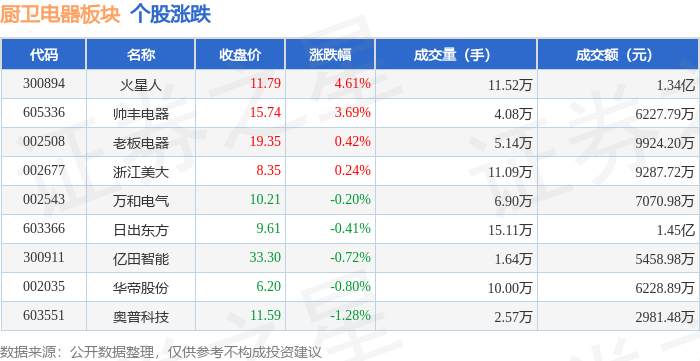
Group 1 - The kitchen and bathroom appliance sector increased by 0.27% on December 31, with Mars Man leading the gains [1] - The Shanghai Composite Index closed at 3968.84, up 0.09%, while the Shenzhen Component Index closed at 13525.02, down 0.58% [1] - Mars Man's stock price rose by 4.61% to 11.79, with a trading volume of 115,200 shares and a transaction value of 134 million yuan [1] Group 2 - The main capital outflow from the kitchen and bathroom appliance sector was 12.37 million yuan, while retail investors saw a net inflow of 6.70 million yuan [1] - Zhejiang Meida had a main capital inflow of 6.01 million yuan, but retail investors had a net inflow of only 1.72 million yuan [2] - Mars Man experienced a main capital inflow of 5.42 million yuan, but retail investors had a net outflow of 15.93 million yuan [2]



华帝股份股价跌1.12%,嘉实基金旗下1只基金重仓,持有42万股浮亏损失2.94万元
Xin Lang Cai Jing· 2025-12-31 07:14
Company Overview - Vatti Corporation Limited is located in Zhongshan, Guangdong Province, established on April 8, 1992, and listed on September 1, 2004. The company primarily engages in the production and sale of gas appliances, kitchen utensils, household electrical appliances, and investment in its own assets, as well as import and export operations [1]. Business Revenue Composition - The revenue composition of Vatti is as follows: range hoods 41.76%, cooking stoves 26.21%, water heaters 18.56%, and other products including ovens, cabinets, dishwashers, and water purifiers contributing smaller percentages [1]. Stock Performance - As of December 31, Vatti's stock price decreased by 1.12%, trading at 6.18 yuan per share, with a total market capitalization of 5.238 billion yuan and a trading volume of 58.8575 million yuan, resulting in a turnover rate of 1.21% [1]. Fund Holdings - According to data, one fund under Jiashi Fund holds a significant position in Vatti. Jiashi Selected Balanced Mixed A (009649) held 420,000 shares in the third quarter, accounting for 2.8% of the fund's net value, ranking as the tenth largest holding [2]. Fund Performance - Jiashi Selected Balanced Mixed A (009649) was established on June 11, 2020, with a current scale of 86.4294 million yuan. The fund has achieved a year-to-date return of 3.95%, ranking 7026 out of 8085 in its category, and a one-year return of 2.73%, ranking 7268 out of 8085 [2].
今年十大最惨板块,跌麻了
3 6 Ke· 2025-12-30 12:11
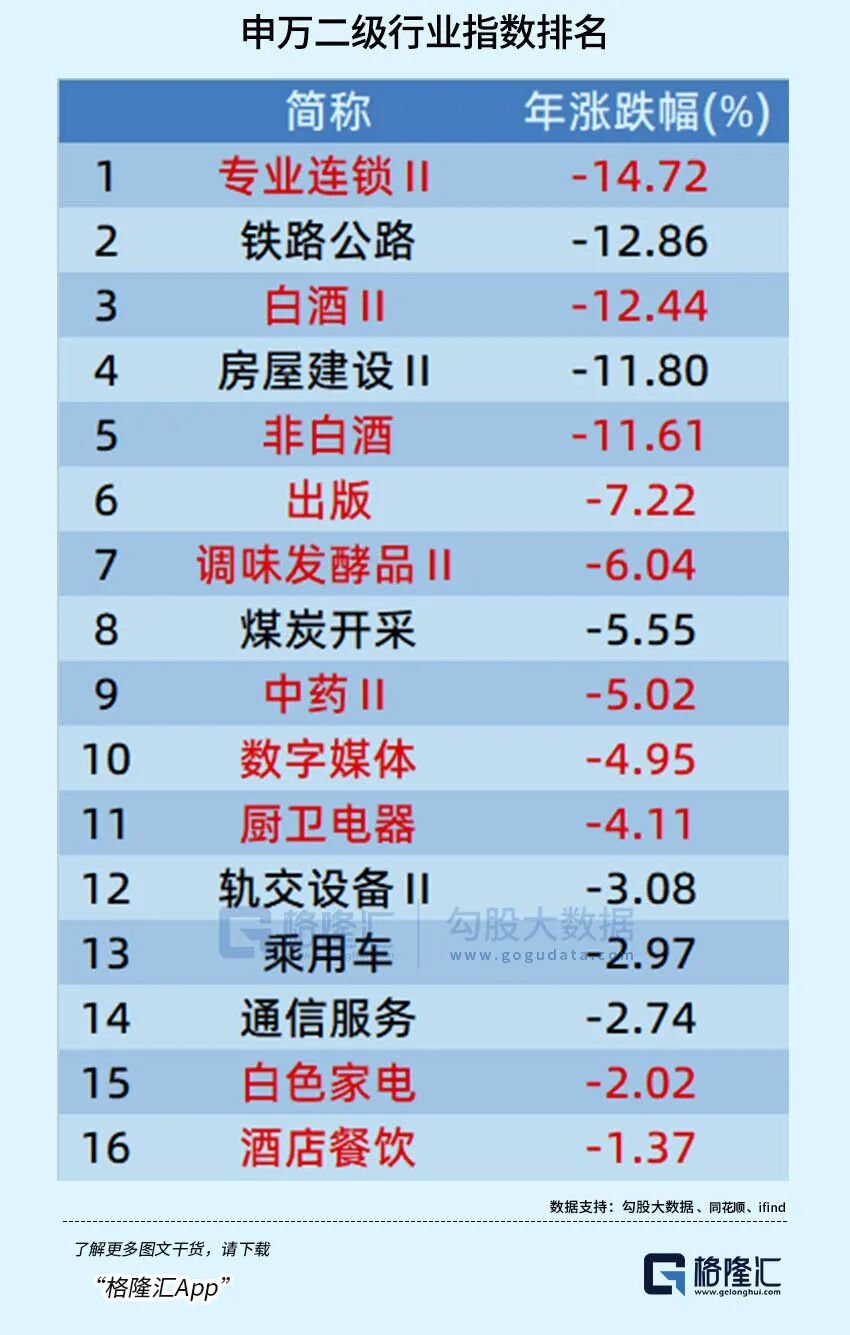
Core Viewpoint - The consumer sector has faced significant challenges in the past year, with many industries within this sector experiencing declines despite overall market growth. The focus on domestic demand and consumption has not translated into positive performance for many consumer-related industries [1]. Group 1: Consumer Sector Performance - In the first half of the year, 10 out of 16 industries that saw declines were from the consumer sector, indicating a troubling trend for consumer-related stocks [1]. - The white liquor sector, a key component of the consumer market, has seen a year-to-date decline of 12.44%, with major brands like Wuliangye experiencing significant drops in revenue and profit [5][8]. - The professional chain sector has been particularly hard hit, with a year-to-date decline of 14.72%, as traditional retail models struggle to adapt to changing consumer behaviors [13][14]. Group 2: White Liquor Industry - The white liquor industry is facing its eighth consecutive year of production decline, with both volume and price dropping, leading to increased inventory pressure and cash flow issues for many companies [9]. - Wuliangye reported a 10.26% decline in revenue and a 13.72% drop in net profit for the first three quarters, marking its first negative growth in nearly a decade [8]. - The changing consumer landscape, with a shift towards lower-alcohol and healthier options, is forcing white liquor companies to adapt or risk further declines [12]. Group 3: Professional Chain Sector - The professional chain sector is experiencing a crisis, with many traditional stores closing and business models failing to adapt to the digital age [14][19]. - The decline of major players like Renrenle, which has seen its market value plummet and faced continuous losses, exemplifies the struggles within this sector [18]. - The shift towards online shopping and personalized consumer experiences is reshaping the retail landscape, leaving traditional large-format stores at a disadvantage [20]. Group 4: Non-White Liquor Sector - The non-white liquor sector, including beer and wine, has also faced challenges, with a year-to-date decline of 11.61% [22]. - Budweiser APAC reported an 8.2% drop in domestic sales and a 24.4% decline in net profit, reflecting broader issues within the beer industry [25]. - The rise of cross-industry competition, with liquor companies diversifying into other beverage categories, indicates a shift in market dynamics [27]. Group 5: Publishing Industry - The publishing industry has seen a decline in the overall market, with a 10.4% drop in the domestic paper book market, yet some companies have managed to increase profits through cost control [35][38]. - Chinese Media, a leading player in the sector, has faced significant revenue and profit declines, highlighting the challenges of adapting to changing educational policies [36][38]. Group 6: Seasoning Industry - The seasoning industry has experienced a 6.04% decline, with companies like Qianhe Flavor struggling due to a drop in sales across key product lines [43][47]. - The industry is facing increased competition and changing consumer preferences, necessitating a shift in strategy for many companies [52]. Group 7: Traditional Chinese Medicine - The traditional Chinese medicine sector has seen a 5.02% decline, with companies like Pian Zai Huang facing significant revenue and profit drops due to rising costs and regulatory pressures [53][56]. - The industry is undergoing a transformation as companies seek to innovate and diversify their product offerings in response to market challenges [62]. Group 8: Digital Media - The digital media sector has faced a 4.95% decline, with traditional advertising models struggling to keep pace with new digital trends [67]. - Companies like Mango TV have reported significant revenue declines, indicating the need for adaptation in a rapidly changing media landscape [66]. Group 9: Kitchen and Bathroom Appliances - The kitchen and bathroom appliance sector has seen a 4.11% decline, largely due to a slowdown in new housing demand and increased competition [69][70]. - Companies like Boss Appliances are experiencing revenue declines for the first time in years, reflecting broader industry challenges [69]. Group 10: White Goods - The white goods sector has faced a 2.02% decline, with major players like Gree Electric experiencing significant revenue and profit drops due to increased competition and market saturation [76][80]. - The industry is shifting towards a focus on product quality and operational efficiency as traditional growth drivers diminish [80]. Group 11: Hotel and Catering - The hotel and catering sector has seen a 1.37% decline, with many businesses struggling to convert increased travel demand into profits due to high commission fees from online platforms [84][85]. - The industry is witnessing a shift towards more refined operational models as companies seek to adapt to changing consumer behaviors and market conditions [86].
万和电气:12月30日召开董事会会议
Mei Ri Jing Ji Xin Wen· 2025-12-30 12:03
每经AI快讯,万和电气12月30日晚间发布公告称,公司六届六次董事会会议于2025年12月30日在公司 会议室以现场表决与通讯表决相结合的方式召开。会议审议了《关于2024年员工持股计划第一批锁定期 届满暨解锁条件达成的议案》等文件。 每经头条(nbdtoutiao)——2025十大财经新闻出炉!护航、酣战、变局、狂飙分别指向哪些大事件? (记者 王晓波) ...
2025年A股十大最惨板块,跌麻了
Ge Long Hui· 2025-12-30 11:30
Core Viewpoint - The consumer sector has faced significant challenges in the past year, with many sub-sectors experiencing declines despite overall market growth. The focus on domestic demand and consumption has not translated into positive performance for many consumer-related industries [1][5]. Consumer Sector Performance - In the first half of the year, 10 out of 16 declining industries were from the consumer sector, indicating a broader trend of underperformance [1]. - The white liquor sector, a key component of the consumer market, has seen a year-to-date decline of 12.44%, with major brands like Wuliangye experiencing significant drops in revenue and profit [6][9]. - The professional chain sector has been particularly hard-hit, with a year-to-date decline of 14.72%, exemplified by the struggles of companies like Renrenle [16][20]. White Liquor Sector - The white liquor industry is facing its eighth consecutive year of production decline, with both volume and price dropping simultaneously [10]. - Wuliangye reported a 10.26% decline in revenue and a 13.72% drop in net profit for the first three quarters, marking its first negative growth in a decade [9]. - The industry is shifting from a growth-driven model to one focused on consumer choice, with a need for companies to adapt to changing consumer preferences [15]. Professional Chain Sector - The professional chain sector is experiencing a crisis, with many physical stores closing and traditional business models failing [16][20]. - Renrenle, once a leading private supermarket, has seen its market value plummet and is now facing delisting due to ongoing financial struggles [21][24]. - The shift towards online shopping and personalized consumer demands has further exacerbated the challenges faced by traditional retail chains [24][25]. Non-White Liquor Sector - The non-white liquor sector, including beer and wine, has also faced declines, with the beer segment seeing a notable drop in sales and profits [27][32]. - Budweiser APAC reported an 8.2% decline in domestic sales and a 24.4% drop in net profit, reflecting broader industry challenges [32][33]. - The market is witnessing a trend of cross-industry competition, with liquor companies diversifying into new beverage categories [34]. Publishing Sector - The publishing industry has shown resilience despite a 10.4% decline in the overall market for printed books, with listed companies managing to increase net profits by 14.65% [43][44]. - However, leading companies like Zhongwen Media are struggling, with significant revenue and profit declines due to changes in educational material procurement policies [45][48]. Seasoning Sector - The seasoning industry has faced a 6.04% decline, with companies like Qianhe Flavor struggling due to falling revenues and a loss of consumer trust [51][55]. - The industry is experiencing a shift in consumer preferences and increased competition, necessitating a reevaluation of business strategies [60]. Traditional Chinese Medicine Sector - The traditional Chinese medicine sector is facing challenges, with companies like Pian Zai Huang reporting significant declines in revenue and profit due to rising costs and regulatory pressures [61][66]. - The industry is undergoing a transformation as companies seek to innovate and diversify their product offerings [70]. Digital Media Sector - The digital media industry has seen a 4.95% decline, with companies like Mango TV reporting significant drops in revenue and profit due to changing consumer behaviors and market dynamics [71][74]. - The sector is grappling with the need to adapt to new content consumption trends while facing pressure from traditional advertising models [75]. Kitchen and Bathroom Appliances Sector - The kitchen and bathroom appliance sector has experienced a 4.11% decline, largely due to reduced demand from the real estate market [78][79]. - Companies like Boss Electric are facing revenue declines for the first time in years, highlighting the challenges of adapting to a changing market landscape [79][80]. White Goods Sector - The white goods sector has seen a 2.02% decline, with major players like Gree Electric facing significant revenue and profit pressures due to increased competition and market saturation [83][84]. - The industry is shifting towards a focus on product quality and brand strength as external stimuli diminish [88]. Hotel and Restaurant Sector - The hotel and restaurant sector has faced a 1.37% decline, with revenue pressures stemming from changing consumer spending habits and increased competition from online platforms [89][92]. - Companies are beginning to adopt more refined operational strategies to navigate the challenging market environment [96].




今年十大最惨板块,跌麻了
格隆汇APP· 2025-12-30 11:04
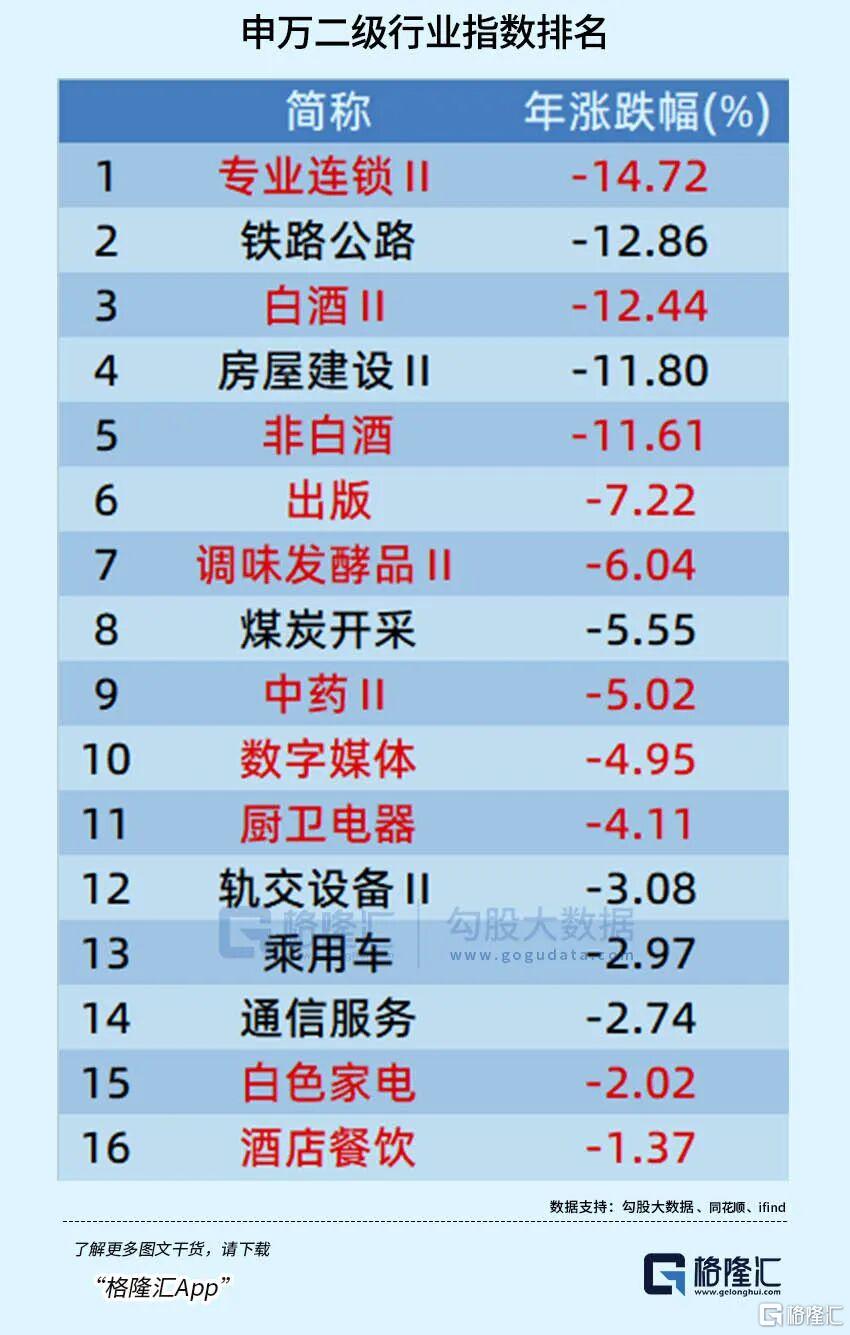
Core Viewpoint - The article discusses the significant downturn in various consumer sectors, particularly the liquor and retail industries, highlighting the challenges and potential opportunities for recovery amidst changing consumer behaviors and market dynamics [2][4][43]. Group 1: Liquor Industry - The liquor sector, especially the white liquor segment, has faced substantial declines, with the overall white liquor market down by 12.44% this year [9][15]. - Major brands like Wuliangye have reported significant drops in revenue and profit, with a 10.26% decline in revenue and a 13.72% drop in net profit for the first three quarters [17]. - The white liquor industry is experiencing a shift from a growth-driven model to one focused on consumer preferences, with a need for companies to adapt to changing consumption patterns [26][27]. Group 2: Retail Industry - The professional chain sector has seen a dramatic decline of 14.72%, with many traditional retail models struggling to survive [28][30]. - Companies like Renrenle have faced severe financial difficulties, leading to a significant reduction in store numbers and ultimately triggering delisting procedures [34][35]. - The shift towards online shopping and changing consumer preferences have forced traditional retailers to innovate or face extinction [36][39]. Group 3: Non-White Liquor Sector - The non-white liquor sector, including beer and wine, has also suffered, with a reported decline of 11.61% this year [40]. - Major players like Budweiser APAC have experienced significant sales drops, with a 9.5% revenue decrease and a 24.4% decline in net profit [46]. - The industry is witnessing a trend of cross-industry competition, with liquor companies diversifying into other beverage categories to adapt to market changes [51][56]. Group 4: Publishing Industry - The publishing sector has faced a 7.22% decline, with the overall market for printed books down by 10.40% [60]. - Despite the downturn, some publishing companies have managed to increase profits through cost control and operational efficiency, with a 14.65% rise in net profit for listed companies [61][62]. - The industry is undergoing significant transformation, moving from traditional sales models to more dynamic content management and IP development strategies [70][71]. Group 5: Seasoning Industry - The seasoning sector has seen a 6.04% decline, with companies like Qianhe Flavor struggling due to a drop in revenue and profit [74]. - The industry is facing challenges from both market saturation and changing consumer preferences, necessitating a shift in strategy for many companies [81]. Group 6: Traditional Chinese Medicine - The traditional Chinese medicine sector has experienced a 5.02% decline, with companies like Pian Zai Huang facing significant revenue and profit drops [86]. - The industry is under pressure from regulatory changes and increased competition, pushing companies to innovate and diversify their product offerings [91][92]. Group 7: Digital Media - The digital media sector has reported a 4.95% decline, with traditional advertising models struggling to adapt to new market realities [97][100]. - Companies like Mango TV have seen significant revenue drops, highlighting the challenges of maintaining profitability in a rapidly changing landscape [101][104]. Group 8: Kitchen and Bathroom Appliances - The kitchen and bathroom appliance sector has faced a 4.11% decline, with major players like Boss Electric experiencing revenue drops for the first time in years [112]. - The industry is grappling with reduced demand due to a slowdown in the real estate market, necessitating a shift towards innovation and international expansion [117][118]. Group 9: White Goods - The white goods sector has seen a 2.02% decline, with companies like Gree Electric facing significant challenges due to market saturation and increased competition [126][129]. - The industry is shifting towards a more rational consumer base that prioritizes product quality and brand reputation over traditional growth drivers [133]. Group 10: Hotel and Restaurant Industry - The hotel and restaurant sector has experienced a 1.37% decline, with many businesses struggling to convert increased tourism into profits [140][141]. - The industry is witnessing a shift towards more refined operational models, with companies focusing on member engagement and digital transformation to enhance profitability [142][143].





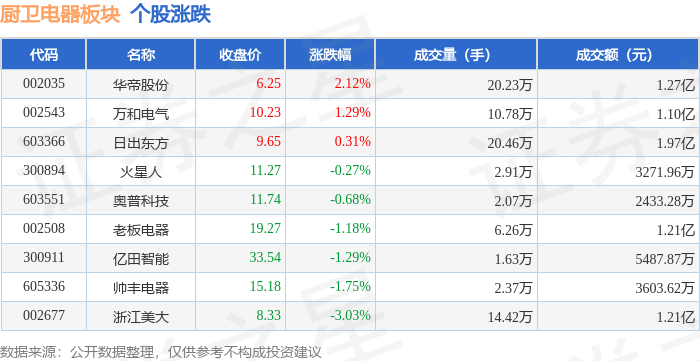
厨卫电器板块12月30日跌0.52%,浙江美大领跌,主力资金净流入3639.41万元
Zheng Xing Xing Ye Ri Bao· 2025-12-30 09:00
Group 1 - The kitchen and bathroom appliance sector experienced a decline of 0.52% on December 30, with Zhejiang Meida leading the drop [1] - The Shanghai Composite Index closed at 3965.12, showing a slight decrease of 0.0%, while the Shenzhen Component Index rose by 0.49% to 13604.07 [1] - Key stocks in the kitchen and bathroom appliance sector showed varied performance, with notable declines in Zhejiang Meida (-3.03%) and Boss Electric (-1.18%) [1] Group 2 - The sector saw a net inflow of 36.39 million yuan from main funds, while retail investors experienced a net outflow of 28.32 million yuan [1] - Detailed fund flow data indicates that Boss Electric had a main fund net inflow of 22.99 million yuan, while Zhejiang Meida faced a net outflow of 9.18 million yuan from main funds [2] - Retail investors showed significant outflows across several stocks, with Boss Electric and Zhejiang Meida experiencing outflows of 9.61 million yuan and 15.00 million yuan, respectively [2]

万和电气12月29日获融资买入377.51万元,融资余额9416.26万元
Xin Lang Cai Jing· 2025-12-30 01:29
12月29日,万和电气涨0.20%,成交额6537.50万元。两融数据显示,当日万和电气获融资买入额377.51 万元,融资偿还665.32万元,融资净买入-287.81万元。截至12月29日,万和电气融资融券余额合计 9448.88万元。 截至9月30日,万和电气股东户数1.89万,较上期增加20.40%;人均流通股34968股,较上期减少 16.95%。2025年1月-9月,万和电气实现营业收入55.24亿元,同比增长5.54%;归母净利润4.79亿元,同 比增长5.57%。 分红方面,万和电气A股上市后累计派现32.05亿元。近三年,累计派现9.32亿元。 机构持仓方面,截止2025年9月30日,万和电气十大流通股东中,红利低波(512890)位居第四大流通 股东,持股3150.51万股,相比上期增加234.35万股。香港中央结算有限公司位居第五大流通股东,持股 2491.61万股,相比上期减少597.29万股。创金合信中证红利低波动指数A(005561)位居第十大流通股 东,持股608.34万股,为新进股东。 融资方面,万和电气当日融资买入377.51万元。当前融资余额9416.26万元,占流通市值的 ...
厨卫电器板块12月29日跌0.32%,日出东方领跌,主力资金净流出5763.48万元
Zheng Xing Xing Ye Ri Bao· 2025-12-29 09:06
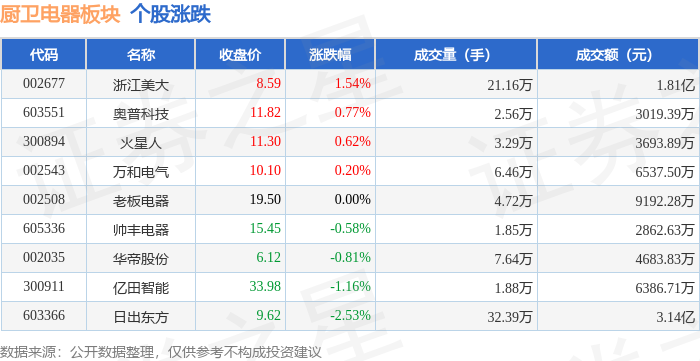
证券之星消息,12月29日厨卫电器板块较上一交易日下跌0.32%,日出东方领跌。当日上证指数报收于 3965.28,上涨0.04%。深证成指报收于13537.1,下跌0.49%。厨卫电器板块个股涨跌见下表: | 代码 | 名称 | 收盘价 | 涨跌幅 | 成交量(手) | 成交额(元) | | --- | --- | --- | --- | --- | --- | | 002677 | 浙江美大 | 8.59 | 1.54% | 21.16万 | 1.81亿 | | 603551 | 奧普科技 | 11.82 | 0.77% | 2.56万 | 3019.39万 | | 300894 | 火星人 | 11.30 | 0.62% | 3.29万 | 3693.89万 | | 002543 | 万和电气 | 10.10 | 0.20% | 6.46万 | 6537.50万 | | 002508 | 老板电器 | 19.50 | 0.00% | 4.72万 | 9192.28万 | | 605336 | 帅幸电器 | 15.45 | -0.58% | 1.85万 | 2862.63万 | | 002035 | 华帝 ...