算力基础设施

Search documents
深南电路(002916) - 2026年3月30日投资者关系活动记录表
2026-03-30 10:06
Group 1: Financial Performance - In 2025, the company achieved total revenue of 23.647 billion CNY, with a net profit attributable to shareholders of 3.276 billion CNY [2] - PCB, packaging substrates, and electronic assembly businesses generated revenues of 14.359 billion CNY, 4.148 billion CNY, and 3.075 billion CNY, accounting for 60.73%, 17.54%, and 13.00% of total revenue respectively [2] Group 2: Market Trends and Strategic Focus - The global PCB industry is projected to grow by 15.8% year-on-year in 2025, driven by demand for high-layer boards, HDI boards, and packaging substrates, with compound annual growth rates of 21.7%, 9.2%, and 10.9% respectively over the next five years [1] - The company plans to adhere to its "3-In-One" strategy in 2026, focusing on artificial intelligence opportunities, enhancing technology and capacity, and ensuring supply chain security for high-quality development [2] Group 3: Production Capacity and Supply Chain Management - The company is actively implementing technological upgrades and gradually increasing production capacity at its Nantong Phase IV and Thailand factories, which are currently in the ramp-up phase [1] - The company maintains a high overall capacity utilization rate, benefiting from strong demand for computing-related products [1] Group 4: Gross Margin and Cost Management - The gross margin for overseas sales in 2025 was 30.11%, a decrease of 1.28 percentage points year-on-year, primarily due to the growth of lower-margin electronic assembly business and the ramp-up phase of the Thailand factory [3] - The company is addressing rising raw material prices by optimizing product structure, enhancing operational efficiency, and maintaining close communication with suppliers and customers [3] Group 5: Product Development and Market Opportunities - The company has made steady progress in the FC-BGA packaging substrate product line, with 22 layers and below already in mass production, while R&D for 24 layers and above is on schedule [4] - The automotive electronics sector is a key focus, with rapid revenue growth driven by opportunities in ADAS and new energy vehicles [8]

贝塔创新科技观察:以算力为核心的新型基础设施体系正在形成
Jiang Nan Shi Bao· 2026-03-23 05:25
Core Insights - The article emphasizes the growing importance of computing infrastructure as a foundation for industrial upgrades, driven by advancements in artificial intelligence (AI) and the digital economy [1][2][3] Industry Trends - The global AI computing industry is transitioning from infrastructure construction to systematic development, reshaping the competitive landscape of the AI industry since 2022 [1][2] - The rapid expansion of the digital economy has transformed computing power from a mere technical resource into a critical production factor, prompting countries to enhance digital infrastructure [2][4] - In China, national projects like "East Data West Computing" are optimizing the layout of computing resources, pushing the transition from traditional data centers to intelligent computing centers focused on AI applications [2][4] Company Strategy - The company has been systematically advancing research and planning for intelligent computing infrastructure, focusing on AI server platforms, high-performance GPU nodes, and regional intelligent computing center architectures [3][5] - The company proposes a development strategy that combines platform capability construction with node resource layout, advocating for a collaborative computing network that includes central, regional, and edge nodes [3][5] - As of 2023, the demand for high-performance computing resources has surged due to the rapid growth of generative AI technologies and large model training needs [3][4] Future Outlook - The company anticipates a structural change in global computing demand by 2024, with a dual focus on centralized high-performance resources for model training and localized infrastructure for enterprise AI applications [5][6] - The future of AI infrastructure is expected to exhibit a networked characteristic, with multi-node, collaborative computing networks becoming essential [6][7] - The competitive logic of the AI industry is shifting from resource competition to system competition, where the ability to build stable, efficient, and scalable computing systems will determine long-term advantages [7][8]
算力|从芯片角度看英伟达GTC前瞻
Xin Lang Cai Jing· 2026-03-16 00:17
Core Insights - The upcoming NVIDIA GTC 2026 conference is expected to showcase an expanded chip product matrix, including the full suite of six core chips from the Vera Rubin AI platform, and potentially reveal details about the Rubin Ultra chip and cabinet innovations, enhancing data interconnectivity and power supply designs [1] Group 1: Rubin Platform and Chip Innovations - The Vera Rubin AI platform, unveiled at CES 2026, includes six core chips: Rubin GPU, Vera CPU, BlueField-4 DPU, NVLink 6 Switch, ConnectX-9 SuperNIC, and Spectrum-6 Ethernet Switch, all utilizing TSMC's 3nm process and upgraded HBM4 memory, enhancing synergy among GPU, CPU, and interconnect chips [2] - At GTC 2026, NVIDIA is likely to disclose more details about the Rubin Ultra chip, which is expected to double the computing performance compared to Rubin by integrating four computing dies, and introduce a two-layer super network architecture for data interconnectivity and power supply systems [2] Group 2: New Inference Chip and System-Level Infrastructure - NVIDIA is anticipated to launch a new inference chip, LPU, at GTC 2026, which will integrate Groq LPU technology and feature a custom chip architecture designed for LLM inference, significantly improving data storage and retrieval speeds [3] - The Rubin CPX, introduced in 2025, is expected to lower prefill costs and may transition from an integrated form to an independent cabinet setup, potentially utilizing GDDR7 or HBM3E memory specifications [3] Group 3: Future Architecture and Industry Trends - The next-generation Feynman architecture is expected to be showcased at GTC 2026, with predictions that it will adopt TSMC's A16 process and incorporate backside power delivery and 3D stacking technologies, with production starting in 2028 and deliveries in 2029 [4] - NVIDIA's insights into the future of AI computing infrastructure will be crucial, especially in the context of the slowing Moore's Law, focusing on innovations in computing, storage, and operational capabilities to support the ongoing evolution of the AI industry [4]



英伟达,急了!
半导体行业观察· 2026-03-15 02:20
Core Viewpoint - The AI computing power industry is experiencing unusual signals, with changes in demand and infrastructure uncertainties impacting the structure of the AI supply chain [2]. Group 1: Changes in AI Computing Demand - NVIDIA has been a dominant player in the AI supply chain, benefiting from explosive growth in GPU demand, with orders often exceeding a year [2]. - OpenAI's Stargate project, initially a massive $500 billion investment plan for 10GW of AI computing infrastructure, has faced delays and adjustments, impacting its expansion plans [4][6]. - The shift in focus from chip supply to infrastructure bottlenecks is becoming evident, as AI data centers require significant power and resources [7]. Group 2: Middle East as a New Battlefield - The Middle East is emerging as a critical region for AI infrastructure, with approximately 170 existing data centers and plans for an additional 111 projects, aiming for a future capacity of 4.5GW [9][11]. - Countries like Saudi Arabia and the UAE are investing heavily in AI infrastructure, with significant commitments from companies like Oracle, AWS, and Microsoft [14][16]. - The region's combination of capital, land, energy, and favorable policies makes it an attractive location for AI data centers [13]. Group 3: Geopolitical Risks - Geopolitical tensions in the Middle East pose risks to AI infrastructure, as evidenced by AWS data centers being damaged in drone attacks [18]. - The ongoing conflicts could lead to increased investment and financing costs, impacting project timelines and returns [19]. - The uncertainty surrounding these geopolitical issues may lead to a reevaluation of demand expectations for AI computing resources [20]. Group 4: Future of AI Infrastructure - The competition in the AI landscape is shifting from GPU battles to infrastructure battles, focusing on data centers, power, and geopolitical factors [22]. - NVIDIA's role is evolving from merely selling GPUs to ensuring that there are adequate facilities and resources for their chips to be utilized effectively [22].

400GWh增量在即,AIDC储能红利谁来收割?
行家说储能· 2026-03-12 10:36
Core Viewpoint - The article discusses the emerging market for AIDC (AI Data Center) energy storage, highlighting the technological advancements and the competitive landscape as companies prepare for a significant shift in energy demands driven by AI and data centers [2][3][4]. Group 1: Market Trends and Developments - By 2026, AIDC energy storage is transitioning from technology validation to project trials, marking the beginning of large-scale development [3]. - The demand for energy storage in AIDC is projected to create a new trillion-dollar market, with estimates suggesting that 100GW of new AI data centers could require 200-400GWh of storage [2]. - Major technology companies are committing to self-sufficient power for AI data centers, indicating a trend towards decoupling AIDC from traditional power grids [2]. Group 2: Key Technological Directions - Four main trends are identified for AIDC energy storage: 1. Full architecture compatibility, requiring adaptation to both existing AC and next-generation high-voltage DC systems [5]. 2. Long-duration energy storage becoming a necessity, with requirements for sustained power supply exceeding 4 hours [5]. 3. Multi-technology collaboration, with sodium and lithium batteries being the current mainstream solution [5]. 4. Intelligent scheduling as a core capability, utilizing AI and big data for dynamic optimization of energy storage systems [5]. Group 3: Competitive Landscape - AIDC energy storage players are categorized into three types: native energy storage companies, technology and power equipment giants, and cross-industry participants [4]. - Companies like CATL and BYD are leading with specialized energy storage solutions tailored for AIDC applications, with BYD's blade battery application exceeding 30% in AIDC [6]. - New entrants and established players are rapidly developing solutions, such as Hicharge's lithium-sodium collaborative energy storage solution and Ronghe Yuan's green electricity direct connection system [6][7]. Group 4: Industry Collaboration and Events - Industry forums are being organized to facilitate collaboration and knowledge sharing among stakeholders, with events scheduled to discuss the synergy between AIDC and third-generation semiconductors [8]. - These forums aim to break down information silos and support companies in transitioning from planning to monetization of AIDC energy storage solutions [8].



计算机行业周观点第50期:应用驱动Infra强需求-20260228
Western Securities· 2026-02-28 10:21
Investment Rating - The industry is rated as "Overweight," indicating an expected increase in value exceeding 10% compared to the market benchmark index over the next 6-12 months [6]. Core Insights - The AI Agent concept is transitioning from theory to practical application, with OpenClaw driving demand for autonomous execution. Token consumption is shifting from "dialogue consumption" to "task consumption," leading to rapid growth in usage [1]. - The release of Seedance 2.0 by ByteDance has highlighted significant demand for computational power, as users report long wait times for video generation due to high traffic and processing demands [2]. - The rapid development of AI applications is driving a surge in token consumption, which will necessitate systematic upgrades and expansions across the entire computational infrastructure, including chips, servers, and data centers [3]. Summary by Sections AI Agent Development - AI Agents are now capable of executing real tasks, with OpenClaw demonstrating a significant increase in token consumption through various operational modes, including multi-round self-correction and context expansion [1]. - The token consumption for active sessions can exceed 230,000 tokens, indicating a substantial increase in operational demands [1]. Seedance 2.0 Launch - Seedance 2.0 utilizes a sparse architecture to enhance training and inference efficiency, achieving industry-leading performance in generating high-quality audio-visual content [2]. - Despite its capabilities, the model faces significant computational bottlenecks, leading to user complaints about extended wait times for video generation [2]. Infrastructure Demand - The growth in AI applications is expected to drive a comprehensive upgrade of the computational infrastructure, highlighting the need for enhanced supply of computational resources [3].
产品出货快速增长,中际旭创2025年度归母净利润增长108.81%至107.99亿元
Zhi Tong Cai Jing· 2026-02-27 14:13
Core Viewpoint - The company Zhongji Xuchuang (300308.SZ) reported significant growth in its 2025 performance, driven by strong demand for computing infrastructure from end customers [1] Financial Performance - The company achieved an operating revenue of 38.24 billion yuan, representing a 60.25% increase compared to 2024 [1] - The net profit attributable to shareholders reached 10.799 billion yuan, marking a 108.81% growth from the previous year [1] - The net profit attributable to shareholders after deducting non-recurring gains and losses was 10.71 billion yuan, reflecting a 111.32% increase year-over-year [1] - Basic earnings per share stood at 9.8 yuan [1] Product and Market Dynamics - The rapid growth in product shipments was attributed to strong investments in computing infrastructure by end customers [1] - The proportion of high-speed optical modules in the product mix continued to increase [1] - Continuous optimization of product solutions and improvement in operational efficiency contributed to the substantial growth in both revenue and net profit compared to the same period last year [1]

中际旭创2025年净利润同比增长108.81%,算力基础设施投入驱动高速光模块放量 | 财报见闻
Hua Er Jie Jian Wen· 2026-02-27 13:25
Core Viewpoint - The leading optical module company, Zhongji Xuchuang, is expected to achieve a significant increase in performance by 2025, with net profit more than doubling, reflecting strong demand for high-end optical interconnection devices driven by the global infrastructure construction boom in computing power [1] Group 1: Financial Performance - In the performance report released on February 27, 2025, the total operating revenue reached 38.24 billion yuan, a year-on-year increase of 60.25% [1] - The net profit attributable to shareholders was approximately 10.8 billion yuan, representing a year-on-year growth of 108.81%, with basic earnings per share rising to 9.80 yuan, up 107.63% from the previous year [1] - The optical module business was the main profit contributor, achieving a net profit of about 11.76 billion yuan, which, after deducting the impact of stock incentive expenses, resulted in a net profit of approximately 11.99 billion yuan, more than doubling from 5.66 billion yuan in 2024 [4] Group 2: Profitability and Efficiency - The operating profit for 2025 reached 13.597 billion yuan, a year-on-year increase of 124.74%, significantly outpacing the revenue growth of 60.25%, indicating improved profitability due to scale effects and product structure enhancements [4] - The net profit after excluding non-recurring gains and losses was 10.71 billion yuan, reflecting a year-on-year growth of 111.32%, indicating that the performance growth primarily stemmed from core business operations rather than one-time items [4] Group 3: Asset Growth - By the end of 2025, the total assets of the company reached 45.53 billion yuan, an increase of 57.72% from the beginning of the period [5] - The net assets attributable to shareholders amounted to 30 billion yuan, up 56.81% from the beginning of the period, with the net asset per share rising to 27.00 yuan, an increase of 58.17% [5] - The expansion in total and net asset scales was primarily driven by revenue growth and increased operational scale, leading to corresponding increases in cash, inventory, and accounts receivable [5]
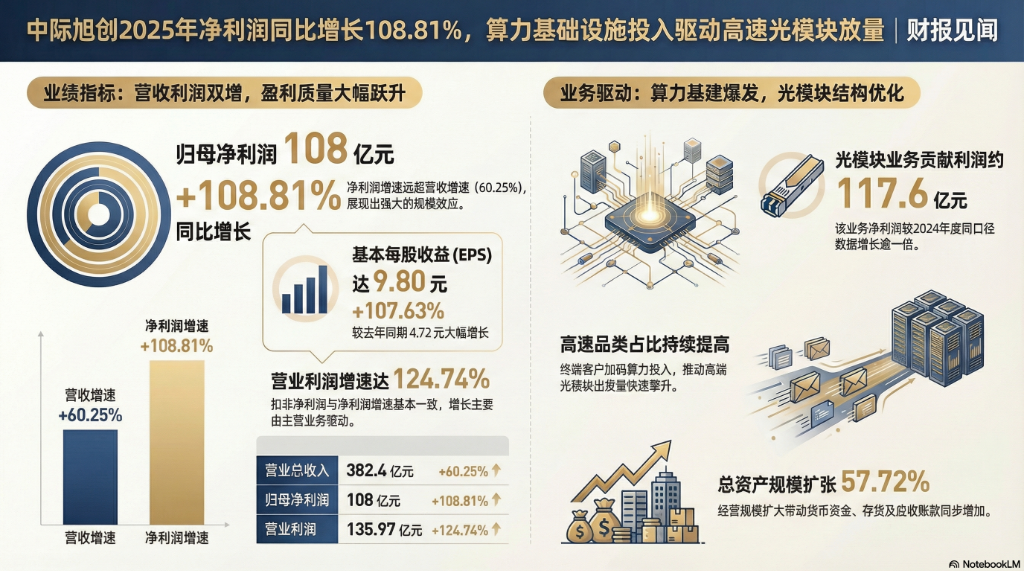
产品出货快速增长,中际旭创(300308.SZ)2025年度归母净利润增长108.81%至107.99亿元
智通财经网· 2026-02-27 13:07
Core Viewpoint - Zhongji Xuchuang (300308.SZ) reported significant growth in its 2025 performance, with substantial increases in both revenue and net profit compared to 2024 [1] Financial Performance - The company achieved an operating revenue of 38.24 billion yuan, representing a growth of 60.25% compared to 2024 [1] - The net profit attributable to shareholders reached 10.799 billion yuan, marking an increase of 108.81% from the previous year [1] - The net profit attributable to shareholders after deducting non-recurring gains and losses was 10.71 billion yuan, reflecting a growth of 111.32% year-on-year [1] - Basic earnings per share stood at 9.8 yuan [1] Market Dynamics - The growth in product shipments was driven by strong investments in computing infrastructure from end customers [1] - The proportion of high-speed optical modules in the product mix continued to increase, contributing to the overall revenue growth [1] - Continuous optimization of product solutions and improvement in operational efficiency played a key role in achieving significant growth in both revenue and net profit [1]
光大期货:2月27日有色金属日报
Xin Lang Cai Jing· 2026-02-27 01:40
Copper - Copper prices showed a weak fluctuation overnight, with the domestic refined copper import window closed [2][11] - LME copper inventory increased by 3,950 tons to 259,600 tons, while Comex copper inventory rose by 9.98 tons to 545,267 tons [2][11] - The core logic driving copper prices upward remains the insufficient global copper mine capital expenditure leading to a supply gap, alongside increasing demand from new energy and AI infrastructure [2][11] Nickel & Stainless Steel - LME nickel fell by 1.75% to $17,730 per ton, while SHFE nickel dropped by 1.25% to 139,100 yuan per ton [12][12] - LME nickel inventory increased by 1,698 tons to 289,506 tons, while SHFE warehouse receipts decreased by 19 tons to 53,158 tons [12][12] - The approved nickel ore production quota in Indonesia is between 260 million to 270 million tons, significantly lower than last year's target [12][12] Aluminum & Alumina & Aluminum Alloys - Alumina prices showed a weak fluctuation, with AO2605 settling at 2,747 yuan per ton, down 3.55% [14][14] - SHFE aluminum fluctuated weakly, with AL2604 closing at 23,780 yuan per ton, down 0.34% [14][14] - The overseas alumina price increased, while domestic electrolytic aluminum plants began winter raw material storage, leading to a counter-trend rise in alumina prices [14][14] Industrial Silicon & Polysilicon - Industrial silicon showed weak fluctuations, with the main contract settling at 834,035 yuan per ton, down 1.3% [15][15] - Polysilicon also experienced a weak fluctuation, with the main contract closing at 46,315 yuan per ton, down 2.59% [15][15] - The supply of industrial silicon has narrative support, but upward price movement is limited due to constrained demand [15][15] Lithium Carbonate - Lithium carbonate futures rose by 3.47% to 173,660 yuan per ton, with battery-grade lithium carbonate prices increasing by 11,250 yuan per ton to 173,000 yuan per ton [16][16] - The weekly lithium carbonate social inventory decreased by 2,839 tons to 100,093 tons, with downstream inventory dropping by 4,471 tons to 40,021 tons [16][16] - Concerns over exports from Zimbabwe have led to a gap opening in lithium carbonate futures prices, with current exports paused [16][16]