
锂离子电池

Search documents
当升科技10月16日获融资买入3.22亿元,融资余额15.78亿元
Xin Lang Cai Jing· 2025-10-17 01:36
Core Viewpoint - The stock of Dangsheng Technology has shown significant trading activity, with a notable increase in financing and margin trading, indicating strong investor interest and confidence in the company's performance [1][2]. Financing Activity - On October 16, Dangsheng Technology recorded a financing buy-in of 322 million yuan, with a net buy of 44.5 million yuan after accounting for repayments [1]. - The total financing balance reached 1.578 billion yuan, representing 4.66% of the circulating market value, which is above the 80th percentile of the past year [1]. - The margin trading activity included a short selling of 85,400 shares, with a total selling amount of approximately 5.71 million yuan, and a remaining short position of 272,500 shares valued at 18.21 million yuan, also above the 90th percentile of the past year [1]. Company Performance - For the first half of 2025, Dangsheng Technology achieved a revenue of 4.432 billion yuan, reflecting a year-on-year growth of 25.17%, while the net profit attributable to shareholders was 311 million yuan, up 8.47% year-on-year [2]. - The company has distributed a total of 1.265 billion yuan in dividends since its A-share listing, with 821 million yuan distributed over the past three years [3]. Shareholder Structure - As of June 30, 2025, the number of shareholders increased by 2.18% to 86,700, with an average of 5,834 circulating shares per person, a decrease of 2.13% [2]. - The top ten circulating shareholders include significant institutional investors, with notable changes in holdings among various ETFs [3].

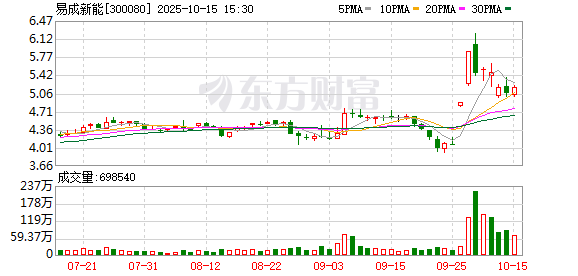
易成新能:公司当前拥有合并报表范围内二级子公司15家,以高端碳材、新型储能为业务主线
Mei Ri Jing Ji Xin Wen· 2025-10-15 09:09
Group 1 - The company currently has a total of 15 subsidiaries within its consolidated financial statements [2] - The main business focuses are high-end carbon materials and new energy storage [2] - The industry layout includes multiple sectors in the new energy and new materials industries, with key activities in new energy including the development, construction, and operation of new energy and energy storage power stations, as well as lithium-ion batteries and photovoltaic battery components [2] Group 2 - In the new materials sector, the primary business involves ultra-high power graphite electrodes and anode materials [2]


德方纳米:9月29日召开董事会会议
Mei Ri Jing Ji Xin Wen· 2025-09-29 11:52
Group 1 - The core point of the article is that Defang Nano (SZ 300769) held its 20th meeting of the fourth board of directors on September 29, 2025, to discuss the proposal for capital increase and introduction of strategic investors for its controlling subsidiary [1] - For the first half of 2025, Defang Nano's revenue composition shows that lithium-ion battery cathode materials account for 94.39% of total revenue, while other businesses contribute 5.61% [1] - As of the time of reporting, Defang Nano has a market capitalization of 11.5 billion yuan [1] Group 2 - The article also mentions a competitive situation in the beverage industry, where Nongfu Spring's new green bottle product has led to a significant decline in market share for Yibao, dropping nearly 5 percentage points [1]
星源材质:公司主要客户覆盖宁德时代等国内外知名锂离子电池厂商
Zheng Quan Ri Bao Wang· 2025-09-23 10:42
Core Viewpoint - Xingyuan Material (300568) has a diverse customer base that includes major domestic and international lithium-ion battery manufacturers, indicating strong market positioning and potential for growth [1] Customer Base - The company primarily serves well-known clients such as CATL (300750), BYD (002594), Zhongxin Innovation, Guoxuan High-Tech (002074), Xinwangda (300207), LG Chem from South Korea, Samsung SDI, Murata from Japan, and SK On [1]




星源材质:公司主要客户覆盖宁德时代、三星SDI、日本村田、SK On等国内外知名锂离子电池厂商
Mei Ri Jing Ji Xin Wen· 2025-09-23 03:55
Core Viewpoint - The company confirmed that its major clients include prominent lithium-ion battery manufacturers such as CATL, BYD, and others, indicating a strong position in the supply chain of the battery industry [1] Group 1 - The company has a diverse client base that includes both domestic and international well-known lithium-ion battery manufacturers [1] - Major clients mentioned include CATL, BYD, China Innovation Aviation, Guoxuan High-Tech, Xinwangda, LG Chem, Samsung SDI, Murata, and SK On [1] - The inquiry about the impact of CATL's expansion on the company suggests potential benefits from increased demand in the battery sector [1]
华宝新能:9月19日召开董事会会议
Mei Ri Jing Ji Xin Wen· 2025-09-19 09:05
每经头条(nbdtoutiao)——5万亿ETF的370名基金经理薪酬大揭秘!他们的日常工作,就是跟着指数 买股票吗? (记者 王晓波) 2025年1至6月份,华宝新能的营业收入构成为:锂离子电池产业链相关业务占比100.0%。 截至发稿,华宝新能市值为119亿元。 每经AI快讯,华宝新能(SZ 301327,收盘价:68.5元)9月19日晚间发布公告称,公司第三届第十五次 董事会会议于2025年9月19日在公司会议室以现场结合通讯表决的方式召开。会议审议了《关于增加经 营场所并修订 <公司章程> 的议案》等文件。 ...
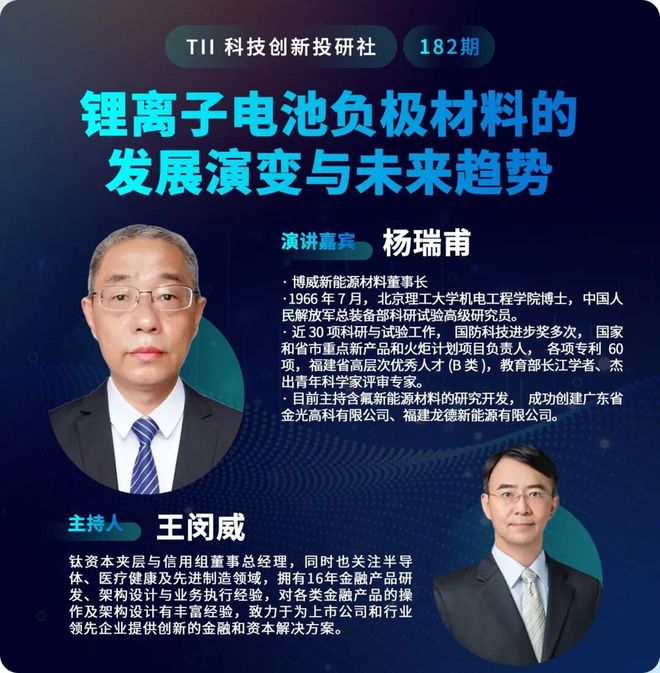
杨瑞甫:锂离子电池负极材料的发展演变与未来趋势 | 钛资本新能源组
Tai Mei Ti A P P· 2025-09-13 04:40
Group 1 - The rapid development of the new energy industry has significantly increased the market scale of lithium-ion batteries, with an annual growth rate exceeding 20% in recent years [5] - In 2024, the shipment volume of cathode materials is expected to reach 3.2 million tons, while anode materials will exceed 2.1 million tons, indicating a strong growth trend [5] - Graphite anodes dominate the market, accounting for over 95% of the total, while silicon-based and other composite anodes represent less than 5% [5] Group 2 - Graphite anodes possess a hexagonal layered structure that allows lithium ions to embed and extract easily, making them suitable for battery charging and discharging cycles [6] - The theoretical specific capacity of graphite is 372 mAh/g, with commercial products typically ranging from 330 to 360 mAh/g, meeting energy density needs for most applications [7] - Graphite anodes exhibit excellent cycling performance, with lifespans exceeding 1000 cycles for consumer electronics and over 3000 cycles for power batteries [7] Group 3 - Despite their advantages, graphite anodes face limitations, including a capacity ceiling close to their theoretical value, which restricts their use in high-energy-density applications like electric vehicles [8] - Fast charging performance is limited due to kinetic constraints, leading to potential safety hazards from lithium dendrite formation [8] - Low-temperature adaptability is poor, with capacity loss exceeding 30% at -30°C, limiting their use in cold environments [8] Group 4 - The industry is exploring alloy materials with higher capacities, such as silicon, phosphorus, tin, and aluminum, which can significantly exceed the capacity of graphite [9] - Silicon-based anodes have undergone four generations of technological iterations, focusing on improving volume expansion, cycling life, and initial efficiency [9][10] - By 2030, silicon-based anodes are expected to achieve a market penetration of 30%, with phosphorus-based materials expanding in high-end applications [9] Group 5 - The first generation of silicon-based anodes utilized a physical modification approach, resulting in a core-shell structure that reduced volume expansion but had short cycling life and low initial coulombic efficiency [11][12] - The second generation improved cycling stability and capacity through chemical modification, but still faced challenges with initial efficiency and conductivity [13][14] - The third generation introduced pre-lithiation techniques, significantly enhancing initial efficiency and cycling life, but increased complexity and costs [15][16] Group 6 - The fourth generation of silicon-based anodes employs a porous carbon framework to stabilize silicon particles and enhance conductivity, achieving a balance between capacity, cycling, and cost [17][18] - This generation shows significant improvements in specific capacity, volume expansion, initial efficiency, and cycling performance, making it a promising direction for future applications [19] - However, challenges remain regarding production costs, structural stability over long cycles, and electrolyte compatibility [20] Group 7 - The demand for silicon-carbon composite materials is expected to grow significantly, with projections indicating a market space of hundreds of billions by 2030 [24] - Companies like Zhangjiagang Bowei are positioning themselves as collaborative suppliers, leveraging their technological advantages to partner with leading firms in the industry [25] - The industry is currently in the early stages of commercialization, with ongoing efforts to optimize production processes and expand application scenarios [21][24]
华宝新能:拟向激励对象71人授予限制性股票300.05万股
Mei Ri Jing Ji Xin Wen· 2025-09-12 12:39
Core Viewpoint - Huabao New Energy announced an incentive plan involving the grant of restricted stock to a maximum of 71 individuals, with a total of 3,000,500 shares, representing 1.72% of the company's total share capital [1] Group 1: Incentive Plan Details - The incentive plan will utilize the second type of restricted stock, sourced from shares repurchased in the secondary market and/or newly issued shares directed to the incentive recipients [1] - The grant price for the restricted stock is set at 33.15 yuan per share, allowing recipients to purchase shares at this price upon meeting the vesting conditions [1] - The validity period for the restricted stock is from the date of the initial grant until all shares are vested or become void, with a maximum duration of 60 months [1] Group 2: Company Financials - For the first half of 2025, Huabao New Energy's revenue will be entirely derived from the lithium-ion battery industry chain, accounting for 100% of its business [1] - As of the announcement, Huabao New Energy has a market capitalization of 11.4 billion yuan [1]
深圳金融的服务样本:平安银行以“三专机制”助力特区科技集群再腾飞
券商中国· 2025-09-03 09:10
Core Viewpoint - Shenzhen Special Economic Zone has achieved remarkable growth over 45 years, with significant contributions from both technology and finance sectors, exemplified by the development of Ping An Bank and its support for local tech enterprises [1][2]. Group 1: Shenzhen Economic Development - Shenzhen has 4.508 million business entities, including 25,000 national high-tech enterprises, averaging 12 per square kilometer [1]. - The city's R&D investment is projected to account for 6.46% of GDP in 2024, with PCT international patent applications leading the nation for 21 consecutive years [1]. Group 2: Ping An Bank's Role - Ping An Bank's value added in the financial sector grew from 0.16 billion yuan at the establishment of the special zone to 471.1 billion yuan in 2024 [1]. - The bank has provided significant financial support to technology enterprises, including a 20 million yuan credit loan to XWD for expansion, which later successfully listed on the Sci-Tech Innovation Board [2]. Group 3: Financial Services for Technology Enterprises - Ping An Bank's financial services for XWD represent a broader strategy of "relay financing" to support the entire lifecycle of tech enterprises [3]. - The bank has provided 600 billion yuan in credit support to a specific new energy vehicle company, facilitating financing for approximately 700 downstream dealers [3]. Group 4: Organizational and Product Innovation - Ping An Bank has established a Technology Finance Center to address the needs of tech enterprises at various stages, creating a comprehensive financial service system [4]. - The bank has developed innovative products like "Tengfei Loan" and "Listing Loan" to cater to the high-growth characteristics of tech companies [5]. Group 5: Financial Performance Indicators - As of June, Ping An Bank's corporate deposit balance reached 2.37 trillion yuan, with corporate loan balance at 1.68 trillion yuan [6]. - The bank issued 239.77 billion yuan in new loans to foundational industries and 123.82 billion yuan to emerging industries in the first half of the year [6].


当升科技8月29日获融资买入4.12亿元,融资余额14.18亿元
Xin Lang Cai Jing· 2025-09-01 02:16
Core Viewpoint - The company, Dangsheng Technology, has shown significant trading activity and financial performance, indicating strong investor interest and growth potential in the lithium-ion battery materials sector [1][2]. Trading Activity - On August 29, Dangsheng Technology's stock rose by 6.48%, with a trading volume of 2.926 billion yuan [1]. - The financing buy-in amount for the day was 412 million yuan, while the financing repayment was 309 million yuan, resulting in a net financing buy-in of 103 million yuan [1]. - As of August 29, the total financing and securities lending balance was 1.428 billion yuan, with the financing balance accounting for 5.81% of the circulating market value, indicating a high level of financing activity compared to the past year [1]. Company Overview - Beijing Dangsheng Materials Technology Co., Ltd. was established on June 3, 1998, and went public on April 27, 2010 [1]. - The company's main business involves the research, production, and sales of lithium-ion battery cathode materials, contributing 98.35% to its revenue, while high-end intelligent equipment accounts for 1.65% [1]. Financial Performance - For the first half of 2025, Dangsheng Technology reported a revenue of 4.432 billion yuan, representing a year-on-year growth of 25.17% [2]. - The net profit attributable to shareholders was 311 million yuan, reflecting an 8.47% increase compared to the previous year [2]. - Since its A-share listing, the company has distributed a total of 1.265 billion yuan in dividends, with 821 million yuan distributed over the past three years [2]. Shareholder Structure - As of June 30, 2025, the number of shareholders increased by 2.18% to 86,700, with an average of 5,834 circulating shares per person, a decrease of 2.13% [2]. - Notable institutional holdings include E Fund's ChiNext ETF as the second-largest shareholder, holding 10.046 million shares, a decrease of 245,600 shares from the previous period [2].