
汽车电子

Search documents
豪恩汽电: 第三届董事会第十七次会议决议公告
Zheng Quan Zhi Xing· 2025-08-05 16:20
证券代码:301488 证券简称:豪恩汽电 公告编号:2025-042 深圳市豪恩汽车电子装备股份有限公司 本公司及董事会全体成员保证公告内容的真实、准确和完整, 没有虚假记载、误导性陈述或重大遗漏。 一、董事会会议召开情况 深圳市豪恩汽车电子装备股份有限公司(以下简称"公司")第三届董事会第十七 次会议通知于 2025 年 8 月 1 日通过电子邮件方式发出并送达全体董事。会议于 2025 年 会议应出席董事 6 名,实际出席董事 6 名,会议由董事长陈清锋主持,公司监事和高级 管理人员列席本次会议。本次会议的召集、召开和表决程序符合《中华人民共和国公司 法》等法律、行政法规、部门规章、规范性文件和《深圳市豪恩汽车电子装备股份有限 公司章程》的有关规定。 二、董事会会议审议情况 本次董事会审议通过并形成以下决议: (一)、审议通过了《关于公司符合向特定对象发行A股股票条件的议案》 根据《中华人民共和国公司法》《中华人民共和国证券法》《上市公司证券发行注 册管理办法》等有关法律法规的规定,对照上市公司向特定对象发行股票的条件,董事 会对公司的实际情况及相关事项进行认真的自查论证后,认为公司符合向特定对象发行 ...
豪恩汽电: 第三届监事会第十四会议决议公告
Zheng Quan Zhi Xing· 2025-08-05 16:20
证券代码:301488 证券简称:豪恩汽电 公告编号:2025-043 一、监事会会议召开情况 深圳市豪恩汽车电子装备股份有限公司(以下简称"公司")第三届监事会第十四 次会议通知于 2025 年 8 月 1 日通过电子邮件方式发出并送达全体监事。会议于 2025 年 议由监事会主席陈特芳主持召开。本次会议的召集、召开和表决程序符合《中华人民共 和国公司法》等法律、行政法规、部门规章、规范性文件和《深圳市豪恩汽车电子装备 股份有限公司章程》的有关规定。 二、监事会会议审议情况 本次监事会审议通过并形成以下决议: (一)、审议通过了《关于公司符合向特定对象发行A股股票条件的议案》 深圳市豪恩汽车电子装备股份有限公司 第三届监事会第十四次会议决议公告 本公司及监事会全体成员保证公告内容的真实、准确和完整, 没有虚假记载、误导性陈述或重大遗漏。 根据《中华人民共和国公司法》《中华人民共和国证券法》《上市公司证券发行注 册管理办法》等有关法律法规的规定,对照上市公司向特定对象发行股票的条件,监事 会对公司的实际情况及相关事项进行认真的自查论证后,认为公司符合向特定对象发行 A 股股票的资格和条件,同意公司申请本次向特 ...
豪恩汽电: 深圳市豪恩汽车电子装备股份有限公司2025年度向特定对象发行A股股票预案
Zheng Quan Zhi Xing· 2025-08-05 16:20
Core Viewpoint - Shenzhen Haon Automotive Electronics Equipment Co., Ltd. plans to issue A-shares to specific investors in 2025 to raise funds for expanding production capacity and enhancing its competitive position in the rapidly growing smart automotive market. Group 1: Issuance Overview - The company intends to issue no more than 27,600,000 shares, which is capped at 30% of the total share capital before the issuance, with a total fundraising amount not exceeding 1,104.9391 million yuan [3][18][19]. - The final issuance price will be determined based on the average trading price of the company's shares over the 20 trading days prior to the pricing benchmark date, set at no less than 80% of that average [2][17]. - The issuance will require approval from the shareholders' meeting, Shenzhen Stock Exchange, and the China Securities Regulatory Commission (CSRC) [1][22]. Group 2: Fund Utilization - The total investment for the projects funded by the issuance is estimated at 1,452.1552 million yuan, with the raised funds allocated to specific projects [4][23]. - Key projects include the expansion of the Shenzhen production line and the construction of a new production line in Huizhou, aimed at increasing production capacity for smart driving perception systems [13][24]. - The company plans to invest 304.4626 million yuan in the Shenzhen expansion project, which will enhance production efficiency and meet customer demand [23][24]. Group 3: Market Context and Strategic Importance - The smart automotive market in China is experiencing rapid growth, with the automotive electronics market projected to increase from 659.55 billion yuan in 2020 to 1,134.19 billion yuan in 2023, reflecting a compound annual growth rate of approximately 20.5% [10]. - The company focuses on smart driving perception systems, which are essential for advanced driver-assistance systems (ADAS) and autonomous driving technologies, positioning itself to capitalize on the increasing demand for these technologies [12][14]. - The implementation of the projects funded by the issuance is expected to enhance the company's core competitiveness and market share in the automotive electronics sector, aligning with national policies promoting the development of smart vehicles [24][28].
豪恩汽电: 深圳市豪恩汽车电子装备股份有限公司关于本次向特定对象发行股票不存在直接或通过利益相关方向参与认购的投资者提供财务资助或补偿的公告
Zheng Quan Zhi Xing· 2025-08-05 16:20
关于本次向特定对象发行股票不存在直接或通过利益相关方 向参与认购的投资者提供财务资助或补偿的公告 证券代码:301488 证券简称:豪恩汽电 公告编号:2025-046 深圳市豪恩汽车电子装备股份有限公司 本公司不存在向本次发行的发行对象作出保底保收益或变相保底保收益承 诺的情形,不存在直接或通过利益相关方向发行对象提供财务资助或者补偿损 害公司利益的情形,亦不存在以代持、信托持股等方式谋取不正当利益或向其 他相关利益主体输送利益的情形。 特此公告。 深圳市豪恩汽车电子装备股份有限公司董事会 本公司及董事会全体成员保证信息披露的内容真实、准确、完整,没有虚假记 载、误导性陈述或重大遗漏。 深圳市豪恩汽车电子装备股份有限公司(以下简称"公司")于2025年8月5 日召开了第三届董事会第十七次会议和第三届监事会第十四次会议,审议通过 了公司2025年向特定对象发行股票(简称"本次发行")的相关议案。公司现就 本次向特定对象发行股票不存在直接或通过利益相关方向参与认购的投资者提 供财务资助或补偿事宜承诺如下: ...
豪恩汽电: 关于公司向特定对象发行A股股票摊薄即期回报、填补措施及相关主体承诺的公告
Zheng Quan Zhi Xing· 2025-08-05 16:20
根据《国务院办公厅关于进一步加强资本市场中小投资者合法权益保护工作 的意见》 《国务院关于进一步促进资本市场健康发展的若干意见》 《国务院关于加 证券代码:301488 证券简称:豪恩汽电 公告编号:2025-045 深圳市豪恩汽车电子装备股份有限公司 关于向特定对象发行 A 股股票摊薄即期回报、填补措施 及相关主体承诺的公告 强监管防范风险推动资本市场高质量发展的若干意见》以及《关于首发及再融资、 重大资产重组摊薄即期回报有关事项的指导意见》等规定的要求,为保障中小投 资者利益,深圳市豪恩汽车电子装备股份有限公司(以下简称"公司"或"豪恩 汽电")就本次向特定对象发行股票对即期回报摊薄的影响进行了认真分析,并 制定了具体的填补回报措施,相关主体对公司填补回报措施能够得到切实履行作 出了承诺。具体内容如下: 一、本次向特定对象发行股票对公司主要财务指标的影响 (一)财务指标计算主要假设和说明 以下假设仅为测算本次向特定对象发行股票对公司主要财务指标的影响,并 不代表公司对未来年度经营情况及趋势的判断,亦不构成盈利预测。投资者不应 据此进行投资决策,投资者据此进行投资决策造成损失的,公司不承担任何赔偿 责任。 ...
豪恩汽电: 深圳市豪恩汽车电子装备股份有限公司2025年度向特定对象发行A股股票方案的论证分析报告
Zheng Quan Zhi Xing· 2025-08-05 16:20
Group 1 - The core viewpoint of the article emphasizes the strategic opportunity for the automotive industry, particularly in the smart vehicle sector, driven by technological advancements and supportive government policies [1][2][4] - The smart automotive market in China is experiencing rapid growth, with the automotive electronics market projected to increase from 659.55 billion RMB in 2020 to 1,134.19 billion RMB in 2023, reflecting a compound annual growth rate of approximately 20.5% [2][3] - The company aims to enhance its production capacity and technological capabilities through a specific stock issuance to meet the growing demand for intelligent driving perception systems, which are essential for advanced driver assistance and autonomous driving [4][5] Group 2 - The company has established a strong focus on research and development, with a total R&D investment of 381.62 million RMB from 2022 to 2024, accounting for 10.34% of its total revenue during the same period [5][6] - The company plans to use the funds raised from the stock issuance for expanding production lines in Shenzhen and Huizhou, as well as upgrading its R&D center, to ensure a stable and high-quality production capacity [4][6] - The competitive landscape in the automotive electronics industry is intensifying, necessitating the company to continuously improve its core competitiveness and market position [3][4] Group 3 - The stock issuance is expected to optimize the company's capital structure and enhance financial stability, reducing future debt pressure and cash outflows [7][8] - The issuance will involve up to 35 specific investors, complying with relevant regulations, and will be priced based on the average trading price of the company's shares over the preceding 20 trading days [8][9] - The company has committed to ensuring the effective use of raised funds and has established measures to mitigate the potential dilution of immediate returns for shareholders [20][24]
豪恩汽电拟募资11亿元加码智能驾驶感知系统产能建设
Ju Chao Zi Xun· 2025-08-05 13:44
Core Insights - The company plans to raise no more than 1.105 billion yuan through a private placement of A-shares to fund the expansion of production lines in Shenzhen, construction of a production line in Huizhou, and upgrading of its R&D center, demonstrating its commitment to the intelligent driving perception system sector [1] - The Chinese automotive market is rapidly entering the "universal intelligent driving" era, with the automotive electronics industry growing from 659.55 billion yuan in 2020 to 1,134.19 billion yuan in 2023, reflecting a compound annual growth rate of 19.81% [1] - The company’s main products, intelligent driving visual perception systems and radar perception systems, have gained recognition from numerous domestic and international manufacturers, but increased competition necessitates accelerated capacity expansion and technological innovation to capture opportunities in the high-level autonomous driving market [1] Strategic Importance - The private placement is strategically significant as it capitalizes on the rapid increase in the penetration rate of automotive intelligence [1] - It aims to enhance the company's full-stack capabilities in "hardware + algorithms + system integration" [1] - The company is expected to further strengthen its leading position in the perception system sector and deepen partnerships with major automotive manufacturers, sharing in the growth of the intelligent driving industry [1] R&D Focus - A portion of the raised funds will be allocated to upgrading the R&D center, with a focus on enhancing algorithm capabilities and vehicle adaptability to meet increasingly complex technological challenges [2] - This strategic move aligns with the long-term trend of advancing towards high-level autonomous driving [2]
豪恩汽电定增募资不超11.05亿 扩建深圳产线项目
Zheng Quan Shi Bao Wang· 2025-08-05 10:35
Core Viewpoint - The company plans to raise up to 1.105 billion yuan through a private placement of shares to fund the expansion of its production lines and upgrade its R&D center, aiming to enhance its competitiveness in the automotive intelligent driving perception system market [1] Group 1: Fundraising and Control - The company intends to raise a total of no more than 1.105 billion yuan, which will be used for the expansion of its Shenzhen production line, construction of the Huizhou production line, and upgrading of its R&D center [1] - The controlling shareholders, Chen Qingfeng and Chen Jinfang, currently hold 58.76% of the voting rights, and after the issuance, they will control 45.2%, ensuring no change in control [1] Group 2: Production Line Expansion - The Shenzhen production line expansion project will utilize 304 million yuan to introduce advanced production equipment and hire experienced personnel, creating a highly automated automotive electronics production base [2] - The Huizhou production line construction project will use 472 million yuan to renovate 30,000 square meters of factory space and enhance production capacity for radar and camera products [2] Group 3: R&D Center Upgrade - The R&D center upgrade project will allocate 329 million yuan to build a high-level testing laboratory for intelligent driving systems in Shenzhen, aiming to attract high-end technical talent and enhance research and innovation capabilities [3] - The completion of the R&D center will strengthen collaboration with OEM clients in R&D testing, consolidating the company's technological advantages in automotive intelligent driving electronic products [3] Group 4: Financial Performance - For the fiscal year 2024, the company expects to achieve a revenue of 1.409 billion yuan, representing a growth of 17.25% compared to the previous year, driven by increased penetration of its intelligent driving perception system products [1]
豪恩汽电:拟向特定对象增发募资不超过约11.05亿元
Mei Ri Jing Ji Xin Wen· 2025-08-05 09:45
Group 1 - The core business of Haon Automotive Electronics is 100% focused on automotive electronics for the year 2024 [1] - Haon Automotive Electronics announced a stock issuance to specific investors, approved by the board and supervisory committee [3] - The stock issuance will involve up to 27.6 million shares, not exceeding 30% of the total shares before the issuance [3] Group 2 - The company aims to raise up to approximately 1.105 billion yuan through this stock issuance [3] - The raised funds will be allocated to three main projects: Shenzhen production line expansion (approximately 304 million yuan), Huizhou production line construction (approximately 472 million yuan), and R&D center upgrade (approximately 329 million yuan) [3]

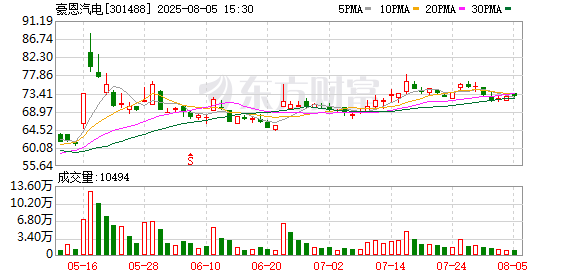
豪恩汽电:8月5日召开董事会会议
Mei Ri Jing Ji Xin Wen· 2025-08-05 09:29
Core Points - The company, Haon Qidian (SZ 301488), announced that its 17th meeting of the third board of directors was held on August 5, 2025, to discuss the proposal for issuing A-shares to specific targets for the year 2025 [2] - For the year 2024, the company's revenue composition is entirely from automotive electronics, accounting for 100.0% [2]