渔业

Search documents
每周股票复盘:开创国际(600097)前三季度净利增269.47%
Sou Hu Cai Jing· 2025-11-02 01:27
Core Points - The stock price of Kaichuang International (600097) closed at 11.43 yuan as of October 31, 2025, down 2.72% from the previous week [1] - The company reported a total market capitalization of 2.754 billion yuan, ranking 5th in the fisheries sector and 4711th in the A-share market [1] Shareholder Changes - As of September 30, 2025, the number of shareholders was 14,900, a decrease of 408 (2.67%) from June 30 [2] - The average number of shares held per shareholder increased from 15,700 to 16,200, with an average holding value of 179,500 yuan [2] Performance Disclosure Highlights - For the first three quarters of 2025, the company reported a main revenue of 1.7 billion yuan, a year-on-year decrease of 1.74% [3] - The net profit attributable to shareholders was 60.5173 million yuan, up 269.47% year-on-year, while the net profit excluding non-recurring items was 53.4926 million yuan, up 340.06% [3] - In Q3 alone, the main revenue was 450 million yuan, down 32.82% year-on-year, with a net profit of 32.9145 million yuan, down 22.25% [3] Company Announcements Summary - The Q3 report indicated a significant increase in net profit due to higher production in the deep-sea fishing segment [4] - The net cash flow from operating activities decreased by 60.13% due to a higher increase in cash paid for goods compared to cash received [4] - The top ten shareholders include Shanghai Ocean Fishing Co., Ltd. with a 42.26% stake and Beijing Yizhen Technology Development Co., Ltd. with a 5.96% stake [4] - The company has made a provision for inventory impairment of 11,339,587.93 yuan, which will reduce the total profit and net profit for the current period [4]

行业观察丨打造海上新广东,渔业社会化服务正当时
Nan Fang Nong Cun Bao· 2025-11-01 09:03
Core Viewpoint - The article discusses the transformation of Guangdong's marine fishery sector through the establishment of a social service system, moving away from individualistic operations to a more integrated and supportive framework for high-quality development in the industry [2][8]. Group 1: Industry Overview - Guangdong is a major fishing province in China, with a projected total aquatic product output exceeding 9.6 million tons and an economic output surpassing 470 billion yuan in 2024, employing over one million people [12][13]. - There is a strong demand and ample space for socialized services in the fishery sector, which has been hindered by an underdeveloped service system [14][16]. Group 2: Policy Framework - The provincial government has included socialized services in the overall development plan for marine fisheries, addressing the inadequacies in the current service system [17][18]. - The "Guangdong Provincial Modern Marine Ranch Development Overall Plan (2024-2035)" aims to innovate and enhance the social service system, focusing on professional service supply, rural collective economy, financial service capacity, and insurance product innovation [20][21]. Group 3: Service Implementation - The establishment of multi-functional service centers, such as the mutual insurance fishery service center in Yangjiang, exemplifies the integration of various service offerings, including information consultation, mutual insurance, crew training, and financing guarantees [31][34]. - The article highlights the importance of financial services in the agricultural social service sector, addressing long-standing issues like financing difficulties and high-interest rates from informal lenders [38][40]. Group 4: Talent Development - There is a pressing need for quality training for fishing crew members, with a significant gap in qualified personnel, which poses safety risks in marine operations [51][53]. - The establishment of specialized training programs and partnerships with educational institutions aims to enhance the professional capabilities of fishing crews [55][57]. Group 5: Future Outlook - The ongoing development of socialized services in Guangdong's fishery sector is expected to deepen, creating a comprehensive service system that supports the entire industry chain and promotes sustainable growth in marine fisheries [58][62].


浙江离海洋到底有多远?
Zhong Guo Neng Yuan Wang· 2025-11-01 04:13
Core Viewpoint - The article emphasizes the transformation of Zhejiang's marine economy, highlighting its strategic shift towards sustainable development and innovation in marine industries, driven by technological advancements and ecological awareness [2][9][23]. Group 1: Marine Economic Development - The "Eight-Eight Strategy" initiated in 2003 aimed to significantly develop the marine economy, which has gained renewed focus in recent years with the Central Financial Committee's call for high-quality marine economic development [2][12]. - Zhejiang has built a modern marine industry supported by world-class ports and technological innovation, establishing a comprehensive strategy for marine resource utilization [2][12][23]. Group 2: Fishing Industry Transformation - The fishing industry in Zhejiang has evolved from traditional methods to a focus on sustainable practices, including deep-sea fishing and aquaculture, responding to past overfishing issues [5][9]. - Companies like Dayang Family have implemented advanced cold chain logistics to preserve seafood quality, showcasing the integration of technology in traditional industries [5][8]. Group 3: Renewable Energy Initiatives - The article highlights the deployment of renewable energy sources, such as offshore wind farms and solar power, to meet the growing energy demands of Zhejiang, which reached a peak load of 131 million kilowatts this summer [20][21]. - The establishment of the "Green Energy Port Ecosystem" at Ningbo-Zhoushan Port demonstrates a commitment to reducing carbon emissions and enhancing energy efficiency through innovative energy management systems [17][18]. Group 4: Global Trade and Logistics - The opening of the "Ice Silk Road" significantly shortens shipping times and reduces costs, marking a shift in global trade dynamics from traditional routes to polar pathways [12][14]. - Ningbo-Zhoushan Port has evolved into a strategic hub for both domestic and international trade, facilitating efficient logistics and resource exchange [14][23]. Group 5: Technological Advancements - The development of a 640 kV ultra-high voltage direct current cable testing platform represents a significant technological achievement, enhancing the capacity for offshore clean energy development [22]. - The emergence of a complete new energy industry chain in Zhejiang, including wind, solar, and storage technologies, reflects the province's ambition to lead in energy equipment manufacturing and standard-setting [22][23].
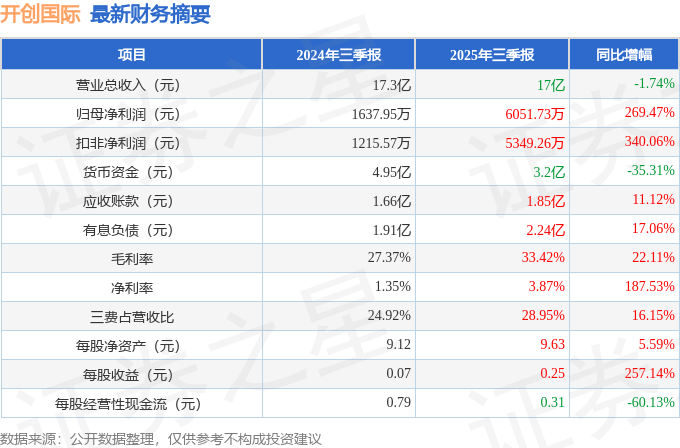
开创国际(600097)2025年三季报简析:净利润同比增长269.47%,盈利能力上升
Sou Hu Cai Jing· 2025-10-31 22:12
Core Insights - The company reported a total revenue of 1.7 billion yuan for Q3 2025, a year-on-year decrease of 1.74%, while the net profit attributable to shareholders reached 60.5 million yuan, an increase of 269.47% [1] - In Q3 alone, total revenue was 450 million yuan, down 32.82% year-on-year, and net profit attributable to shareholders was 32.9 million yuan, down 22.25% [1] - The company's profitability improved, with a gross margin increase of 22.11% year-on-year and a net margin increase of 187.53% [1] Financial Performance - Gross margin stood at 33.42%, reflecting a year-on-year increase of 22.11%, while the net margin was 3.87%, up 187.53% year-on-year [1] - Total selling, administrative, and financial expenses amounted to 492 million yuan, accounting for 28.95% of revenue, which is a 16.15% increase year-on-year [1] - Earnings per share (EPS) was 0.25 yuan, showing a significant year-on-year increase of 257.14% [1] Cash Flow and Assets - The company reported operating cash flow per share of 0.31 yuan, which is a decrease of 60.13% year-on-year [1] - The net asset value per share increased to 9.63 yuan, reflecting a year-on-year growth of 5.59% [1] Business Evaluation - The company's return on invested capital (ROIC) was 3.04%, indicating weak capital returns, with a historical median ROIC of 6.84% over the past decade [3] - The net profit margin last year was 2.97%, suggesting low added value for products or services [3] - The business model relies heavily on marketing-driven performance, necessitating a thorough examination of the underlying drivers [3] Accounts Receivable - The company has a concerning accounts receivable situation, with accounts receivable to profit ratio reaching 301.56% [2]
渔业板块10月31日涨1.26%,国联水产领涨,主力资金净流出320.28万元
Zheng Xing Xing Ye Ri Bao· 2025-10-31 08:36
Core Insights - The fishery sector experienced a rise of 1.26% on October 31, with Guolian Aquatic leading the gains [1] - The Shanghai Composite Index closed at 3954.79, down 0.81%, while the Shenzhen Component Index closed at 13378.21, down 1.14% [1] Stock Performance - Guolian Aquatic (300094) closed at 3.53, up 2.62% with a trading volume of 302,800 shares and a turnover of 106 million yuan [1] - Dahu Co. (600257) closed at 5.73, up 2.50% with a trading volume of 230,000 shares and a turnover of 131 million yuan [1] - Zhanzi Island (002069) closed at 3.78, up 1.89% with a trading volume of 177,200 shares and a turnover of 66.45 million yuan [1] - Haodangjia (600467) closed at 2.40, up 0.42% with a trading volume of 328,100 shares and a turnover of 78.67 million yuan [1] - Zhongshui Fishery (000798) closed at 8.03, up 0.12% with a trading volume of 40,900 shares and a turnover of 32.87 million yuan [1] - Kaichuang International (600097) closed at 11.43, down 0.17% with a trading volume of 47,000 shares and a turnover of 53.72 million yuan [1] Capital Flow - The fishery sector saw a net outflow of 3.2028 million yuan from institutional investors, while retail investors contributed a net inflow of 4.0552 million yuan [1] - The capital flow for individual stocks showed varied trends, with Haodangjia experiencing a net inflow of 1.5964 million yuan from institutional investors [2] - Guolian Aquatic had a net outflow of 1.6382 million yuan from institutional investors, but a net inflow of 3.5327 million yuan from retail investors [2]


爱尔兰食品局亮相亚洲最大海鲜博览会 展示爱尔兰海鲜出口新成就
Zhong Guo Shi Pin Wang· 2025-10-31 07:05
Core Insights - The Irish seafood sector is focusing on expanding its market presence in China, which is seen as a significant growth opportunity for high-end seafood products [3][4]. Group 1: Trade Delegation and Events - The Irish Minister for Agriculture, Food and the Marine, Timmy Dooley, led a trade delegation to China to enhance commercial cooperation in seafood, meat, and dairy products [1]. - The delegation participated in the China International Fisheries Expo, which is recognized as Asia's largest seafood trade event, attracting around 50,000 professional visitors from over 130 countries [1]. Group 2: Market Potential and Demand - China is identified as one of the most promising growth markets for Irish seafood exports, particularly for high-end shellfish and deep-sea fish products [3]. - The demand for high-end imported seafood in China is on the rise, with Irish exporters benefiting from strong competition due to their reputation for food safety, traceability, and high-quality production [4]. Group 3: Export Statistics - In 2024, Ireland is expected to export approximately 157,000 tons of seafood to over 70 markets globally, with total export value nearing €600 million, reflecting a 9% increase from 2023 [5].
开创国际(600097.SH):2025年三季报净利润为6051.73万元、同比较去年同期上涨269.47%
Sou Hu Cai Jing· 2025-10-31 00:07
Core Insights - The company reported a total revenue of 1.7 billion yuan for Q3 2025, ranking third among disclosed peers [1] - The net profit attributable to shareholders reached 60.52 million yuan, ranking first among disclosed peers, with a year-on-year increase of 44.14 million yuan, representing a 269.47% growth compared to the same period last year [1] - The net cash inflow from operating activities was 75.64 million yuan [1] Financial Ratios - The latest debt-to-asset ratio is 29.18%, ranking first among disclosed peers, with a decrease of 0.78 percentage points from the previous quarter and a decrease of 1.54 percentage points from the same period last year [3] - The latest gross profit margin is 33.42%, ranking first among disclosed peers, with an increase of 1.93 percentage points from the previous quarter and an increase of 6.05 percentage points from the same period last year [3] - The latest return on equity (ROE) is 2.61%, ranking second among disclosed peers, with an increase of 1.86 percentage points from the same period last year [3] Earnings Per Share and Turnover Ratios - The diluted earnings per share (EPS) is 0.25 yuan, ranking first among disclosed peers, with an increase of 0.18 yuan compared to the same period last year, representing a 257.14% growth [3] - The latest total asset turnover ratio is 0.51 times, ranking second among disclosed peers [3] - The latest inventory turnover ratio is 1.53 times, ranking third among disclosed peers [3] Shareholder Information - The number of shareholders is 14,900, with the top ten shareholders holding 136 million shares, accounting for 56.62% of the total share capital [3]
大湖股份:10月30日召开董事会会议
Mei Ri Jing Ji Xin Wen· 2025-10-30 18:22
Group 1 - The company Dahu Co., Ltd. (SH 600257) announced the convening of its 20th meeting of the 9th Board of Directors on October 30, 2025, to review the proposal regarding the company's Q3 2025 report [1] - For the fiscal year 2024, the company's revenue composition is as follows: Agriculture accounts for 51.65%, Other Industries for 37.1%, Industry for 9.98%, and Other Businesses for 1.28% [1]

百洋股份:公司及控股子公司亦无逾期对外担保
Zheng Quan Ri Bao Wang· 2025-10-30 13:46
Core Points - Baiyang Co., Ltd. (002696) announced on the evening of October 30 that the company and its controlling subsidiaries have no overdue external guarantees or any external guarantees related to litigation [1] Group 1 - The company confirmed the absence of overdue external guarantees [1] - There are no external guarantees involved in any litigation matters [1]

Iceland Seafood International hf: Q3 2025 results and investors presentation
Globenewswire· 2025-10-30 11:15
Group 1 - Iceland Seafood will publish its Interim Financial Statement for Q3 2025 on November 13th, 2025, which is six days earlier than the previously scheduled date of November 19th [1] Group 2 - The company will pause hosting meetings for investors and market participants for Q1 and Q3 until further notice [2] - Meetings for investors and market participants will still be held for Q2 (half-year results) and Q4 (full-year results), with dates available on the company website [2]