
软件与信息技术服务

Search documents
中国软件国际(00354)上涨3.06%,报6.4元/股
Jin Rong Jie· 2025-08-22 06:45
Group 1 - The core viewpoint of the article highlights the performance and growth of China Software International, which saw a stock price increase of 3.06% to 6.4 HKD per share, with a trading volume of 304 million HKD [1] - The company specializes in global software and IT services, including cloud applications, AIoT, digital twins, ERP consulting, and digital transformation services, serving various industries such as government, finance, energy, manufacturing, telecommunications, internet, transportation, water conservancy, and public utilities [1] - Since its listing in 2003, the company has achieved a compound annual revenue growth rate of 28.7%, currently employing approximately 70,000 staff and operating in 47 countries and regions, ranking 73rd in Gartner's global IT services market share [1] Group 2 - As of the latest financial report, China Software International reported total revenue of 16.951 billion CNY and a net profit of 513 million CNY [2] - The company is set to disclose its mid-year report for the fiscal year 2025 on August 25 [3]

京北方9.98%涨停,总市值241.73亿元
Jin Rong Jie· 2025-08-22 05:48
Core Insights - On August 22, Jingbeifang's stock reached a 9.98% limit up, trading at 27.87 CNY per share with a transaction volume of 3.596 billion CNY and a turnover rate of 16.57%, resulting in a total market capitalization of 24.173 billion CNY [1] Company Overview - Jingbeifang Information Technology Co., Ltd. is located in Haidian District, Beijing, and focuses on providing comprehensive software and information technology solutions, including artificial intelligence, big data, and blockchain technologies [1] - The company is dedicated to digital transformation and technological innovation, holding 32 national patents and over 260 software copyrights, with more than 670 completed information innovation certifications [1] - Jingbeifang's services span software development, testing, and operation and maintenance, showcasing strong technical research and service capabilities through multiple industry certifications [1] Financial Performance - As of August 8, Jingbeifang had 86,600 shareholders, with an average of 9,735 circulating shares per person [2] - For the first half of 2025, Jingbeifang achieved operating revenue of 2.361 billion CNY, representing a year-on-year growth of 5.22%, while the net profit attributable to shareholders was 119 million CNY, a decrease of 0.91% year-on-year [2]
中科星图: 中科星图股份有限公司第三届董事会第八次会议决议公告
Zheng Quan Zhi Xing· 2025-08-21 13:14
Meeting Overview - The third meeting of the board of directors of Zhongke Xingtou Co., Ltd. was held via email, with all 11 directors present and agreeing to waive the notice period for the meeting [1][2] Board Resolutions Approval of A-Share Issuance - The board approved the proposal for the company to issue A-shares to specific targets, confirming that the company meets the necessary qualifications and conditions for this issuance according to relevant laws and regulations [1][2] Adjustment of Fundraising Amount - The total amount for the A-share issuance was adjusted from RMB 250 million to RMB 248.84682 million, with the net proceeds intended for specific projects [2][3] - The total investment for the projects is RMB 254.87211 million, with the adjusted fundraising amount allocated as follows: - Low-altitude cloud supervision and flight service digital infrastructure project - Defense and public safety big data intelligent analysis platform project [2] Approval of Revised Issuance Plans - The board approved the revised proposal for the A-share issuance and the feasibility analysis report, which were adjusted based on the new fundraising amount [4][5][6] Technology Innovation Focus - The board confirmed that the fundraising will be directed towards technology innovation fields, as outlined in the revised documentation [6][7] Dilution of Immediate Returns - The board approved a report addressing the dilution of immediate returns from the A-share issuance and the measures the company will take to mitigate this impact [7][8]

中科星图: 中科星图股份有限公司第三届监事会第七次会议决议公告
Zheng Quan Zhi Xing· 2025-08-21 13:14
Core Viewpoint - The company has convened its third supervisory board meeting to approve various proposals related to the issuance of A-shares to specific investors, including adjustments to the fundraising amount and the associated plans [1][2][3]. Meeting Details - The meeting was held on August 21, 2025, via electronic communication, with all three supervisors present, and the procedures complied with relevant laws and regulations [1]. - The meeting's resolutions were deemed legal and effective [1]. Resolutions Passed - The supervisory board approved the proposal confirming the company's eligibility to issue A-shares to specific investors, affirming compliance with the relevant laws and regulations [2]. - The total amount of funds to be raised through the issuance was adjusted from RMB 250,000.00 million to RMB 248,846.82 million, with the net proceeds intended for specific projects [2]. - The board also approved the revised proposal for the issuance of A-shares, reflecting the adjustments made to the fundraising amount [3][4]. - A revised feasibility analysis report regarding the use of the raised funds was also approved [5]. - The board confirmed that the fundraising will be directed towards technology innovation projects [5]. - The board approved a report on the dilution of immediate returns from the issuance and the measures to mitigate this dilution [6].
盛视科技:拟投资设立全资子公司深圳菲菲特文化创新有限公司
Mei Ri Jing Ji Xin Wen· 2025-08-21 12:54
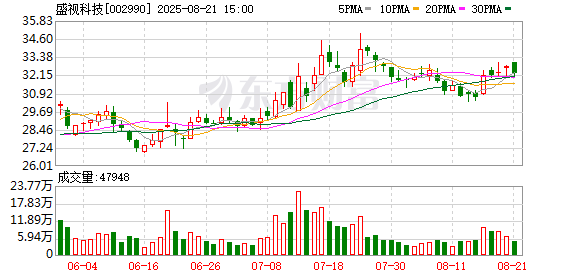
(文章来源:每日经济新闻) 盛视科技(SZ 002990,收盘价:32.27元)8月21日晚间发布公告称,盛视科技股份有限公司于2025年8 月21日召开第三届董事会第三十一次会议,审议通过了《关于投资设立全资子公司的议案》。根据业务 发展和实际经营需要,公司拟使用自有资金以现金出资方式,投资设立全资子公司深圳菲菲特文化创新 有限公司,该子公司注册资本为人民币1000万元,公司持有其100%股权。 2024年1至12月份,盛视科技的营业收入构成为:软件与信息技术服务占比99.51%,其他业务占比 0.49%。 ...

软通动力股价小幅回落 盘中一度快速回调
Jin Rong Jie· 2025-08-20 19:36
Group 1 - The stock price of Softline Power closed at 59.76 yuan on August 20, 2025, down 0.71% from the previous trading day [1] - The stock opened at 60.06 yuan, reached a high of 60.80 yuan, and a low of 58.20 yuan during the day, with a total trading volume of 30.15 billion yuan and a turnover rate of 7.47% [1] - Softline Power specializes in software and information technology services, covering areas such as digital consulting, cloud computing, and big data [1] Group 2 - On the morning of August 20, the stock experienced a rapid decline, with a drop of over 2% within 5 minutes at 9:36 AM, and a transaction amount of 4.10 billion yuan during that period [1] - The net outflow of main funds on that day was 3.39 billion yuan, with a cumulative net outflow of 88.94 million yuan over the past five trading days [1]
益盛鑫上涨3.77%,报2.75美元/股,总市值6445.31万美元
Jin Rong Jie· 2025-08-20 15:05
Core Viewpoint - YSXT's stock price increased by 3.77% to $2.75 per share, with a total market capitalization of $64.45 million as of August 20 [1] Financial Performance - As of March 31, 2025, YSXT reported total revenue of $71.45 million, representing a year-on-year growth of 22.04% [1] - The net profit attributable to the parent company was $4.02 million, showing a year-on-year decrease of 11.92% [1] Company Overview - YSXT is an offshore holding company registered in the Cayman Islands, operating in the People's Republic of China (PRC) through a VIE structure [1] - The company provides comprehensive business solutions primarily to insurance companies and brokerage firms in China [1] - YSXT focuses on value-added services in the auto insurance aftermarket, software development, IT services, and customized services based on specific scenarios [1] - The company leverages its proprietary industry knowledge to collaborate with clients, understanding their needs and challenges to provide suitable services [1]
朗新科技集团:以AI之力为能源转型提供可持续的“中国方案”
Zhong Zheng Wang· 2025-08-20 10:56
Core Insights - The company has developed the "Langxin Nine Functions AI Energy Model," which recently won the BIRD-Bench dual championship, surpassing top global competitors like Google and Stanford, indicating its leading position in AI technology research [1] Group 1: AI Integration in Core Business - The company has deeply integrated AI into core businesses such as electricity market trading and electric vehicle charging, enhancing operational efficiency [2] - In electricity market trading, AI is applied for load forecasting, price analysis, and decision support, providing technical support for efficient operations [2] - The "Xindian Rabbit" intelligent charging assistant, powered by AI, improves the charging experience for electric vehicle owners by offering real-time information on charging stations and facilities [2] Group 2: Industry-Specific AI Model - The "Langxin Nine Functions" model is tailored for the energy sector, featuring nine core capabilities including precise load and generation forecasting, smart energy scheduling, and dynamic safety alerts [3] - This specialized model addresses unique challenges in the energy sector, such as weather and price fluctuations, with a design focused on industry-specific needs [3] - The model is already being utilized in various applications, including electricity trading and virtual power plant scheduling, providing accurate time-series data analysis [3] Group 3: Future Plans and Ecosystem Development - The company plans to gradually open its AI ecosystem to foster collaboration and connectivity among various stakeholders, aiming to drive industry progress [4] - As a multifaceted participant in the energy market, the company will continue to launch high-quality products and services in areas like smart marketing and zero-carbon parks, contributing to sustainable energy transformation [4]
趣图:“老公是程序员,双休有时间,想给他找个兼职”
程序员的那些事· 2025-08-20 08:44
Group 1 - The article discusses the dynamics of relationships where one partner is a programmer, emphasizing the importance of mutual growth and understanding in a partnership [1] - It highlights the challenges faced by programmers, particularly the mental strain from their work, and suggests that partners should be considerate of their needs [1] - The conversation includes humorous and light-hearted comments about relationships and the responsibilities of each partner, reflecting a community perspective on work-life balance [1]

小米取得回风盖板和空气调节设备专利,提升盖板本体强度和稳定性
Jin Rong Jie· 2025-08-20 05:49
Group 1 - Xiaomi Technology (Wuhan) Co., Ltd., Xiaomi Smart Home Appliances (Wuhan) Co., Ltd., and Beijing Xiaomi Mobile Software Co., Ltd. have obtained a patent for "Return Air Cover and Air Conditioning Equipment" with the announcement number CN223243009U, applied on October 2024 [1] - The patent describes a return air cover that includes a cover body, at least two first connecting pieces, and at least one first reinforcing rib, which enhances the strength and stability of the cover body to prevent deformation or breakage during use [1] Group 2 - Xiaomi Technology (Wuhan) Co., Ltd. was established in 2017 with a registered capital of 21 million RMB and has invested in 5 companies, holding 1108 patents and 13 administrative licenses [2] - Xiaomi Smart Home Appliances (Wuhan) Co., Ltd. was founded in 2023 with a registered capital of 2 million RMB and has participated in 7 bidding projects, holding 302 patents [2] - Beijing Xiaomi Mobile Software Co., Ltd. was established in 2012 with a registered capital of 148.8 million RMB, has invested in 4 companies, participated in 139 bidding projects, holds 5000 patents, and has 123 administrative licenses [2]
