
网络安全

Search documents
天融信2022年回购股份处理完毕:596.22万股用于员工持股计划
Xin Lang Cai Jing· 2025-09-15 12:10
Core Viewpoint - Tianrongxin Technology Group Co., Ltd. announced the handling of repurchased shares on September 16, 2025, detailing the situation regarding the repurchase of shares in 2022 [1] Group 1: 2022 Share Repurchase Overview - On January 16, 2022, the company's board approved a share repurchase plan using self-owned funds, with a total repurchase amount not less than 100 million yuan and not exceeding 200 million yuan, to be completed within 12 months [2] - The first repurchase occurred on January 18, 2022, and by January 15, 2023, the company had repurchased a total of 5,962,219 shares, accounting for 0.50% of the total share capital at that time, with a total transaction amount of 101,427,174.14 yuan (excluding transaction fees) [2] Group 2: Specific Uses of Repurchased Shares - The repurchased shares are designated for employee stock ownership plans, with 943,712 shares allocated to the first phase of the "Striver" employee stock ownership plan, completed by January 31, 2024, and 5,018,507 shares for the second phase, completed by September 12, 2025 [3] - As of September 12, 2025, all repurchased shares have been transferred to the corresponding special securities accounts for the employee stock ownership plans, aligning with the intended use outlined in the repurchase plan [3] Group 3: Compliance Statement - The company confirmed that the actual number of repurchased shares, repurchase prices, total funds used, repurchase period, and handling of repurchased shares all comply with the board-approved repurchase plan, with no violations of relevant regulations [4]

用AI护航AI,网络空间治理寻找新解法
2 1 Shi Ji Jing Ji Bao Dao· 2025-09-15 11:40
Core Insights - The recent State Council document emphasizes the importance of "AI governance capabilities" as a key action area, aiming to enhance network space governance through AI technologies [1] - The launch of the "AI Large Model Ecosystem Construction Cluster" in Zhuhai reflects local efforts to address cybersecurity challenges through development and innovation [1][3] Group 1: AI and Cybersecurity Challenges - The rapid development of AI technologies has introduced new cybersecurity risks, including deepfake technology and data bias, which increase the sophistication of cyberattacks [1] - Common cybersecurity threats include the unauthorized use of large models, the mass production of personalized phishing attacks using generative AI, and risks to data security and AI system integrity [1] Group 2: AI as a Solution for Cybersecurity - AI large models are being explored by many tech and cybersecurity companies in China for their ability to better identify and respond to complex security threats compared to traditional tools [2] - AI solutions include intelligent operation, automated risk management, and predictive models for monitoring cyber threats, with applications already in sectors like finance and electricity [2] Group 3: Policy Support and Investment - Zhuhai's policies include a maximum investment of 500 million yuan in "computing power vouchers" to reduce costs for enterprises using AI, and 100 million yuan in "model vouchers" to alleviate financial pressures on R&D [3] - These financial supports aim to accelerate the iteration and upgrade of various AI large models, thereby establishing a technological foundation for the development of the cybersecurity industry [3] Group 4: Future Directions for AI Development - The next step in the large-scale application of AI models may involve creating collective public products that ensure security, as suggested by experts [3] - Establishing a universal security model as an infrastructure service could help reduce compliance costs for large model enterprises and their downstream applications, promoting a safer and more orderly growth of AI technologies [3]
2025国家网络安全周在昆明开幕 蚂蚁集团gPass等多款安全可信AI技术亮相
Zheng Quan Shi Bao Wang· 2025-09-15 09:52
Core Viewpoint - The article highlights Ant Group's participation in the 2025 National Cybersecurity Publicity Week, showcasing its innovations in AI security, data protection, and intelligent risk control, particularly through the introduction of the gPass framework for AI glasses [1][2]. Group 1: gPass Framework - gPass is designed to create a trusted, seamless information bridge between AI glasses and intelligent agents, focusing on three core capabilities: security, interaction, and connectivity [1][2]. - The framework employs technologies such as trusted identity circulation, end-to-end encryption, and device authentication to ensure user information security and privacy [2]. - gPass has already partnered with brands like Rokid, Xiaomi, Quark, and Thunderbird, with plans to expand its applications to various life scenarios, including healthcare and travel [2]. Group 2: Advanced Security Technologies - Ant Group is promoting the ASL initiative to ensure security in the collaboration of intelligent agents, focusing on permissions, data, and privacy [3]. - The "Ant Tianjian" solution for large models includes features for intelligent agent security scanning and abuse detection, forming a comprehensive technology chain [3]. - The "Trusted Data Space" product under Ant Group's MiSuan division provides high-performance, low-cost, and secure data fusion capabilities, supporting various sectors [3]. Group 3: Risk Control Capabilities - Ant Group's financial technology division has demonstrated advanced risk control capabilities against document and voice forgery, achieving a 98% accuracy rate in fake document detection [4]. - The company has collaborated with judicial authorities to address illegal financial intermediaries, involving over 200 individuals since 2024 [4]. - Ant Group aims to build a trustworthy AI governance system to ensure the authenticity and reliability of AI-generated content and agent behavior [4]. Group 4: Commitment to Security Technology - Ant Group emphasizes that security technology is fundamental to its development, committing to enhancing AI security capabilities through responsible privacy protection and comprehensive AI governance [4][5]. - The company has received multiple awards for its advancements in business security, AI security, and content security, reflecting its leadership in the field [5].
亚信安全9月15日现1笔大宗交易 总成交金额207.02万元 溢价率为-10.00%
Xin Lang Zheng Quan· 2025-09-15 09:52
Group 1 - The stock of AsiaInfo Technology closed at 20.91 CNY on September 15, with an increase of 1.11% [1] - A block trade occurred with a total volume of 110,000 shares and a transaction amount of 2.0702 million CNY, with a transaction price of 18.82 CNY per share, reflecting a premium rate of -10.00% [1] - The buyer was Shenwan Hongyuan Securities Co., Ltd., and the seller was Huatai Securities Co., Ltd. [1] Group 2 - In the last three months, AsiaInfo Technology has recorded a total of 7 block trades, amounting to 15.5168 million CNY [1] - Over the past five trading days, the stock has seen a cumulative decline of 0.43%, with a net outflow of 3.1469 million CNY in principal funds [1]

启明星辰:公司的安星智能体主要应用于网络安全场景
Zheng Quan Ri Bao Zhi Sheng· 2025-09-15 09:43
Core Viewpoint - The company, Qiming Star, emphasizes that its Anxing Intelligent System is primarily designed for cybersecurity scenarios, leveraging self-developed security products and tools to enhance intelligent security operations, threat detection, data analysis, and proactive defense capabilities to address complex threats [1] Group 1 - The Anxing Intelligent System helps users build an AI + security protection system, improving efficiency and capabilities [1] - The company states that its intelligent system does not require adaptation to the Hongmeng Intelligent System in the current application scenarios [1]

亚信安全今日大宗交易折价成交11万股,成交额207.02万元
Xin Lang Cai Jing· 2025-09-15 09:35
Group 1 - On September 15, a block trade of 110,000 shares of AsiaInfo Technology was executed, with a transaction amount of 2.0702 million yuan, accounting for 1.56% of the total transaction volume for the day [1] - The transaction price was 18.82 yuan, which represents a 10% discount compared to the market closing price of 20.91 yuan [1]


11月1日起施行!一图读懂《国家网络安全事件报告管理办法》
Yang Shi Xin Wen Ke Hu Duan· 2025-09-15 09:17
Core Points - The National Internet Information Office has issued the "National Cybersecurity Incident Reporting Management Measures," which will take effect on November 1, 2025 [1][3] - The measures consist of 14 articles that outline the scope of cybersecurity incident reporting, regulatory responsibilities, reporting entities, reporting processes, timelines, and content requirements [1][3] Scope and Reporting Entities - The obligation to report cybersecurity incidents applies to network operators that build and operate networks or provide services through the internet within the territory of the People's Republic of China [4] Regulatory Responsibilities - The national internet information department is responsible for coordinating the management of cybersecurity incident reporting nationwide, while provincial internet information departments manage reporting within their respective regions [6] Classification of Cybersecurity Incidents - Cybersecurity incidents are categorized into four levels: particularly major, major, relatively large, and general incidents, based on the harm caused to networks and information systems [9] Reporting Process and Timeliness Requirements - Network operators must report significant cybersecurity incidents (above a certain level) within specified timeframes, such as: - Operators of critical information infrastructure must report to protection departments and public security agencies within 1 hour [10] - Major and particularly major incidents must be reported to the national internet information department within 1 hour by the protection departments [11] - Other network operators must report to provincial internet information departments within 4 hours [12] Encouragement for Reporting - Social organizations and individuals are encouraged to report significant cybersecurity incidents they become aware of [13] Reporting Channels - The internet information department has established multiple channels for reporting cybersecurity incidents, including a hotline (12387), a website, a WeChat mini-program, email, and fax [16][17][18] Penalties for Delayed Reporting - Network operators that delay, omit, falsely report, or conceal cybersecurity incidents will face severe penalties [19] - Timely reporting may result in reduced or waived penalties for the relevant units and personnel [21]

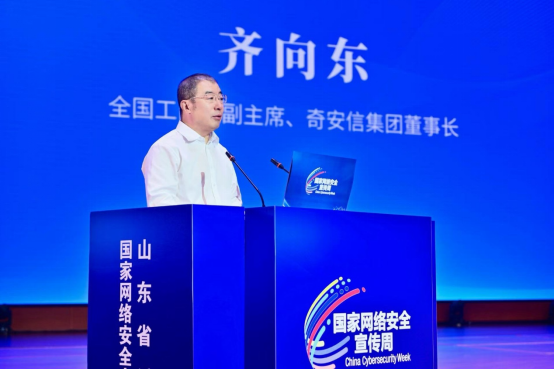
奇安信董事长齐向东出席2025网安周山东省活动开幕仪式
Qi Lu Wan Bao· 2025-09-15 08:52
Core Viewpoint - The 2025 National Cybersecurity Awareness Week emphasizes the importance of building an internal security system to enhance cybersecurity capabilities during the "14th Five-Year Plan" period, addressing new challenges and evolving threats in the digital age [1][4]. Group 1: New Transitions in Cybersecurity - Three major new transitions are reshaping the traditional security landscape: the application of artificial intelligence, the concentration of data, and the deepening of digital transformation, which collectively create systemic security demands [2][4]. - The evolution of security capabilities must outpace technological applications and industrial development to prevent vulnerabilities [2]. Group 2: Security Challenges - Four significant security challenges hinder the advancement of cybersecurity during the "14th Five-Year Plan": - The first challenge is the invisibility of advanced threats, with organized digital groups targeting critical national infrastructure and core enterprise data [3]. - The second challenge is the inability to defend weak links, as disparate systems and lack of unified response hinder effective security management [3]. - The third challenge involves the management of data flow, where internal threats pose significant risks, especially in the context of AI applications [5]. - The fourth challenge is the lagging security measures in various scenarios, particularly in industries like energy and finance, where traditional security solutions fail to adapt [5]. Group 3: Solutions for Cybersecurity Enhancement - To address these challenges, a focus on internal security is proposed through six dimensions: - Breaking down data silos to enhance security system implementation [6]. - Empowering security systems with AI to improve operational efficiency [7]. - Integrating security capabilities across endpoints, networks, clouds, and data to combat multi-faceted attacks [8]. - Establishing a "zero trust" framework to mitigate internal threats [9]. - Strengthening application security defenses tailored to AI scenarios [9]. - Unifying security protection barriers through a coordinated platform to enhance operational effectiveness [10]. Group 4: Commitment to Cybersecurity - The company expresses its commitment to collaborating with various stakeholders to enhance cybersecurity capabilities, ensuring national security and public welfare during the critical phase of the "14th Five-Year Plan" [10].

启明星辰:公司持续为金融新业务场景提供安全产品和服务
Zheng Quan Ri Bao Wang· 2025-09-15 08:41
Core Viewpoint - The company emphasizes its commitment to providing security products and services tailored to the financial sector, particularly in the context of new business scenarios involving stablecoins [1] Group 1 - The financial sector remains a key industry client for the company, highlighting its importance in the overall business strategy [1] - The company is actively monitoring the progress of stablecoin applications and is focused on analyzing the associated security challenges [1] - The company aims to align its security products and services with the specific security needs of its clients in the financial industry [1]
奇安信等在内蒙古成立城市网络安全技术公司
Zheng Quan Shi Bao Wang· 2025-09-15 08:37
Core Insights - Inner Mongolia Urban Cybersecurity Technology Co., Ltd. has been established with a registered capital of 10 million RMB [1] - The company is co-owned by Qihoo 360's subsidiary, Qihoo 360 (Beijing) Network Technology Co., Ltd. [1] Company Overview - The legal representative of the new company is Feng Jilong [1] - The business scope includes internet security services, network and information security software development, and information technology consulting services [1]