互联网餐饮

Search documents
趋势研判!2026年中国互联网餐饮行业发展历程、产业链、发展现状、重点平台及未来趋势:互联网普及与消费观念转变,推动互联网餐饮规模超万亿元[图]
Chan Ye Xin Xi Wang· 2026-02-07 01:25
Core Insights - The internet dining market is rapidly growing due to increasing consumer demand for convenient, high-quality dining services, with a projected market size of approximately 1.38 trillion yuan by 2025, reflecting a year-on-year growth of 7.68% [1][12] - Government support for the internet dining sector is strengthening, with policies aimed at enhancing food safety and promoting the industry through initiatives like consumer vouchers [1][12] - The shift in consumer preferences towards quality and personalized dining experiences is driving the evolution of the internet dining market [1][12] Internet Dining Industry Overview - Internet dining is a new business model that reconstructs dining service processes through mobile internet technology, primarily categorized into online takeout and O2O dining [4] - Major online takeout platforms include Meituan Waimai, Taobao Shanguo, and JD Waimai, while O2O dining platforms include Dazhong Dianping and Weimeng [4] Industry Development History - Significant capital influx into the internet dining sector began in 2014, leading to rapid expansion of platforms like Ele.me and Meituan [4] - By 2017, the online takeout market surpassed 300 billion yuan, marking a 13.6-fold increase since 2011, with mobile payment coverage reaching 86% [4] Current Industry Status - China's dining revenue reached 4.67 trillion yuan in 2019, with a growth rate of 9.38%, but saw a decline in 2020 due to the pandemic [8] - The dining revenue is expected to reach 5.8 trillion yuan by 2025, growing at a rate of 4.06% [8] Internet User Growth - As of mid-2025, China's internet user base is projected to reach 1.12 billion, with an internet penetration rate of 79.7%, indicating strong growth potential for the internet dining sector [10] Competitive Landscape - The internet dining market is highly competitive, dominated by major platforms like Meituan and JD Waimai, which leverage significant capital investments to expand their market share [12] - Traditional dining businesses are increasingly entering the internet dining space, either by launching their own delivery services or partnering with existing platforms [12] Existing Challenges - The industry faces challenges such as food safety issues, high delivery time complaints, and increased pressure on small merchants due to rising commission rates [16] Future Trends - The industry is expected to undergo smart upgrades, focusing on AI and big data to enhance operational efficiency and customer experience [16] - A shift towards green practices is anticipated, promoting resource conservation and waste reduction [16] - Regulatory frameworks are expected to evolve towards more precise and real-time monitoring of food safety [16]



交警为外卖骑手送安全“必修课”很有必要
Xin Lang Cai Jing· 2025-12-21 17:39
Core Viewpoint - The initiative by the Chengdu traffic police to provide safety training for delivery riders addresses the urgent need for improved safety awareness among this group, which has become essential in daily life due to the rapid growth of the internet food delivery industry [3][4]. Group 1: Safety Training Initiative - The traffic police conducted a safety training session for delivery riders, focusing on practical safety tips tailored to their daily delivery challenges, such as wearing safety gear and protective techniques for various scenarios [3]. - The training aimed to enhance the riders' understanding of traffic regulations and the consequences of violations, thereby promoting a "safety first" mindset [4]. Group 2: Impact on Public Safety - By ensuring that delivery riders adhere to traffic laws, the initiative not only protects the riders' lives but also contributes to the overall safety of the public, creating a safer environment for pedestrians and other road users [4]. - The program is seen as a significant step towards fostering a societal focus on the safety of new employment forms, such as delivery riders, and is recommended for broader implementation [4].

跟风的小红书momo党、CBD糖葫芦与流动的盛宴
3 6 Ke· 2025-11-14 11:11
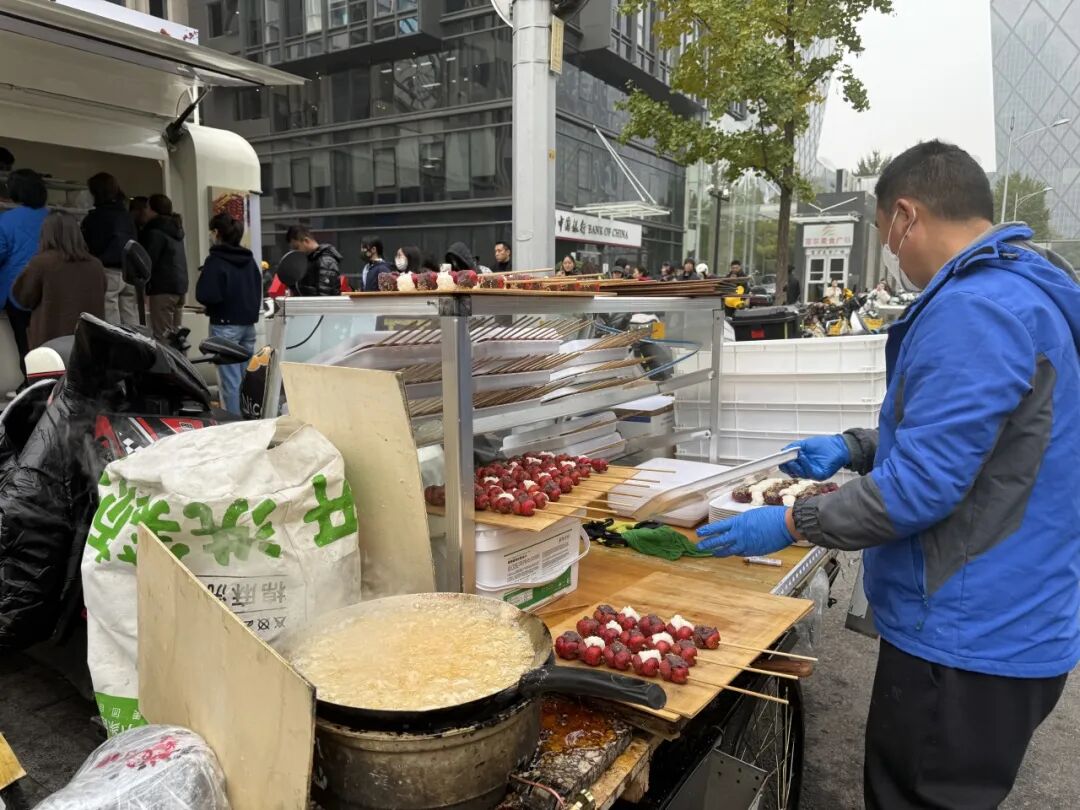
Core Insights - The rise of street food vendors, particularly sugar-coated hawthorn and fried rice stalls, in Beijing's CBD reflects a shift in consumer preferences towards affordable, authentic food experiences amidst a backdrop of high-end dining options [1][3][8] - Social media platforms like Xiaohongshu (Little Red Book) have played a significant role in popularizing these street food vendors, creating a new wave of consumer engagement and marketing opportunities [35][36][38] Group 1: Street Food Phenomenon - A roadside sugar-coated hawthorn stall has become a sensation in the CBD, with customers willing to wait up to two hours for a treat priced at 8 yuan per skewer, contrasting sharply with the high prices of nearby restaurants [1][3] - Another popular vendor, "Little Guangdong Fried Rice," originally a nighttime stall, has seen its customer base grow to over 1,500 people, with long queues forming even in the early hours [3][5] - The popularity of these vendors highlights a consumer desire for "smoky" street food experiences that offer social interaction and a sense of community, which are often lacking in high-end dining [8][35] Group 2: Impact of Social Media - Xiaohongshu has become a key platform for promoting these street food vendors, with users actively sharing their experiences and forming communities around these food options [8][36][38] - The rise of social media-driven food culture has led to a shift in how consumers perceive dining, prioritizing experience and social engagement over traditional metrics like taste [8][35] - The phenomenon of "代购" (daigou) or purchasing on behalf of others has emerged, indicating a growing trend where consumers are willing to pay extra for the convenience of accessing popular street food [1][35] Group 3: Changing Dining Landscape - The CBD's dining scene has evolved, with traditional high-end restaurants facing competition from affordable street food options that resonate more with the current consumer sentiment [1][3][8] - The transformation of street food vendors into more formalized operations, such as food trucks and mini-stores, reflects a broader trend of adapting to consumer expectations while maintaining the essence of street food [43][46] - The success of these vendors serves as a reminder that consumer preferences can shift rapidly, and businesses must adapt to remain relevant in a changing market [35][43]