
全民健身

Search documents
从“量”到“质”:全民健身事业的下一个方向
Xin Lang Cai Jing· 2025-12-29 17:12
Core Insights - The core focus of the reports is the transition of China's national fitness initiative from "quantity" to "quality" improvement in the next phase of development [1][4] Group 1: National Fitness Monitoring Reports - The "Sixth National Physical Fitness Monitoring Report" indicates that the proportion of individuals meeting national fitness standards is 84.9%, with a good rating at 30.9%, showing increases of 0.8% and 1.5% respectively since 2020 [1][2] - The "2025 National Fitness Activity Status Survey" reveals that the proportion of people regularly participating in sports has reached 38.52%, an increase of approximately 1.3% compared to 2020 [1][2] - The monitoring involved a sample of 243,600 individuals across 31 provinces, covering various age groups, and utilized a three-tiered collaborative mechanism for implementation [1][2] Group 2: Health and Fitness Indicators - The monitoring employed a dual approach of "physical fitness testing + health questionnaires," assessing 25 indicators across three categories: body shape, function, and quality [2] - The results show a gradual reduction in the gap between urban and rural residents' fitness levels, with enhanced effects of physical activity on fitness improvement [2][3] - Notably, while fitness levels in children and the elderly have improved, there is a concerning decline in muscle strength among adults, particularly in males [2][3] Group 3: Public Fitness Services and Participation - The survey indicates a significant increase in public participation in sports events, with 45.1% of residents aged 19 and above having participated in such events, up by 9.3% since 2020 [3][4] - The "15-minute fitness circle" concept has largely been realized, providing accessible fitness facilities in various community settings [3] - However, the growth in the proportion of people engaging in regular exercise has shown signs of plateauing, with increases of 4.6% and 1.3% compared to 2015 and 2020 respectively [4] Group 4: Challenges and Future Directions - The reports highlight ongoing issues of uneven development between urban and rural areas, as well as insufficient professional fitness guidance and organizational support [4][5] - The development of "sports project population" is emphasized as a critical area for enhancing the quality of sports participation and bridging competitive and mass sports [5]
体育赛事热 健身去处多(迈向“十五五”的文化图景)
Ren Min Ri Bao· 2025-11-19 22:20
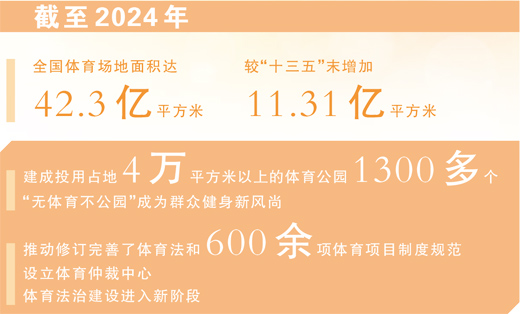
Core Insights - The article emphasizes the significant progress in promoting mass sports and competitive sports in Jiangsu, highlighting the transformation of public demand for sports facilities from mere availability to quality and accessibility [3][4][5]. Group 1: Development of Sports Infrastructure - Jiangsu has built over 1,400 sports parks and 5.23 million kilometers of fitness trails, with a total of 363,700 sports venues [4]. - The "Village World Cup" football tournaments have expanded, with participation from over 70 teams across various provinces, enhancing brand influence and local tourism [4][5]. - The "Su Super" event attracted over 22 billion viewers across 85 matches in six months, showcasing the growing interest in sports [3]. Group 2: Community Engagement and Participation - The article discusses the shift in public perception towards sports facilities, with a focus on quality and user experience, as evidenced by community feedback on sports equipment and venues [4][6]. - Various local sports initiatives, such as "Village BA" and "Village Run," have emerged, reflecting the diverse interests of the community [5]. - The integration of sports into daily life is evident, with increasing participation from families and individuals in community sports activities [5][6]. Group 3: Future Goals and Initiatives - The focus for the "15th Five-Year Plan" includes enhancing the accessibility and quality of public sports services, promoting scientific exercise, and fostering a culture of active participation [6][8]. - The aim is to transition public engagement in sports from mere interest to informed participation, improving overall health outcomes [6][8]. - The article highlights the importance of top-level design and collaboration among various sectors to meet the diverse fitness needs of the population [8].

青岛 旧空间焕发新活力
Jing Ji Ri Bao· 2025-05-16 21:53
Group 1: Urban Transformation - Qingdao has successfully transformed old industrial parks into innovative spaces, exemplified by the "Chuang Chuang Yi·Youth Dream Factory," which now hosts numerous cultural and creative enterprises [1] - The city has developed a "Qingdao Model" for revitalizing low-efficiency land through area coordination, urban integration, and quality enhancement, focusing on high-quality development [1] Group 2: Environmental and Community Revitalization - The Zhangcun River area, once a polluted urban "scar," has undergone significant ecological restoration, creating diverse recreational spaces for residents and enhancing community engagement [2][3] - The "Happy Coastal City" project has revitalized a previously neglected coastal area, transforming it into a vibrant living space through targeted development strategies [2] Group 3: Industrial Development - Qingdao has initiated the demolition of over 2.2 million square meters of old factories to create 15,000 acres of low-efficiency land for new industrial parks, particularly in the display technology sector [4] - The new display industry park has attracted 17 enterprises with a total investment of 35.68 billion yuan, projected to generate 44.9 billion yuan in revenue in 2024, marking a 14% year-on-year increase [4] Group 4: Creative Space and Community Facilities - The transformation of the former idle material trading market into the Qingdao Guoxin National Fitness Center has revitalized the area, providing modern sports facilities for all age groups [7] - The "Old Soda Factory" has been repurposed into a creative center that combines industrial heritage with modern service functions, enhancing the local cultural landscape [8] Group 5: Overall Impact - Qingdao has implemented over 650 "micro-updates" to transform low-efficiency land into new urban highlands, reflecting a broader commitment to improving the quality of life for residents [8]