
制冷业

Search documents
【中国新闻网】制冷业或迎绿色革命 中国团队打破不可能三角关系设计四步循环
Zhong Guo Xin Wen Wang· 2026-01-23 02:22
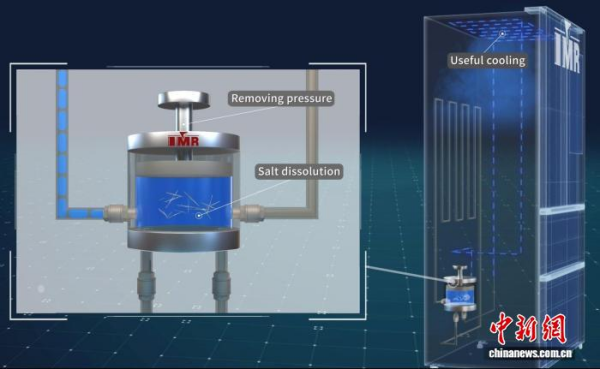
Core Insights - Chinese scientists have discovered the "dissolution pressure card effect," breaking the long-standing "low carbon - high cooling capacity - high heat exchange" triangle in refrigeration materials, potentially leading to a green revolution in the refrigeration industry [1][3] Group 1: Climate Change and Energy Efficiency - Refrigeration technology is a cornerstone of modern society, contributing approximately 2% to China's GDP while consuming nearly 20% of electricity and generating 7.8% of carbon emissions [2] - The research team has focused on developing solid-state phase change refrigeration materials to address climate change and energy reduction needs, avoiding emissions from gas refrigerants [2] Group 2: Breakthrough in Refrigeration Materials - The research identified that ammonium thiocyanate solution exhibits remarkable thermal effects under pressure changes, with temperature drops of nearly 30°C within 20 seconds at room temperature, surpassing known solid-state phase change materials [3] - This breakthrough combines refrigerants and heat exchange media, addressing the core challenges of low carbon emissions, high cooling capacity, and high heat exchange efficiency [3] Group 3: Next-Generation Refrigeration Technology - Based on the "dissolution pressure card effect," the research team designed an efficient four-step cycle system that can absorb 67 joules of heat per gram of solution, with a theoretical efficiency of 77% [4] - This research lays a critical scientific foundation for developing efficient, environmentally friendly, and scalable next-generation refrigeration technologies, with significant potential in large data center thermal management [6]

不用制冷剂的“冰柜”来了!
Xin Lang Cai Jing· 2026-01-18 00:57
Core Viewpoint - The development of the world's first green弹卡冷冻 device capable of achieving temperatures as low as -12°C represents a significant advancement in sustainable refrigeration technology, addressing the high energy consumption and emissions associated with traditional cooling methods [1][8]. Group 1: Industry Challenges - The global warming crisis and increasing refrigeration demand create a stark contradiction, with traditional vapor compression refrigeration technologies being major sources of carbon emissions due to the use of potent greenhouse gases like hydrofluorocarbons [2]. - It is estimated that by 2025, the annual emissions of hydrofluorocarbons will exceed 1.2 billion tons of CO2 equivalent, with approximately 27% (around 330 million tons) coming from sub-zero refrigeration applications [2]. Group 2: Technological Innovations - The new弹卡冷冻 technology utilizes a nickel-titanium shape memory alloy that undergoes solid-state phase changes under cyclic stress, allowing for efficient cooling without traditional refrigerants [2][3]. - The team selected a high nickel content (51.2 at%) nickel-titanium alloy, achieving an austenite finish temperature of -20.8°C, which maintains excellent superelasticity and significant phase change latent heat even at low temperatures [3]. - A 30 wt% calcium chloride solution was chosen as the heat transfer fluid, which remains fluid at low temperatures and effectively avoids ice crystal blockage, enhancing heat transfer efficiency [3][6]. Group 3: Performance Metrics - The prototype, measuring 1.0×0.5×0.5 m³, successfully achieved a temperature drop from approximately 24°C to -12°C, demonstrating a temperature difference of 36°C, marking a first in the field [4]. - The system can achieve a maximum energy efficiency of 3.4, with a cooling power of 1.43 watts per gram, showcasing its energy-saving and cooling potential [6]. Group 4: Future Implications - The successful development of the green弹卡冷冻 device could significantly reduce greenhouse gas emissions by approximately 330 million tons of CO2 equivalent annually if widely adopted in the global refrigeration sector [8]. - The technology is seen as a potential game-changer for the refrigeration industry, especially as regulations on hydrofluorocarbons become stricter, offering a zero-emission, low-energy alternative to traditional methods [8].
现在的雨水不一样了,该为此担忧吗?
Hu Xiu· 2025-09-20 09:38
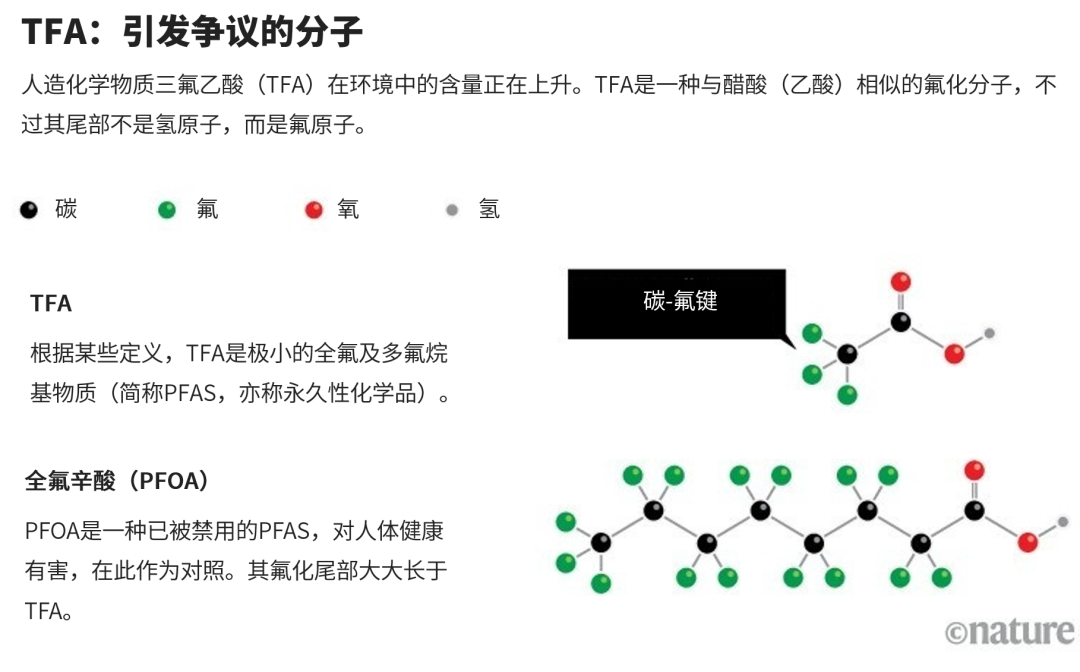
Core Insights - The article discusses the increasing presence of trifluoroacetic acid (TFA) in various environmental samples, including rainwater, lakes, rivers, and even human blood and urine, indicating a global trend of rising TFA concentrations [1][2][3]. Group 1: Environmental Impact - TFA levels in the leaves and needles of various tree species in Germany have increased by 5 to 10 times over the past 40 years [2]. - TFA is classified as a "forever chemical" due to its strong carbon-fluorine bonds, which make it resistant to natural degradation [3]. - The United Nations Environment Programme (UNEP) has assessed TFA's risk since 1998, concluding that its current risk is minimal, at least until 2100, although this assessment may be re-evaluated in 2024 [7][10]. Group 2: Regulatory Actions - Germany has proposed to classify TFA as a reproductive toxin and a highly stable substance, with public consultations ending on July 25, 2024 [10]. - European environmental scientists have expressed concerns that rising TFA levels could pose irreversible harm and have called for a broad ban on all PFAS, including TFA [11]. - Some countries, including Denmark and Minnesota, have begun to take action against pesticides that generate TFA, with Denmark announcing a ban on such pesticides by July 2025 [57]. Group 3: Sources of TFA - TFA enters the environment through various pathways, including the use of TFA in biological research and its release from industrial processes in agriculture, pharmaceuticals, and precision chemicals [15][16]. - The primary source of TFA in rainwater is attributed to the release of fluorinated gases, such as refrigerants, which can decompose and produce TFA [17][20]. - Research indicates that TFA may also be naturally generated in the ocean, with estimates suggesting that oceanic TFA could range from 60 million to 200 million tons [25][26]. Group 4: Health Concerns - Current studies suggest that TFA does not exhibit acute toxicity, with some researchers comparing its toxicity to that of table salt [39]. - However, there is growing evidence that TFA may have biological effects, including lowering lipid and cholesterol levels in mice [41]. - Concerns have been raised about TFA's potential impact on ecosystems, with studies indicating that TFA can accumulate in plants and affect soil pH levels [44][50]. Group 5: Future Directions - Researchers agree that more long-term toxicological data on TFA is needed to understand its effects fully and to identify all sources of TFA [52]. - The introduction of new fluorinated gases, such as HFOs, may lead to increased TFA production, prompting calls for the rapid phase-out of these substances [54][56]. - Ongoing debates among researchers and regulatory bodies highlight the urgency of addressing TFA emissions and their potential environmental and health impacts [59].
“双轮”驱动外贸企业乘风破浪
Zhong Guo Jing Ji Wang· 2025-08-08 03:27
Group 1 - The core viewpoint of the articles highlights the challenges faced by import and export enterprises due to exchange rate fluctuations, rising raw material prices, and liquidity shortages, and how MinTai Bank's strategies support these businesses in navigating these difficulties [1] - MinTai Bank's dual strategy of "stabilizing the supply chain and enhancing efficiency" is effectively implemented to provide timely financial support to foreign trade enterprises in Quzhou [1][7] - The success story of Zhejiang Jinze Refrigeration Co., Ltd. illustrates how a former worker transitioned to a business owner, aided by MinTai Bank's financial services, showcasing the growth of foreign trade enterprises in Quzhou [2][3] Group 2 - The article details the entrepreneurial journey of Wen Liuqing, who identified a market opportunity in Africa for refrigerants, leading to the establishment of his foreign trade business [3] - The sudden increase in raw material prices posed a significant challenge for Jinze Refrigeration, which faced a liquidity crisis despite having orders [3][4] - MinTai Bank responded quickly to Jinze Refrigeration's needs by providing a 5 million yuan credit line with a low interest rate of 2.5%, enabling the company to confidently accept larger orders [4][6] Group 3 - Dongju Kang Optoelectronics Co., Ltd. also benefited from MinTai Bank's support, overcoming challenges related to raw material shortages and currency fluctuations, which affected their profitability [5][6] - The bank's proactive approach included forming a specialized financial service team to address the urgent needs of Dongju Kang, resulting in a 5 million yuan credit approval within three days [6] - With the financial support, Dongju Kang expanded its production capabilities and improved product quality, positioning itself as a high-end custom manufacturer in the market [6][7] Group 4 - MinTai Bank's president emphasized the importance of financial support for foreign trade enterprises to overcome challenges and achieve high-quality development [7] - The bank has issued loans totaling 27.5 million yuan to 10 foreign trade enterprises in Quzhou this year, demonstrating its commitment to supporting local economic growth [7] - The bank aims to continue optimizing its services and increasing support for foreign trade enterprises, contributing to the sustainable development of the regional economy [7]
江苏深化"税银互动"机制 十年发放贷款超1.6万亿元
Zhong Guo Chan Ye Jing Ji Xin Xi Wang· 2025-06-05 22:06
Core Insights - The "Tax-Bank Interaction" project in Jiangsu Province has issued over 1.6 trillion yuan in loans since its launch in 2015, benefiting more than 2.1 million enterprises and significantly contributing to the province's high-quality economic development [1][2] - The project has established deep cooperation with 58 banks, launching 82 credit products that convert tax credit into financing benefits through data sharing and service innovation [1] - The efficiency of loan applications has improved by 50% due to the online submission of tax credit information, as demonstrated by Jiangsu Yisite Refrigeration Co., which secured a 30 million yuan loan [1] Group 1 - Jiangsu Province's tax authorities have implemented the "Tax-Bank Interaction" project, which has provided substantial financial support to enterprises [1] - The project has facilitated the transformation of tax credit into tangible financing advantages, enhancing the overall efficiency of loan processes [1] - Companies like Danyang Tongya New Materials Co. have utilized loans to upgrade production lines, resulting in a 15% increase in production efficiency and a 4% improvement in product quality [1] Group 2 - The initiative also supports enterprises with credit repair, allowing them to regain financing capabilities, as seen with Nantong Wujian Holding Group, which received a 30 million yuan loan after restoring its tax credit [2] - The Jiangsu Provincial Taxation Bureau aims to deepen the application of the "Tax-Bank Interaction" project, enhancing the value of tax credit and enabling more enterprises to benefit from credit-based financing [2]