
国防产业

Search documents
高市早苗压倒性胜选:日本政治经济全面转向 股市大涨背后逻辑深度拆解
Sou Hu Cai Jing· 2026-02-09 15:43
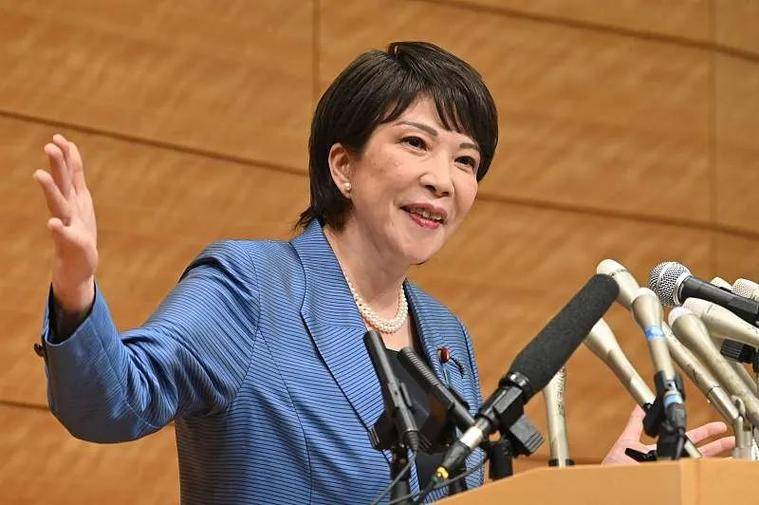
Group 1 - The core viewpoint of the article is that the overwhelming election victory of Kishi Sanae and the Liberal Democratic Party (LDP) will reshape Japan's domestic and foreign policies, influence the Asian geopolitical landscape, and drive the Japanese stock market to historical highs [2] - The LDP's victory allows for constitutional amendments, solidifying Kishi's leadership and enabling the implementation of comprehensive economic, military, and diplomatic strategies [2][3] - Morgan Stanley MUFG Securities has raised its forecast for the Japanese stock market, predicting a 2,450-point increase in the Tokyo Stock Exchange index by the end of 2026, driven by fiscal expansion, defense investment, and corporate profitability [2][5] Group 2 - Kishi's foreign policy focuses on strengthening the Japan-U.S. alliance while maintaining trade and strategic partnerships with Europe and India, which has garnered support from the business community and conservatives [3] - Domestically, Kishi's political agenda resonates with the public's desire for economic improvement and national strength, leading to high approval ratings and electoral success [4] - Kishi's administration is implementing expansionary fiscal policies that align with the Bank of Japan's monetary policies, creating a "loose fiscal + stable monetary" environment that supports market liquidity and lowers financing costs for businesses [5] Group 3 - The combination of fiscal spending and monetary policy is expected to create a positive feedback loop for the Japanese economy and stock market, with increased government spending boosting infrastructure, defense, and consumer sectors [5] - The forecast of 4,250 points for the stock market is based on rational assessments of policy implementation, profit improvement, and capital inflow, with high liquidity stocks and defense-related sectors showing significant potential for excess returns [5] - While acknowledging the short-term benefits of Kishi's policies, there are concerns about the long-term risks associated with extreme right-wing tendencies and aggressive military expansion, which could undermine regional economic cooperation [6]

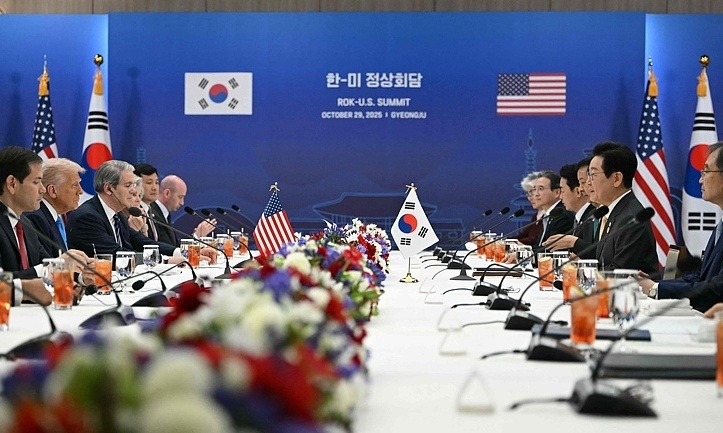
李在明同特朗普会晤
Xin Jing Bao· 2025-10-29 12:42
Group 1 - The core viewpoint of the meeting between South Korean President Lee Jae-myung and U.S. President Trump is to strengthen the South Korea-U.S. alliance and address issues related to North Korea [1][3] Group 2 - South Korea plans to significantly enhance its self-defense capabilities by increasing its defense budget and developing its defense industry, thereby reducing the defense burden on the U.S. [3] - South Korea aims to further solidify and deepen the South Korea-U.S. alliance through expanded investments and imports from the U.S. [3] - Trump expressed his commitment to maintaining a good relationship with South Korea and working together to resolve issues on the Korean Peninsula [3]
北约秘书长吕特:在北约盟国决定增加国防开支之后,现在由相关产业部门承担落实任务的责任。
news flash· 2025-06-24 11:56
Core Points - NATO Secretary General Jens Stoltenberg stated that after NATO allies decided to increase defense spending, it is now the responsibility of the relevant industrial sectors to implement these tasks [1] Group 1 - The decision by NATO allies to increase defense spending indicates a shift in focus towards enhancing military capabilities [1] - The industrial sectors are expected to play a crucial role in fulfilling the commitments made by NATO member states regarding defense expenditure [1]