企业盈利

Search documents
JEPI Vs. DIVO: Why These 2 Win In A Flat, Volatile Market - But 1 Wins More
Seeking Alpha· 2026-03-30 08:25
Core Insights - The article emphasizes the importance of quantitative research, financial modeling, and risk management in equity valuation and market trends to identify high-growth investment opportunities [1] Group 1: Company Expertise - The company has over 20 years of experience in quantitative research and financial modeling, focusing on equity valuation and market trends [1] - The company has developed deep expertise in both fundamental and technical analysis through leadership roles in model validation and stress testing [1] - The research approach combines rigorous risk management with a long-term perspective on value creation [1] Group 2: Research Focus - The company has a particular interest in macroeconomic trends, corporate earnings, and financial statement analysis [1] - The goal is to provide actionable ideas for investors seeking to outperform the market [1]


1-2月工业企业利润点评:强劲的外需,和不请自来的通胀
Changjiang Securities· 2026-03-27 15:08
Group 1: Economic Performance - In the first two months of 2026, the total profit of industrial enterprises increased by 15.2% year-on-year, while operating revenue grew by 5.3% year-on-year, marking the strongest performance since 2023[4]. - The profit recovery is primarily driven by strong external demand and rising prices of upstream cyclical products, particularly in the mining and manufacturing sectors[2][8]. - The mining industry's profit growth reached 9.9%, while manufacturing profits surged by 18.9%[8]. Group 2: Sector Analysis - The computer electronics, non-ferrous metallurgy, and chemical industries collectively contributed 17.6 percentage points to the profit growth in January-February 2026, significantly outperforming other sectors[8]. - The electronic industry showed the highest growth rate, supported by robust export and industrial growth data, with machinery and high-tech products driving exports[8][16]. - The inclination for enterprises to replenish inventory has returned, with nominal inventory growth reaching 6.6%, the highest since April 2023[8]. Group 3: Future Outlook - The interplay between external demand and inflation may lead to a tug-of-war effect on future corporate profits, as rising oil prices could increase production costs for downstream enterprises[2][33]. - The external economic environment remains volatile, with uncertainties in policy decisions affecting domestic demand growth[6][38].
——2026年1-2月工业企业盈利数据点评:企业盈利高增,利润分配向中上游倾斜
EBSCN· 2026-03-27 12:08
Profit Growth - In January-February 2026, industrial enterprises' profits increased by 15.2% year-on-year, compared to a mere 0.6% growth for the entire previous year[2] - Revenue for the same period grew by 5.3% year-on-year, up from 1.1% for the previous year[2] - The profit margin for industrial enterprises reached 4.92%, an increase of 0.39 percentage points year-on-year, marking the highest level for the same period since 2023[5] Structural Changes - Profit distribution is shifting towards midstream and upstream sectors, with mining profits growing by 9.9% and manufacturing profits rising by 18.9% year-on-year[15] - The share of manufacturing profits increased to 70.46%, up by 1.1 percentage points from the previous year, while the share of consumer goods manufacturing profits decreased to 23.7%, down by 6.2 percentage points[16][23] - Upstream raw materials manufacturing profits surged by 72.2%, with non-ferrous metal smelting profits increasing by 148.2%[20] Market Outlook - The Producer Price Index (PPI) is expected to turn positive in March 2026, driven by rising oil prices and improved supply-demand dynamics due to "anti-involution" policies[3][5] - Short-term pressures on profit margins are anticipated for midstream equipment and downstream consumer goods sectors due to high oil prices[34] Inventory Trends - Industrial enterprises showed signs of proactive inventory replenishment, with finished goods inventory growing by 6.6% year-on-year, aligning with a revenue growth of 5.3%[32][33]
海外因素压制风险偏好,股指偏弱震荡
Guo Mao Qi Huo· 2026-03-16 09:47
1. Report Industry Investment Rating - Not provided in the given content 2. Core Viewpoints of the Report - The stock index is expected to stabilize and resume its upward trend in the future as the external geopolitical situation eases and market risk appetite recovers. Domestically, the economic tone is generally in line with expectations, multiple policies continue to work together to promote economic growth, macro - liquidity remains abundant, and capital market policies aim to support a "slow - bull" market. There is still upward room for the stock index. Strategically, investors can consider constructing long positions in the medium - to - long - term by taking advantage of the stock index futures discount [3]. 3. Summary According to Relevant Catalogs 3.1 Main Views and Strategy Overview - **Influence Factors and Their Driving Forces** - **Economic and Corporate Profits**: 1 - 2 months' exports in China exceeded expectations, with a total export of 20994.3 billion yuan and a growth rate of 18.3%, much higher than the market - expected 7.2%. In February, the single - month export growth rate was as high as 36.1%. February's financial data continued to show a good trend, with new social financing of 2.38 trillion yuan, an increase of 146.1 billion yuan year - on - year. The "Two Sessions" closed, and the goals in the "Government Work Report" were basically in line with expectations [3]. - **Policy**: The CSRC Chairman proposed to improve the market mechanism and ecosystem for "long - term investment of long - term funds", perfect the construction of the Chinese - characteristic market - stabilizing mechanism, and add a more precise and inclusive listing standard on the Growth Enterprise Market. The central bank governor said that this year, various monetary policy tools such as reserve requirement ratio cuts and interest rate cuts will be used flexibly and efficiently [3][50]. - **Overseas Factors**: The uncertainty of the Middle East conflict remains, and the risk of overseas imported inflation is still high. China and the US will hold economic and trade consultations in France [3]. - **Liquidity**: Last week, A - share trading volume decreased slightly, with the average daily trading volume decreasing by 4.563 billion yuan compared with the previous week [3]. - **Investment Viewpoint and Trading Strategy** - The investment view is to go long in the medium - to - long - term. The strategy is to go long in the medium - to - long - term at an appropriate time, and pay attention to overseas geopolitical factors [3]. 3.2 Stock Index Market Review - **Index Performance**: Last week, the Shanghai - Shenzhen 300 rose 0.19% to 4669.1; the Shanghai 50 fell 1.2% to 2956.8; the CSI 500 fell 1.44% to 8239.8; the CSI 1000 fell 0.42% to 8214.3 [5]. - **Industry Index Performance**: Among the Shenwan primary industry indexes, the power equipment (4.6%), building decoration (4.1%), public utilities (3.1%), banks (1.4%), and agriculture, forestry, animal husbandry and fishery (1%) led the gains last week, while national defense and military industry (- 6.6%), comprehensive (- 4.3%), non - ferrous metals (- 3.7%), media (- 3.2%), and machinery and equipment (- 2.4%) led the losses [9]. - **Stock Index Futures Volume and Open Interest**: The trading volume of the Shanghai - Shenzhen 300 futures, Shanghai 50 futures, CSI 500 futures, and CSI 1000 futures decreased by 18.05%, 26.46%, 20.34%, and 12.86% respectively. The open interest of the Shanghai - Shenzhen 300 futures, Shanghai 50 futures, CSI 500 futures, and CSI 1000 futures changed by 0.18%, - 2.85%, 0.91%, and 2.17% respectively [11]. - **Contract Premium and Discount**: As of March 13, the annualized discounts of the current - month contracts IF2603, IC2603, and IM2603 were 12.44%, 16.45%, and 17.32% respectively, while IH2603 had an annualized premium of 0.27% [15]. 3.3 Stock Index Influence Factors - Liquidity - **Central Bank Operations**: This week, the central bank conducted 176.5 billion yuan of reverse repurchase operations in the open market, with 277.6 billion yuan of reverse repurchases due, resulting in a net withdrawal of 101.1 billion yuan. Next week, 176.5 billion yuan of reverse repurchases will mature, and 60 billion yuan of 182 - day repurchase - style reverse repurchases will mature on March 17. The central bank has carried out 50 billion yuan of repurchase - style reverse repurchase operations, with a reduction of 10 billion yuan [24]. - **Market Trading Volume and Margin Trading Balance**: As of March 12, the margin trading balance of A - shares was 2656.15 billion yuan, an increase of 18.95 billion yuan from the previous week. As of March 12, the proportion of margin trading purchases in the total market trading volume was 9.5%, at the 74% quantile level in the past ten years. Last week, the daily trading volume of A - shares decreased, with the average daily trading volume decreasing by 4.563 billion yuan compared with the previous week. As of March 13, the risk premium rate of the Shanghai - Shenzhen 300 was 5.22, at the 48.4% quantile level in the past ten years [30]. 3.4 Stock Index Influence Factors - Economic Fundamentals and Corporate Profits - **Macroeconomic Indicators**: In February 2026, the manufacturing PMI was 49.0, a decrease of 0.3 from the previous month; the non - manufacturing PMI was 49.5, an increase of 0.1 from the previous month. In terms of other indicators, the export in US dollars increased by 39.6% in February, and the import increased by 13.8% [33][42]. - **Corporate Profit Indicators**: The year - on - year growth rates of the net profit attributable to the parent company of the Shanghai - Shenzhen 300, Shanghai 50, CSI 500, and other major broad - based indexes showed different trends in different periods. For example, the year - on - year growth rate of the net profit attributable to the parent company of the Shanghai - Shenzhen 300 was 5.22% as of September 30, 2025 [45]. 3.5 Stock Index Influence Factors - Policy Driven - **National People's Congress and Related Conferences**: The "Government Work Report" set the economic growth target at 4.5% - 5%, the consumer price increase at about 2%, the deficit rate at 4%, and the deficit scale at 5.89 trillion yuan. The CSRC Chairman proposed to improve the market mechanism and ecosystem for "long - term investment of long - term funds", perfect the construction of the Chinese - characteristic market - stabilizing mechanism, and add a more precise and inclusive listing standard on the Growth Enterprise Market. The central bank governor said that this year, various monetary policy tools such as reserve requirement ratio cuts and interest rate cuts will be used flexibly and efficiently [50]. - **Other Policies**: There have been a series of policies in real estate, consumption, and other fields, such as optimizing real estate purchase restrictions and promoting consumer goods replacement [51][53]. 3.6 Stock Index Influence Factors - Overseas Factors - **US Economic Indicators**: In February, the US manufacturing PMI was 52.4%, a decrease of 0.2 percentage points from the previous value; the non - manufacturing PMI was 56.1%, an increase of 2.3 percentage points from the previous value. The seasonally - adjusted unemployment rate in February was 4.4%, and the number of new non - farm payrolls was - 92,000. In January, the year - on - year increase in PCE was 2.83%, and the year - on - year increase in core PCE was 3.06% [63][65][70]. 3.7 Stock Index Influence Factors - Valuation - **Index Valuation**: As of March 13, 2026, the rolling price - to - earnings ratios of the Shanghai - Shenzhen 300, Shanghai 50, CSI 500, and CSI 1000 were 14.2 times, 11.5 times, 37.1 times, and 49.9 times respectively, at the 83.3%, 78.1%, 77.9%, and 72.8% quantile levels since October 2014 [72]. - **Sector Valuation**: Different sectors have different price - to - earnings ratios and price - to - book ratios and their corresponding historical quantile levels. For example, the price - to - earnings ratio of the banking sector is 6.3, at the 44% quantile level in the past ten years [76].
股指黄金周度报告-20260313
中盛期货· 2026-03-13 11:57
Report Summary 1. Report Industry Investment Rating - No investment rating provided in the report 2. Core Viewpoints of the Report - Short - term: After the conclusion of the National Two Sessions, the policy side is mostly favorable, but geopolitical risks persist. Stock indices may fluctuate in the short - term, and investors should wait patiently for stabilization signals. The repeated escalation of the US - Iran situation has pushed up inflation expectations due to rising oil prices, suppressing expectations of Fed rate cuts, and gold has entered a high - level consolidation pattern, with the risk of a breakdown downward [35]. - Medium - to long - term: Stock index valuations will still be dragged down by the decline in corporate profit growth at the molecular end, while the support at the denominator end mainly comes from the recovery of risk appetite. The stock index will maintain a wide - range consolidation in the medium term. The stimulative effect of US tax cuts on the economy will gradually emerge, and there is a risk of a deep adjustment in gold [36]. 3. Summary by Relevant Catalogs 3.1 Macroeconomic Data - In February 2026, China's CPI rose 1.3% year - on - year, with the increase expanding by 1.1 percentage points from the previous month. PPI fell 0.9% year - on - year, with the decline narrowing by 0.5 percentage points. From January to February, imports increased 19.8% year - on - year, and exports increased 21.8% year - on - year, the highest growth rate since February 2022 [6]. - In the US in February, non - farm payrolls unexpectedly decreased by 92,000, the unemployment rate rose from 4.3% to 4.4%, CPI rose 2.4% year - on - year, and core CPI rose 2.5% year - on - year, with the increase remaining the same as the previous month [20]. 3.2 Stock Index Fundamental Data - The escalation of the Middle East geopolitical situation has led to rising prices of international crude oil and chemical commodities, which helps repair the profits of upstream raw material processing industries. However, downstream enterprises still face high operating pressure, with the long - standing phenomenon of increasing revenue without increasing profits, and they have to reduce production and inventory [14]. - The margin balance of the Shanghai and Shenzhen stock markets rebounded slightly to 2634.2 billion yuan. The central bank conducted 176.5 billion yuan of 7 - day reverse repurchase operations this week, achieving a net withdrawal of 101.1 billion yuan [17]. 3.3 Gold Fundamental Data - The growth of Shanghai gold futures warehouse receipts and inventory has slowed down, and the COMEX gold inventory in New York has continued to decline, indicating a relief of delivery pressure [34].
南顺(香港)(00411.HK)中期股东应占溢利1.76亿港元 同比减少6.5%
Ge Long Hui· 2026-02-25 11:56
Core Viewpoint - The company reported a slight decline in revenue and profit for the six months ending December 31, 2025, primarily due to rising raw material costs and targeted pricing incentives [1] Financial Performance - The group recorded revenue of HKD 2.669 billion, a year-on-year decrease of 0.4% [1] - Gross margin narrowed by 0.6 percentage points to 23.0%, influenced by increased raw material costs and pricing strategies [1] - Shareholders' profit attributable to the company was HKD 176 million, down 6.5% compared to the same period last year [1] Cash Position - As of December 31, 2025, the group had cash reserves of HKD 1.965 billion, an increase of 2.6% from the end of the previous fiscal year [1] - The company maintains a strong liquidity position to support ongoing operations and future development [1] Dividend Declaration - The board declared an interim dividend of HKD 0.15 per share for the fiscal year ending June 30, 2026 [1]
都在喊跌就安全了?美股情绪指标急转直下 多头却看到了希望
智通财经网· 2026-02-24 12:13
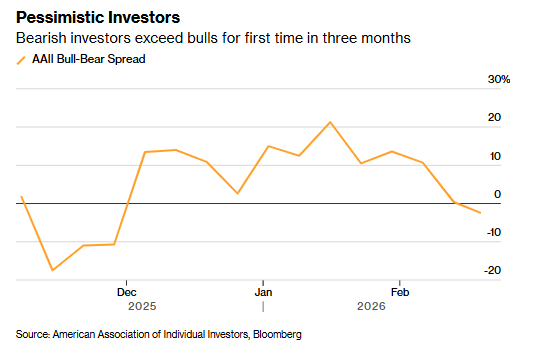
Core Viewpoint - The U.S. stock market has been fluctuating near historical highs for nearly four months, with each rally quickly followed by a sell-off, indicating a shift in investor sentiment towards a more bearish outlook for the first time since November last year [1] Group 1: Market Sentiment and Trends - A recent investor sentiment survey shows that bearish sentiment has surpassed bullish sentiment for the first time since November 2022, with Deutsche Bank's subjective stock positioning indicator dropping to an underweight zone [1] - Despite the bearish signals, historical patterns suggest that this could signal a buying opportunity, as stock buying may soon rebound [1] - The current market environment is characterized by a rare combination of pessimism and broad upward momentum, which is seen as overall positive for the U.S. stock market [1][2] Group 2: Performance of Indices - The S&P 500 index is down 0.8% from its historical high on October 28, 2022, and has declined 2% from its peak four weeks ago, while the Russell 2000 small-cap index and S&P 500 equal-weight index have risen at least 5.2% this year [2] - Funds are shifting from large-cap tech stocks to smaller, riskier stocks, as well as sectors like energy, materials, and consumer staples [2] Group 3: Earnings and Investor Behavior - The earnings data indicates that S&P 500 companies are expected to see a 13% year-over-year profit growth in Q4, significantly exceeding the market's previous expectation of less than 9% [2] - Despite a generally pessimistic sentiment from the American Association of Individual Investors (AAII), there is a belief that respondents may not fully reflect their true market actions, as they are increasing their positions in risk assets [3][5] Group 4: Market Dynamics and Uncertainties - Investors are increasingly moving into high-risk stocks and using leveraged ETFs to increase bullish bets, with retail investors actively buying on dips [5] - Approximately half of the S&P 500 companies have raised their earnings guidance, marking the highest proportion since Q2 2021, indicating strong operational performance despite market pricing challenges [5] - The market is currently in a "chaotic range," suggesting a need for tactical caution, yet Citigroup maintains an overweight position on U.S. stocks while reducing exposure to tech stocks [6]
Oceaneering Q4 Earnings Surpass Estimates, Revenues Miss
ZACKS· 2026-02-20 17:36
Core Insights - Oceaneering International, Inc. (OII) reported an adjusted profit of 45 cents per share for Q4 2025, exceeding the Zacks Consensus Estimate of 44 cents and up from 37 cents in the same quarter last year, driven by strong performance in Subsea Robotics, Manufactured Products, and Aerospace and Defense Technologies segments [1][9] Financial Performance - Total revenues for Q4 2025 were $668.6 million, missing the Zacks Consensus Estimate of $711 million and down approximately 6.3% from $713.5 million in the prior year, primarily due to lower revenues in energy-focused businesses [2] - Adjusted EBITDA for the quarter was $90.5 million, reflecting a 10.9% decrease year over year [2] Share Repurchase - The company repurchased 419,005 shares for approximately $10.1 million during Q4 2025 [3] Segment Performance - **Subsea Robotics (SSR)**: Revenues were $211.7 million, slightly down from $212.2 million year-over-year and missing the estimate of $225 million. Operating income increased to $67.8 million from $63.5 million, beating the estimate of $65 million, with an EBITDA margin of 38% [4][5] - **Manufactured Products**: Revenues totaled $132.4 million, down from $143 million year-over-year and missing the estimate of $140 million. Operating profit rose to $20.4 million from $4.2 million, exceeding the estimate of $9.4 million [6] - **Offshore Projects Group (OPG)**: Revenues decreased by about 29.1% to $130.8 million from $184.4 million year-over-year, missing the estimate of $161 million. Operating income fell to $15 million from $39.3 million, missing the estimate of $28.7 million [7][8] - **Integrity Management & Digital Solutions (IMDS)**: Revenues were $66.5 million, down from $75.1 million year-over-year and missing the estimate of $72 million. The segment reported an operating loss of $0.12 million, reversing the prior year's profit of $2 million [10] - **Aerospace and Defense Technologies (ADTech)**: Revenues increased to $127.3 million from $98.8 million year-over-year, beating the estimate of $113 million. Operating income rose to $14.2 million from $9.9 million, although it missed the estimate of $16.6 million [11] Backlog and Book-to-Bill Ratio - The backlog as of December 31, 2025, was $511 million, down 15.4% from the same time in 2024, with a book-to-bill ratio of 0.84 for the 12 months ending December 31, 2025 [7] Capital Expenditure and Balance Sheet - Capital expenditure in Q4 totaled $36 million. As of December 31, 2025, cash and cash equivalents were $688.9 million, with long-term debt of approximately $487.4 million, resulting in a debt-to-capitalization ratio of 31.2% [12] Q1 & 2026 Outlook - The company anticipates lower revenues in Q1 2026 compared to Q1 2025 due to reduced activity levels in energy markets, with consolidated EBITDA expected between $80 million and $90 million [13] - For the full year 2026, OII expects consolidated revenues to grow in the low to mid-single-digit percentage range, with projected EBITDA of $390 million to $440 million [16] - Segment expectations include modest revenue growth for SSR, significantly higher operating income for Manufactured Products, and strong revenue growth for ADTech [14][17]


Allegion plc Q4 2025 Earnings Call Summary
Yahoo Finance· 2026-02-17 17:32
Core Insights - Allegion plc reported strong enterprise revenue growth driven by robust performance in the Americas nonresidential markets and over $600 million in accretive M&A [5] - The company experienced underperformance in U.S. residential markets in Q4, with volume declines offsetting favorable price realization [5] - Management expects continued margin expansion due to pricing and productivity gains that exceed inflationary impacts [5] Strategic Performance Drivers - Americas nonresidential markets benefited from healthy demand and robust spec-writing trends, providing resilience amid macro volatility [5] - International segment growth was primarily fueled by Electronics and M&A, which mitigated sluggishness in Mechanical markets [5] - The company expanded its mid-tier commercial portfolio with new product launches to capture broader market share in the nonresidential aftermarket [5] 2026 Outlook and Strategic Assumptions - The 2026 guidance assumes Americas nonresidential volume growth remains consistent with 2025 levels, supported by current specification activity [5] - Management projects soft demand in the Americas residential segment throughout 2026, with a slight decline expected for the year [5] - Organic growth in the Americas segment is anticipated to rely more on pricing than volume [5] Capital Allocation and Risk Factors - Allegion deployed approximately $630 million toward acquisitions in 2025, focusing on core mechanical, electronics, and software solutions [5] - The company increased its dividend for the twelfth consecutive year, indicating a commitment to balanced capital return alongside growth investments [5] - Net debt to adjusted EBITDA stands at 1.6 times, providing significant balance sheet flexibility for continued disciplined M&A [6]
US stocks open in the green: Dow surges 300 points, S&P up 0.3%
Invezz· 2026-02-12 14:46
Core Viewpoint - US equities experienced modest gains as investors reacted to a strong January jobs report and new labor market data while monitoring inflation indicators that may influence interest rate decisions [1] Group 1: Market Performance - The Dow Jones Industrial Average increased by 295 points, approximately 0.6% [1]