塑料原料

Search documents
韩国多地现垃圾袋“抢购潮”
第一财经· 2026-03-27 02:55
Core Viewpoint - The ongoing tensions in the Middle East have led to concerns in South Korea regarding the supply of key raw materials for plastic products, particularly garbage bags, prompting a surge in purchases and the implementation of purchase limits in some supermarkets [1][2] Group 1: Government Response - The South Korean government plans to classify garbage bags as "core controlled items" to monitor supply and demand, emphasizing that current inventory levels are sufficient and there is no need for panic buying [1][2] - A government official stated that the management system is being strengthened to prevent potential disruptions in the supply chain [2] Group 2: Supply Chain and Inventory - Current data indicates that the average inventory of garbage bags across 228 local governments in South Korea can last over three months, with 123 local governments having reserves that can supply for more than six months [1] - Recycling companies possess enough recycled materials to produce approximately 1.83 billion garbage bags, exceeding the total sales of 1.78 billion bags in the previous year, suggesting that production can continue for over a year even if raw material supply is completely interrupted [1] Group 3: Oil Supply Concerns - Approximately 55% of South Korea's naphtha demand is met by domestic production, while about 45% is imported, raising concerns that companies heavily reliant on imported naphtha may be forced to halt operations due to supply disruptions from the Middle East [2] - The South Korean government announced a restriction on naphtha exports starting from the 27th, in response to the supply concerns [2]


研判2025!中国塑料原料行业发展历程、产业链、市场规模、竞争格局及前景展望:随着环保意识的提高和环保政策趋严,塑料原料行业将加快绿色化转型步伐[图]
Chan Ye Xin Xi Wang· 2025-04-30 01:27
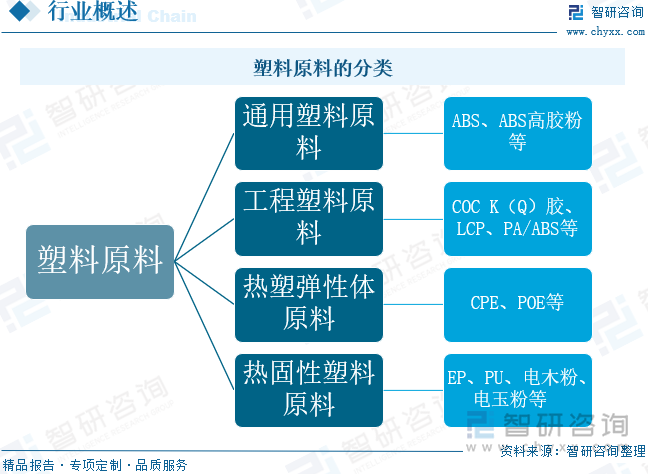
Core Viewpoint - The plastic raw materials industry in China is experiencing rapid growth driven by increasing demand across various sectors, with a projected market size of approximately 1.87 trillion yuan in 2024. The industry is also shifting towards greener and low-carbon solutions due to stricter environmental policies and rising consumer demand for eco-friendly products [1][16]. Industry Overview - Plastic raw materials, also known as polymers, are widely used in construction, agriculture, packaging, automotive, electronics, and home goods due to their lightweight, corrosion resistance, good electrical insulation, and strong plasticity [3][16]. - The industry has evolved through four stages: initial development (1950-1970), scale expansion (1980-1990), rapid growth (2000-2010), and transformation and upgrading (2020-present) [5]. Market Dynamics - The demand for plastic raw materials in China has shown a steady increase, with consumption rising from 10.4 million tons in 2017 to an estimated 13.07 million tons in 2024, reflecting a compound annual growth rate of 3.32% [14]. - The global demand for plastic raw materials is expected to reach approximately 41 million tons in 2024, indicating a stable growth trend in the coming years [13]. Industry Structure - The Chinese plastic raw materials industry features a diversified competitive landscape, dominated by state-owned enterprises like Sinopec and PetroChina, which hold about 60% of the market share in general plastics [19]. - Private companies such as Wanhua Chemical and Hengli Petrochemical are rapidly advancing in high-end engineering plastics and modified materials, while international giants like Covestro and BASF control high-value segments [19]. Key Companies - **Wanhua Chemical Group**: Focuses on polyurethane, petrochemical, and fine chemicals, with projected revenue of 179.8 billion yuan in 2024, marking a 4.72% increase [21]. - **Hengli Petrochemical**: Aims to enhance its high-end chemical raw materials capabilities, with expected revenue of 218 billion yuan in 2024 [23]. Development Trends - The industry is expected to accelerate towards high-performance and high-value sectors, driven by technological innovation and increased R&D investment [25]. - The shift towards green and low-carbon solutions will be a primary focus, with an emphasis on bioplastics and biodegradable materials, as well as the promotion of a circular economy [26]. - Vertical integration and global expansion are becoming key strategies for leading companies, enhancing competitiveness and addressing international trade challenges [28].