实时云渲染

Search documents
海马云二次冲刺港股:2025年前10月营收5.84亿,亏1.49亿元
Sou Hu Cai Jing· 2026-02-02 11:28
Core Viewpoint - HaiMa Cloud Technology Co., Ltd. has re-submitted its listing application to the Hong Kong Stock Exchange, indicating its commitment to the capital market and the rapidly growing real-time cloud rendering sector [2] Company Overview - HaiMa Cloud is a leading provider of GPU as a Service (GPUaaS) in China, offering an end-to-end platform that integrates GPU hardware and software [2] - The company has developed a comprehensive GPUaaS solution, targeting both enterprise and individual users with services such as cloud gaming, cloud XR, cloud mobile, and metaverse applications [2] - HaiMa Cloud's service network spans multiple regions, including China, the United States, Japan, Europe, and Southeast Asia, showcasing its extensive market reach [2] Financial Performance - The financial data disclosed in the prospectus shows that HaiMa Cloud has maintained steady revenue growth, with revenues of 290 million RMB, 337 million RMB, and 520 million RMB projected for 2022, 2023, and 2024 respectively, indicating a significant compound annual growth rate [2] - The company's losses have narrowed from 245 million RMB to 186 million RMB between 2022 and 2024, with the loss margin decreasing from 84.6% to 35.7%, reflecting improved profitability [2] Recent Performance - In the first ten months of 2025, the company achieved revenues of 584 million RMB, with a gross profit of 143 million RMB and a loss of 149 million RMB, while the adjusted net loss was only 43.42 million RMB, showing substantial improvement [3] - The core revenue source is the cloud gaming GPUaaS business, contributing 521 million RMB, which accounts for 89.2% of total revenue [3] Industry Growth - The real-time cloud rendering industry is experiencing robust growth, with the global market size expected to increase from 11 billion RMB in 2020 to 29.7 billion RMB in 2024, representing a compound annual growth rate of 28.1% [3] - The Chinese market is outperforming globally, with a projected growth from 2.4 billion RMB in 2020 to 8 billion RMB in 2024, achieving a compound annual growth rate of 34.4% [4] Market Dynamics - The cloud gaming segment is the primary growth driver, with a compound annual growth rate of 45.2% from 2020 to 2024, and an expected rate of 35.4% from 2024 to 2029, aligning well with HaiMa Cloud's core business strategy [5]


蔚领时代:首部3A级沉浸XR剧集发布,将开启商业化运营
Xin Lang Cai Jing· 2025-09-23 10:27
Group 1 - The core viewpoint of the article highlights the launch and commercialization of the immersive XR film "Mulan 2125" by Weiling Times, marking a significant milestone in the 3D content industry [2] - "Mulan 2125" is the only competition piece from a mainland Chinese team at the 82nd Venice International Film Festival's immersive competition section, showcasing its international recognition [2] - The film is set to be available on major immersive headset platforms, including Meta Quest and Apple Vision Pro, indicating a strategic move towards mainstream accessibility [2] Group 2 - Weiling Times utilizes AI to optimize production processes, significantly reducing the content production cycle and overcoming traditional efficiency bottlenecks [3] - The company has developed XR holographic streaming technology, allowing users to experience seamless, ultra-high-definition immersive visuals without latency [3] - Weiling Times is opening its methodologies and tools for "Mulan 2125" to partners and developer teams through a developer platform, aiming to promote high-quality content production across the industry [3]

研判2025!中国实时云渲染行业技术框架、市场规模、竞争格局及未来趋势分析:数字化建设驱动实时云渲染产业蓬勃向上,催化实时云渲染技术快速发展[图]
Chan Ye Xin Xi Wang· 2025-08-12 01:05
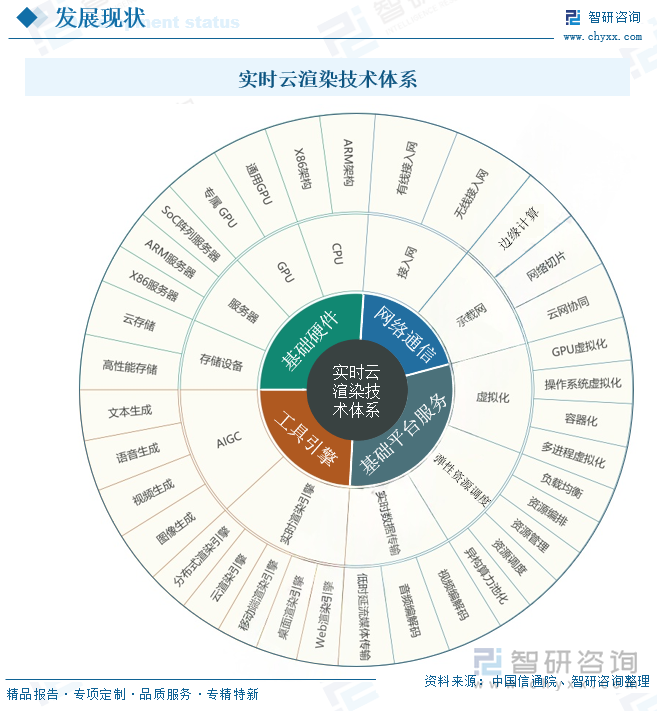
Core Insights - Real-time cloud rendering is an emerging rendering method based on rapid advancements in cloud computing, virtualization, and rendering engines, enabling high-quality video streaming of complex 2D or 3D graphics in real-time [1][2][7] - The global real-time cloud rendering market is projected to grow from $1.595 billion in 2020 to $4.03 billion by 2024, achieving a compound annual growth rate (CAGR) of 26% [7][9] - In China, the market is expected to reach 8 billion yuan in 2024, with a year-on-year growth of 45.5%, significantly outpacing the global market [9] Market Overview - Real-time cloud rendering enhances user experiences across various sectors, including entertainment, film, tourism, architecture, social interaction, and office applications, as well as cutting-edge fields like the metaverse and digital twins [1][9] - The service is categorized into three main applications: cloud gaming, cloud-native, and other scenarios, with cloud gaming being the primary application due to its established industry framework and large user base [11][13] Competitive Landscape - The real-time cloud rendering market consists of independent rendering cloud vendors and cloud computing providers, each offering different capabilities and solutions [13] - Independent vendors, like Ruiyun Technology, provide platforms compatible with multiple computing resources, while cloud computing firms, such as Alibaba Cloud, offer integrated "compute + render" platforms but with limited application support [13] Business Model - Various pricing models exist for cloud rendering services, including billing by duration, frame count, or node count, with many platforms adopting a dual-track pricing model based on configuration and time [15] Industry Trends - The real-time cloud rendering market is evolving towards large-scale, diversified, and specialized services, driven by the increasing complexity of application scenarios and the demand for high-quality rendering [19] - Enhanced infrastructure capabilities are necessary to meet the growing demands for computing power, storage speed, and network bandwidth [20] - The integration of artificial intelligence with real-time cloud rendering is improving rendering quality and system responsiveness, enhancing user interaction [21] - The industry ecosystem is expanding, attracting more participants and driving growth, although many applications are still in early development stages [22]