按摩仪

Search documents
贷款飚千倍,分红仍过亿:SKG上市为哪般?
Sou Hu Cai Jing· 2026-01-31 01:59
Core Viewpoint - The financial maneuvers of SKG, including a sudden dividend payout of nearly 200 million yuan and a dramatic increase in bank loans, raise questions about the company's long-term viability and intentions ahead of its IPO [2][4][7]. Financial Operations - In the first nine months of 2025, SKG declared dividends amounting to 199.4 million yuan, which is 1.87 times its net profit of 106 million yuan during the same period [2][4]. - The company's interest-bearing bank loans surged from 173,000 yuan at the end of 2022 to 180 million yuan by the end of the third quarter of 2025, marking an increase of over 1,000 times [2][4]. Shareholder Dynamics - SKG's founder Liu Jie and his wife control nearly 86% of the company, meaning approximately 171 million yuan from the recent dividend payout would flow into their accounts [7]. - This is not the first instance of significant dividend payouts during critical IPO phases, as the company previously distributed 155 million yuan and 160 million yuan in 2020 and 2021, respectively [7]. Market Position and Challenges - SKG's revenue growth has stagnated, with figures of 9.04 billion yuan, 10.46 billion yuan, 10.45 billion yuan, and 8.78 billion yuan from 2022 to the first three quarters of 2025, indicating a lack of momentum [15]. - The company's marketing expenditures have increased significantly, while R&D investment has decreased, raising concerns about its long-term innovation capabilities [16]. Competitive Landscape - The market is becoming increasingly competitive, with major players like Huawei and Xiaomi entering the smart health sector, posing a potential threat to SKG's market share [21]. - New brands are emerging with innovative marketing strategies, contrasting SKG's reliance on celebrity endorsements [21]. Future Outlook - SKG's third attempt at an IPO raises questions about whether it can overcome its current challenges and whether the listing will provide a sustainable solution or merely delay financial issues [20][24]. - The company's focus on marketing over product development may hinder its ability to adapt to changing market conditions and consumer expectations [24][28].


2025年肩颈按摩仪行业社媒趋势数据分析
数说Social Research· 2026-01-26 08:00
Investment Rating - The report does not explicitly provide an investment rating for the neck and shoulder massager industry. Core Insights - The neck and shoulder massager industry in China exhibited significant activity and dynamic changes on social media in 2025, with notable peaks in engagement driven by e-commerce promotional events and marketing strategies of leading brands [3][4][8]. - Key consumer considerations when purchasing neck and shoulder massagers include actual massage effectiveness, heat function, ease of use, and multifunctionality, alongside brand reputation and price sensitivity [4][21]. Summary by Sections Social Media Performance Overview - In 2025, the neck and shoulder massager industry showed notable fluctuations in social media volume and engagement, peaking in June due to e-commerce promotions, with May also seeing high volume driven by holiday marketing [3][7][10]. - The overall social media volume reached a peak of 30,477 posts in May, while engagement peaked at 1,171,738 interactions in June, indicating strong consumer demand and effective brand marketing [7][10]. Top Brands and Marketing Highlights - Leading brands in social media heat include SKG, Philips, and Breo, with SKG achieving a total engagement of 18,034,324, largely attributed to celebrity endorsement by Wang Yibo [4][11]. - Philips garnered 7,307,130 interactions through its "Little Goldfish" product, showcasing successful product IP creation and multi-platform marketing [4][11]. - Breo, with 1,882,667 interactions, utilized sports celebrity endorsements to enhance brand visibility [4][11]. Consumer Purchase Considerations - Consumers prioritize actual massage effects, particularly favoring physical kneading styles, heat functions, ease of use, and multifunctionality when selecting neck and shoulder massagers [4][21]. - Brand trust and price sensitivity are also critical factors, with consumers actively seeking value and avoiding products perceived as overpriced or ineffective [4][21]. Social Media Trends and Brand Strategies - The report identifies a clear "event-driven" and "node marketing" characteristic in social media performance, with peaks often linked to significant events or promotional periods [8][10]. - The influence of top celebrities in driving social media engagement is highlighted, with SKG and Breo leveraging endorsements effectively to boost brand visibility [9][16]. - Seasonal gifting occasions and health topics also significantly impacted social media discussions around neck and shoulder massagers [9][10]. Conclusion - The neck and shoulder massager industry demonstrated strong growth and high engagement on social media in 2025, with key drivers being e-commerce events and celebrity endorsements [23]. - The competitive landscape is marked by distinct strategies, with SKG leading through celebrity influence, Philips focusing on product IP, and Breo balancing celebrity marketing with channel development [23].

一个中专生卖网红按摩仪,分红带走2个亿
盐财经· 2026-01-05 10:23
Core Viewpoint - The article discusses the rise and challenges of SKG, a brand known for its massage devices, highlighting its marketing strategies, financial struggles, and the implications of its upcoming IPO [4][20][38]. Group 1: Marketing Strategies - SKG has effectively utilized celebrity endorsements, including high-profile figures like Mei Musk and Wang Yibo, to enhance brand visibility and appeal to younger consumers [4][8][17]. - The brand transitioned from a small appliance manufacturer to a leader in the smart wearable device sector, achieving a 21.5% market share in China by 2024 [4][5]. - SKG's marketing approach includes leveraging social media and popular entertainment platforms to create a lifestyle image around its products, moving away from traditional low-cost competition [9][16]. Group 2: Financial Performance - Despite strong sales growth initially, SKG's revenue growth has stagnated, with a mere 0.2% increase in smart wearable device revenue in recent quarters [20][21]. - The company's total revenue for the first three quarters of 2025 reached 878.19 million RMB, reflecting a 16.22% year-on-year growth, but the growth rate is slowing [20][21]. - SKG's financial practices have raised concerns, particularly regarding high dividend payouts that have significantly reduced available profits, leading to questions about the company's financial health [31][33]. Group 3: Industry Challenges - The massage device market has seen a decline, with the overall market size dropping from 555 billion RMB in 2021 to 452 billion RMB in 2023, indicating a compound annual growth rate of -9.76% [24]. - SKG faces intense competition from both established brands and low-cost alternatives, which has pressured its pricing and market position [38][40]. - The brand's reliance on marketing over product innovation has created vulnerabilities, as consumer demand may not sustain without continuous product development [20][22]. Group 4: IPO and Future Prospects - SKG is making its third attempt to go public, this time targeting the Hong Kong market, which may offer a more favorable environment for consumer brands compared to A-share markets [20][35]. - Concerns about the company's financial practices, including aggressive dividend distributions and insufficient R&D investment, could impact investor confidence and IPO valuation [31][34][37]. - The upcoming IPO is seen as a critical juncture for SKG, with potential implications for its operational sustainability and market strategy moving forward [35][37].

未来健康弃A转港:SKG按摩仪增长见顶、明星代言难掩研发乏力 创始人夫妇累计分红超5亿
Xin Lang Cai Jing· 2025-12-24 10:09
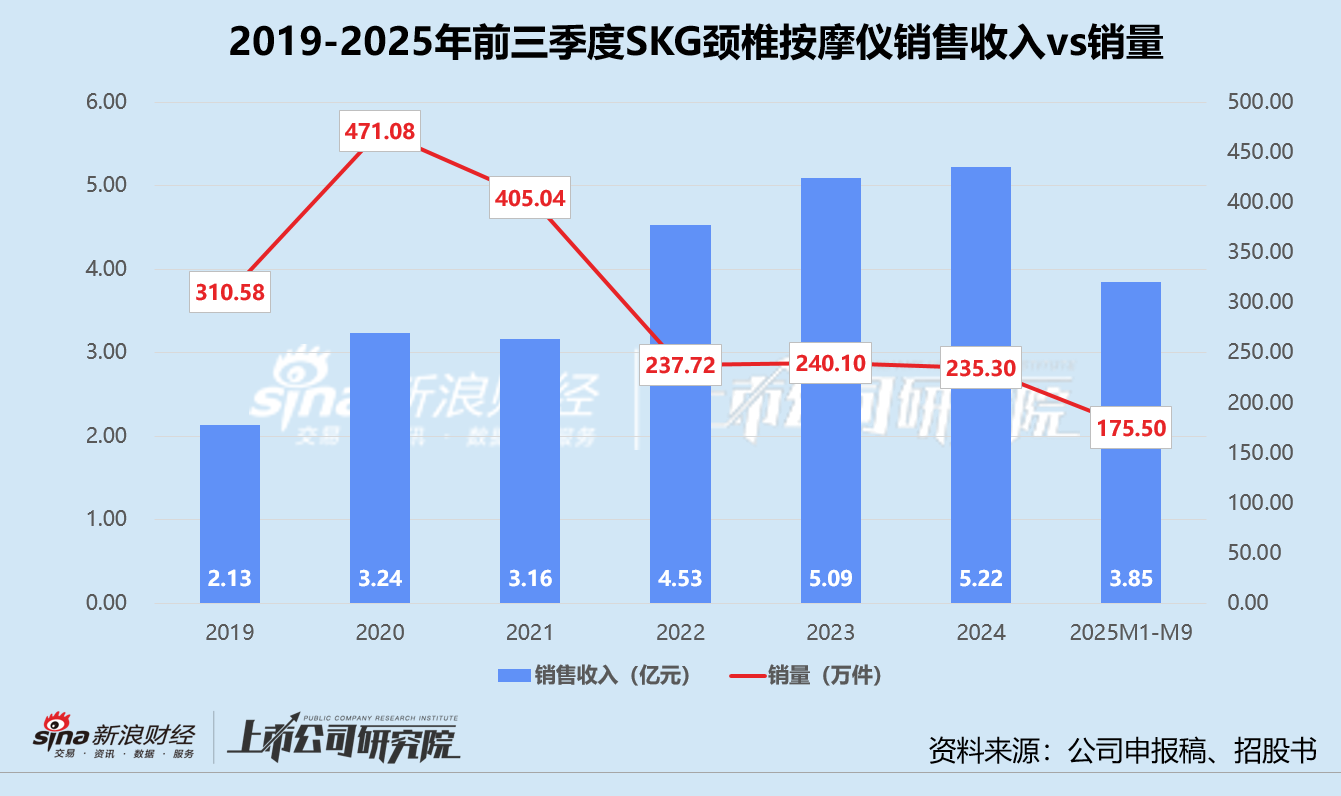
Core Viewpoint - Future Health, the parent company of the SKG massage device brand, has submitted an application for a mainboard listing on the Hong Kong Stock Exchange after a tumultuous IPO journey in China [1][15]. Financial Performance - Future Health reported total revenues of 9.05 billion yuan, 10.46 billion yuan, and 10.45 billion yuan for the years 2022, 2023, and 2024 respectively, with adjusted net profits of 1.37 billion yuan, 1.23 billion yuan, and 1.26 billion yuan, maintaining a gross margin around 50% [1][15]. - For the first three quarters of 2025, the company achieved approximately 8.78 billion yuan in total revenue, a year-on-year increase of 16.2%, and an adjusted net profit of about 1.18 billion yuan, a significant increase of 58.8% compared to the same period in 2024 [2][16]. Product Performance - The sales of the core product, the SKG neck massage device, have stagnated, with sales volume fluctuating and showing a slight increase of 3.2% in the first three quarters of 2025, but revenue from this product category decreased by 1.8% [3][20]. - Other products, such as the eye and waist massage devices, have not developed as expected, with sales declining by 16.8% and 0.8% respectively in the first nine months of 2025 [5][20]. Marketing and R&D - Future Health has heavily invested in marketing, with sales and marketing expenses rising from 1.64 billion yuan in 2022 to 1.98 billion yuan in 2025, while R&D expenses have decreased, leading to a lower R&D expense ratio from 9.1% to 6.6% [7][22]. - The company has relied on celebrity endorsements for marketing, with significant spending on endorsements, which accounted for about 10% of sales and marketing expenses in 2021-2022 [6][21]. Customer Concentration and Financial Health - Future Health's revenue is highly concentrated, with the top five customers contributing over 40% of total revenue, which poses risks to the company's financial stability [11][24]. - The company has been generous with cash dividends, distributing a total of 5.94 billion yuan from 2020 to 2023, while also increasing its bank borrowings by 176.8% to 1.80 billion yuan as of September 30, 2025, raising concerns about its financial management [12][28].
2025年品牌战略的实操要点有哪些?
Sou Hu Cai Jing· 2025-10-22 06:52
Core Insights - Brand strategy has evolved from a marketing function to a core element of corporate top-level design in the rapidly changing global business environment of 2025 [1] - The quality of brand strategy formulation and implementation directly influences a company's survival and growth potential in the era of rising consumer sovereignty [1] Group 1: Strategic Diagnosis and Monitoring - Establishing a multi-dimensional monitoring mechanism is essential for brand strategy formulation, allowing companies to track industry structure changes, competitive landscape shifts, technological trends, and consumer value orientation [3] - A brand strategy health dashboard should be constructed to monitor key indicators of brand assets in real-time, providing precise data support for strategic adjustments [3] - Brand strategies must possess foresight and adaptability to respond to the rapidly changing market environment [3] Group 2: Differentiation and Resource Allocation - Planning and selecting a differentiation path is a core aspect of brand strategy, requiring alignment between a company's core capabilities and market opportunities [3] - Companies should define their value propositions, identify target customer groups, and establish a complete brand architecture system to create differentiated advantages [3] - Optimizing strategic resource allocation and leveraging effects is crucial for the implementation of brand strategies, necessitating a focus on resource efficiency across R&D, production, channels, and communication [3] Group 3: Implementation and Performance Management - Planning the implementation path and execution control determines the ultimate effectiveness of brand strategies, requiring the breakdown of long-term strategies into phased goals [5] - A cross-departmental collaboration mechanism should be established, along with a scientific performance evaluation system to incorporate strategic execution outcomes into departmental assessments [5] - Successful brand strategies depend on rigorous execution control in the current era where execution capability is paramount [5] Group 4: Digital Transformation and Competitive Advantage - In the digital wave of 2025, the formulation and implementation of brand strategies have become a rigorous management science [7] - Companies that integrate systems thinking, data-driven approaches, and continuous innovation will build sustainable competitive advantages and gain proactive development in intense market competition [7]