支付收单

Search documents
市场竞争激烈、毛利率下滑,翠微股份2025年预亏4.5亿元-4.9亿元
Ju Chao Zi Xun· 2026-01-17 03:07
Core Viewpoint - Cuiwei Co., Ltd. announced a projected net loss for the year 2025, estimating a loss of between 490 million to 450 million yuan, which represents an improvement compared to the previous year's loss of 687 million yuan [1] Financial Performance - The company expects a net profit attributable to shareholders, excluding non-recurring gains and losses, to be between 530 million to 490 million yuan, a reduction in loss from 681 million yuan in the same period last year [1] Reasons for Performance - The primary reasons for the anticipated loss include: - The company's subsidiary, Beijing Haike Rongtong Payment Service Co., Ltd., faced losses due to intense competition in the acquiring industry and a decline in gross profit margins [1] - The retail business experienced a drop in sales revenue due to market environment impacts, leading to reduced overall gross profit and operational losses in retail. Additionally, the company adjusted the recognition amount of deferred tax assets based on the current market conditions, which affected the net profit for the period [1]

翠微股份:2025年全年预计净亏损4.90亿元—4.50亿元
2 1 Shi Ji Jing Ji Bao Dao· 2026-01-16 09:26
Core Viewpoint - The company expects a net profit attributable to shareholders for the year 2025 to be between -4.90 billion and -4.50 billion, indicating a reduction in losses compared to the previous year [1] Group 1: Financial Performance - The anticipated net profit loss represents an improvement of 1.97 billion to 2.37 billion compared to the same period last year [1] - The primary reason for the expected loss is the operational losses from the company's subsidiary, Beijing Haike Rontong Payment Service Co., Ltd., due to intense market competition and declining gross margins in the acquiring industry [1] Group 2: Retail Business Impact - The retail business has been adversely affected by the market environment, leading to a decline in sales revenue and a reduction in overall gross profit, which has resulted in operational losses for this segment [1] - In response to the current market conditions affecting the retail business, the company has adjusted the recognition amount of deferred tax assets, which has also impacted the net profit for the reporting period [1]
数字人民币及新大陆-新国都-拉卡拉更新
2025-12-29 15:51
Summary of Conference Call on Digital RMB and Related Companies Industry Overview - The conference call discusses the development and implications of Digital RMB, highlighting its transition from digital cash to digital deposit currency, which is expected to enhance user willingness to adopt it. By the end of November 2025, the cumulative transaction amount is projected to reach 17 trillion yuan, with 230 million wallets created, indicating strong governmental support for its promotion [1][2]. Key Points and Arguments 1. **Digital RMB Implementation**: A new management service system and financial infrastructure for Digital RMB will be officially implemented on January 1, 2026. This includes a significant change where wallet balances will earn interest like demand deposits, marking a shift to a digital deposit currency era [2][4]. 2. **Impact on Payment Service Providers**: Companies like Newland, Newland, Lakala, and Lianlian Technology are expected to benefit from the Digital RMB ecosystem, particularly in domestic acquiring and cross-border payment sectors. They will need to manage wallets, build payment platforms, and upgrade financial equipment [1][4][6]. 3. **Bank IT System Development**: IT system construction companies such as Sifang Jichuang, Xincheng Technology, Jingbeifang, Yuxin Technology, and Changliang Technology will participate in the necessary system upgrades for operational institutions, including clearing and settlement systems, leading to new order increments [1][4][6]. 4. **Stablecoins vs. Digital RMB**: While stablecoins and Digital RMB share technological similarities, they differ in policy environments. The Chinese government is focused on promoting Digital RMB to replace cash and enhance efficiency, while stablecoin development is still ongoing in regions like Hong Kong [1][4]. 5. **Long-term Investment Opportunities**: The Digital RMB sector presents high cost-effectiveness, with recommendations to focus on companies in bank IT systems, financial equipment, hardware wallets, and the acquiring and cross-border payment sectors, such as Sifang Jichuang, Guodian Yuntong, and Newland [3][9]. Additional Important Insights - **Cross-Border Payment Trends**: The acquiring industry is shifting towards cross-border payments and AI applications. Newland has launched cross-border payment services in Southeast Asia and is applying for licenses in the U.S. and Hong Kong, indicating significant growth potential [3][7]. - **Company Developments**: Newland is collaborating with Alibaba Cloud to develop a specialized model for the payment industry, while Newland has established a sub-brand, Pay Car, focusing on cross-border and overseas acquiring services. Lakala is expanding its cross-border payment business through acquisitions and has achieved substantial transaction volumes in regions like Singapore and Japan [7][8]. - **Future Demand for IT Systems**: The promotion of Digital RMB will create new business opportunities for bank IT system providers, as many financial institutions will need to upgrade their systems to accommodate the new digital currency [6][9]. This summary encapsulates the key insights from the conference call regarding the Digital RMB and its implications for various industries and companies involved in its ecosystem.






电子证件(Digital ID)的全球信任度全景:亚洲、中东与非洲领先,欧美市场滞后
Jin Tou Wang· 2025-08-21 07:41
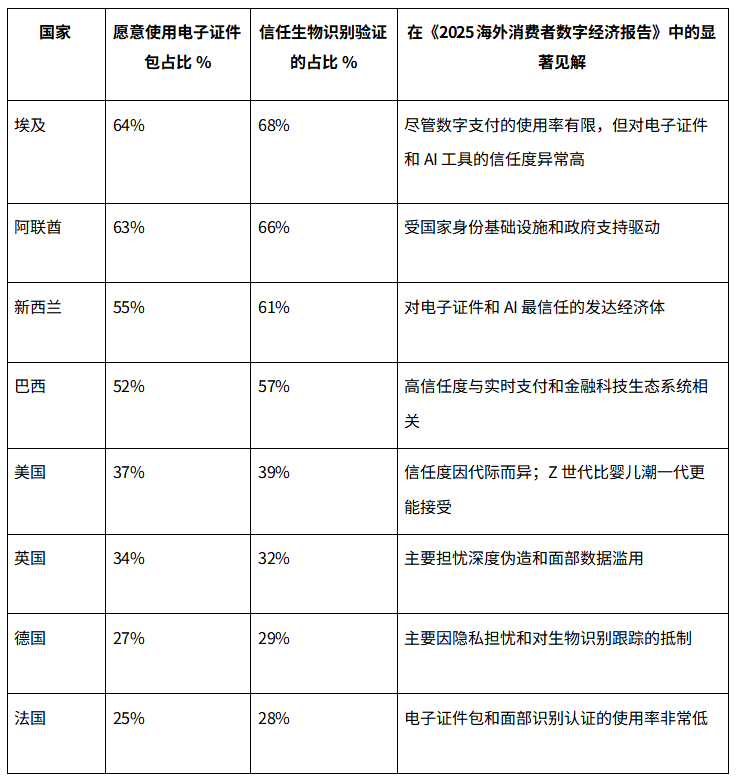
Core Insights - Checkout.com's global survey highlights significant regional differences in the acceptance of digital IDs, emphasizing the need for building trust [1][2] - Consumers in Asia, the Middle East, and Africa show high trust in digital IDs and biometric authentication, while Europe and North America exhibit lower acceptance [1][2] - The rise of AI-driven e-commerce agents underscores the importance of digital identity systems in maintaining transaction trust [1][2] Regional Analysis - In Egypt, 68% of consumers view digital IDs as a secure payment method, with 74% trusting AI-assisted transactions [2][3] - In the UAE, 63% of consumers are willing to use digital ID packages, driven by national identity infrastructure and government support [5] - New Zealand leads developed economies with 55% of consumers open to digital ID packages and 61% trusting biometric technology [3][5] - Brazil shows similar trends with 52% and 57% trust levels, attributed to a thriving fintech ecosystem and a tech-savvy population [3][5] - In contrast, only 32% of UK consumers trust digital IDs, with concerns over deepfakes and facial recognition being major barriers [3][5] - Trust levels in Germany and France remain below 30%, reflecting a cautious attitude towards centralized personal data storage [3][5] Generational Perspectives - 60% of Generation Z consumers believe digital IDs will soon become the primary method for online payments, indicating a more optimistic outlook compared to older generations [3][4]