
数字身份

Search documents
First Advantage (NasdaqGS:FA) Conference Transcript
2026-03-11 19:17
Summary of First Advantage Conference Call Company Overview - **Company**: First Advantage - **Industry**: Software and Data Services focusing on human capital risk management - **Core Business**: Transitioned from traditional background screening to a comprehensive risk management platform, including identity verification and ongoing employee monitoring [2][3] Key Financial Highlights - **Q4 Performance**: Achieved 12% consolidated growth, driven by a 17% increase in new logo and upsell/cross-sell activities [7][8] - **Customer Base**: Serves 80,000 customers across 200 territories, with 205 million screening events conducted last year [3] - **2026 Guidance**: Expected growth in new logo and upsell/cross-sell to reach 9%-10%, with a conservative base growth forecast of 0% to -2% [9][30] Market Dynamics - **Screening Market Evolution**: Shift from point-in-time screening to holistic risk management, emphasizing ongoing identity verification due to rising risks associated with AI and bad actors [11][12] - **Customer Priorities**: Risk management has become a top priority for enterprises, with 89% of surveyed customers planning to enhance their risk assessment capabilities [20] Strategic Initiatives - **Post-Acquisition Benefits**: The acquisition of Sterling has led to increased scale, diversification across verticals, and improved cash flow and EBITDA margins [15][18] - **Verticalized Go-to-Market Strategy**: Dedicated sales teams for different verticals (healthcare, retail, financial services) have improved win rates and customer engagement [27][28] Technology and Innovation - **AI Integration**: First Advantage utilizes AI to enhance operational efficiency and compliance, leveraging over 1 billion proprietary records for decision-making [47][48] - **Digital Identity Solutions**: The company is addressing the growing demand for persistent identity verification, particularly in gig economy roles [41][45] Financial Management and Capital Allocation - **Debt Management**: Successfully paid down over $95 million of acquisition financing, with ongoing efforts to balance debt reduction and share repurchases [53][54] - **Margin Expansion**: Expected EBITDA margin improvement driven by operational efficiencies and synergy realization, with a target of $65-$80 million in synergies [33][38] Future Outlook - **Growth Opportunities**: Anticipated growth from emerging markets and maturing industries, with a focus on addressing complex risk environments [63][64] - **Key Success Metrics for 2026**: Continued go-to-market success, effective synergy execution, and strong cash flow generation are critical for a successful year [67][71] Additional Insights - **Customer Retention**: Retention rates remain high at 96%-97%, reflecting strong customer satisfaction and integration success post-acquisition [70] - **Risk Landscape**: The increasing complexity of risks in the corporate environment necessitates ongoing innovation and adaptation in service offerings [60][61] This summary encapsulates the key points discussed during the First Advantage conference call, highlighting the company's strategic direction, financial performance, and market positioning.

OpenClaw 带火了给 Agent 的专用邮箱,刚拿了 600 万美金打造 AI 时代数字身份
投资实习所· 2026-03-11 04:28
Group 1 - The current wave of AI is evolving from simple chatbots to autonomous "digital employees," with OpenClaw accelerating this trend. Sequoia Capital predicts that by 2026, the world will fully enter the era of autonomous driving, creating a significant opportunity for "service as software" [1] - AgentMail has emerged to address the lack of a universal identity and communication channel for AI agents, recently completing a $6 million seed round led by General Catalyst. It provides a dedicated email service for AI agents, akin to Gmail for humans [2][3] - Email is not just a communication tool but serves as the foundational identity layer of the internet, as highlighted by AgentMail's founder [3] Group 2 - AgentMail has implemented a robust security and anti-abuse mechanism to prevent spam and security issues associated with AI sending emails. Since its launch, AgentMail has seen rapid growth, especially after the rise of OpenClaw, with hundreds of thousands of "agent users" and over 500 B2B clients [4] - Key features of AgentMail include full API interaction for email management, autonomous account creation through an Onboarding API, and a two-way communication bridge allowing AI to send and receive emails like real users. This enables AI agents to register and use existing internet tools without traditional limitations [5] - The platform offers flexible free and paid plans optimized for AI scenarios, standardizes identity through email, and includes monitoring features to detect unusual activity and filter sensitive content [5] Group 3 - The founder of AgentMail noted that autonomous agents have begun to self-register for the service, indicating a shift where the next billion internet users will be AI agents. AgentMail is not just an email service but aims to define identity standards in the AI era [8] - The increasing prevalence of agents in the workforce presents a significant opportunity to build infrastructure for them, as evidenced by the rapid growth of AI-focused databases and the insights from Sequoia Capital regarding the software landscape [9]


爱施德(002416.SZ):目前未涉及基于区块链技术的供应链可信溯源服务,亦未开展数字身份相关业务布局
Ge Long Hui· 2026-02-12 08:52
Core Viewpoint - Aishide (002416.SZ) focuses on providing value-added services in the 3C digital protection service sector, including mobile screen protection and extended warranty services, and has not ventured into blockchain-based supply chain traceability or digital identity-related business layouts [1] Group 1 - The company operates under the brand Aibo Technology, which specializes in 3C digital protection services [1] - Current offerings include mobile screen protection and extended warranty services for consumers [1] - The company has not engaged in blockchain technology for supply chain traceability services [1]

IOTA 联创:战略重心转向全球贸易基础设施
Xin Lang Cai Jing· 2026-01-23 05:30
Core Insights - IOTA's strategic focus has shifted from speculative cryptocurrency to building infrastructure for the $35 trillion global trade market [1] Group 1: Strategic Shift - IOTA aims to address inefficiencies in traditional trade by vertically integrating digital identity, real-world assets (RWA), and trade finance [1] Group 2: Implementation and Partnerships - The IOTA-based TWIN network has been implemented in Kenya and the UK, and is collaborating with the World Economic Forum to advance the African digital trade initiative ADAPT [1] Group 3: Technological Upgrades - With the Rebased upgrade, IOTA has introduced a token deflation mechanism and is focused on the tokenization of commodities and trade receivables [1]
当算法成为裁判:创业者如何管理数字身份?
3 6 Ke· 2025-11-27 08:09
Core Insights - The article emphasizes the importance of digital identity for entrepreneurs, highlighting how it has become a critical factor in investment decisions and reputation management in the digital age [1][5][12]. Digital Identity - Digital identity is defined as the sum of an individual's self-presentation and data traces in the online space, which evolves dynamically based on entrepreneurial stages, institutional contexts, and algorithmic feedback [2][4]. - The comparison between digital identity and traditional identity management reveals that digital identity involves continuous negotiation and adaptation, while traditional identity is static and role-confirming [3]. Types of Digital Footprints - Digital footprints are categorized into active and passive footprints. Active footprints are consciously created by entrepreneurs, while passive footprints are generated through interactions with digital infrastructure and are less controllable [4][6]. Challenges in Digital Identity Management - The article discusses the misalignment of external ratings, where digital scores generated from data can sometimes predict outcomes better than human evaluations [7][8]. - Time pressure is highlighted as a challenge, where algorithms can amplify negative perceptions based on isolated incidents, leading to permanent digital footprints that are difficult to erase [9][10]. Conflicts in Identity - Conflicts arise between digital identity and offline identity, as discrepancies between online presentations and real-life behaviors can lead to credibility issues for entrepreneurs [10][11]. - The article also notes the tension between active and passive footprints, where curated online personas may clash with unfiltered data revealing underlying issues [11]. 3R Digital Identity Management Framework - The 3R framework (Recognition-Response-Reinforcement) is proposed as a guide for entrepreneurs to manage their digital identities proactively, focusing on continuous improvement rather than reactive crisis management [12][23]. - The framework emphasizes the importance of identifying potential crises early through sentiment analysis and timely responses to maintain a positive digital identity [13][15]. Strategies for Identity Management - The article outlines various strategies for reinforcing a positive digital identity, including emotional engagement, narrative consistency, and strategic content dissemination across platforms [16][20]. - It also discusses the importance of transparency and ethical considerations in managing digital identities, urging entrepreneurs to maintain integrity in their narratives [24][25].


Blockchain Technology Explained
Medium· 2025-10-26 21:28
Core Concept - Blockchain technology is a distributed digital ledger that provides an unchangeable, transparent, and decentralized record of transactions, enabling systems that do not require trust in a central authority [1] Group 1: The Problem Blockchain Solves - The double-spend problem in digital currencies arises from the ability to create infinite copies of digital assets, necessitating a central intermediary like banks to prevent fraud [4][5] - Satoshi Nakamoto's creation of Bitcoin introduced blockchain as a solution to the double-spend problem, allowing a network of disconnected individuals to agree on a shared transaction history [6] Group 2: How Blockchain Works - Transactions are recorded in blocks, which are linked together to form a chain, with each block containing transaction data, a timestamp, and a reference to the previous block [7] - Cryptographic hashing ensures data integrity, as even minor changes to input data result in a completely different hash, making tampering evident [8][9] - The immutability of blockchain is achieved through cryptographic links between blocks, making it nearly impossible to alter past transactions without detection [10][11] Group 3: Consensus Mechanisms - Consensus mechanisms are rules that participants follow to validate transactions and add new blocks to the blockchain [12][13] Group 4: Core Properties of Blockchain - Key properties include decentralization, immutability, transparency, and security, which distinguish blockchain from traditional databases [14][17] - Public blockchains are open and permissionless, while private blockchains are controlled by a single organization, and consortium blockchains are managed by a pre-selected group [15][16] Group 5: Applications Beyond Cryptocurrency - Smart contracts, introduced by Ethereum, enable self-executing agreements that are transparent and immutable, unlocking various applications such as decentralized finance, supply chain management, and digital identity [16][19] Group 6: Challenges Facing Blockchain Technology - The blockchain trilemma highlights the difficulty of achieving decentralization, security, and scalability simultaneously [18] - User experience remains a barrier for mainstream adoption, and energy consumption of Proof of Work models raises environmental concerns [18]

Poste Italiane considers digital identity fee, analysts see potential 100 mln euro profit boost
Reuters· 2025-09-26 12:32
Core Viewpoint - Poste Italiane is contemplating the introduction of an annual management fee for users of its digital identity service, as indicated by analysts following a company briefing [1] Group 1 - The potential annual management fee is part of Poste Italiane's strategy to enhance its digital services [1] - Analysts have highlighted this consideration in their daily reports, suggesting it may impact user engagement and revenue [1]


Avery Dennison (AVY) 2025 Conference Transcript
2025-09-03 21:52
Summary of Avery Dennison (AVY) 2025 Conference Call Company Overview - Avery Dennison is an $8.8 billion business focused on material science and digital identification [5][6] - The business is divided into two main segments: Materials (70% of portfolio) and Solutions (30% of portfolio) [6][8] - Approximately 60% of the business is anchored in Consumer Staples, which is less cyclical [6] Core Business Insights - The company aims for GDP plus growth and top quartile returns, focusing on value creation through cycles [8] - High value categories are identified as key growth catalysts, typically growing at GDP plus 2-2.5x with strong margins [7][13] - Significant exposure to emerging markets is expected to drive growth beyond Western or North American GDP [7] Growth Strategy - Anticipated growth of 4.5% to 5% in the next cycle, with contributions from base businesses, Intelligent Labels, and other high value categories [14] - The company maintains a strong balance sheet with a leverage ratio in the low 2s, allowing for strategic acquisitions and share buybacks [15][16] Recent Acquisition - Avery Dennison announced a small acquisition in the Adhesives space, specifically a flooring adhesives business, which has been growing at mid-single digits with high margins [17][22] - The acquisition is expected to leverage existing adhesive manufacturing capabilities and generate synergies [23][30] Apparel Market Challenges - The apparel market has faced challenges due to tariff uncertainties, leading to a decline in volumes [35][36] - The company is focusing on optimizing its Intelligent Labels business to adapt to these market conditions [38][39] Intelligent Labels Business - More than 60% of the Intelligent Labels business is anchored in apparel, which has been affected by market conditions [38] - The company is exploring growth opportunities in Food and Logistics segments, which have significant potential for adoption [41][42] Innovation and Competitive Advantage - Avery Dennison emphasizes innovation as a key driver for maintaining market leadership, with ongoing developments in RFID technology and digital identity solutions [53][55] - The company has developed a cloud platform, Atma.io, to manage digital identities and track supply chain events, enhancing its competitive edge [74][75] Other High Value Categories - Vescom and Imbellix are highlighted as strong performers, with growth potential in the retail and performance sports sectors [61][64] - The company is also optimistic about its specialty and durable label business, which is expected to grow mid-single digits [69] Pricing Power and Market Adaptation - Avery Dennison has successfully implemented pricing surcharges to manage inflationary pressures and tariff impacts [57][58] - The company leverages its global scale to adapt sourcing routes and manage costs effectively [58][60] Conclusion - Avery Dennison is well-positioned to navigate current market challenges through strategic acquisitions, innovation, and a focus on high value categories, while maintaining a disciplined approach to capital allocation and pricing strategies [16][17][57]

电子证件(Digital ID)的全球信任度全景:亚洲、中东与非洲领先,欧美市场滞后
Jin Tou Wang· 2025-08-21 07:41
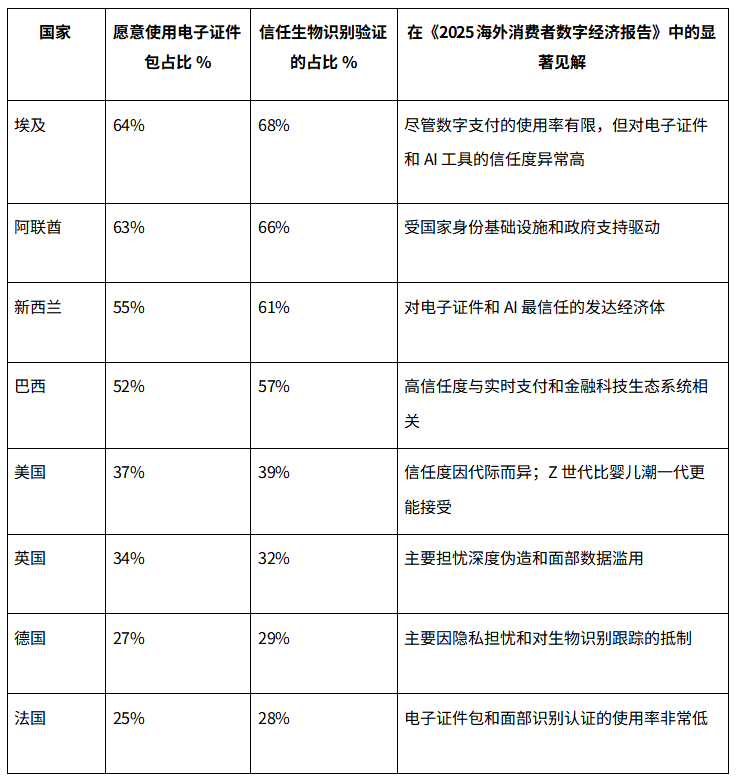
Core Insights - Checkout.com's global survey highlights significant regional differences in the acceptance of digital IDs, emphasizing the need for building trust [1][2] - Consumers in Asia, the Middle East, and Africa show high trust in digital IDs and biometric authentication, while Europe and North America exhibit lower acceptance [1][2] - The rise of AI-driven e-commerce agents underscores the importance of digital identity systems in maintaining transaction trust [1][2] Regional Analysis - In Egypt, 68% of consumers view digital IDs as a secure payment method, with 74% trusting AI-assisted transactions [2][3] - In the UAE, 63% of consumers are willing to use digital ID packages, driven by national identity infrastructure and government support [5] - New Zealand leads developed economies with 55% of consumers open to digital ID packages and 61% trusting biometric technology [3][5] - Brazil shows similar trends with 52% and 57% trust levels, attributed to a thriving fintech ecosystem and a tech-savvy population [3][5] - In contrast, only 32% of UK consumers trust digital IDs, with concerns over deepfakes and facial recognition being major barriers [3][5] - Trust levels in Germany and France remain below 30%, reflecting a cautious attitude towards centralized personal data storage [3][5] Generational Perspectives - 60% of Generation Z consumers believe digital IDs will soon become the primary method for online payments, indicating a more optimistic outlook compared to older generations [3][4]
如果AI开始用钱:加密货币能接住吗?
Hu Xiu· 2025-08-19 02:01
Core Viewpoint - The article discusses the potential integration of AI in financial transactions, particularly focusing on the challenges and opportunities presented by traditional payment systems and the suitability of cryptocurrency for AI-driven payments [1][3]. Group 1: Challenges of Traditional Payment Systems - Traditional payment systems are not designed to accommodate AI, leading to issues such as compliance, security, and transaction speed [2][4]. - The current payment industry standards, such as PCI DSS, impose strict requirements on the handling of cardholder data, making it difficult for AI to interact with traditional payment methods [5][6]. - The experience and risk management in traditional payments are structured to counteract automated systems, which does not align with the needs of AI-driven transactions [6]. Group 2: Advantages of Cryptocurrency for AI Payments - Cryptocurrency can facilitate immediate payment and delivery (DvP), aligning well with the operational model of AI services, where payment is made for specific outputs [7]. - The concept of tokenization in cryptocurrency allows for a direct correlation between AI tokens and crypto tokens, enabling precise billing and microtransactions that are challenging to implement in fiat systems [7][8]. - The separation of transaction construction and signing can enhance security, allowing AI to identify payment scenarios without compromising sensitive data [10][11]. Group 3: Future Payment Relationships - Payment relationships can be categorized into three types: human-to-machine, machine-to-human, and machine-to-machine, with the latter being more naturally suited to a digital economy [8][9]. - Scenarios such as automated payments for services or rewards between AI agents illustrate the potential for a decentralized payment ecosystem [9]. - The integration of AI and cryptocurrency could lead to a more efficient and secure payment infrastructure, reducing reliance on centralized systems [13]. Group 4: Legal and Identity Considerations - For AI agents to operate independently in financial transactions, they must utilize cryptocurrency, which grants them a form of digital identity and civil capacity [14][15]. - The legal framework of "code is law" can establish binding agreements through smart contracts, ensuring that AI actions are recognized as legitimate transactions [15][16]. Group 5: Technical and Compliance Challenges - The article emphasizes the need for robust technical and compliance frameworks to ensure that AI's payment capabilities are reliable and accountable [17]. - The integration of signature and rule layers is crucial to mitigate the uncertainties associated with AI reasoning in critical financial operations [17].