
新兴服务

Search documents
中欧基金王培:展望2026,周行不殆,科技迭新
Zheng Quan Shi Bao Wang· 2025-12-11 09:05
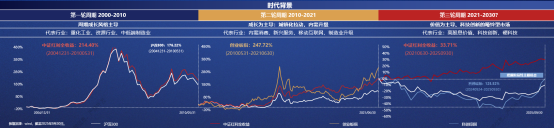
Core Viewpoint - The current market is transitioning from high growth to moderate growth, with a trend of convergence between technology and value sectors in the new cycle [1] Group 1: Market Cycle Analysis - Understanding cyclical changes is essential for future market judgments, with significant shifts observed over the past two decades [2] - The first phase (2000-2010) was dominated by cyclical growth, benefiting heavy industries, resource sectors, and low-end manufacturing [3] - The second phase (2010-2021) saw a shift towards growth, driven by urbanization and the rise of consumer demand and emerging services, with the ChiNext index experiencing rapid growth [3] - Since 2021, the market has gradually shifted back to moderate growth, with value styles regaining dominance, as evidenced by the performance of the STAR Market index compared to the CSI Dividend Index [3] - Long-term migration of industry weights indicates structural upgrades, with technology, consumer healthcare, and cyclical finance gaining share in the CSI 300 over the past 16 years [3] Group 2: Future Outlook for 2026 - The outlook for 2026 is summarized by three keywords: technology leading, value following, and returning to leaders, based on long-term industry structural evolution [4] - The current AI narrative, represented by the STAR Market, mirrors the technology cycle from 2011 to 2015, but with different supporting backgrounds such as demographic changes and geopolitical factors [4] - Key signals for market improvement include PPI and inventory conditions, with expectations for corporate performance to improve in mid-2024 following a low PPI point [4][5] Group 3: Investment Directions - The market is witnessing a recovery in value sectors, which may present structural opportunities in 2026, especially after a year of significant underperformance compared to growth sectors [6] - Investment focus will include cyclical industries (oil, coal, basic metals), non-banking sectors (insurance, brokerage), high ROE industries (internet, traditional consumption), and new cycle industries (new energy, power equipment) [6] - Continuous themes may emerge in CXO, innovative pharmaceuticals, AI applications, and humanoid robotics, although market volatility is expected to increase [6] Group 4: Research and Investment Strategy - The exponential growth of fund numbers, asset management scale, and listed companies has increased information density, posing challenges for research and investment [7] - The company is developing a systematic investment approach through professional division of labor and industrialized production lines to meet client needs [7] - AI is anticipated to become a core capability in active management, fundamentally reshaping the research and investment chain over the next three years [7]

轻工15项职业(工种)标准列入国家开发计划
Xiao Fei Ri Bao Wang· 2025-07-18 02:08
Core Points - The China Employment Training Technical Guidance Center has issued a notice regarding the "National Occupational Standards Development Plan," which includes 12 occupational standards led by the China Light Industry Federation and 3 standards in which it participated [1] - The China Light Industry Federation has undertaken 76 national standard revision tasks and has independently developed 30 occupational ability evaluation standards based on the needs of the light industry talent pool [1] - The approved occupational standards cover various fields, including traditional craftsmanship, modern manufacturing, cultural creativity, and emerging services, marking a significant step towards integrating skill evaluation systems with digital technology and service industry trends [1] Group 1 - The 12 occupational standards include roles such as luxury watch appraiser, leather product processor, and service dog trainer, among others [1] - The 3 participating occupational standards include roles such as life service experience staff and artificial intelligence digital human trainer [1] - The standards aim to fill gaps in industry standardization and enhance the skill evaluation system in the light industry [1] Group 2 - The China Light Industry Federation will strictly follow the guidelines from the Ministry of Human Resources and Social Security and the China Employment Training Technical Guidance Center to implement the 2023 version of the National Occupational Standards Compilation Technical Regulations [2] - The focus will be on key occupational ability indicators in areas such as traditional craft inheritance and innovation, artificial intelligence, and digital cultural product development [2] - The goal is to accurately grasp industry development trends and social needs, ensuring high-quality completion of standard development tasks to support the high-quality development of the light industry [2]