
材料研究

Search documents
用人单位邀请函||2026“奔甬而来”中国科学院宁波材料技术与工程研究所春季硕博专场招聘会
DT新材料· 2026-02-11 16:04
Core Viewpoint - The article discusses the upcoming recruitment event organized by the Ningbo Institute of Materials Technology and Engineering, aiming to connect graduates with potential employers and promote high-quality employment opportunities for its students [6]. Group 1: Recruitment Event Details - The recruitment event is scheduled for March 13, 2026, from 14:00 to 16:30 at the Ningbo Institute of Materials Engineering [7]. - Approximately 60 professional organizations are expected to participate, including institutions like Ningbo University and the University of Nottingham Ningbo China [7]. - The event will feature 789 graduates, comprising 666 master's students and 123 doctoral students, from various programs including those jointly cultivated with other universities [6]. Group 2: Organizing Units - The event is hosted by the Ningbo Institute of Materials Technology and Engineering, in collaboration with several local human resources and social security departments [8]. - The organizing committee includes the Ningbo Talent Development Group and various local talent service centers [8]. Group 3: Participation Guidelines - Companies interested in participating must register by March 6, 2026, through the Ningbo Talent Network [9]. - Each participating company is allowed one booth with a maximum of two representatives [9]. - The overall promotional costs for the event will be covered by Ningbo Oriental Human Resources Service Co., Ltd. [9].


不需要火箭就可直达,太空电梯离我们还有多远?
Ren Min Ri Bao· 2026-01-24 03:47
Core Insights - The concept of a space elevator, which allows direct access to space without rockets, has been a topic of interest since 1895, but remains largely theoretical due to material challenges [1] Group 1: Material Development - The key to building a space elevator lies in finding a sufficiently strong cable material, with carbon nanotubes emerging as a promising candidate due to their exceptional tensile strength and low density [1] - Carbon nanotubes can theoretically exceed a tensile strength of 100 GPa, which is hundreds of times stronger than the best steel, and have a Young's modulus of 1 TPa [1] - Research teams, particularly from Tsinghua University, have made significant strides in the controlled preparation of carbon nanotubes, achieving lengths over half a meter and developing methods to create super-strong fibers from them [2] Group 2: Research Progress - In 2018, a team published findings on centimeter-long bundles of carbon nanotubes with tensile strengths exceeding 80 GPa, indicating progress towards practical applications [2] - A 2020 study demonstrated that carbon nanotubes can withstand over a hundred million cycles of stretching without breaking, maintaining their high strength after load removal [2] Group 3: Remaining Challenges - Despite advancements, the production of carbon nanotubes at the scale required for a space elevator remains a significant challenge, as the needed cable length is in the thousands of kilometers [3] - The space environment poses additional challenges, including exposure to atmospheric conditions and cosmic radiation, which the cable must withstand [3] - Beyond the cable, the construction of the elevator's base and the power systems for the elevator car present complex engineering challenges that require interdisciplinary collaboration [4]
国际材联总部落户北京
Ren Min Wang· 2026-01-08 01:17
Core Viewpoint - The establishment of the International Union of Materials Research Societies (IUMRS) headquarters in Beijing marks a significant enhancement of China's influence in the global materials science governance system, contributing to the construction of a community with a shared future for mankind through technological support [1][2]. Group 1 - The IUMRS headquarters will officially operate from January 1, 2026, with the Chinese Materials Research Society (C-MRS) responsible for its management [1]. - This is the first time China has hosted a headquarters of this level for an international scientific organization, indicating a notable increase in China's global scientific authority [1]. - The president of C-MRS emphasized the critical role of materials in the ongoing technological revolution and the need for international collaboration to address major global challenges [1]. Group 2 - Founded in 1991 in Chicago, the IUMRS includes member societies from over 100 countries across five continents, making it a key player in the international academic organization system [2]. - The IUMRS has been instrumental in promoting cooperation and communication among materials scientists worldwide, serving as a backbone in the development of global materials science [2]. - The organization has gathered top experts and outstanding young scientists, enhancing its influence and role in the advancement of materials science [2].
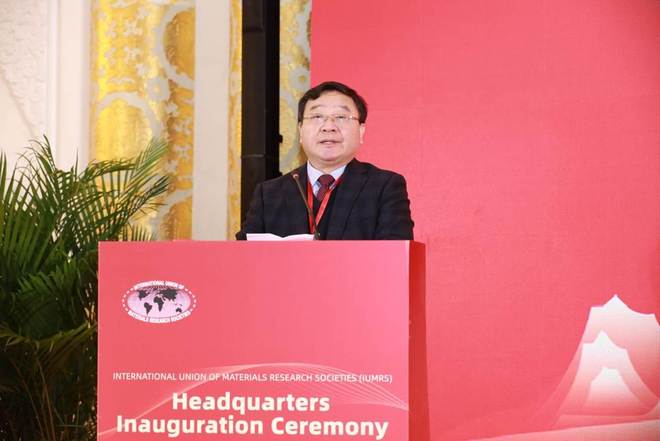
国际材联(IUMRS)总部启动仪式在京举行
Huan Qiu Wang Zi Xun· 2025-12-19 09:00
Core Points - The International Union of Materials Research Societies (IUMRS) headquarters officially launched in Beijing, marking a significant milestone for global materials science governance [1][2][3] - The headquarters will be operated by the Chinese Materials Research Society (C-MRS) and will commence operations on January 1, 2026, enhancing China's influence in the global materials science community [2][3] Group 1 - The launch ceremony was attended by over 40 guests, including international representatives and leaders from the materials science community, highlighting the global significance of the event [1] - The process of relocating the IUMRS headquarters to Beijing involved multiple steps, including a formal application by C-MRS in October 2024 and unanimous approval from the IUMRS Executive Committee in September 2025 [3] - The relocation signifies a key step for C-MRS in taking on major responsibilities in international materials development [3] Group 2 - The president of C-MRS emphasized the critical role of materials in the ongoing technological revolution and the need for IUMRS to lead global efforts in addressing major material-related challenges [5] - C-MRS is the largest materials society globally, with over 210,000 members, and aims to unite global materials scientists to promote societal progress and development [5] - The IUMRS headquarters in Beijing will serve as a collaborative platform for scientists worldwide, facilitating scientific exchange and cooperation [9] Group 3 - The IUMRS was established in 1991 in Chicago and now includes member societies from over 100 countries, playing a vital role in international academic collaboration [9] - The headquarters' financial and operational plans were presented during the ceremony, indicating a structured approach to its future activities [9] - The event included a registration announcement for the IUMRS headquarters in accordance with Chinese law, further solidifying its operational status in Beijing [7]
中国科学院成立新所
仪器信息网· 2025-12-12 09:03
Core Viewpoint - The establishment of the Dongguan Institute of Materials Science and Technology by the Chinese Academy of Sciences aims to create a globally influential research center focused on strategic and frontier materials exploration and fundamental scientific issues [2]. Group 1 - The Dongguan Institute is a collaborative research institution built by the Chinese Academy of Sciences, Guangdong Province, and Dongguan City [2]. - The institute will focus on research in various fields, including information materials, energy materials, functional ceramics, and metal materials [2]. - The goal is to enhance the global influence and leadership in new materials research [2].

布局新材料!中国科学院成立新研究所
DT新材料· 2025-12-11 16:04
Core Viewpoint - The establishment of the Dongguan Materials Institute is a significant strategic move to accelerate the advancement of new materials technology and support the Guangdong-Hong Kong-Macao Greater Bay Area in becoming a globally influential international science and technology innovation center [1][2]. Group 1: Institute Overview - The Dongguan Materials Institute is a collaborative research institution established by the Chinese Academy of Sciences, Guangdong Province, and Dongguan City, focusing on strategic and frontier material exploration and basic scientific research [2][3]. - The institute is located in the Songshan Lake Science City, covering an area of 263 acres, and is led by Academician Wang Weihua [3]. Group 2: Research Focus and Goals - The institute aims to address cutting-edge scientific issues and key application challenges in the new materials field, with a mission to cultivate new productive forces and promote innovative development in material science and technology [3][4]. - It will focus on basic common technology research and application technology development for strategic core materials urgently needed by the country, facilitating the integration of the innovation chain and industrial chain [3]. Group 3: Talent and Technology Development - The Dongguan Materials Institute plans to strengthen the aggregation of high-level talent and high-energy platform facilities in the materials field, aiming to produce a series of critical core technologies [4]. - The institute aspires to become a leading research institution in China's new materials sector, serving as a source of original innovation and a hub for national innovation talent [4].
1亿元!中国科学院金属所近期55项仪器采购意向
仪器信息网· 2025-11-18 03:55
Core Insights - The Chinese Academy of Sciences' Institute of Metal Research has announced procurement intentions for 55 items of laboratory equipment, with a total budget of 100 million yuan, expected to be purchased between September and November 2025 [2][3]. Procurement Overview - The procurement includes high-temperature thermal vibration fatigue testing systems, multifunctional fully automatic mechanical testing systems, fully automatic super-depth optical microscope detection systems, research-type inverted metallographic microscopes, and ultra-high cooling rate vacuum quenching furnaces [3][4][5][6]. - The total budget for these procurement intentions is 100 million yuan [2][3]. Equipment Details - **Research-type Inverted Metallographic Microscope**: This instrument is crucial for analyzing the microstructure of metals and alloys, allowing researchers to observe grain structures, phase distributions, and defects, which are essential for understanding material properties [4]. - **High Cooling Rate Vacuum Quenching Furnace**: This specialized equipment is used for heating and rapidly cooling metal workpieces in a vacuum environment, widely applied in high-end manufacturing [5]. - **High Temperature Thermal Vibration Fatigue Testing System**: This system evaluates material performance degradation under high temperature and cyclic loading, applicable in aerospace, energy, and petrochemical industries [6]. Specific Equipment Procurement - The procurement list includes various advanced instruments such as: - Carbon Nanotube/Metal Composite Material Preparation System: 12.4 million yuan [8] - Multifunctional Fully Automatic Mechanical Testing System: 11.1 million yuan [8] - Fully Automatic Super-depth Optical Microscope Detection System: 8.7 million yuan [8] - Research-type Inverted Metallographic Microscope: 5.2 million yuan [8] - Ultra-high Cooling Rate Vacuum Quenching Furnace: 35.3 million yuan [8] - Additional equipment includes high-precision cylindrical measuring instruments, high-performance coordinate measuring machines, and various testing systems for advanced materials [9][10][11]. Institutional Background - The Institute of Metal Research was established in 1953 and has since integrated with other research institutes to enhance its capabilities in materials science, focusing on advanced structural materials and new functional materials [12]. - The institute has multiple national engineering technology centers and key laboratories, employing over 1,800 staff, including five academicians [12].

新方法利用食用真菌生成防渗膜
Ke Ji Ri Bao· 2025-10-22 23:40
Core Insights - Researchers from the University of Maine and the University of Cincinnati have developed a new method for creating a waterproof barrier using edible fungi, which shows potential as an alternative to plastic coatings [1] Group 1: Research and Development - The new waterproof membrane is formed by combining fungi with wood fibers, creating a protective layer that effectively blocks water, oil, and grease [1] - The materials used for the membrane include fluffy wood fibers primarily composed of cellulose nanofibers, which naturally possess hydrophobic properties [1] - The process involves growing the edible turkey tail mushroom with fibers to create a protective coating on various surfaces, including denim, polyester felt, birch veneer, and paper [1] Group 2: Performance and Characteristics - The research indicates that the fungi must grow for at least three days to form an effective waterproof barrier, with the new membrane not significantly increasing the thickness of the materials but altering their color to yellow, orange, or brown mottled patterns [1] - Treated fabrics and papers exhibit water droplets that bead and roll off, while untreated materials absorb water quickly [2] - The fungal coating is also effective in blocking the penetration of various liquids, including n-heptane, toluene, and castor oil [2]
国际材料研究学会联合会总部将迁至中国
Zhong Guo Xin Wen Wang· 2025-10-18 00:14
Core Points - The International Union of Materials Research Societies (IUMRS) will officially relocate its headquarters to China starting January 2026 [1] - The IUMRS was established in 1991 and consists of various national and regional materials research societies, aiming to promote global communication and collaboration in the field of materials science and engineering [1] - As a formal member of the International Science Council (ISC), IUMRS is dedicated to advancing interdisciplinary research and sustainable development in materials science, as well as fostering international cooperation and educational exchange [1]
党建聚合力 创新加速度(党旗在基层一线高高飘扬)
Ren Min Ri Bao· 2025-08-18 22:31
Group 1 - The core viewpoint emphasizes the importance of the Dongguan Songshan Lake Materials Laboratory in advancing scientific research and technology transfer, particularly in the field of advanced materials [1][2] - The laboratory has published over 50 research papers and applied for 8 patents, showcasing its commitment to innovation and research excellence [1] - The laboratory is part of a comprehensive innovation model that includes basic research, applied research, industrial technology research, and industrial transformation [1] Group 2 - Dongguan has approximately 210,000 small and medium-sized enterprises (SMEs) facing challenges such as insufficient R&D capabilities and funding shortages, which limit their growth potential [2] - The laboratory's initiatives include a "party building leads, technology assists enterprises" action plan, which has resulted in the introduction of 27 innovative model factory teams and the incubation of 38 industrial companies, generating sales contracts exceeding 1.2 billion yuan [2] - The laboratory aims to further integrate party building with business development to enhance its research capabilities and produce more advanced scientific outcomes [2]