信息材料

Search documents
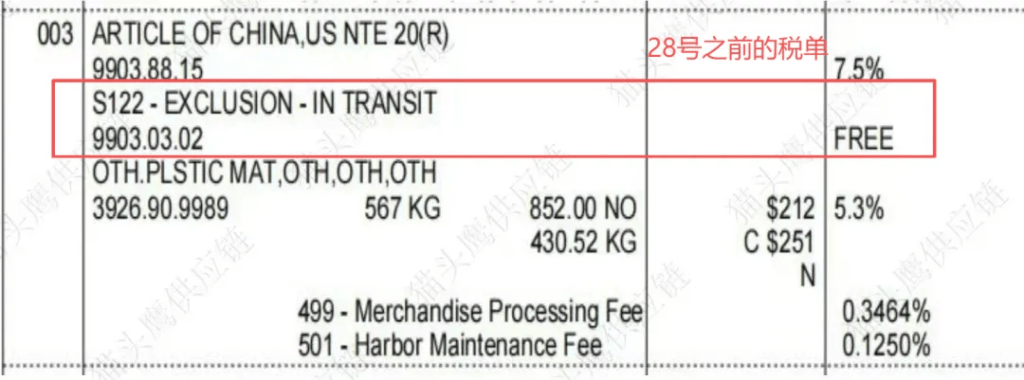
美国最新10%怎么收?附上关税单解读!
Sou Hu Cai Jing· 2026-02-26 03:06
Core Viewpoint - The article discusses the recent changes in U.S. tariff policies, specifically the 10% reduction in tariffs and the conditions under which certain products can be exempt from the new 122 tariff. Group 1: Tariff Exemptions - Products eligible for the 10% exemption under the 122 tariff include specific items such as critical minerals, precious metals, energy products, certain agricultural products (e.g., beef, tomatoes, oranges), pharmaceuticals, some electronics, aerospace products, informational materials (e.g., books), donations, and personal luggage [1] - Goods that have already incurred the 232 tariff are exempt from the new 122 tariff, as the 232 tariff does not overlap with the 122 tariff [1] - Products from Canada and Mexico that comply with the United States-Mexico-Canada Agreement (USMCA) and textiles and apparel entering duty-free under the Dominican Republic-Central America Free Trade Agreement are also exempt [1] Group 2: Shipping and Arrival Deadlines - For goods shipped to the U.S., if they are loaded for transport before February 24, 2026, at 00:01 EST and arrive between February 24, 2026, at 00:01 and February 28, 2026, at 00:01, they qualify for the 10% exemption [2] - The exemption applies specifically to shipments arriving within the four-day window (excluding February 28) [2] - Transshipment goods must also be en route to the U.S. before February 24, 2026, to qualify for the exemption [3]

中国科学院成立新所
仪器信息网· 2025-12-12 09:03
Core Viewpoint - The establishment of the Dongguan Institute of Materials Science and Technology by the Chinese Academy of Sciences aims to create a globally influential research center focused on strategic and frontier materials exploration and fundamental scientific issues [2]. Group 1 - The Dongguan Institute is a collaborative research institution built by the Chinese Academy of Sciences, Guangdong Province, and Dongguan City [2]. - The institute will focus on research in various fields, including information materials, energy materials, functional ceramics, and metal materials [2]. - The goal is to enhance the global influence and leadership in new materials research [2].

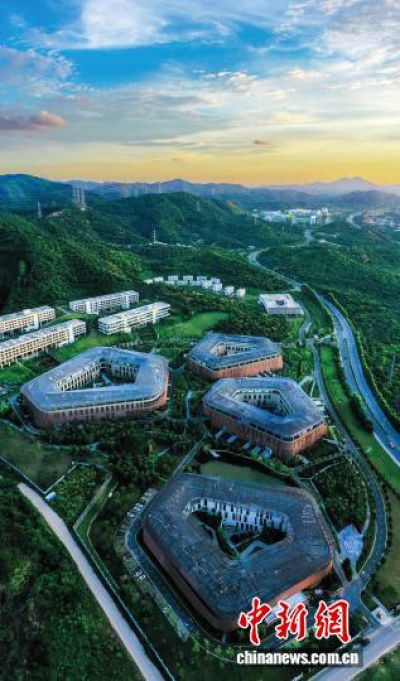
【中国新闻网】中国科学院东莞材料科学与技术研究所成立
Zhong Guo Xin Wen Wang· 2025-12-07 00:07
Core Insights - The establishment of the Dongguan Institute of Materials Science and Technology by the Chinese Academy of Sciences marks a significant development in the field of materials research in China [2] - This institute is the second specialized research institute established by the Chinese Academy of Sciences within a short period, following the Industrial Artificial Intelligence Research Institute in Nanjing [2] Group 1 - The Dongguan Institute is a collaborative effort between the Chinese Academy of Sciences, Guangdong Province, and Dongguan City [2] - The institute will focus on strategic and frontier material exploration as well as fundamental scientific research [2] - Research areas will include information materials, energy materials, functional ceramics, and metal materials [2] Group 2 - The goal is to create a new materials research center with global influence and leadership [2]
青海省高质量发展政府投资基金招GP
FOFWEEKLY· 2025-10-21 10:00
Core Viewpoint - Qinghai Province is launching a market-oriented sub-fund application guide for its high-quality development government investment fund, with a total scale of 5 billion yuan and an initial capital of 1.5 billion yuan already in place [1] Investment Focus and Direction - The fund aims to support key industries in Qinghai, focusing on the unique resource endowment of the province, promoting the upgrade of salt lake industries, optimizing industrial layout, and enhancing resource utilization [2] - It will support the energy revolution, develop a clean energy industry chain, and establish a national energy storage development demonstration zone [2] - The fund will also promote zero-carbon industry development, new power system development, technological innovation, and the establishment of national-level tourism and organic agricultural enterprises [2] - At least 70% of the fund's investments will be directed towards sub-funds supporting the "Four Places" construction [2] Types of Sub-Funds - Sub-funds are categorized into major (special) sub-funds, regional sub-funds, and market-oriented sub-funds [3] - Major sub-funds are established according to the directives of the Qinghai Provincial Party Committee and government [3] - Regional sub-funds operate through market mechanisms, focusing on cooperation with local parks and cities to achieve coordinated regional development [3] - Market-oriented sub-funds are initiated by professional fund managers in collaboration with social capital, targeting key supported industries and areas [3]