电动汽车换电

Search documents
规范新兴产业、未来产业 11月起一批重要国家标准开始实施
Zhong Guo Jing Ji Wang· 2025-11-04 08:23
Core Points - A series of important national standards will be implemented starting in November, aimed at regulating emerging and future industries, creating a favorable consumer environment, and ensuring the safety of people's lives and property [3]. Group 1: Electric Vehicles - The national standard for electric vehicle battery swapping safety requirements for commercial vehicles (GB/T 40032.2-2025) specifies safety requirements unique to N1, N2, and N3 class battery-swapping commercial electric vehicles, with other types encouraged to follow [4]. - The implementation of this standard will promote the adoption of battery swapping models in the commercial vehicle sector, ensuring safe and reliable operation of electric commercial vehicles and fostering the healthy development of the battery swapping industry [5]. Group 2: Construction Materials - The mandatory national standard for building waterproof coatings (GB 45671-2025) outlines safety technical requirements such as combustion performance, flash point, and harmful substance limits [6]. - This standard's implementation will help ensure the quality of construction projects, protect human health and environmental safety, and further guide the industry's green and high-quality development [7]. Group 3: Electrical Products - The recommended national standard for household and similar use plug sockets with USB power (GB/T 2099.31-2025) sets safety and electromagnetic compatibility requirements [8]. - The implementation of this standard will guide consumers in the safe use of USB power sockets, promote technological advancement in the power socket industry, and enhance product quality and competitiveness [9]. Group 4: Home Appliances - The recommended national standard for electric oil heaters (GB/T 28199-2025) defines terms, classifications, requirements, inspection rules, labeling, packaging, transportation, and storage requirements for household and similar use electric oil heaters [10][11]. - This standard will provide a more comprehensive and reliable technical basis for testing electric oil heater products, promoting technological progress in this sector [12]. Group 5: Personal Care Products - The recommended national standards for toothbrushes include general requirements and testing methods for manual toothbrushes (GB/T 19342—2024) and performance testing methods for electric toothbrushes (GB/T 45637-2025) [14][15]. - The implementation of these standards will further improve the standard system in the toothbrush sector, enhance product quality, and better meet market demands [16]. Group 6: Automotive Services - The recommended national standard for car rental services (GB/T 29911-2025) outlines overall requirements for small and micro passenger car rental services, including requirements for operators, vehicles, service personnel, service processes, rental platforms, and service quality management [17][18]. - The implementation of this standard will standardize operational behaviors in the car rental industry, improve service levels, and lead to high-quality development in the sector [19]. Group 7: Data Security - The recommended national standard for data security concerning sensitive personal information processing (GB/T 45574-2025) establishes general and specific security requirements for handling sensitive personal information [20][21]. - The implementation of this standard will provide technical support for regulating sensitive personal information processing and protecting the rights and interests of individuals [22]. Group 8: Civil Defense - The recommended national standard for the environmental hygiene of civil defense engineering during normal use (GB/T 17216-2025) specifies hygiene requirements applicable to civil defense projects used for accommodation and commercial purposes [23][24]. - The implementation of this standard will help create a healthy and hygienic environment for civil defense projects, preventing health risks [25]. Group 9: Fire Safety - The mandatory national standard for determining major fire hazards (GB 35181-2025) establishes rules for identifying significant fire hazards in buildings and locations [26][27]. - The implementation of this standard will aid in the timely identification and elimination of major fire hazards [28].


商用电动汽车换电安全等一批国家标准11月起实施
Xin Hua She· 2025-10-31 09:20
Group 1 - The implementation of new national standards for commercial electric vehicle battery swapping and lithium-ion battery coding will support the healthy development of emerging industries and ensure consumer safety starting from November 1 [1] - The recommended national standard for electric vehicle battery swapping safety specifies safety requirements for N1, N2, and N3 class commercial electric vehicles, promoting the adoption of battery swapping models in the commercial vehicle sector [1] - The national standard for lithium-ion battery coding assigns a unique identity code to each new battery product, facilitating lifecycle management from production to recycling and enhancing product traceability and industry regulation [1] Group 2 - The recommended national standard for electric oil heaters outlines terminology, classification, requirements, inspection rules, and packaging for household and similar use electric oil heaters, providing a reliable technical basis for product testing and promoting technological advancement in this sector [1] - The recommended national standard for household and similar use plug sockets with USB power specifies safety and electromagnetic compatibility requirements, guiding consumers in the safe use of these products and enhancing the quality and competitiveness of the power socket industry [2] - The mandatory national standard for building waterproof coatings sets safety technical requirements regarding combustion performance, flash point, and harmful substance limits, contributing to construction quality and environmental safety while promoting green and high-quality industry development [2]
11月1日起 商用电动汽车换电安全等一批重要国家标准开始实施
Zheng Quan Shi Bao Wang· 2025-10-31 06:47
Core Points - Starting from November 1, a series of important national standards will be implemented, including those related to commercial electric vehicle battery swapping safety, waterproof coatings, sensitive personal information processing, and more, aimed at regulating emerging industries and ensuring a safe consumption environment [1] Group 1: National Standards Implementation - The new standards will support the healthy development of emerging industries and safeguard public safety [1] - The standard for electric vehicle battery swapping safety (GB/T40032.2—2025) specifies safety requirements for N1, N2, and N3 class commercial electric vehicles, with recommendations for other types of battery-swapping vehicles [1] - The implementation of this standard is expected to promote the adoption of battery swapping models in the commercial vehicle sector, ensuring safe and reliable operation of electric commercial vehicles [1]
南瑞牵头编制的电动汽车换电系统安全要求国际标准正式发
Zhong Guo Neng Yuan Wang· 2025-07-17 10:15
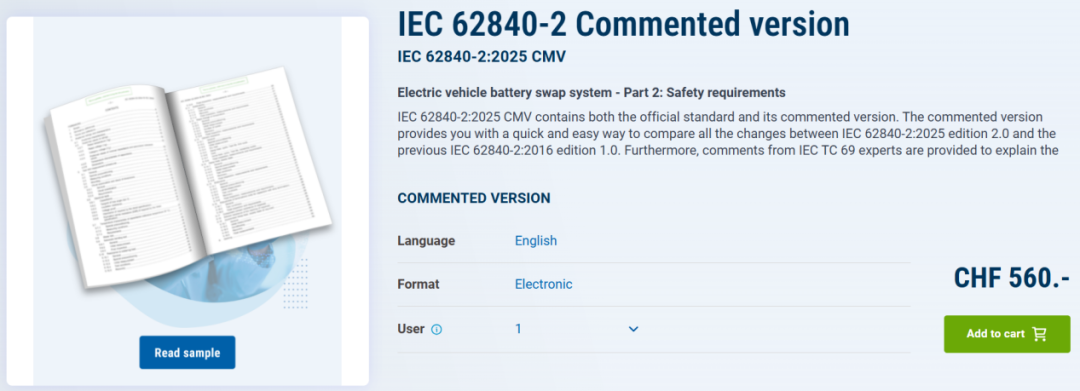
Group 1 - The international standard IEC 62840-2:2025 CMV for electric vehicle battery swapping systems has been officially released, marking a significant step towards the standardization and safety of the global electric vehicle battery swapping industry, and recognizing China's technological solutions in the new energy vehicle sector [1][4] - The standard focuses on the safety of battery swapping systems, ensuring the safety of personnel and equipment during the battery swapping process, and is applicable to electric vehicle battery swapping systems connected to the power supply network [4] - The new standard includes safety requirements for portable battery swapping systems and expands its scope to light vehicles, covering scenarios for two-wheeled and three-wheeled electric vehicles, enhancing interoperability requirements and reinforcing electrical, mechanical, and data safety protections [4] Group 2 - The standard was published by the International Electrotechnical Commission (IEC) in a commentary version (CMV), facilitating quick understanding and comparison of version differences for users, and aiding in the consistent testing of battery swapping products for entry into different national markets [5] - The company actively participated in international standardization collaboration during the standard's preparation, with experts contributing technical solutions to help reach a consensus among global experts [5] - The company aims to leverage the release of this standard to strengthen the integration of "standards-research-development-industry," enhancing China's influence in global standard governance and contributing to global energy transition and low-carbon transportation development [5]