电视操作系统

Search documents
Omdia:至2029年零售商将控制北美电视操作系统市场份额的47%
Zhi Tong Cai Jing· 2026-02-02 02:55
Core Insights - Omdia's report predicts that by 2029, retailers will control 47% of the North American TV operating system (OS) market share, up from 27% in 2025, indicating a shift towards retail media advertising driven by e-commerce rather than traditional TV sales [1] - The global TV OS market is evolving into three distinct segments, with localized Android ecosystems in China maintaining a dominant 96% market share, while Google TV leads in other regions with a 40% share, which is expected to be gradually divided among competitors Vidaa, Titan, and TiVo [1] Group 1 - By 2027, North America is expected to reach a turning point, with Walmart's CastOS devices projected to ship 14 million units, benefiting from Walmart's acquisition of Vizio and the expansion of its CastOS platform [4] - Following the acquisition, Walmart is expected to increase Vizio's shipments from 4.8 million units in 2024 to 6.6 million units in 2025, a growth of 37.5%, while Amazon's FireTV shipments are projected to rise from 6.1 million units in 2024 to 6.8 million units in 2025, an increase of 11.5% [4] - By 2029, Walmart's CastOS devices are expected to reach 14.8 million units, while Amazon's FireTV is projected to reach 8.8 million units, resulting in a total shipment of 23.6 million units and a market size of 50 million units [4] Group 2 - At the 2026 CES, VIDAA OS will undergo significant changes, rebranding to V Home OS to reflect its broader role beyond just television, and announcing a partnership with Microsoft to integrate Copilot generative AI features into the platform [4] - Google has integrated Gemini AI into Google TV, launching interactive shoppable video features at CES, which aim to seamlessly connect viewing and purchasing experiences through AI recognition of products on screen [4] - The emphasis on "conversational shopping" allows users to inquire about products while watching, with the TV identifying brands and providing options to add items to a shopping cart, highlighting the growing importance of shopping functionalities across multiple TV OS platforms [4]





Omdia:随着广告策略的转变, 至2029年零售商将控制北美电视操作系统市场份额的47%
Canalys· 2026-02-02 02:32
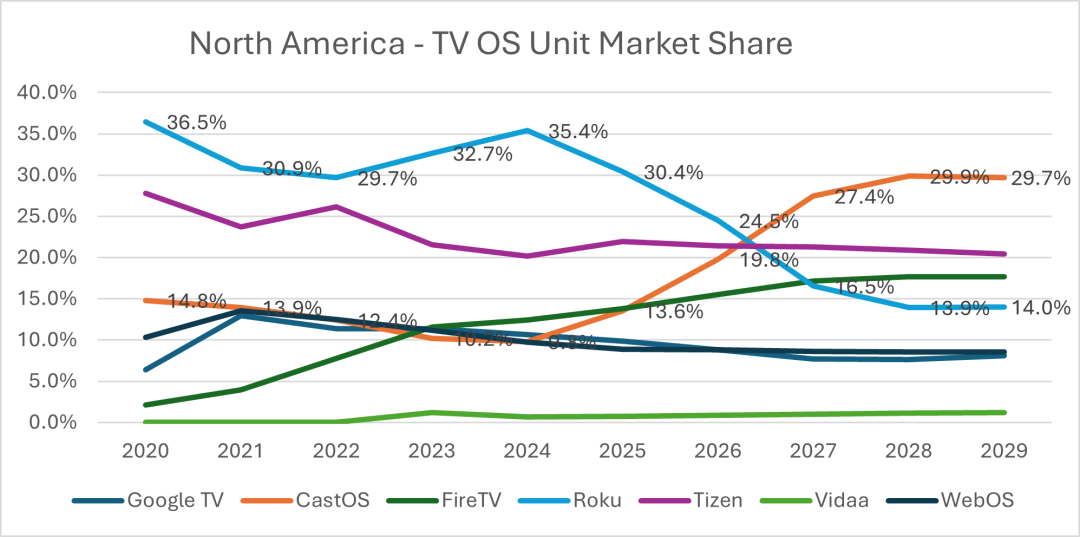
Core Insights - By 2029, retailers are expected to control 47% of the North American TV operating system (OS) market share, up from 27% in 2025 according to Omdia [1] Retail Media and Advertising - The latest "TV Design and Function Insights" report indicates that retailers are prioritizing the development of e-commerce-driven retail media advertising over traditional TV shipment leadership [2] Market Trends and Predictions - Omdia forecasts that the global TV OS market is evolving into three distinct segments. In China, a localized Android ecosystem without Google services continues to dominate with a stable 96% market share, which is expected to persist. In other global regions (excluding North America and China), Google TV currently leads with a 40% market share, but this is anticipated to be gradually divided among three competitors: Vidaa, Titan, and TiVo [3] North American Market Developments - Omdia predicts a turning point in the North American market by 2027, with shipments of Walmart's CastOS devices reaching 14 million units. This growth is attributed to Walmart's acquisition of Vizio and the expansion of its CastOS platform. Following the acquisition, Walmart is expected to increase Vizio's shipments from 4.8 million units in 2024 to 6.6 million units in 2025, a growth of 37.5%. Meanwhile, Amazon is projected to raise FireTV shipments from 6.1 million units in 2024 to 6.8 million units in 2025, an increase of 11.5% [6] Future Projections - By 2029, Omdia anticipates that shipments of Walmart's CastOS devices will reach 14.8 million units, while Amazon's FireTV will reach 8.8 million units. Consequently, the total shipments from these two retailers will amount to 23.6 million units, with the market size expected to reach 50 million units [6] AI Integration and User Experience - At the 2026 CES, VIDAA OS underwent significant changes, rebranding to V Home OS to reflect its broader role beyond just television. The company announced a key partnership with Microsoft to integrate Copilot generative AI features into the platform, enhancing user experience through advanced AI services. This rebranding is part of a strategy to evolve the OS to support AI and ultimately serve as a shopping gateway [6] - Google has integrated Gemini AI into Google TV and introduced interactive shoppable video features at CES. AI-driven "shoppable" prompts are linked to screen content, aiming to create a seamless experience between viewing and purchasing. Google emphasized a direct path from discovery to checkout without leaving the interface, allowing users to engage in conversational shopping [6]

Omdia:预计2029年CastOS北美出货量将达1500万台 成为电视操作系统主导者
Zhi Tong Cai Jing· 2025-11-06 01:32
Group 1 - Omdia's report predicts that CastOS shipments in North America will grow from 6.5 million units in 2025 to 15 million units by 2029, potentially surpassing Roku, Tizen, and FireTV after 2025 [1] - Walmart's decision to switch its Onn. TV brand's operating system from Roku to CastOS is expected to accelerate this growth, allowing Walmart to leverage its own platform for direct advertising to consumers, thereby increasing e-commerce revenue [1] - Matthew Rubin, Omdia's chief analyst, notes that Walmart's integration of the TV platform will provide significant assets for advertising revenue and sales growth, enhancing its competitive position against Amazon [1] Group 2 - Globally, the Android platform is expected to maintain a leading position, with market share slightly decreasing from 42% in 2025 to 39% in 2029, though this includes various Android-based platforms [3] - Tizen is projected to remain the second-largest TV operating system, with its share declining from 17% in 2025 to 16% in 2029 [3] - Vidaa and Amazon's Fire TV are expected to be the fastest-growing operating systems, with Vidaa's market share increasing from 6% in 2025 to nearly 8% by 2029, and Fire TV's share rising from 4% to just over 5% [3] Group 3 - Outside of China, the Android platform, including a significant portion of Google TV, will hold a market share of 32% in 2025, remaining the dominant TV operating platform [5] - The competitive operating system market, particularly in Europe, is expected to have expansion opportunities, with retailers and platform providers closely monitoring developments in North America [5]

Omdia:CastOS出货量将突破1500万台,有望主导北美电视操作系统市场
Canalys· 2025-11-06 01:03
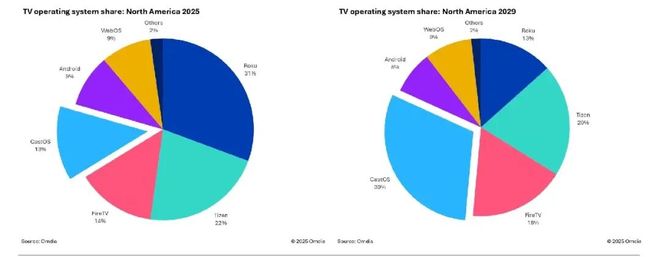
Core Insights - Walmart's acquisition of Vizio and the launch of its own operating system on the Onn. TV brand will propel CastOS to become the largest TV operating system by shipment volume in North America [2] - CastOS shipments are projected to grow from 6.5 million units in 2025 to 15 million units by 2029, surpassing competitors like Roku, Tizen, and FireTV [2] - The shift from Roku to CastOS for Walmart's Onn. brand will significantly increase its advertising capabilities and e-commerce revenue [2][3] Market Dynamics - Omdia's chief analyst Matthew Rubin noted that Walmart's integration of TV platforms will provide significant assets for revenue growth and enhance competition with Amazon [3] - Amazon's recent partnership with Roku for advertising could lead to a decline in Roku's shipment volumes as Walmart's Onn. brand takes market share [3] Competitive Landscape - Globally, the Android platform is expected to maintain a leading position, with its market share slightly decreasing from 42% in 2025 to 39% in 2029 [5] - Tizen is projected to remain the second-largest TV operating system, with a slight decline in market share from 17% in 2025 to 16% in 2029 [5] - The fastest-growing TV operating systems besides CastOS are expected to be Vidaa, increasing from 6% in 2025 to nearly 8% in 2029, and Amazon's Fire TV, rising from 4% in 2025 to just over 5% by 2029 [7] Regional Insights - Outside of China, the Android platform, including a significant share of Google TV, is expected to hold a 32% market share in 2025, indicating its dominance in the TV operating platform market [9] - The competitive landscape in Europe remains dynamic, with opportunities for expansion as retailers and platform providers observe North American trends [9]