FireTV

Search documents
Omdia:至2029年零售商将控制北美电视操作系统市场份额的47%
Zhi Tong Cai Jing· 2026-02-02 02:55
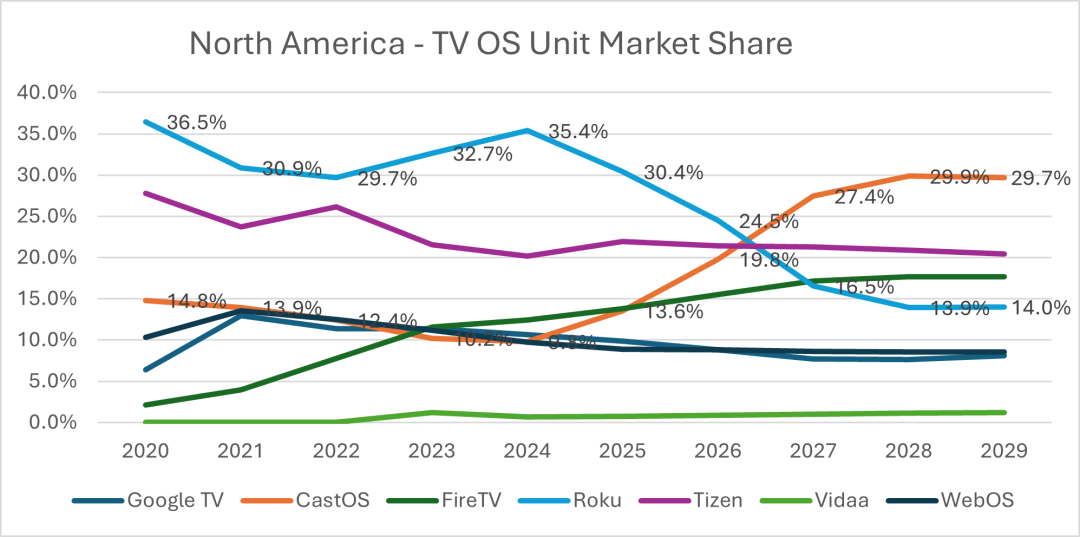
Core Insights - Omdia's report predicts that by 2029, retailers will control 47% of the North American TV operating system (OS) market share, up from 27% in 2025, indicating a shift towards retail media advertising driven by e-commerce rather than traditional TV sales [1] - The global TV OS market is evolving into three distinct segments, with localized Android ecosystems in China maintaining a dominant 96% market share, while Google TV leads in other regions with a 40% share, which is expected to be gradually divided among competitors Vidaa, Titan, and TiVo [1] Group 1 - By 2027, North America is expected to reach a turning point, with Walmart's CastOS devices projected to ship 14 million units, benefiting from Walmart's acquisition of Vizio and the expansion of its CastOS platform [4] - Following the acquisition, Walmart is expected to increase Vizio's shipments from 4.8 million units in 2024 to 6.6 million units in 2025, a growth of 37.5%, while Amazon's FireTV shipments are projected to rise from 6.1 million units in 2024 to 6.8 million units in 2025, an increase of 11.5% [4] - By 2029, Walmart's CastOS devices are expected to reach 14.8 million units, while Amazon's FireTV is projected to reach 8.8 million units, resulting in a total shipment of 23.6 million units and a market size of 50 million units [4] Group 2 - At the 2026 CES, VIDAA OS will undergo significant changes, rebranding to V Home OS to reflect its broader role beyond just television, and announcing a partnership with Microsoft to integrate Copilot generative AI features into the platform [4] - Google has integrated Gemini AI into Google TV, launching interactive shoppable video features at CES, which aim to seamlessly connect viewing and purchasing experiences through AI recognition of products on screen [4] - The emphasis on "conversational shopping" allows users to inquire about products while watching, with the TV identifying brands and providing options to add items to a shopping cart, highlighting the growing importance of shopping functionalities across multiple TV OS platforms [4]





Omdia:随着广告策略的转变, 至2029年零售商将控制北美电视操作系统市场份额的47%
Canalys· 2026-02-02 02:32
Core Insights - By 2029, retailers are expected to control 47% of the North American TV operating system (OS) market share, up from 27% in 2025 according to Omdia [1] Retail Media and Advertising - The latest "TV Design and Function Insights" report indicates that retailers are prioritizing the development of e-commerce-driven retail media advertising over traditional TV shipment leadership [2] Market Trends and Predictions - Omdia forecasts that the global TV OS market is evolving into three distinct segments. In China, a localized Android ecosystem without Google services continues to dominate with a stable 96% market share, which is expected to persist. In other global regions (excluding North America and China), Google TV currently leads with a 40% market share, but this is anticipated to be gradually divided among three competitors: Vidaa, Titan, and TiVo [3] North American Market Developments - Omdia predicts a turning point in the North American market by 2027, with shipments of Walmart's CastOS devices reaching 14 million units. This growth is attributed to Walmart's acquisition of Vizio and the expansion of its CastOS platform. Following the acquisition, Walmart is expected to increase Vizio's shipments from 4.8 million units in 2024 to 6.6 million units in 2025, a growth of 37.5%. Meanwhile, Amazon is projected to raise FireTV shipments from 6.1 million units in 2024 to 6.8 million units in 2025, an increase of 11.5% [6] Future Projections - By 2029, Omdia anticipates that shipments of Walmart's CastOS devices will reach 14.8 million units, while Amazon's FireTV will reach 8.8 million units. Consequently, the total shipments from these two retailers will amount to 23.6 million units, with the market size expected to reach 50 million units [6] AI Integration and User Experience - At the 2026 CES, VIDAA OS underwent significant changes, rebranding to V Home OS to reflect its broader role beyond just television. The company announced a key partnership with Microsoft to integrate Copilot generative AI features into the platform, enhancing user experience through advanced AI services. This rebranding is part of a strategy to evolve the OS to support AI and ultimately serve as a shopping gateway [6] - Google has integrated Gemini AI into Google TV and introduced interactive shoppable video features at CES. AI-driven "shoppable" prompts are linked to screen content, aiming to create a seamless experience between viewing and purchasing. Google emphasized a direct path from discovery to checkout without leaving the interface, allowing users to engage in conversational shopping [6]

中国卖家占据亚马逊半壁江山,深圳成亚马逊全球布局重点
Sou Hu Cai Jing· 2026-01-10 09:53
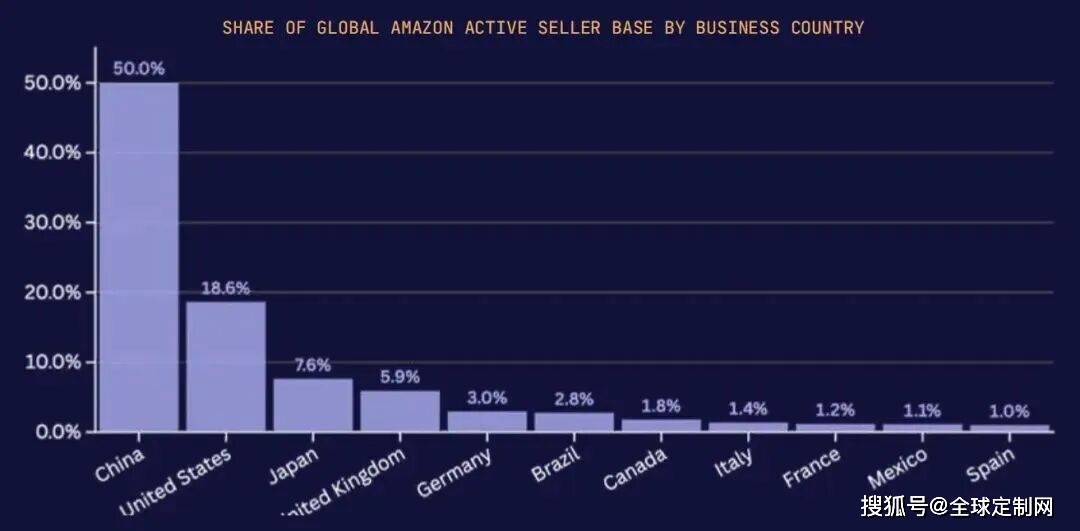
Core Insights - The report by Marketplace Pulse highlights the significant growth of Chinese sellers on Amazon, projecting that by 2025, they will account for over 50% of active sellers globally [2]. Group 1: Chinese Sellers' Dominance - Chinese sellers are expected to surpass 50% of Amazon's global active sellers by 2025, marking a historic milestone [2] - Despite increased tariffs imposed by the U.S., Chinese sellers maintain a strong position on Amazon due to advantages in supply chain integration and cost control [4] - Chinese sellers possess both manufacturing and sales capabilities, allowing them to manage production and pricing directly, unlike U.S. sellers who face additional costs from tariffs and wholesale markups [4] Group 2: Amazon's U.S. Marketplace - The U.S. marketplace remains the preferred choice for new sellers, with a first-order success rate of 60%, outperforming other countries such as Japan (50%), Germany (42%), and the UK (33%) [5] - The average traffic per active seller on the U.S. platform has increased by over 30% compared to four years ago, providing more opportunities for global sellers, including those from China [6] Group 3: Amazon's Investment in Shenzhen - Amazon continues to invest in Shenzhen, China's leading cross-border e-commerce city, with the establishment of the world's first smart hub warehouse (GWD) set to open by the end of 2025 [7] - The smart hub will offer a one-stop service for storage, customs clearance, and global distribution, potentially reducing storage costs for sellers by 20%-40% [10] - Amazon's initiatives in Shenzhen extend beyond attracting sellers to include hardware research and development, with the establishment of innovation centers aimed at enhancing product and brand capabilities for sellers [10]
InterDigital enforces patents against Amazon
Globenewswire· 2025-11-10 09:30
Core Viewpoint - InterDigital, Inc. has initiated litigation against Amazon for the infringement of its intellectual property related to video content compression and HDR technology [1][2]. Group 1: Litigation Details - The patents involved pertain to the compression of video content and enhancement of picture quality through HDR technology [2]. - Legal actions have been filed in multiple jurisdictions, including the United States Federal District Court in Delaware, Brazil's Rio de Janeiro State Court, Germany's Munich Regional Court, and the Local Division of Mannheim in the Unified Patent Court [3]. Group 2: Company Position - InterDigital prefers to resolve licensing issues through amicable negotiations but indicates that Amazon's choice to litigate reflects a preference for legal battles over negotiations [4]. - The company emphasizes the importance of fair compensation for its innovations, which are crucial for Amazon's ability to deliver high-quality content globally [4]. Group 3: Company Overview - InterDigital is a global R&D company focused on wireless, video, AI, and related technologies, providing foundational technologies for various communication and entertainment products [5]. - The company has a history of innovation in wireless technology, from early digital cellular systems to advanced 5G and Wi-Fi technologies, and is also a leader in video processing and AI research [5].


Omdia:CastOS出货量将突破1500万台,有望主导北美电视操作系统市场
Canalys· 2025-11-06 01:03
Core Insights - Walmart's acquisition of Vizio and the launch of its own operating system on the Onn. TV brand will propel CastOS to become the largest TV operating system by shipment volume in North America [2] - CastOS shipments are projected to grow from 6.5 million units in 2025 to 15 million units by 2029, surpassing competitors like Roku, Tizen, and FireTV [2] - The shift from Roku to CastOS for Walmart's Onn. brand will significantly increase its advertising capabilities and e-commerce revenue [2][3] Market Dynamics - Omdia's chief analyst Matthew Rubin noted that Walmart's integration of TV platforms will provide significant assets for revenue growth and enhance competition with Amazon [3] - Amazon's recent partnership with Roku for advertising could lead to a decline in Roku's shipment volumes as Walmart's Onn. brand takes market share [3] Competitive Landscape - Globally, the Android platform is expected to maintain a leading position, with its market share slightly decreasing from 42% in 2025 to 39% in 2029 [5] - Tizen is projected to remain the second-largest TV operating system, with a slight decline in market share from 17% in 2025 to 16% in 2029 [5] - The fastest-growing TV operating systems besides CastOS are expected to be Vidaa, increasing from 6% in 2025 to nearly 8% in 2029, and Amazon's Fire TV, rising from 4% in 2025 to just over 5% by 2029 [7] Regional Insights - Outside of China, the Android platform, including a significant share of Google TV, is expected to hold a 32% market share in 2025, indicating its dominance in the TV operating platform market [9] - The competitive landscape in Europe remains dynamic, with opportunities for expansion as retailers and platform providers observe North American trends [9]