Roku

Search documents
Must-Track Streaming Stocks in the Evolving Media Landscape
ZACKS· 2026-02-26 18:51
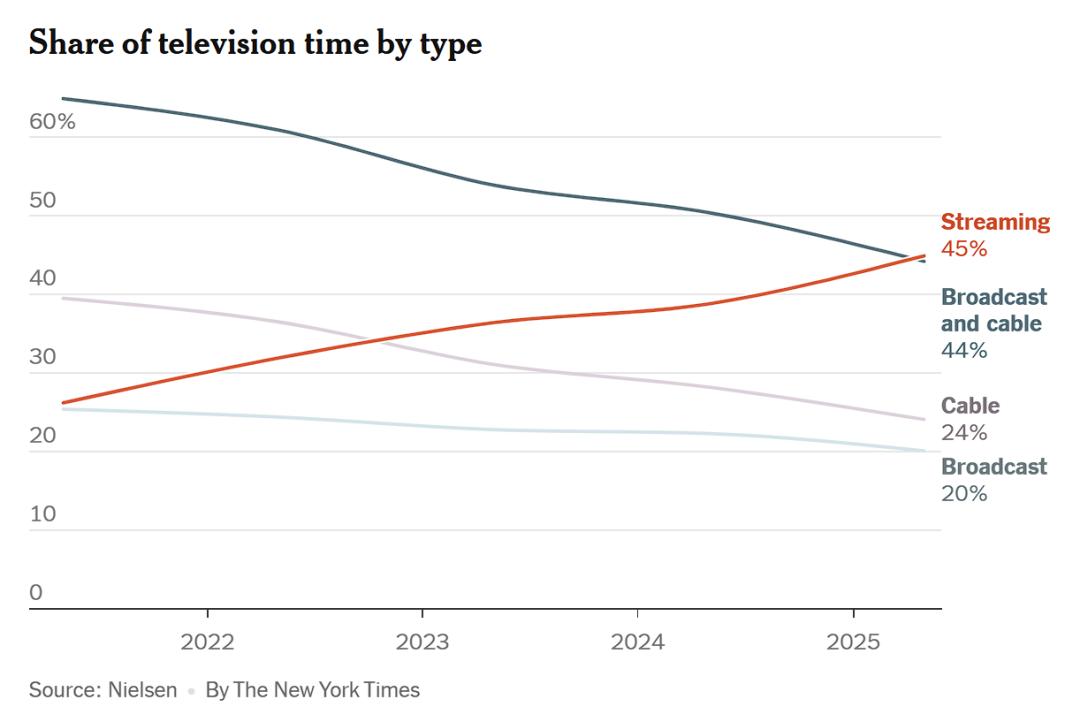
Industry Overview - The global streaming content industry has transitioned from a niche market to a core component of media consumption, creating a multibillion-dollar ecosystem supported by broadband and connected TV adoption [2] - Streaming now accounts for over 45% of total U.S. TV time in 2025, surpassing traditional linear viewing in major markets [3] Advertising and Monetization - Advertising has become a key monetization strategy, with ad-supported tiers gaining popularity and programmatic advertising improving measurement tools [4] - Major platforms are introducing lower-priced ad tiers to address subscription fatigue, while FAST channels are engaging viewers effectively [4] Company Strategies - Companies are focusing on operating leverage, content efficiency, and churn management, with strategies like bundling, password-sharing crackdowns, and pricing optimization supporting ARPU stability [5] - Future growth will rely on international expansion, localized content investment, and AI-driven personalization rather than solely on subscriber additions [5] Roku Insights - Roku reported over 90 million logged-in streaming households by the end of 2025, becoming the leading streaming OS in the U.S., Canada, and Mexico [7] - The platform's monetization extends beyond device sales into recurring revenue from advertising and content distribution, with aggregate hours streamed exceeding 145 billion in 2025, a 15% year-over-year increase [8] - Roku's partnerships and content licensing strategies are enhancing engagement, while international expansion offers significant growth potential [9][10] Alphabet (YouTube) Insights - YouTube's revenue surpassed $60 billion in 2025, benefiting from its diverse offerings including premium video content and subscription services [12] - YouTube leads in watch time among U.S. audiences, leveraging AI for content discovery and personalized recommendations to enhance viewer engagement [14] - The platform's ability to monetize various content formats, including short-form video and live sports, strengthens its competitive position [14][15] Spotify Insights - Spotify reached 290 million premium subscribers and over 750 million monthly active users by the end of Q4 2025, showcasing its scale in the audio streaming market [16][17] - The company is focusing on AI-driven personalization and expanding content formats to deepen user engagement and broaden monetization [17] - Despite competition, Spotify's focus on audio and data-driven strategies supports its durable market position [19]

Top Streaming Stocks Positioned to Gain From Expanding Content Trends
ZACKS· 2025-11-11 18:31
Industry Overview - Streaming has transitioned from a niche option to a dominant force in entertainment, driven by technological advancements, wider internet access, and changing consumer preferences [2] - The streaming revenue is projected to reach approximately $190 billion by 2029, supported by an estimated 2 billion paid global subscriptions, with ad-supported and hybrid tiers expanding the market [4] - Live sports, interactive viewing, and strategic partnerships are becoming key differentiators in the streaming landscape, indicating ongoing growth potential in the sector [5] Fox Corporation - Fox Corporation's streaming strategy began with the acquisition of Tubi for about $440 million in 2020, which has since become a crucial part of its digital strategy [7] - Tubi achieved quarterly profitability in Q1 of fiscal 2026, with a 27% revenue growth driven by an 18% increase in viewership, validating its business model [8] - Tubi aims for a long-term margin of 20-25% and is expected to grow its user base to over 100 million monthly active users, benefiting from younger audiences favoring free streaming [9] - With Tubi's profitability, Fox can invest more in content and personalized advertising tools, marking a shift from early-stage expansion to execution [10] fuboTV - fuboTV launched in 2015, focusing on live sports for cord-cutters, and has evolved into a comprehensive live TV streaming service [11] - The platform has improved its technology for better speed and video quality, enhancing viewer engagement and positioning itself as a primary TV source [12] - fuboTV's content mix has improved, now including major networks like ESPN and ABC, which boosts subscriber satisfaction [13] - The company is focused on long-term margin expansion through smarter content agreements and automation, with significant potential for ad revenue growth [14][15] Roku - Roku began as a streaming device manufacturer in 2008 and has since developed into a full streaming platform that integrates content distribution, advertising, and subscription services [16] - The platform's scale allows for expanded monetization through advertising and services, with a strong growth trajectory in ad revenue [17][18] - Roku is enhancing its user experience with AI-driven recommendations and an expanding lineup of original content, contributing to its subscription revenue growth [19] - The company anticipates double-digit revenue growth and improved operating margins in the coming years, solidifying its position in the streaming market [20]



Omdia:预计2029年CastOS北美出货量将达1500万台 成为电视操作系统主导者
Zhi Tong Cai Jing· 2025-11-06 01:32
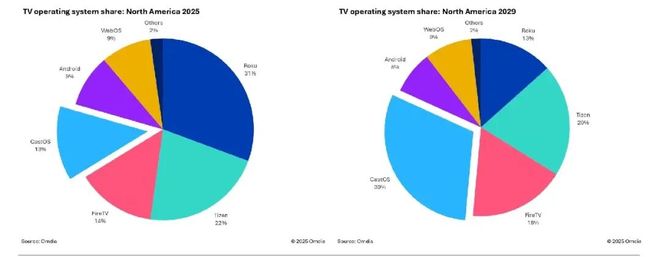
Group 1 - Omdia's report predicts that CastOS shipments in North America will grow from 6.5 million units in 2025 to 15 million units by 2029, potentially surpassing Roku, Tizen, and FireTV after 2025 [1] - Walmart's decision to switch its Onn. TV brand's operating system from Roku to CastOS is expected to accelerate this growth, allowing Walmart to leverage its own platform for direct advertising to consumers, thereby increasing e-commerce revenue [1] - Matthew Rubin, Omdia's chief analyst, notes that Walmart's integration of the TV platform will provide significant assets for advertising revenue and sales growth, enhancing its competitive position against Amazon [1] Group 2 - Globally, the Android platform is expected to maintain a leading position, with market share slightly decreasing from 42% in 2025 to 39% in 2029, though this includes various Android-based platforms [3] - Tizen is projected to remain the second-largest TV operating system, with its share declining from 17% in 2025 to 16% in 2029 [3] - Vidaa and Amazon's Fire TV are expected to be the fastest-growing operating systems, with Vidaa's market share increasing from 6% in 2025 to nearly 8% by 2029, and Fire TV's share rising from 4% to just over 5% [3] Group 3 - Outside of China, the Android platform, including a significant portion of Google TV, will hold a market share of 32% in 2025, remaining the dominant TV operating platform [5] - The competitive operating system market, particularly in Europe, is expected to have expansion opportunities, with retailers and platform providers closely monitoring developments in North America [5]


Omdia:CastOS出货量将突破1500万台,有望主导北美电视操作系统市场
Canalys· 2025-11-06 01:03
Core Insights - Walmart's acquisition of Vizio and the launch of its own operating system on the Onn. TV brand will propel CastOS to become the largest TV operating system by shipment volume in North America [2] - CastOS shipments are projected to grow from 6.5 million units in 2025 to 15 million units by 2029, surpassing competitors like Roku, Tizen, and FireTV [2] - The shift from Roku to CastOS for Walmart's Onn. brand will significantly increase its advertising capabilities and e-commerce revenue [2][3] Market Dynamics - Omdia's chief analyst Matthew Rubin noted that Walmart's integration of TV platforms will provide significant assets for revenue growth and enhance competition with Amazon [3] - Amazon's recent partnership with Roku for advertising could lead to a decline in Roku's shipment volumes as Walmart's Onn. brand takes market share [3] Competitive Landscape - Globally, the Android platform is expected to maintain a leading position, with its market share slightly decreasing from 42% in 2025 to 39% in 2029 [5] - Tizen is projected to remain the second-largest TV operating system, with a slight decline in market share from 17% in 2025 to 16% in 2029 [5] - The fastest-growing TV operating systems besides CastOS are expected to be Vidaa, increasing from 6% in 2025 to nearly 8% in 2029, and Amazon's Fire TV, rising from 4% in 2025 to just over 5% by 2029 [7] Regional Insights - Outside of China, the Android platform, including a significant share of Google TV, is expected to hold a 32% market share in 2025, indicating its dominance in the TV operating platform market [9] - The competitive landscape in Europe remains dynamic, with opportunities for expansion as retailers and platform providers observe North American trends [9]

Every Company Needs a Kid! | Makenna Riley | TEDxSt Pete Women
TEDx Talks· 2025-10-10 16:45
Key Idea - Every company needs a kid to bring creativity, curiosity, and courage [1] - Innovation rarely comes from inside, but from people with fresh ideas and unfiltered imagination [1] - Imagination is more important than knowledge [7] - The greatest ideas are coming from young kids in their bedroom [8] Industry Trend - Entire industries and corporations have vanished because they failed to evolve [1] - Traditional media was becoming outdated due to the rise of streaming platforms and COVID [1] - To stay relevant, companies need to know how to use the internet, AI, and social media [10][12] - Companies need to bridge the gap between generations, experience, and innovation [15] Business Practice - The speaker and her mother grossed over 1 million dollars in revenue within nine months by teaching people how to pitch [4] - The speaker helped 5,000 business owners bring their businesses online [12] - The speaker created financial freedom for thousands of people by the age of 22 [13]

谷歌削减Google TV项目预算5亿美元并裁员25% 官方称仍“致力于生态发展”
Huan Qiu Wang· 2025-06-25 02:19
Core Insights - Google is making significant adjustments to its streaming platform Google TV, cutting its budget by approximately $500 million and laying off about 75 employees, which constitutes 25% of the team [1][2][3] - The budget cuts will affect various areas including content procurement, hardware development, and marketing, as user growth and advertising revenue have not met expectations since the platform's integration in 2020 [2][3] - Google plans to redirect resources towards AI-driven personalized recommendations and cross-device content integration, indicating a strategic shift in response to competitive pressures in the streaming market [2][3] Company Adjustments - The layoffs primarily impact content operations, user growth, and hardware engineering departments, marking the second round of significant layoffs for Google in 2025, following a previous reduction of about 300 employees in its cloud computing division [3] - Despite the budget cuts, Google maintains a long-term commitment to the Google TV ecosystem and continues to invest in integrating the Gemini AI model to enhance user experience [2][3] Industry Context - The adjustments to Google TV are closely linked to changes in the streaming market landscape, where competitors like Roku and Amazon Fire TV have gained market share through low-cost hardware and content partnerships [2] - Platforms such as Netflix and Disney+ are strengthening their own hardware development, reducing reliance on third-party systems, while Apple TV+ is leveraging original content and device ecosystem integration to further challenge Google TV [2]

欧美老年观众也开始抛弃电视台了,中国呢?
3 6 Ke· 2025-06-19 10:58
Core Insights - The elderly demographic, particularly those aged 65 and above, is increasingly shifting from traditional television to streaming platforms, significantly impacting viewership trends in both the U.S. and China [2][5][12] - Streaming services are projected to surpass cable and broadcast television viewership in the U.S. by May 2025, marking a historic shift in media consumption [2][5] - Platforms like YouTube are experiencing a surge in viewership among older adults, with a reported 106% increase in watch time on YouTube via television since May 2023 [2][5] Group 1: Streaming Trends - The elderly are becoming the fastest-growing user group for streaming services, with their viewing time accounting for one-third of total television consumption across all age groups [2][5] - Free streaming services such as Tubi, Roku, and Pluto are particularly popular among older viewers, collectively capturing 5.7% of total television viewing time, surpassing paid platforms like Disney+ and Hulu [5][8] - YouTube has redesigned its TV application to enhance user experience, making it more accessible for older viewers [8][9] Group 2: Technological and Content Factors - The decline in technical barriers, with simpler interfaces on streaming devices, has facilitated the transition for older adults from traditional TV to streaming [5][11] - The content strategy shift towards classic shows and familiar programming has attracted older viewers, who prefer nostalgic content over new productions aimed at younger audiences [8][9] - The rise of FAST (Free Ad-Supported Television) channels mimics traditional TV viewing experiences, making it easier for older adults to adapt to streaming [11][12] Group 3: Domestic Context in China - In China, the elderly population still heavily relies on traditional television, with ongoing efforts to simplify access to content through regulatory measures [12][15] - The fragmentation of smart TV ecosystems and complex user interfaces have hindered the adoption of streaming services among older Chinese viewers [12][15] - Initiatives are being implemented to improve user experience for elderly viewers, including the introduction of universal remote controls and simplified subscription models [13][15]