
盐化工

Search documents
恒力期货日报系列-20260327
Heng Li Qi Huo· 2026-03-27 03:33
Report Industry Investment Rating No relevant content provided. Core Viewpoints of the Report The report analyzes multiple industries including oil products, aromatics - polyester, coal chemical, salt chemical, and non - ferrous metals. Geopolitical factors, especially the situation in the Middle East, have a significant impact on the supply and price of various commodities. Market sentiment is complex and volatile, and different industries face different supply - demand situations and price trends. [3][4][6] Summary by Directory 01 Oil Products Crude Oil - **Logic**: Geopolitical news dominates market fluctuations, and Trump has postponed energy strikes. - **Fundamentals**: The shipping volume in the Strait of Hormuz is low, and the export of Russian oil is restricted, leading to a tightening of global crude oil supply. The recovery of shut - down production capacity is uncertain. - **Macro**: The Fed maintains the interest rate at 3.5% - 3.75%, and the market's expectation of a Fed rate cut is rising. The geopolitical situation in the Middle East is tense, and the macro - sentiment is weak. [3] Fuel Oil - **Logic**: Funds are flowing out, and the high - sulfur crack spread is falling. - **Fundamentals**: High - sulfur fuel oil has limited follow - up ability despite strong crude oil. The low - sulfur fuel oil is in a tight supply - demand situation, with supply being tight and demand shifting to Asia. It will continue to be strong but may experience a correction. [6][7] LPG - **Logic**: Geopolitical factors cause repeated disturbances, and there is short - term support. - **Fundamentals**: The international oil price rebound drives the LPG price up. The supply gap in the Middle East cannot be quickly filled, and the price is expected to be easy to rise and difficult to fall in the short term. [8] 02 Aromatics - Polyester PTA - **Logic**: Pay attention to geopolitical progress, and the downstream load has slightly decreased. - **Fundamentals**: The TA2605 contract has risen, the spot basis has strengthened, the PTA load has increased, and the downstream polyester load has decreased. Mainstream polyester filament manufacturers have increased production cuts. [9][10] 03 Coal Chemical Urea - **Logic**: The sentiment is generally stable, with support, but beware of policy pressure. - **Fundamentals**: The positive overseas sentiment and domestic policy pressure offset each other. The inventory has decreased, and the price is expected to remain stable. The supply is at a high level, and the demand is stable. The international price is rising, but the domestic - international price transmission is limited. [11] Methanol - **Logic**: There is still geopolitical uncertainty, but short - term import shortages provide support, and it maintains high - level operation. - **Fundamentals**: The MA2605 contract has risen. The price in the port area has rebounded, and the basis has strengthened. The import in April is expected to be low, and the port inventory may further decrease. [12] 04 Salt Chemical Soda Ash - **Logic**: The cost has increased, but the supply - demand pressure is high. - **Fundamentals**: The increase in coal prices supports the bottom price, but the supply - demand situation lacks effective support. The inventory is at a high level, and the rebound requires supply - side production cuts. [13] Glass - **Logic**: The situation of weak supply and demand continues. - **Fundamentals**: The glass inventory continues to decline, but the market sentiment has cooled. The supply is at a low level, and the price has support at a low level. The improvement in the second - hand housing market may drive the demand for glass. [14][15] Caustic Soda - **Logic**: The supply - demand side has strong support, but the futures valuation is high. - **Fundamentals**: The manufacturer's inventory pressure is small, and the supply - demand support is strong. The impact of the Strait of Hormuz blockade on the supply and demand of caustic soda needs to be continuously monitored. [16] 05 Non - Ferrous Metals Copper - **Logic**: Shanghai copper has a slight increase. - **Fundamentals**: The situation in the Middle East is complex, and the market sentiment changes. The domestic inventory is decreasing, and the cost of copper is supported. The long - term demand for copper in the new energy transformation is positive. [17] Gold - **Logic**: It fluctuates strongly. - **Fundamentals**: The uncertainty of monetary policy and the situation in the Middle East affect the US dollar index. If the US dollar index weakens, it may drive the gold price up. [18] Silver - **Logic**: It fluctuates strongly. - **Fundamentals**: The market focuses on the situation in the Middle East and the Fed's interpretation of inflation expectations. The silver price has temporarily escaped the low point but still faces uncertainties. [19] Appendix: Daily Data Monitoring of Each Sector The appendix provides daily data monitoring of various commodities, including price changes, basis, spreads, and inventory data, which helps to understand the market trends of different commodities. [21][22][23]
恒力期货日报系列-20260326
Heng Li Qi Huo· 2026-03-26 02:28
1. Report Industry Investment Rating No relevant content provided. 2. Core Views of the Report - The report analyzes multiple industries including oil products, aromatics - polyester, coal chemical, salt chemical, and non - ferrous metals, and provides investment logic and fundamental analysis for each sub - sector [3][8][10]. - The geopolitical situation in the Middle East has a significant impact on the prices of various commodities, and continuous attention should be paid to the development of the situation, especially the negotiation progress between the US and Iran and the navigation situation in the Strait of Hormuz [3][5][7]. 3. Summary by Directory 3.1 Oil Products 3.1.1 Crude Oil - **Logic**: The differences in the five cease - fire conditions proposed by Iran have promoted the recovery of crude oil prices. The market is still tense, and the long - term supply pattern is affected by the oil flow in the Middle East [3]. - **Fundamentals**: Last week, the US EIA crude oil inventory increased by 6.926 million barrels, exceeding expectations. The shipping traffic in the Strait of Hormuz is still scarce, and the overall crude oil supply is tight [3]. - **Macro**: The Federal Reserve kept the interest rate unchanged at 3.5% - 3.75%. The market's expectation of the Fed's interest rate cut has increased, and the macro - sentiment is weak [3]. - **Geopolitics**: There are differences between the US and Iran in the negotiation. The deterioration of the geopolitical situation has promoted the rise of oil prices [3]. 3.1.2 Fuel Oil - **Logic**: COSCO Shipping resumes flights, and attention should be paid to the passage situation in the Strait of Hormuz [5]. - **High - sulfur fuel oil**: The geopolitical sensitivity is high. The price has dropped, but the downward space is limited due to the support of fundamentals. The demand in Asia has increased, and the supply in the Middle East has decreased, resulting in a tight balance sheet [5]. - **Low - sulfur fuel oil**: The sentiment has cooled, but it is still running at a high level. The supply increment is limited, and the demand in ports has been affected. It is expected to continue to be strong but may continue to correct [6]. 3.1.3 LPG - **Logic**: The geopolitical sentiment has eased, and the LPG price has fallen [7]. - **Fundamentals**: The US intends to cease fire for one month, and the international oil price has fallen, driving the LPG price to correct. However, the geopolitical situation is still uncertain, and the price is expected to be easy to rise and difficult to fall [7]. 3.2 Aromatics - Polyester 3.2.1 PTA - **Logic**: Geopolitical conflicts dominate the cost - driven factor, and attention should be paid to its progress [8]. - **Fundamentals**: The TA2605 contract has risen, and the open interest has increased. The spot market atmosphere is average, and the basis has strengthened. The PTA load has increased, and the polyester load has also increased. The mainstream polyester filament manufacturers have begun to implement production cuts [8]. 3.3 Coal Chemical 3.3.1 Urea - **Logic**: Supported by sentiment and cost, be vigilant against policy pressure [10]. - **Fundamentals**: The market procurement atmosphere is average, and the new orders are weak. The supply is at a high level, and the demand is stable. The inventory has decreased. The international price has risen, but the domestic price is under policy pressure, and the price is expected to consolidate at a high level in the short term [10]. 3.3.2 Methanol - **Logic**: The geopolitical sentiment has eased, but the short - term import shortage provides support. Do not chase the high price [11]. - **Fundamentals**: The MA2605 contract has fallen, but the decline is limited. The port price has fallen, and the basis is still strong. The short - term import is expected to decrease, and the port inventory is expected to further decrease [11]. 3.4 Salt Chemical 3.4.1 Soda Ash - **Logic**: Supported by the cost increase expectation [12]. - **Fundamentals**: The coal price has risen, and the cost has increased. However, the supply and demand in the real - world are not effectively supported, and the inventory is expected to fluctuate at a high level. The rebound needs the cooperation of supply - side production cuts [12]. 3.4.2 Glass - **Logic**: Supported by the low - level supply [13]. - **Fundamentals**: The supply has been continuously shrinking, and the daily melting volume is at a low level. The demand impact of the real estate sector has been narrowing, and the market is moving towards supply - demand balance. The price has support at a low level, and the demand for home - decoration orders may improve [13][14]. 3.4.3 Caustic Soda - **Logic**: Supported by the continuous reduction of production at home and abroad, the supply - demand side support is strong [15]. - **Fundamentals**: The spot price is relatively strong, mainly supported by export demand. The supply of caustic soda in the ethylene - method PVC industry at home and abroad is affected by the Strait blockade. If the blockade lasts for a long time, the price may rise further [15]. 3.5 Non - Ferrous Metals 3.5.1 Copper - **Logic**: Oscillating strongly [16]. - **Fundamentals**: There are disturbances in upstream copper mines, and the processing fee is at a historical low, providing cost support. The long - term demand for copper in the new energy transformation is positive. If the Middle East oil price disturbance ends, the macro - pressure may weaken [16]. 3.5.2 Gold - **Logic**: Oscillating strongly [18]. - **Fundamentals**: The prospect of monetary policy is uncertain, and the rise in energy costs has pushed up inflation. The short - term Middle East situation affects the US dollar index. If the US dollar index weakens, the gold price may rise [19]. 3.5.3 Silver - **Logic**: Oscillating strongly [20]. - **Fundamentals**: The market focus is on the Middle East situation and the Fed's interpretation of inflation expectations. The silver price has temporarily got out of the low point, but the future is still uncertain [20].
恒力期货日报系列-20260319
Heng Li Qi Huo· 2026-03-19 02:18
1. Report Industry Investment Rating No relevant content provided. 2. Core View of the Report - The report analyzes the fundamentals, logic, and market trends of various industries including oil products, aromatics - polyester, coal chemical, salt chemical, and non - ferrous metals. Geopolitical factors such as the Middle East conflict, especially the situation in the Strait of Hormuz, have a significant impact on the prices and supply - demand relationships of multiple commodities [3][4]. 3. Summary by Directory 3.1 Oil Products 3.1.1 Crude Oil - Logic: Energy facilities may be attacked, leading to a rebound and surge in crude oil prices. - Fundamentals: Last week, API and EIA crude oil inventories in the US increased by 655,600 barrels and 615,600 barrels respectively. The resumption of oil exports from the Kirkuk oil field in Iraq has slightly eased supply concerns, but the Strait of Hormuz remains closed, and the overall crude oil supply is tight, with prices expected to remain high [3]. - Macro: The Fed maintains the interest rate at 3.5% - 3.75%. Tensions in the Middle East have led to a sharp rise in oil prices, impacting global inflation and economic growth, with a weak macro - sentiment and a strong short - term market risk - aversion tendency [3]. - Geopolitical: Tensions in the Middle East remain high. Iran has warned that the oil facilities of Saudi Arabia, the UAE, and Qatar are legitimate targets. The situation in the Strait of Hormuz shows no sign of calming down, and oil prices are highly sensitive to geopolitical news [4]. 3.1.2 Fuel Oil - Logic: The decline in bunker sales in Fujairah leads to a strong performance of low - sulfur fuel oil. - Fundamentals: For high - sulfur fuel oil, geopolitical sensitivity remains high. There are rumors of China releasing strategic reserves, and the market sentiment has cooled slightly. Some bunker demand has shifted to Singapore, and Egypt has increased high - sulfur power generation demand. However, the high valuation of high - sulfur fuel oil has reduced the refinery's processing willingness. The supply of high - sulfur fuel oil from Iran and Russia is limited, and the Asian high - sulfur balance sheet is tight. For low - sulfur fuel oil, attacks on Fujairah Port have affected bunker operations, with a 38% month - on - month decline in bunker sales in February. The shift of bunker demand to Singapore has supported low - sulfur fuel oil prices, and the Asian low - sulfur balance sheet is also tight [6][7]. 3.1.3 LPG - Logic: Geopolitical disturbances continue. - Fundamentals: The war has led to the suspension of some operations at Iran's South Pars Gas Field and the blockade of the Strait of Hormuz, increasing concerns about energy supply and providing cost support for the LPG market. Although the spot market is affected by high prices and the demand is cautious, the market's bullish sentiment remains strong, and the LPG market is expected to remain strong in the short term [8]. 3.2 Aromatics - Polyester 3.2.1 PTA - Logic: Geopolitical conflicts drive costs, and attention should be paid to their progress. - Fundamentals: The overnight TA2605 closed up 110 points or 1.60% to 7004 points, with little change in positions. The spot market had a general negotiation atmosphere, and the spot basis was weak. The PTA load was 77.3% (-3.7 pct), and a Japanese PX supplier issued a force majeure notice. The polyester load increased to 86.7% (+2.6 pct), and the sales of polyester products were generally light [9]. 3.3 Coal Chemical 3.3.1 Urea - Logic: The sentiment has回调, and the market is in a wide - range consolidation. - Fundamentals: The market sentiment is weak, with factory quotes in mainstream areas slightly decreasing by 10 yuan/ton. Downstream procurement is cautious, but enterprises have good backlog orders and are reluctant to lower prices significantly. The inventory of urea enterprises has decreased by 15.53% week - on - week. The supply is at a high level, and the demand is gradually being fulfilled. The international urea price has risen, while the domestic market maintains a stable supply and price policy, and the futures market is expected to consolidate at a high level in the short term [10]. 3.3.2 Methanol - Logic: The attack on the South Pars Gas Field facilities provides a strong upward drive, and the price is likely to rise and difficult to fall. - Fundamentals: On Wednesday, MA2605 closed at 2912 points, up 3.34%. The news of the attack on the South Pars Gas Field in Iran has stimulated the night - session of MA2605 to open higher and reach a new high. The uncertainty in the raw material supply of Iranian methanol and the threat of Iran to counter - attack surrounding energy facilities have provided a strong short - term upward drive [11][12]. 3.4 Salt Chemical 3.4.1 Soda Ash - Logic: The supply - demand side has weak drivers. - Fundamentals: After the decline in the futures price, downstream enterprises have replenished stocks from the futures - spot market, but the supply is still at a high level. The demand from the glass industry has limited support, and the cost of soda ash has no support. The upward drive mainly comes from the sentiment of other chemical commodities, and the supply - demand side is under pressure [13]. 3.4.2 Glass - Logic: The sentiment is weak, but the low - supply level provides support. - Fundamentals: The supply has continued to decrease, and the spot price is relatively stable. The speculative demand has slowed down, and the inventory of middle - men has reached a high level. The downstream demand is weak, but the impact of the weak real - estate demand is gradually narrowing. If the second - hand housing sales continue to pick up, the demand for glass for home decoration may improve [14][16]. 3.4.3 Caustic Soda - Logic: There is still supply - demand support, but the valuation is relatively high. - Fundamentals: The spot price is rising, mainly driven by export demand. The 32% caustic soda in the futures market has followed the rise but with a smaller increase. The current futures valuation is relatively high. The blockade of the Strait of Hormuz has affected the supply of caustic soda for ethylene - based PVC at home and abroad, and the supply - demand support remains. Attention should be paid to the duration of the Strait of Hormuz blockade [17]. 3.5 Non - Ferrous Metals 3.5.1 Copper - Logic: The copper production in Chile decreased in January. - Fundamentals: Codelco's copper production in January was 91,000 tons, a sharp drop of 47% from December last year and a 1.8% year - on - year decline. Although there are upstream mine disturbances and long - term demand from the new energy transition, in the short - term stagflation trading logic, the long - term positive factors are often ignored. If the destocking in the peak season in late March fails to meet expectations, the inventory pressure may suppress copper prices [18]. 3.5.2 Gold - Logic: The Fed keeps the interest rate unchanged, and the gold price fluctuates weakly. - Fundamentals: Stagflation concerns and the Fed's possible hawkish stance have put pressure on the gold price. The inflation expectation has postponed the Fed's interest - rate cut expectation, supporting the US dollar. The conflict between Iran and the US - Israel coalition is still intense, and the gold price is under pressure in the short term [20]. 3.5.3 Silver - Logic: It fluctuates weakly. - Fundamentals: The rise in energy prices is expected to lead to an increase in inflation, which is not conducive to interest - rate cuts. The US consumer spending and core PCE price index have increased, which may suppress the Fed's interest - rate cut expectation, and the silver price is expected to decline [21].
恒力期货日报系列-20260316
Heng Li Qi Huo· 2026-03-16 03:37
1. Report Industry Investment Rating - No information provided in the report. 2. Core Views of the Report - **Energy Sector**: The Middle East situation is tense, leading to high oil prices. The release of strategic oil reserves and temporary permits for Russian oil purchases cannot fundamentally resolve the supply crisis. The situation in the Strait of Hormuz is the key factor affecting oil prices [3]. - **Fuel Oil**: High - sulfur fuel oil is in short supply due to reduced Middle East supply and limited Russian export capacity. Low - sulfur fuel oil has upward potential due to the attack on the Fujairah port [6][8]. - **LPG**: The blockage of the Strait of Hormuz provides cost support for LPG. The domestic LPG futures and spot markets show some differentiation, and the market is expected to be relatively strong in the short term [9]. - **Aromatics - Polyester**: Geopolitical conflicts drive the cost of PTA. The supply and demand of PTA and its downstream products show different trends, and attention should be paid to the progress of geopolitical conflicts [10]. - **Coal Chemical Industry**: For urea, international sentiment drives the market, with reduced inventory and a short - term supply - demand balance. For methanol, geopolitical disturbances support the valuation, but the near - end basis is weakening [12][14]. - **Salt Chemical Industry**: For soda ash, speculative demand supports the spot price, but the overall supply - demand situation is under pressure. For glass, low supply and speculative demand interact, and the future demand may improve. For caustic soda, export demand and domestic passive production cuts support the price [15][16][18]. - **Non - ferrous Metals**: For copper, the macro and fundamental factors may lead to a price decline. For gold, inflation expectations and the Middle East situation affect the price. For silver, the CFTC position and macro data suggest a possible downward trend [19][21][22]. 3. Summary by Directory 3.1 Energy 3.1.1 Crude Oil - **Logic**: Tense Middle East situation makes oil prices prone to rise and difficult to fall [3]. - **Fundamentals**: The US issued a 30 - day temporary permit for Russian oil purchases. The IEA released 400 million barrels of strategic oil reserves. The Strait of Hormuz is blocked, and oil supply is tight [3]. - **Macro**: Tense Middle East geopolitics affects global inflation and economic growth, and the market has a strong risk - aversion sentiment [3]. 3.1.2 Fuel Oil - **Logic**: The attack on the Fujairah port gives low - sulfur fuel oil upward potential [6]. - **Fundamentals**: High - sulfur fuel oil supply is tight due to reduced Middle East supply and limited Russian export. Low - sulfur fuel oil supply is also tight due to the port attack, and the price is expected to rise [6][8]. 3.1.3 LPG - **Logic**: Geopolitical disturbances continue to affect the market [9]. - **Fundamentals**: The blockage of the Strait of Hormuz provides cost support. The domestic futures and spot markets show differentiation, and the market is expected to be relatively strong in the short term [9]. 3.2 Aromatics - Polyester 3.2.1 PTA - **Logic**: Geopolitical conflicts drive the cost, and attention should be paid to their progress [10]. - **Fundamentals**: The PTA futures price rose, the supply load decreased, and the downstream demand showed different trends [10][11]. 3.3 Coal Chemical Industry 3.3.1 Urea - **Logic**: International sentiment drives the market, and the support continues [12]. - **Fundamentals**: International sentiment boosts the market, inventory decreases, and the short - term supply - demand is in a good situation [12]. 3.3.2 Methanol - **Logic**: Geopolitical disturbances support the valuation, but the near - end basis is weakening [14]. - **Fundamentals**: The futures price fluctuates, the port inventory is high, and the inland market shows different trends [14]. 3.4 Salt Chemical Industry 3.4.1 Soda Ash - **Logic**: Speculative demand supports the spot price [15]. - **Fundamentals**: Speculative demand drives spot buying, but the overall supply - demand is under pressure [15]. 3.4.2 Glass - **Logic**: Low supply and speculative demand interact [16]. - **Fundamentals**: Speculative demand drives the market, the supply is decreasing, and the future demand may improve [16][17]. 3.4.3 Caustic Soda - **Logic**: Export demand and domestic passive production cuts resonate [18]. - **Fundamentals**: Export demand and domestic production cuts support the price, and attention should be paid to the development of the situation [18]. 3.5 Non - ferrous Metals 3.5.1 Copper - **Logic**: The price may break through the integer - level support [19]. - **Fundamentals**: Macro factors and supply - demand fundamentals may lead to a price decline [19]. 3.5.2 Gold - **Logic**: Inflation expectations strengthen, and the price fluctuates weakly [21]. - **Fundamentals**: The Middle East situation and inflation affect the price, and the Fed's interest - rate decision may impact the market [21]. 3.5.3 Silver - **Logic**: The CFTC position warns of a potential downward trend [22]. - **Fundamentals**: The CFTC long - position of silver decreases, and macro data suggest a possible downward trend [22].
化工板块,集体大涨
财联社· 2026-03-11 07:11
Market Overview - The A-share market saw all three major indices close higher, with the ChiNext index initially rising over 2% before pulling back [1] - The total trading volume in the Shanghai and Shenzhen markets reached 2.51 trillion yuan, an increase of 110.5 billion yuan compared to the previous trading day [7] - Despite the overall market rise, over 3,200 stocks declined [1] Sector Performance - The chemical sector experienced a collective rebound, with coal chemical and salt chemical leading the gains. Notable stocks included Jinniu Chemical, Zhongyan Chemical, Jinpu Titanium, Baichuan Co., and Lianke Technology, all hitting the daily limit [1] - The green energy concept surged, with Green Power gaining for two consecutive days and energy-saving wind power stocks hitting the daily limit [1] - The energy storage concept remained active, with stocks like Chint Power and Shouhang New Energy also hitting the daily limit [1] - The lithium mining sector showed strong performance, with Weiling Co. achieving two limits in four days [1] Declining Sectors - The small metals sector saw a decline, with Xianglu Tungsten and Zhongtung High-tech both dropping over 5% [2] - The gas turbine sector weakened, with stocks such as Jerry Holdings, Tunan Co., and Hailianxun collectively falling [2] Index Performance - The Shanghai Composite Index rose by 0.25%, the Shenzhen Component Index increased by 0.78%, and the ChiNext Index gained 1.31% [3][4]


【全球资源回收】玻璃纯碱:节后大幅累库,后续关注需求成色
Xin Lang Cai Jing· 2026-02-28 02:11
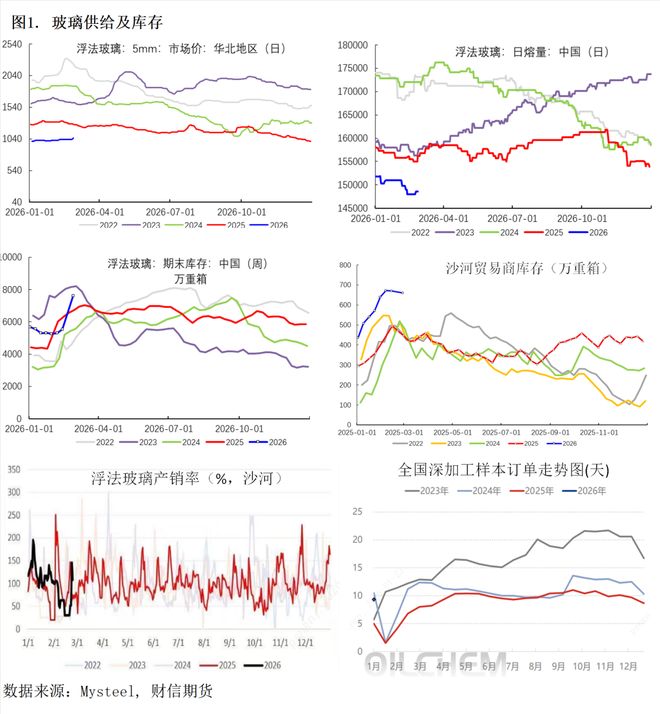
Core Viewpoint - The glass industry is currently experiencing weak demand and inventory accumulation, with prices showing slight adjustments in various regions, while the overall market remains cautious post-holiday [1][4][5]. Supply and Production - As of February 26, 2026, the national float glass daily production is 148,600 tons, with an industry operating rate of 70.61%. The weekly production is 1,038,400 tons, reflecting a month-on-month increase of 0.23% but a year-on-year decrease of 4.5% [1]. - The supply side has not seen significant changes during the holiday, with no new production lines expected to start due to environmental policy constraints [1][6]. Cost and Profitability - The average profit for float glass using natural gas as fuel is -142.26 CNY/ton, showing a month-on-month increase of 24.29 CNY/ton. In contrast, coal gas and petroleum coke have profits of -30.79 CNY/ton and 43.93 CNY/ton, respectively, with the latter remaining stable [2]. - The overall cost pressures are expected to rise due to the transition to gas as a fuel source, impacting the industry's cost structure [6]. Inventory Levels - As of February 26, 2026, the total inventory of float glass in sample enterprises is 76.008 million heavy boxes, marking a month-on-month increase of 2.0656 million heavy boxes (37.32%) and a year-on-year increase of 13.22%. The inventory days have increased to 33.8 days, up by 9.4 days from the previous period [2][4]. Demand and Market Conditions - The downstream demand has not yet recovered, with the main consumption areas slowly resuming operations. The Low-e market is particularly quiet, with limited transactions during the holiday period [4]. - The overall market sentiment is characterized by "neutral expectations and weak realities," with significant differentiation in the chemical market, leading to a decline in glass and related chemical products [4][5]. Price Trends - Current spot prices for float glass in Hubei and Shahe are at 1,110 CNY/ton and 1,030 CNY/ton, respectively, with futures prices also declining to around 981 CNY/ton and 1,058 CNY/ton, both near yearly lows [4][5]. - The market is expected to experience fluctuations around the average cost line, with a projected trading range for the main glass contract between 1,000 CNY/ton and 1,100 CNY/ton [6].
江盐集团:卤水提锂项目目前正在推进中
Mei Ri Jing Ji Xin Wen· 2026-02-27 09:17
Core Viewpoint - The company is currently advancing its lithium extraction project from brine, with further updates to be provided in future announcements [1] Group 1 - Investors inquired about the production and sales status of the company's lithium carbonate production line [1] - The company confirmed that the brine lithium extraction project is in progress [1]

江苏苏盐井神股份有限公司关于向特定对象发行股票发行结果暨股本变动公告
Shang Hai Zheng Quan Bao· 2026-02-26 18:25
Core Viewpoint - Jiangsu Suyuan Jingshen Co., Ltd. has successfully completed a private placement of shares, raising approximately 1.8 billion yuan through the issuance of 173,410,404 shares at a price of 10.38 yuan per share, with the funds intended for specific corporate purposes [2][8][11] Issuance Overview - The company issued 173,410,404 shares of ordinary A-shares at a price of 10.38 yuan per share, raising a total of 1,799,999,993.52 yuan, with a net amount of 1,794,245,834.04 yuan after deducting issuance costs [2][8][11] - The shares were fully subscribed in cash, with no asset transfers involved [11] Regulatory Process - The issuance followed a series of internal approvals, including board meetings and shareholder meetings, with necessary approvals from the Jiangsu Provincial State-owned Assets Supervision and Administration Commission and the China Securities Regulatory Commission [3][4] Subscription and Lock-up Period - The shares subscribed by the controlling shareholder's subsidiary, Suyuan Asset Management Co., Ltd., are subject to an 18-month lock-up period, while other subscribers have a 6-month lock-up period [2] Financial Performance - The company reported total assets of approximately 1.067 billion yuan and total liabilities of about 410.55 million yuan, indicating a reasonable level of asset and liability management [20] - The company's revenue and net profit have shown fluctuations, primarily due to market price volatility affecting the sales prices of its main products, including industrial salt and soda ash [22] Shareholder Structure Changes - Following the issuance, the controlling shareholder's stake decreased from 62.49% to 51.14%, while the subsidiary's stake increased from 0% to 1.02%, resulting in a combined holding of 52.16% [19] Underwriter and Legal Opinions - The underwriter, Huatai United Securities, confirmed that the issuance process adhered to fair and just principles, complying with relevant laws and regulations [13][14] - Legal opinions from Beijing Haotian Law Firm affirmed the legality and validity of the issuance process and documentation [14]

中盐化工:公司始终聚焦盐化工核心主业
Zheng Quan Ri Bao· 2026-02-25 11:41
Group 1 - The company, Zhongyan Chemical, focuses on its core salt chemical business and aims to consolidate and develop its advantageous products [2] - The company is exploring strategic emerging industries and will make acquisition decisions based on its strategic planning [2]

中盐化工股价涨5.32%,华夏基金旗下1只基金位居十大流通股东,持有478.16万股浮盈赚取224.73万元
Xin Lang Cai Jing· 2026-02-24 03:47
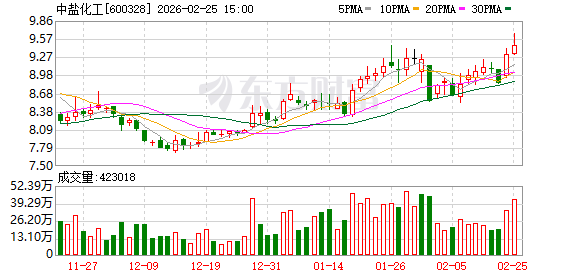
Group 1 - The core viewpoint of the news is that Zhongyan Chemical has seen a stock price increase of 5.32%, reaching 9.31 yuan per share, with a trading volume of 182 million yuan and a turnover rate of 1.36%, resulting in a total market capitalization of 13.651 billion yuan [1] - Zhongyan Chemical is located in Alxa League, Inner Mongolia, and was established on December 31, 1998, with its listing date on December 22, 2000. The company primarily engages in salt chemical business, with main products including sodium metal, soda ash, PVC resin, caustic soda, and calcium carbide [1] - The revenue composition of Zhongyan Chemical's main business includes soda ash and its by-products at 50.75%, resin products at 27.76%, sodium products at 9.72%, chlor-alkali products at 9.19%, and other categories [1] Group 2 - Among the top ten circulating shareholders of Zhongyan Chemical, Huaxia Fund has a fund that ranks among them. The Huaxia CSI 1000 ETF (159845) entered the top ten circulating shareholders in the third quarter, holding 4.7816 million shares, which accounts for 0.33% of the circulating shares [2] - The Huaxia CSI 1000 ETF (159845) was established on March 18, 2021, with a latest scale of 49.908 billion yuan. It has achieved an 8% return this year, ranking 1610 out of 5580 in its category, and a 33.65% return over the past year, ranking 1876 out of 4297 [2]