碳服务

Search documents
虹口成立绿色低碳服务工作专班 培育面向未来的产业集群 “探路队”为绿色转型蹚出新路
Jie Fang Ri Bao· 2026-01-19 01:50
Core Insights - The article discusses the establishment of a green low-carbon industry cluster in Hongkou District, Shanghai, aiming to grow the industry scale from nearly 60 billion to nearly 80 billion yuan by 2024 [1] Group 1: Industry Development - Hongkou District has initiated a collaborative effort led by the district mayor and various departments to promote green low-carbon services, forming a specialized task force [1] - The task force has successfully developed a statistical framework, termed "Hongkou Code," which clearly defines five key sectors: green shipping, finance, trade, technology, and carbon services, gaining recognition from municipal statistical authorities [2] - By 2024, Hongkou is expected to contribute two-thirds of the city's "dual carbon" project standards, having already published 14 relevant group standards since 2025 [3] Group 2: Project Implementation - The task force has faced challenges in implementing green projects, such as a rooftop solar project that was paused due to community opposition, which was resolved by addressing underlying issues like noise pollution [4] - Innovative solutions were applied to install solar panels on rooftops with space constraints, achieving significant wind resistance and successful integration of solar technology [5] Group 3: Ecosystem Support - The task force has shifted its role from being a regulatory body to becoming a supportive partner for enterprises, facilitating smoother operations and transactions [6] - Hongkou District has attracted over a thousand green low-carbon enterprises, employing various strategies such as forming industry alliances, launching special policies, and establishing dedicated funding to create a supportive ecosystem for the industry [7]
虹口这支专业团队,为大楼披上可发电的“新甲”
Xin Lang Cai Jing· 2026-01-18 06:08
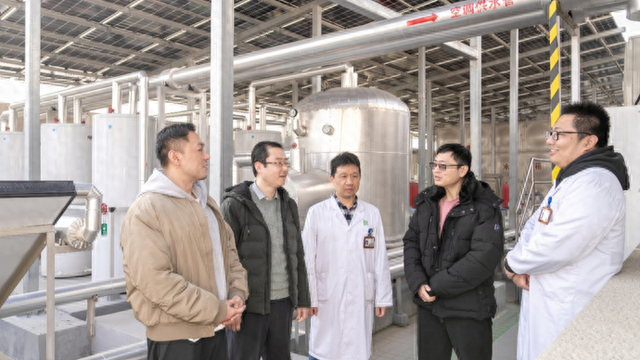
Core Insights - The article highlights the efforts of the Hongkou District Green Low-Carbon Service Task Force in successfully integrating photovoltaic panels on the rooftop of the Shanghai Integrated Traditional Chinese and Western Medicine Hospital, overcoming challenges posed by the building's height and existing equipment [3][4]. Group 1: Project Implementation - The task force collaborated with various entities, including the Shanghai Runtianlei New Energy Co., to ensure the photovoltaic components were seamlessly integrated with existing rooftop equipment, enhancing the project's wind resistance [3]. - The project transformed a previously deemed "unusable" rooftop into a functional energy-generating space, showcasing the task force's innovative approach to resource management and green energy solutions [3]. Group 2: Statistical Framework Development - Starting in 2024, Hongkou District will serve as a pilot area for green low-carbon services, necessitating the development of a precise statistical framework to measure the industry's growth [4]. - The task force, in collaboration with the Shanghai Energy Efficiency Center, created an industry map and statistical measurement system to reflect the local green low-carbon service industry, addressing challenges such as unclear statistical standards and data barriers [4]. - The initiative resulted in the establishment of the "Hongkou Code," a statistical framework that aligns with national standards while incorporating regional characteristics, gaining recognition from city-level authorities [4]. Group 3: Innovation and Ecosystem Development - The task force initiated the "Tianjiao Bay Cup" Green Low-Carbon Innovation and Entrepreneurship Competition to foster an entrepreneurial ecosystem and stimulate development within the sector [6]. - The competition facilitated connections between innovative companies and local projects, exemplified by Shanghai Lanjimi Technology Co., which proposed smart lighting solutions for an underground parking garage [6]. - The task force actively encourages green low-carbon enterprises to cluster in specialized parks, enhancing technological upgrades and supporting the growth of a vibrant green industry in Hongkou District [6]. Group 4: Industry Growth Metrics - Over the past two years, Hongkou District has seen the establishment of more than 50 new green low-carbon enterprises, with the industry scale approaching 800 billion yuan [7]. - The region has achieved a cumulative photovoltaic grid connection of over 20,000 kilowatts, indicating significant progress in renewable energy adoption [7].

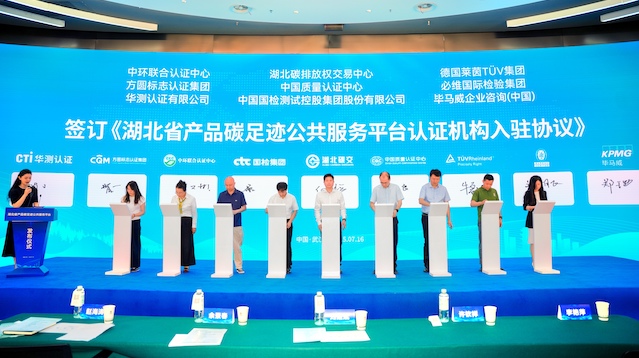
湖北启动产品碳足迹公共服务平台
Di Yi Cai Jing· 2025-07-16 09:41
Core Viewpoint - The establishment of the "Hubei Province Product Carbon Footprint Public Service Platform" marks a significant step in carbon footprint management, providing a comprehensive service for enterprises in carbon accounting, certification, labeling, and disclosure [1][3]. Group 1: Platform Services - The platform serves as a data aggregation center, management platform, and service hub for carbon footprint data in Hubei, offering a one-stop service for enterprises [1]. - The accounting module allows enterprises to create custom models or use embedded industry models to quickly build accounting frameworks, with 15 types of accounting models for key products like chemicals, batteries, and optical fibers [1][3]. - The certification module provides online application for report certification, audit tracking, and electronic certificate issuance, complying with IS014067 and GB/T24067 standards [3]. Group 2: Consumer Engagement and Data Analysis - The labeling module enables certified products to apply for exclusive QR code carbon labels, allowing consumers to trace the carbon emissions throughout the product's lifecycle [3]. - The disclosure module creates a multi-dimensional data dashboard for real-time analysis of regional and industry-specific carbon footprint distribution, aiding enterprises in benchmarking and supporting government policy-making [3]. Group 3: Future Development and Strategic Goals - The platform aims to leverage Hubei's carbon market and carbon finance center to promote green and low-carbon transformation in key industries, fostering strategic emerging industries such as automotive, telecommunications, lithium batteries, and recycling resources [4]. - The focus is on establishing a robust carbon footprint management system, enhancing international trust in carbon footprint rules, and continuously improving carbon footprint capabilities [3].