网络借贷

Search documents
年化400%!网贷高利新变种:分期商城与月系融担的最后疯狂
Xin Lang Cai Jing· 2026-01-12 03:20
Core Viewpoint - The new regulations on lending and small loans intended to curb high-interest online loans have not effectively stopped the emergence of new high-interest lending schemes, such as installment malls and monthly guarantee platforms, which continue to exploit users through hidden fees and exorbitant interest rates [1][21]. Installment Malls - Platforms like "Xiaoxiang Youpin" are using a model of "product installment + platform buyback" to disguise high-interest loans, with annualized interest rates exceeding 146.8% for some users [3][23]. - A specific example includes a gold bracelet priced at 14,029 yuan, where the total repayment amount reached 15,746.02 yuan, resulting in an annualized interest rate of 101.57% when calculated based on the buyback price of gold [4][5]. - Many users are unaware of the actual interest rates due to the lack of clear disclosures, leading to potential violations of consumer rights [29]. Monthly Guarantee Platforms - Monthly guarantee platforms are more straightforward in their approach, charging high guarantee service fees that push annualized interest rates above 400% [9][30]. - For instance, a user borrowed 5,200 yuan and ended up repaying 7,124 yuan, with a significant portion attributed to hidden guarantee fees [9][30]. - These platforms often do not disclose the actual lending institutions or interest rates, leading to confusion and potential exploitation of borrowers [32]. Market Dynamics - The rise of installment malls and monthly guarantee platforms is attributed to a combination of market demand for "subprime" loans and the short-sighted profit motives of the industry [36]. - Following the introduction of new lending regulations, many high-interest lending models have become unsustainable, prompting smaller platforms to innovate ways to bypass regulations [36][37]. - The current high-interest lending practices are seen as a "last hurrah" for the industry, as they are not sustainable in the long term due to high risks and regulatory scrutiny [39]. Recommendations for Regulation - There is a call for stricter enforcement of regulations that require all fees to be included in the total cost of loans, ensuring compliance with the 24% annualized interest rate cap [36][40]. - Recommendations also include the need for platforms to clearly disclose all costs and the identities of funding sources, as well as establishing a cross-departmental enforcement mechanism to combat deceptive practices [40].


警惕校园网贷陷阱,守护青春财富
招商银行App· 2025-11-27 06:27
Core Viewpoint - The article highlights the increasing prevalence of illegal campus online lending activities that exploit students' financial naivety and urgent consumption needs, leading them into debt traps that threaten their mental health and academic progress [2]. Group 1: Zero-Threshold Loans - Illegal lenders use advertisements claiming "zero-threshold loans" to entice students, often requiring them to repay amounts significantly higher than what they receive [3]. - Tactics include high service fees deducted upfront and extremely short repayment periods, which lead to exorbitant interest rates [6]. - Students are often coerced into borrowing from other platforms to repay initial loans, resulting in escalating debt [6]. Group 2: Order-Fraud Loans - Students are lured into "order-fraud" schemes, where they are promised high earnings for completing tasks, leading them to take out loans that they must repay without receiving any actual income [8]. - Initial small payments create a false sense of security, but the lenders eventually disappear, leaving students responsible for the full loan amount [11]. Group 3: Beauty Loans - The "beauty loan" scheme ties cosmetic procedures to high debt, with students misled into believing they can repay loans through part-time work that turns out to be a scam [13]. - The loans often come with hidden fees and high-interest rates disguised as "no service charge" offers [15][16]. Group 4: Campus Loan Cancellation Scams - Scammers impersonate customer service representatives, claiming that students need to clear their campus loan accounts to avoid negative impacts on their credit scores, leading to fraudulent transfers [18]. - These scams utilize psychological tactics, such as creating a sense of urgency and fear regarding employment prospects, to manipulate students into transferring money [21].

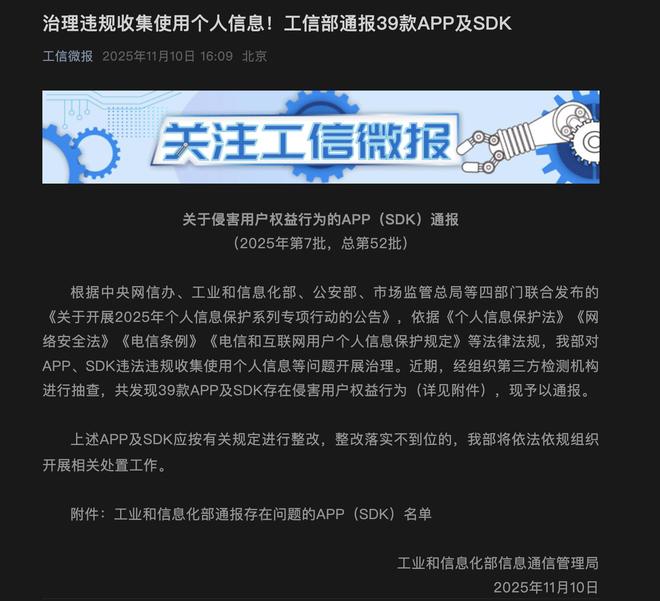
工信部通报“拍拍贷”隐私违规,网贷平台个人信息保护再敲警钟
Guan Cha Zhe Wang· 2025-11-11 09:26
Core Viewpoint - The news highlights the privacy policy issues faced by the online lending platform, Paipaidai, which has been criticized for its "default consent" practice regarding user data, reflecting significant shortcomings in user information protection mechanisms [1][4][10]. Group 1: Regulatory Actions - The Ministry of Industry and Information Technology (MIIT) has named Paipaidai for violating user rights through its "default consent" privacy policy, marking it as part of a broader initiative to protect personal information [3][4]. - This inspection is part of a series of special actions launched in 2025 to enforce compliance with the Personal Information Protection Law and the Cybersecurity Law [3]. Group 2: Compliance Challenges - Paipaidai's parent company, Xinye Technology, faces dual challenges of business expansion and compliance governance, particularly as it transitions from a P2P platform to a financial technology service provider [3][10]. - The company has a vast user base, with hundreds of millions of registered users, which raises the stakes for data compliance and protection [10][11]. Group 3: User Complaints and Violations - As of November 2025, there have been over 74,000 complaints against Paipaidai, with 19,000 related to "violent collection" practices and 4,000 concerning personal information issues [6]. - Users have reported that the platform disclosed their overdue loan information to friends and family without consent, causing distress [9][10]. Group 4: Industry Implications - The case of Paipaidai illustrates the need for financial technology companies to balance business innovation with compliance governance to achieve sustainable development [12]. - The regulatory focus on personal information protection signifies a critical shift in the industry, emphasizing the importance of integrating user rights into product design and operational processes [11][12].
《中国审判》收录最高法判玖富为案例,平台系中介不担赔偿责任
Sou Hu Wang· 2025-09-30 05:08
Core Viewpoint - The article discusses a significant legal case regarding online lending platforms in China, specifically focusing on the ruling that a platform, Beijing Jiufu Puhui Information Technology Co., Ltd., is classified as an information intermediary and not liable for repayment in a civil lending dispute [3][6]. Group 1: Case Overview - The case involves a lender, Wang, who sued Jiufu Puhui after a borrower defaulted on a loan facilitated through the platform [5]. - The case is notable as it is the only one in the P2P industry that has reached the Supreme Court for a ruling, highlighting its importance and authority [5]. - The Supreme Court's decision clarified that the relationship between Wang and Jiufu Puhui is one of an intermediary contract rather than a direct lending relationship [6]. Group 2: Legal Analysis - The court found that there was no evidence of a lending agreement between Wang and Jiufu Puhui, as no loan contract was signed, and thus, no lending intent was established [6][7]. - The ruling emphasized that the lack of a lending agreement and the nature of the intermediary services provided by Jiufu Puhui were critical in determining the legal relationship [7]. - The article notes that the case serves as a reference for similar cases across various courts, aiming to standardize judicial interpretations and avoid inconsistent rulings [3][7]. Group 3: Implications for the Industry - The case reflects the evolving nature of internet finance and the complexities involved in online lending disputes, marking it as a new type of legal conflict [7]. - The ruling indicates a trend in judicial decisions favoring the classification of online lending platforms as intermediaries, which may influence future regulatory frameworks and legal interpretations in the industry [7]. - The article suggests that lenders should pursue claims against actual borrowers rather than platforms, as the latter are not considered liable for repayments [7].

消费者质疑网贷莫名收费 记者介入平台退费和解
Huan Qiu Wang Zi Xun· 2025-06-13 10:17
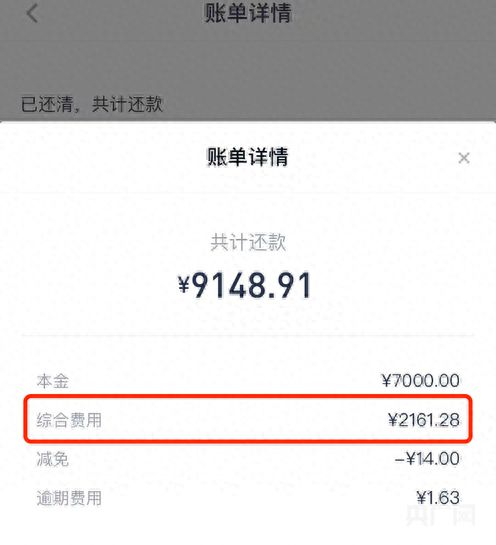
Core Viewpoint - A consumer in Chengdu, Ms. Ma, reported issues with a domestic online lending platform, including unexpected "comprehensive fees" and automatic subscription to services without her consent [1][2][12]. Group 1: Consumer Complaints - Ms. Ma began borrowing from the platform in 2021, with varying loan amounts and repayment terms, noticing annualized interest rates of 24% and 36% [2][13]. - She expressed confusion over the "comprehensive fees" included in her repayments, which amounted to 2,161.28 yuan for a loan of 7,000 yuan [4][13]. - Attempts to view her loan contract were met with redirects to a third-party risk detection page, which required additional fees to access [6][8]. Group 2: Platform Response - The platform's representative confirmed that the "comprehensive fees" were calculated based on the annualized interest rate and included "interest + guarantee service fee," totaling 9,161.28 yuan for repayment [13]. - The platform agreed to refund the "membership fees" and "third-party risk detection fees" that were charged without Ms. Ma's consent, reaching a settlement [12][14]. Group 3: Industry Practices - The incident highlights potential issues within the online lending industry, such as unclear fee structures and automatic subscription practices that may infringe on consumer rights [15][17]. - Legal experts suggest consumers should thoroughly review loan contracts and be cautious of automatic renewals for services they did not explicitly agree to [15][16][17].
1至2月社零总额增长4%,一线城市二手房价转降 | 财经日日评
吴晓波频道· 2025-03-18 00:31
Group 1: Consumer Market Performance - In January and February, the total retail sales of consumer goods reached 83,731 billion yuan, a year-on-year increase of 4%, which is 0.5% faster than the entire previous year [1] - Retail sales excluding automobiles amounted to 76,838 billion yuan, growing by 4.8% [1] - The retail sales of goods were 73,939 billion yuan, with a year-on-year growth of 3.9%, while catering revenue was 9,792 billion yuan, increasing by 4.3% [1][2] Group 2: Government Consumption Stimulus Measures - The State Council released a special action plan to boost consumption, proposing measures such as expanding income channels and stabilizing the stock market [3] - The plan emphasizes the importance of increasing residents' income and providing consumption subsidies to stimulate spending [3][4] - The plan also includes measures to improve the business environment for enterprises, which is crucial for increasing residents' wage income [3] Group 3: Real Estate Market Trends - In February, the second-hand housing prices in first-tier cities showed a slight decline, while new housing prices remained stable [5][6] - Real estate development investment in January and February was 1,072 billion yuan, a year-on-year decrease of 9.8%, but the decline was narrower than the previous year [5] - The market is experiencing a divergence, with core cities showing resilience while non-core areas may take longer to recover [6] Group 4: Company-Specific Financial Performance - CATL reported a 15% increase in net profit for 2024, despite a 9.7% decline in revenue, marking the first revenue drop in nearly a decade [7] - The sales volume of power battery systems and energy storage systems increased by 18.85% and 34.32%, respectively, although revenue from these segments declined [7][8] - The company is increasing capital expenditure to expand production and strengthen its global market share [8] Group 5: Market Dynamics in the Chip Industry - Samsung and SK Hynix joined the trend of increasing storage chip prices, with expected price hikes of around 10% or more starting in April [13][14] - The chip industry is experiencing a supply-demand mismatch due to previous overproduction and subsequent market recovery not meeting expectations [13] - The demand for storage chips is anticipated to grow with the advancement of AI and smart driving technologies, although the market remains volatile [14] Group 6: Stock Market Overview - The stock market experienced narrow fluctuations with the Shanghai Composite Index rising by 0.19% on March 17, with a total trading volume of 1.57 trillion yuan [15][16] - Market sentiment was affected by the lack of specific consumption policy details, leading to a mixed performance across various sectors [15][16] - The influx of new retail investors has changed the market dynamics, making it challenging for traditional investors to navigate [16]

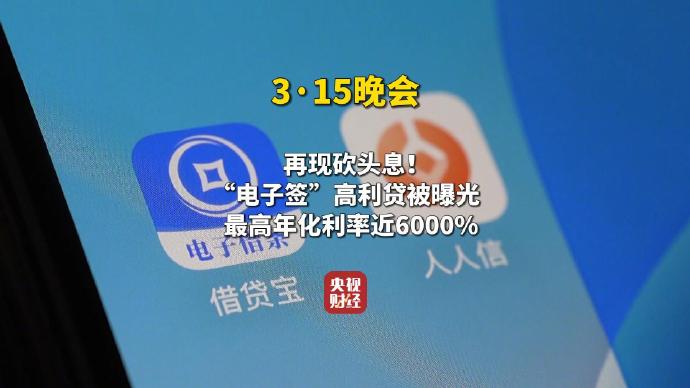
“砍头息”再现!315晚会曝光电子签高利贷 电子签放款人竟不是活人
Zheng Quan Shi Bao Wang· 2025-03-15 13:02
Core Insights - The article highlights the rising concerns regarding the use of electronic signatures in online lending platforms, particularly focusing on high-interest loans and predatory lending practices [1][2] - It reveals that many borrowers are unaware of the true costs associated with loans facilitated through electronic signatures, leading to significant financial losses [1] Group 1: Electronic Signature Platforms - Electronic signature platforms like "借贷宝" and "人人信" are being used to facilitate high-interest loans, often resulting in borrowers receiving much less than the amount they signed for [1] - The platforms allow lenders to operate under false identities, making it difficult for borrowers to pursue legal action in case of disputes [2] Group 2: Borrower Experiences - Borrowers like 洪先生 and 王女士 reported receiving significantly lower amounts than what they borrowed, with 洪先生 receiving 3500 yuan instead of 5000 yuan and 王女士 receiving 14000 yuan instead of 30000 yuan [1] - The article emphasizes that the electronic signature agreements do not protect borrowers from high-interest rates and aggressive collection practices [1] Group 3: Platform Accountability - The business model of these platforms appears to prioritize profit over borrower protection, as they collect fees from borrowers while allowing lenders to evade responsibility [2] - The claim of "real-name authentication" on these platforms is deemed ineffective, as it does not prevent fraudulent activities [2]