
航空物流等

Search documents
广东支持开展产业链整合,推动国企兼并优质资源
Huan Qiu Wang· 2025-11-27 01:23
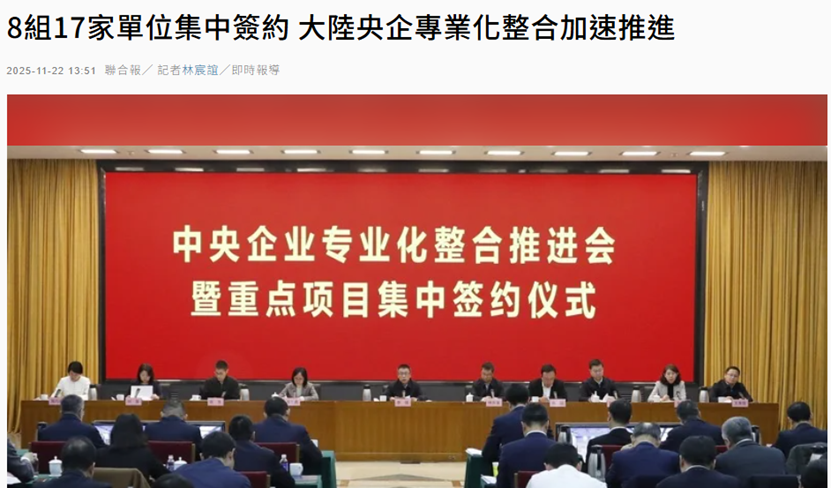
Group 1 - Guangdong Province has introduced a financial support plan for enterprises to conduct industrial chain integration and mergers, aiming to enhance the quality of listed companies and facilitate the integration of state-owned enterprises with quality resources [1] - The State-owned Assets Supervision and Administration Commission (SASAC) held a meeting to promote the professional integration of central enterprises, resulting in the signing of key projects involving 17 units across 8 groups in critical sectors such as new materials, artificial intelligence, cruise operations, inspection and testing, and air logistics [1][4] Group 2 - Professional integration refers to enterprises breaking boundaries through asset restructuring, equity cooperation, asset replacement, non-compensatory transfer, and strategic alliances, concentrating resources towards advantageous and core enterprises [4] - Since 2024, central enterprises have been adjusting their stock and optimizing their increment to align with national strategies, promote technological innovation, and enhance high-quality development through a series of integrations, thereby optimizing industrial layout and improving resource allocation efficiency [4]

官宣!组建新央企!
券商中国· 2025-11-22 04:58
Core Viewpoint - The article discusses the recent signing of key projects aimed at promoting specialized integration among central enterprises in China, focusing on strategic emerging industries and optimizing traditional sectors for high-quality development [1][2]. Group 1: Key Projects and Areas of Focus - A total of 8 groups consisting of 17 units signed key projects, primarily in critical fields such as new materials, artificial intelligence, cruise operations, inspection and testing, and air logistics [1]. - The integration projects aim to accelerate breakthroughs in core technologies and enhance the scale and strength of strategic emerging industries while optimizing resource allocation [1][2]. Group 2: Cruise Industry Development - China Tourism Group is leading the establishment of a central enterprise cruise operation platform, which will result in the largest fleet in Asia post-integration [1]. - The cruise industry has a significant multiplier effect, with every 1 yuan of revenue generating 10 to 14 yuan in economic benefits for related upstream and downstream industries [1]. Group 3: Government's Strategic Direction - The State-owned Assets Supervision and Administration Commission (SASAC) emphasizes that specialized integration must align with future industry and technology trends, focusing on long-term growth rather than short-term scale [2]. - SASAC's deputy director calls for deepening core business operations, enhancing resource allocation efficiency, and focusing on high-quality development through the integration of quality resources along the industrial chain [2]. Group 4: Company Overview - China Tourism Group is a significant state-owned enterprise directly managed by the central government, with a history dating back to 1923 and a diverse business portfolio including travel agencies, scenic spots, hotels, and cruise operations [3]. - The group operates in over 30 countries and regions, employs more than 42,000 people, and has total assets exceeding 200 billion yuan, serving over 80 million tourists annually [3].
国务院国资委释放央企专业化整合重要信号:多用善用资本市场 行业资源配置向“新”向“高”
Shang Hai Zheng Quan Bao· 2025-11-22 01:48
Core Viewpoint - The State-owned Assets Supervision and Administration Commission (SASAC) emphasizes the importance of utilizing capital markets and mergers for the professional integration of central enterprises, aiming to enhance the integration capabilities of strategic emerging industries [1][2]. Group 1: Key Directions for Professional Integration - The focus of the next phase of professional integration will be on optimizing industry resource allocation, supporting leading enterprises in restructuring, and enhancing scale effects [2]. - Integration efforts will target high-end sectors to acquire critical resources and technologies, extending into high-end market shares [2]. - Internal consolidation of similar business units within central enterprises is a priority to eliminate redundant operations and improve overall efficiency [2]. Group 2: Strategic Initiatives and Requirements - Central enterprises are encouraged to explore the injection of non-core but growth-potential strategic emerging businesses into other core enterprises for mutual benefits [2]. - A comprehensive review and integration of human resources, technology, and market aspects of merged units are required to enhance collaboration and operational efficiency [3]. - The integration process should also focus on brand consolidation to strengthen brand cohesion and influence [3]. Group 3: Implementation and Future Contributions - Central enterprises are urged to adopt systematic thinking and innovative measures to enhance the efficiency of state capital allocation and operations [3]. - The meeting resulted in the signing of key projects involving 17 units across critical sectors such as new materials, artificial intelligence, cruise operations, inspection and testing, and air logistics [3].
国务院国资委释放央企专业化整合重要信号 多用善用资本市场 行业资源配置向“新”向“高”
Shang Hai Zheng Quan Bao· 2025-11-21 18:43
Core Viewpoint - The State-owned Assets Supervision and Administration Commission (SASAC) emphasizes the importance of utilizing capital markets and mergers for the professional integration of central enterprises, aiming to enhance the integration capabilities of strategic emerging industries [1][2]. Group 1: Key Directions for Professional Integration - The focus of the next phase of professional integration will be on optimizing industry resource allocation, supporting leading enterprises in restructuring their business layouts, and enhancing scale effects [2]. - Integration efforts will target high-end sectors to acquire critical resources and technologies, extending into high-end market shares [2]. - Internal consolidation of similar business units within central enterprises is a priority, aiming to eliminate low-level redundant construction and improve overall efficiency [2]. Group 2: Strategic Initiatives and Requirements - Central enterprises are encouraged to explore the injection of non-core but growth-potential strategic emerging businesses into other core enterprises for mutual benefits [2]. - A comprehensive review and integration of human resources, technology, and market aspects of merged units are required to deepen collaboration among business segments [3]. - The integration process should also focus on enhancing internal brand cohesion and influence through a structured brand architecture [3]. Group 3: Future Actions and Project Signings - Central enterprises are urged to adopt systematic thinking and innovative measures to enhance the efficiency of state capital allocation and operation [3]. - A total of 17 units from 8 groups signed key projects in critical fields such as new materials, artificial intelligence, cruise operations, inspection and testing, and air logistics [3].
重磅!央企整合重点项目集中签约!
Zheng Quan Ri Bao Wang· 2025-11-21 12:08
Core Viewpoint - The State-owned Assets Supervision and Administration Commission (SASAC) held a meeting to promote the specialized integration of central enterprises, emphasizing the importance of optimizing the layout and structure of state-owned economy as per the directives from the 20th Central Committee [1] Group 1 - Central enterprises have placed significant emphasis on specialized integration work, continuously adjusting existing resources and optimizing new resources to support national strategies, promote technological innovation, and facilitate high-quality development since last year [1] - A series of integrations have been carried out to further optimize industrial layout, improve resource allocation efficiency, and enhance core competitiveness of enterprises [1] - The meeting outlined new tasks and requirements for the current phase, focusing on proactive planning, strategic leadership, and preventing internal competition while optimizing industry resource allocation [1] Group 2 - Eight groups consisting of 17 units signed key project agreements in two batches, covering critical areas such as new materials, artificial intelligence, cruise operation, inspection and testing, and air logistics [1] - The meeting emphasized the need for enterprises to enhance their integration capabilities, create integrated competitive advantages, and promote collaborative efforts to form a cohesive working force [1]