专业化整合

Search documents
能源央企资产大整合提速
中国能源报· 2026-02-09 03:28
Core Viewpoint - The restructuring of state-owned enterprises (SOEs) in the energy sector, particularly in electricity, reflects the strategic intent of the State-owned Assets Supervision and Administration Commission (SASAC) to optimize the layout and structure of the state-owned economy, with a focus on integrating traditional and renewable energy assets [1][3][10]. Group 1: Restructuring Actions - In 2025, the State Power Investment Corporation (SPIC) expects a net profit of approximately 51.69 million yuan, a year-on-year increase of about 48.1 million yuan, representing a growth of approximately 1337% due to significant asset restructuring [3]. - The restructuring efforts involve over ten central enterprises in the electricity sector, including SPIC and China Huadian Corporation, which are advancing large-scale asset integration through suspensions and reorganizations [3][5]. - In 2025 alone, five major electricity SOEs initiated restructuring projects exceeding 100 billion yuan, focusing on optimizing core assets in nuclear power, renewable energy, and coal power [7]. Group 2: Industry Trends - The electricity sector is a key area for SOE restructuring, with numerous cases of mergers and acquisitions in recent years, such as the acquisition of high-quality wind power assets by Inner Mongolia Huadian and the restructuring of China Rare Earth Group with China Minmetals [5]. - Professional integration has become the mainstream model for mergers and acquisitions among SOEs, focusing on breaking down enterprise boundaries and concentrating resources on leading enterprises and core businesses [7][11]. - The restructuring of energy SOEs is expected to significantly impact the industry landscape, enhancing competitiveness and capital market dynamics, while promoting a transition towards cleaner and more efficient energy production [10][12]. Group 3: Policy and Future Directions - The SASAC has positioned 2025 as a critical year for deepening state-owned enterprise reforms, emphasizing strategic restructuring and the concentration of state capital in key areas such as renewable energy and digitalization of the power grid [9][13]. - Future restructuring efforts will focus on industry chain collaboration and regional integration, particularly in strategic fields like renewable energy and digital economy [13][14]. - The integration of advanced digital technologies with production operations is anticipated to enhance decision-making and efficiency in asset and business restructuring, addressing the reverse distribution of energy resources across regions [14].

一周要闻|全球市场1月30日当周回顾与下周展望
Sou Hu Cai Jing· 2026-02-01 11:26
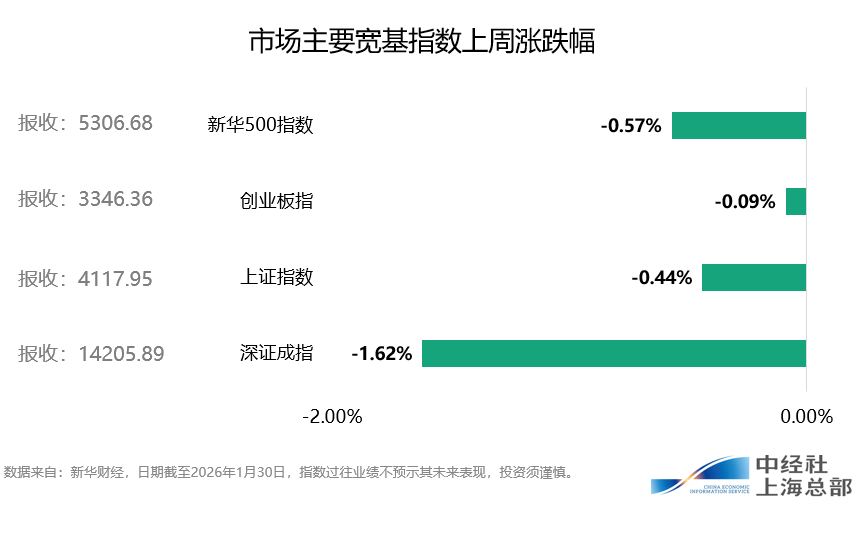
Stock Market Overview - The A-share market indices experienced declines during the week from January 26 to January 30, with the Shanghai Composite Index down by 0.44%, the Shenzhen Component down by 1.62%, the ChiNext Index down by 0.09%, and the Xinhua 500 Index down by 0.57% [1] - The Xinhua 500 Index showed increased volatility, opening at 5354.57 points and closing at 5306.68 points, with a weekly fluctuation of 3.01% and a total trading volume of 5.11 trillion yuan [1] Industry Performance - Most industry indices in the Shenwan first-level sectors declined, with the petroleum and petrochemical, telecommunications, coal, and non-ferrous metals sectors showing the largest gains, while the defense, electric equipment, automotive, and computer sectors experienced significant declines [4] US Stock Market - The US stock indices showed a mixed performance, with the S&P 500 Index rising by 0.34% for the week and 1.32% for January, marking its best monthly performance since October of the previous year [6] - The Dow Jones Industrial Average fell by 0.42% for the week but gained 1.73% in January, while the Nasdaq Composite Index decreased by 0.17% for the week and rose by 0.95% for January [6][7] Commodity Market - In the last trading week of January, precious metals experienced extreme volatility, with gold prices nearing $5600 per ounce before a significant reversal, closing down by 9.6% to around $4860 per ounce [8] - Silver prices also saw a dramatic drop, falling over 30% during the week but closing at approximately $85 per ounce [8] - Despite the weekly declines, COMEX gold futures recorded a 13% increase for January, while COMEX silver saw a monthly rise of over 20% [8][9] - International oil prices rose for four consecutive trading days, with Brent crude oil reaching $70 per barrel at one point, and WTI crude oil increasing by 7.65% for the week and 14.49% for January [8][9] Foreign Exchange Market - The US dollar index rebounded following the nomination of Kevin Warsh as the next Federal Reserve Chair, although it still fell by 0.4% for the week and 1.17% for January [10] - The euro and pound against the dollar rose for the second consecutive week, with the euro increasing by 0.2% for the week and 0.9% for January, and the pound rising by 0.29% for the week and 1.57% for January [10] Economic Indicators - The manufacturing Purchasing Managers' Index (PMI) for January was reported at 49.3%, a decrease of 0.8 percentage points from the previous month, indicating a slight contraction in the manufacturing sector [11] - The production index was above the critical point at 50.6%, while the new orders index fell to 49.2%, suggesting a decline in market demand [11]
中国神华资产重组获受理 或成为上交所首个适用简易审核程序案例
Xin Hua Cai Jing· 2026-01-31 13:00
Core Viewpoint - China Shenhua has announced the issuance of shares and cash payment to acquire equity from 12 core enterprises under its controlling shareholder, the State Energy Investment Group, and has received acceptance from the Shanghai Stock Exchange for its application [1][2]. Group 1: Transaction Details - The proposed transaction involves a significant asset scale exceeding one hundred billion yuan [1]. - The Shanghai Stock Exchange has accepted the application for the issuance of shares to purchase assets and raise matching funds, confirming that the application documents are complete and in legal form [1]. Group 2: Simplified Review Process - This transaction is expected to be the first case to apply the simplified review process under the Shanghai Stock Exchange's new rules, which allows for expedited review for certain qualifying transactions [1][2]. - The simplified review process is designed for well-governed companies with robust information disclosure, enhancing review efficiency for high-quality enterprises [2]. Group 3: Strategic Intent - The restructuring aims to achieve professional integration of coal and related assets within the State Energy Group, addressing long-standing issues of intra-industry competition and creating a more complete industrial chain [2].

扎实做好新央企组建和战略性重组
Xin Lang Cai Jing· 2026-01-30 04:13
Core Viewpoint - The State-owned Assets Supervision and Administration Commission (SASAC) is focusing on the "three concentrations" of state capital, emphasizing restructuring and integration to optimize the layout and structure of state-owned enterprises (SOEs) and accelerate the creation of world-class enterprises [1] Group 1: Restructuring and Integration - SASAC will solidify the establishment of new central enterprises and strategic restructuring, highlighting the role of central enterprises in strategic security, industry leadership, national economy and people's livelihood, and public services [1] - The next steps involve promoting professional integration, supporting innovative enterprises to lead horizontal integration of similar businesses and vertical integration along the industry chain, thereby reducing industry "involution" [1] Group 2: High-Quality Mergers and Acquisitions - Central enterprises will be encouraged to conduct high-quality mergers and acquisitions to acquire core elements, seize technological advantages, and accelerate the development of strategic emerging industries and future industries [1] - There will be a further strengthening of restructuring and integration to maximize the release of reform dividends, continuously enhance core functions, and improve core competitiveness [1]
新华财经早报:1月29日
Sou Hu Cai Jing· 2026-01-28 23:56
Group 1: Tax and Economic Policies - In 2026, the tax authorities will deepen tax system reforms, focusing on expanding local tax sources and increasing local financial autonomy [1] - In 2025, tax revenue reached 33.1 trillion yuan, with tax reductions and refunds exceeding 2.8 trillion yuan to support technological innovation and manufacturing [1] Group 2: State-Owned Enterprises and Mergers - The State-owned Assets Supervision and Administration Commission (SASAC) will promote professional integration among state-owned enterprises (SOEs) to support high-quality mergers and acquisitions [1] - SASAC aims to enhance core functions and competitiveness through restructuring and integration of SOEs [1] Group 3: Company Performance Forecasts - Industrial Fulian expects a net profit of 35.1 billion to 35.7 billion yuan for 2025, a year-on-year increase of 51% to 54%, driven by strong growth in cloud computing [1] - iFlytek anticipates a net profit of 785 million to 950 million yuan for 2025, representing a growth of 40% to 70% [1] - Other companies such as Jingneng Power and Jibite forecast significant profit increases, with Jingneng Power expecting a growth of 89.04% to 118.34% for 2025 [4] Group 4: Market and Economic Indicators - The total telecom business volume in 2025 is projected to grow by 9.1%, with telecom revenue reaching 1.75 trillion yuan, a 0.7% increase [1] - Public fund assets in China reached a record high of 37.71 trillion yuan by the end of December 2025, with significant growth in stock and bond funds [1]

资源股全面爆发,沪指半日收涨0.49%
Mei Ri Jing Ji Xin Wen· 2026-01-28 04:45
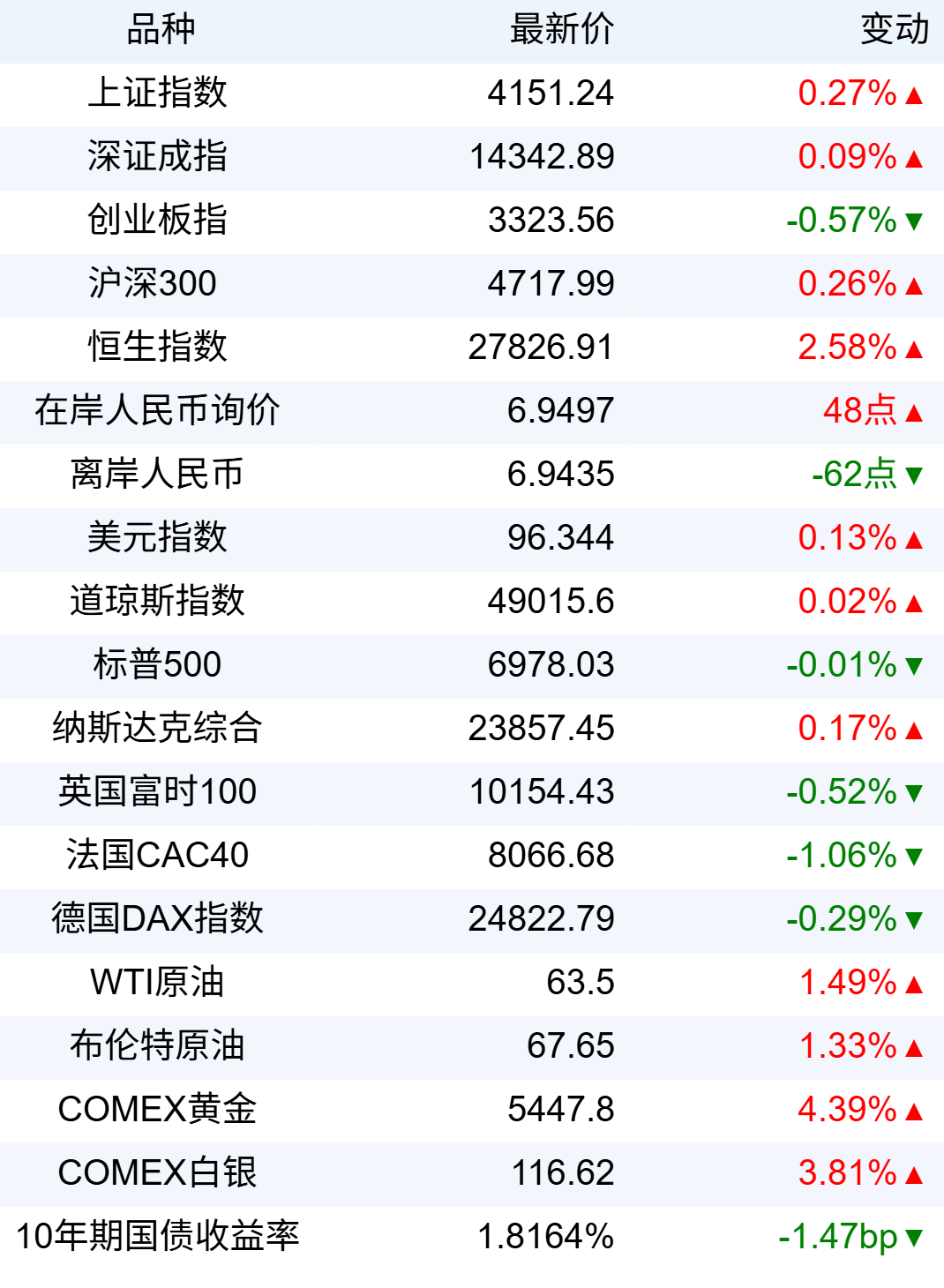
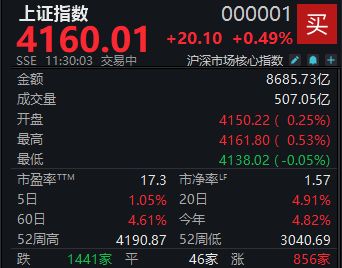
Market Overview - A-shares experienced a narrow range of consolidation with resource stocks showing a broad-based increase, as of January 28, the Shanghai Composite Index rose by 0.49% to 4160.01 points, while the Shenzhen Component Index increased by 0.09% [1] - The total trading volume in A-shares reached 1.93 trillion yuan [1] Economic Indicators - The People's Bank of China conducted a 7-day reverse repurchase operation of 377.5 billion yuan at a fixed rate of 1.4%, with a net injection of 14 billion yuan for the day [2] Energy Sector Insights - The National Energy Administration reported that by the end of 2025, the cumulative installed power generation capacity in China is expected to reach 3.89 billion kilowatts, a year-on-year increase of 16.1%. Solar power capacity is projected to reach 1.2 billion kilowatts, up 35.4%, while wind power capacity is expected to reach 640 million kilowatts, up 22.9% [3] - The State-owned Assets Supervision and Administration Commission emphasized the importance of central enterprises in strategic security and public service, promoting professional integration and innovation [3] Commodity Market Performance - International gold prices surpassed $5,200 per ounce, leading to a surge in the gold and non-ferrous metal sectors, with several companies, including China Gold and Sichuan Gold, hitting their daily price limits [3] - International oil prices reached a new high, with the oil and gas sector performing strongly, particularly China National Offshore Oil Corporation, which saw a price increase of over 7% [3] Sector Performance - The oil sector led with an average increase of 5.18%, followed by non-ferrous metals at 4.54% and coal at 2.52%. In contrast, the healthcare sector saw a decline of 2.02% [4] Company Insights - **Sinopec Oilfield Service**: Benefiting from the "increasing reserves and production" policy, the company is expected to maintain high capital expenditure from its parent company, providing support for workload and profitability [8] - **Zhongman Petroleum**: The company is expected to continue good performance due to rapid growth in oil and gas production [8] - **China National Offshore Oil Corporation**: The company shows resilience in performance during oil price downturns, with a focus on both oil and gas and renewable energy businesses [8] - **CNOOC Oilfield Services**: As a leader in offshore oil and gas equipment, the company is expected to enjoy valuation premiums due to steady growth in oilfield technology and ongoing expansion in deep-sea technology [8]




国务院国资委谈央企重组:减少行业内卷,支持央企高质量并购
Nan Fang Du Shi Bao· 2026-01-28 04:38
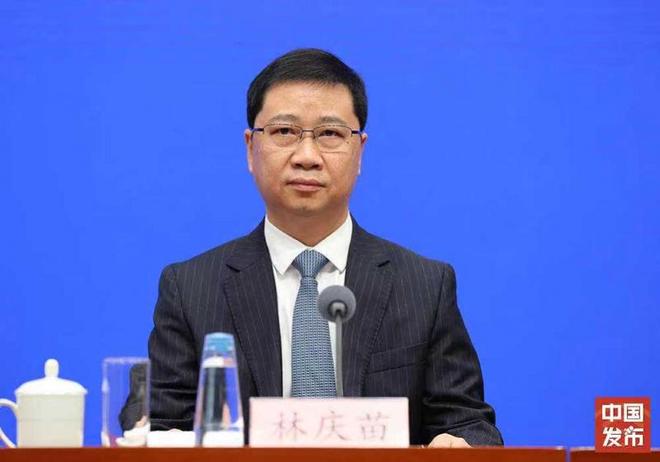
Group 1 - The State-owned Assets Supervision and Administration Commission (SASAC) is focusing on professional integration and supporting innovative enterprises to lead horizontal and vertical integration within industries to reduce internal competition [1][3] - In the past year, significant progress has been made in the restructuring of state-owned enterprises (SOEs), including the establishment of China Yajiang Group and China Chang'an Automobile Group, aimed at enhancing energy security and promoting high-quality development in the smart connected electric vehicle sector [3] - The SASAC has also facilitated the integration of resources in the cruise operation sector, creating a "national team" for China's cruise industry, and has supported companies like China FAW in integrating resources for power batteries to boost the high-quality development of new energy vehicles [3] Group 2 - The SASAC emphasizes the importance of SOEs in strategic security, industry leadership, and public service, aiming to strengthen and optimize these enterprises [3] - There is a commitment to further professional integration and high-quality mergers and acquisitions to foster the development of strategic emerging industries and future industries [3] - The goal is to maximize the benefits of reform, enhance core functions, and improve core competitiveness through deeper integration and restructuring [3]
当2.8万亿能源巨无霸降临
36氪· 2026-01-21 14:33
Core Viewpoint - The merger between Sinopec and China Aviation Oil aims to create a national energy powerhouse that can compete with international giants while focusing on carbon neutrality and supply chain security [4][6]. Group 1: Merger Announcement and Initial Actions - The merger announcement on January 8, 2026, revealed the formation of a new entity with total assets of nearly 2.8 trillion yuan and annual revenue exceeding 3 trillion yuan [4]. - Both companies have initiated the integration of their production and procurement systems, establishing a working group to optimize the supply chain from refineries to fuel pumps [5][9]. - The core principle of the merger is "professional integration" rather than mere scale expansion, indicating a shift in competition from channel-based to efficiency and cost-based [6][7]. Group 2: Industry Impact and Reactions - The merger has triggered a restructuring of the aviation fuel supply chain, affecting upstream suppliers, midstream refiners, and downstream airlines [5][16]. - Smaller refining companies and independent traders are feeling pressure as the procurement system is expected to favor Sinopec, potentially reducing orders from China Aviation Oil by at least 30% in the next couple of years [19]. - Some companies are exploring alliances with other large refiners to enhance their bargaining power and are reassessing direct supply options to airports [19][20]. Group 3: User Perspective and Concerns - Airlines, as the end users of aviation fuel, are closely monitoring the merger's impact on their procurement costs, which typically account for over 30% of their total operating expenses [28]. - While the merger could enhance supply stability and reduce costs, there are concerns about diminished bargaining power as China Aviation Oil and Sinopec become a single entity [28][29]. - Airlines are exploring alternative supply channels and considering sustainable aviation fuel (SAF) as a key variable in future negotiations [32][33]. Group 4: Regulatory and Future Considerations - The merger raises questions about market competition and potential monopolistic behavior, prompting expectations of regulatory scrutiny from the State Administration for Market Regulation [35][36]. - The integration is also seen as a step towards accelerating the decarbonization of the aviation industry, with both companies having complementary strengths in SAF technology and distribution networks [36][37]. - Successful implementation of the merger will depend on optimizing the value chain and enhancing global competitiveness while navigating regulatory challenges [38].


当2.8万亿能源巨无霸降临
经济观察报· 2026-01-18 05:54
Core Viewpoint - The restructuring of China Petroleum & Chemical Corporation (Sinopec) and China Aviation Oil (China National Aviation Fuel Group) aims to create a powerful national entity capable of competing with international energy giants, driven by the dual goals of carbon neutrality and supply chain autonomy [2][4][6]. Group 1: Restructuring Overview - The merger combines Sinopec's extensive refining capabilities with China Aviation Oil's nationwide airport network, creating a comprehensive supply chain from refinery to fuel pump [2][3]. - The restructuring is not merely a scale expansion but focuses on "professional integration" to enhance efficiency and cost competitiveness across the entire aviation fuel industry [4][5]. - A clear timeline and task requirements have been set by the State-owned Assets Supervision and Administration Commission (SASAC) to ensure effective integration and realization of synergies [6]. Group 2: Operational Changes - Following the announcement, both companies initiated immediate actions, including establishing daily information sharing mechanisms and forming joint teams to identify overlapping and complementary resources [8][9]. - The integration aims to streamline logistics and production planning, potentially optimizing supply chain efficiency by reducing intermediary steps [10][12]. - In regions with existing infrastructure, such as the Guangdong-Hong Kong-Macao Greater Bay Area, teams are conducting on-site assessments to create direct supply networks from refineries to airports [14]. Group 3: Market Impact on Midstream Players - The merger has raised concerns among midstream players, including small refining companies and independent traders, who fear losing market share as China Aviation Oil may prioritize Sinopec's supply [17][18]. - Some companies are exploring alliances with other large refiners to enhance their bargaining power and are reassessing direct supply options to airports [19][21]. - The restructuring is expected to lead to a market reshuffle, pushing smaller firms towards specialization and service-oriented business models [24]. Group 4: User Perspective - Major airlines are closely monitoring the restructuring, as aviation fuel costs represent over 30% of their total operating expenses [27]. - While the integration may enhance supply stability and reduce costs, airlines are concerned about diminished bargaining power against a unified supplier [28][29]. - Airlines are exploring alternative supply channels and considering sustainable aviation fuel (SAF) as a strategic component in future negotiations [32][33]. Group 5: Regulatory and Environmental Considerations - The new entity's dominance in the aviation fuel market raises concerns about potential anti-competitive practices, prompting expectations of regulatory scrutiny [35][36]. - The merger is anticipated to accelerate the aviation industry's transition to greener fuels, with both companies leveraging their respective strengths in SAF development and distribution [37][38]. - SASAC views this restructuring as a model for deeper state-owned enterprise reform, emphasizing the need for effective regulatory oversight to ensure fair competition and environmental responsibility [38].

能源“巨无霸”启航
Jing Ji Guan Cha Wang· 2026-01-16 23:51
Core Viewpoint - The restructuring of China Petroleum & Chemical Corporation (Sinopec) and China Aviation Oil Holding Company (China Aviation Oil) aims to create a powerful entity in the energy sector, enhancing competitiveness on a global scale while aligning with China's dual carbon goals and ensuring supply chain autonomy [2][4]. Group 1: Restructuring Details - The restructuring announcement marks the beginning of a significant integration process, combining Sinopec's refining capabilities with China Aviation Oil's extensive airport network [2][3]. - A core principle of the restructuring is "professional integration," focusing on optimizing supply chain efficiency rather than merely expanding scale [3][4]. - Both companies have initiated the integration of production and procurement systems, forming working groups to streamline operations and enhance supply chain efficiency [2][5][6]. Group 2: Industry Impact - The restructuring is expected to shift competition in the aviation fuel market from channel-based competition to a comprehensive competition based on efficiency and cost across the entire supply chain [4][21]. - Smaller refining companies and independent traders are feeling pressure as the new entity may prioritize Sinopec's production capabilities, potentially reducing orders from these smaller players [13][19]. - Some companies are exploring partnerships or alliances to enhance their bargaining power in the evolving market landscape [13][19]. Group 3: User Perspective - Airlines are closely monitoring the restructuring, as aviation fuel costs represent over 30% of their total operating costs, and any changes in the supply chain could significantly impact their profitability [21][22]. - While the integration may enhance supply stability and reduce costs, airlines are concerned about their bargaining power being diminished due to the consolidation of suppliers [21][22]. - Airlines are also exploring alternative supply channels and considering sustainable aviation fuel (SAF) as a key variable in future negotiations [25][26]. Group 4: Regulatory Considerations - The new entity is expected to face scrutiny regarding market competition, with potential antitrust reviews to ensure fair practices and prevent monopolistic behaviors [27][28]. - The restructuring is seen as a critical step in China's broader state-owned enterprise reform, with success measured not just by financial metrics but by the optimization of the entire value chain [30][31].