酒店度假村

Search documents
下周应该关注些什么?
美股研究社· 2026-02-15 06:24
Group 1 - The article highlights key trading events to watch for in the upcoming week, particularly focusing on the impact of the Chinese New Year holiday on the consumer sector [2] - Notable companies affected by the holiday include Las Vegas Sands Corp (LVS), Wynn Resorts (WYNN), Melco Resorts & Entertainment (MLCO), Trip.com Group (TCOM), Alibaba (BABA), JD.com (JD), Pinduoduo (PDD), and Yum China (YUMC) [2] - The New York Consumer Analyst Group Conference will take place in Orlando, featuring major companies such as Coca-Cola (KO), PepsiCo (PEP), General Mills (GIS), Kraft Heinz (KHC), Philip Morris International (PM), and Celsius Holdings (CELH) [2] Group 2 - On February 17, significant earnings reports are expected from companies like Medtronic (MDT), Palo Alto Networks (PANW), Cadence Design Systems (CDNS), Energy Transfer (ET), and Devon Energy (DVN) [4] - The article notes that options trading indicates potential double-digit stock price fluctuations for Fluor Corporation (FLR) and Rush Street Interactive (RSI) following their earnings reports [4] - Companies entering ex-dividend dates next week include Chevron (CVX), ConocoPhillips (COP), Hasbro (HAS), and Microsoft (MSFT) [4] Group 3 - On February 18, earnings reports are anticipated from Analog Devices (ADI), Booking Holdings (BKNG), Moody's (MCO), DoorDash (DASH), Blue Owl (OBDC), and Royal Gold (RGLD) [10] - Allegro MicroSystems (ALGM) will hold an analyst day in Boston to discuss company strategy, growth opportunities, product technology advantages, and financial goals [10] - The article mentions that Noodles & Company (NDLS) will officially implement a 1-for-8 reverse stock split [11] Group 4 - On February 19, earnings reports are expected from Walmart (WMT), Deere & Company (DE), Newmont Corporation (NEM), Akamai Technologies (AKAM), Dropbox (DBX), and Consolidated Edison (ED) [15] - A10 Networks (ATEN) will host an investor day in San Francisco to present its long-term growth framework in traditional and next-generation networking and security [15] - Meta Platforms (META) will have its Chief AI Officer, Alexandr Wang, speak at the AI Impact Summit in India [15] Group 5 - On February 20, the core PCE price index for January is set to be released, with economists expecting a year-over-year increase of 2.7% [20] - The article notes that the March WTI crude oil futures will expire, which typically leads to additional volatility on the expiration date [18] - The Dallas Federal Reserve President, Raphael Bostic, will deliver opening remarks at the Banking Industry Outlook Conference [19]


别让“沉睡”的干部拖垮企业!三管齐下,激活组织新动能
Sou Hu Cai Jing· 2025-09-28 14:55
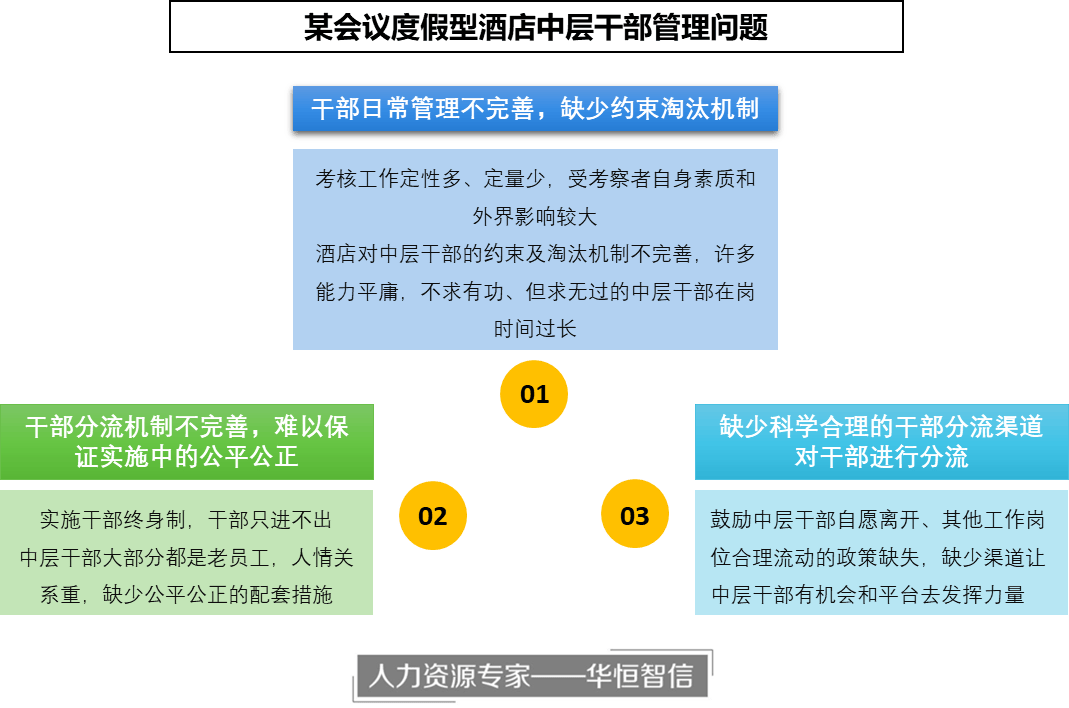
Core Viewpoint - The hotel is facing significant operational challenges due to the pandemic, leading to decreased revenue and high personnel costs, necessitating a restructuring of its management and staff [1][20]. Current Issues and Analysis - The hotel has a weak daily management system for middle-level managers, lacking a robust elimination mechanism, resulting in underperforming staff remaining in their positions for extended periods [3][21]. - There is an inadequate and unfair mechanism for staff separation, as the hotel has historically implemented a lifetime employment system, making it difficult to remove underperforming managers [4][22]. - The absence of suitable channels for staff separation poses a challenge, especially in a state-owned enterprise context where layoffs are not feasible, necessitating stable and effective placement for departing staff [5][23]. Solutions Proposed by Huaheng Zhixin - Establish a management constraint system and improve the evaluation mechanism for middle-level managers, focusing on both performance results and management capabilities [8][24]. - Create a fair and just staff separation mechanism, including clear regulations for staff elimination based on tenure and performance evaluations, ensuring transparency and accountability in the process [10][26]. - Design appropriate channels for staff separation, ensuring that departing managers can transition to other roles where they can continue to contribute effectively, thus optimizing human resource utilization [11][27]. Specific Separation Channels - For highly capable and motivated staff, opportunities will be created to join expert committees or key business departments, allowing them to leverage their expertise for the hotel's benefit [12][28]. - For capable but less motivated staff, measures will be taken to enhance their engagement through training roles or assignments in departments where they can execute tasks effectively [14][29]. - For staff with high motivation but lower professional skills, they will be assigned to supervisory roles to ensure quality and improve service efficiency [15][30]. - For those with low motivation and inadequate skills, a comprehensive evaluation system will be established to guide their development, with potential natural attrition for those unable to meet performance standards [16][31]. Conclusion by Huaheng Zhixin - The effectiveness of middle management is crucial for supporting business development, and addressing the issues of underperforming staff through a robust separation mechanism is essential for enhancing organizational vitality and competitiveness [18][32].