
金属复合材料

Search documents
国泰海通晨报-20260325
GUOTAI HAITONG SECURITIES· 2026-03-25 03:23
Group 1: Oil Crisis Historical Review and Investment Insights - The oil crisis typically begins with geopolitical conflicts and escalates due to expectations of supply disruptions, leading to short-term price spikes and long-term price increases [1][12] - The macroeconomic impact of oil crises has historically led to inflation followed by stagnation or similar conditions, with the 1970s crisis resulting in recession and stagflation in the US, while the 2022 situation only saw a technical recession [1][12] - Market narratives have evolved, reflecting learning effects from past crises, with shifts from valuation model failures to asset worship and supply-side reforms [1][12] - Asset performance during crises shows that commodities like oil benefit directly, while equities face valuation pressures, and bonds initially decline before rising due to inflation expectations [1][12] Group 2: Logistics and Transportation Sector - The daily traffic volume at Ganqimaodu Port has shown a steady recovery, with an average of 1,351 vehicles per day from March 16 to March 22, 2026, marking a 55.7% year-on-year increase [5][17] - The port's cargo throughput has also increased significantly, with a 35% year-on-year growth to 10.24 million tons as of March 15, 2026 [5][17] - Short-distance freight rates have stabilized and increased, averaging 65 RMB per ton in 2026, reflecting an 8.3% year-on-year rise [6][17] Group 3: Company-Specific Insights - Jiayou International reported a revenue of 2.486 billion RMB in Q3 2025, a 30.61% year-on-year increase, driven by the recovery of cross-border business and rising prices of coking coal [7][18] - The company is expected to benefit from the integration of mining services, logistics, customs clearance, and coal sales, enhancing its competitive advantage in the cross-border logistics market [7][18] - Northern International is projected to benefit from rising coking coal and European natural gas prices, with a target price of 18 RMB based on a 24x PE ratio for 2026 [31][32] Group 4: Social Services Sector - The social services sector is experiencing a policy-driven boost in consumer spending, particularly in travel and hospitality, with recommendations for various hotel and tourism companies [19][20] - The education sector is also seeing robust demand, with significant expansion opportunities in high school education and vocational training [20][23] - Traditional retail is undergoing transformation, with new consumption patterns emerging and companies adapting to changing market dynamics [20][23]



北交所企业2025年业绩预告 多元布局谋增长
Zhong Guo Zheng Quan Bao· 2026-02-08 23:15
Core Insights - A total of 123 companies listed on the Beijing Stock Exchange have disclosed their performance forecasts for 2025, showing significant performance differentiation [1] - Among these, 40 companies are expected to have positive performance, with 24 forecasting growth, 13 turning losses into profits, and 3 showing slight increases [1] - Companies demonstrating strong resilience in development attribute their success to technological innovation, market expansion, and operational optimization [1] Performance Highlights - Twelve companies, including Hongyu Packaging and Huiwei Intelligent, are expected to see net profit growth exceeding 100% in 2025, driven by enhanced core competitiveness and industry development benefits [2] - Hongyu Packaging anticipates a net profit of 17 million to 22 million, representing a year-on-year increase of 357.91% to 492.59%, due to optimized customer and product structures and improved operational efficiency [2] - Haineng Technology expects a net profit of 41 million to 44 million, with a growth rate of 213.65% to 236.61%, benefiting from industry demand recovery and continuous investment in high-end product development [2] Turnaround Companies - Among the 13 companies that have turned losses into profits, Lierda and Chunguang Intelligent have implemented targeted operational strategies to achieve this transition [4] - Lierda forecasts a net profit of 35 million to 50 million, recovering from a loss of 109 million the previous year, driven by R&D investments and improved sales in its IoT solutions [4] - Shibibai's turnaround aligns with industry trends, expecting a net profit of 50 million to 60 million, benefiting from increased demand for its composite materials [4] Strategies for Recovery - Some companies are proactively addressing performance pressures through increased R&D investment, business structure optimization, and market channel expansion [6] - Weibo Hydraulic and Kerun Intelligent are focusing on market expansion and internal operational optimization to counteract the impact of rising raw material prices [7] - Companies like Naconor and Beiyikang are adjusting their strategies to improve profitability amid industry cycles and changing market conditions [7]
A股上市公司密集披露大额订单
Zheng Quan Ri Bao· 2026-02-06 16:46
Group 1: Domestic Orders and Contracts - Recently, A-share listed companies have been actively disclosing large orders, major contracts, and significant project wins across various sectors including semiconductors, infrastructure, shipbuilding, and oil and gas engineering [1] - Wuxi Taiji Industrial Co., Ltd. announced that its subsidiary, the Eleventh Design and Research Institute of Information Industry, has pre-won the general contracting project for the Huahong FAB9B project with a bid amount of 3.778 billion yuan, with an expected contract workload share of 98.46% [1] - Xinjiang Beixin Road and Bridge Group announced that it, along with the Changjiang Wuhan Navigation Engineering Bureau, has been confirmed as the winning bidder for two segments of the Anhui Jianghuai bulk sand and gravel distribution center project, with a total contract amount of approximately 1.145 billion yuan [1] Group 2: International Orders - China Shipbuilding Industry Corporation announced that its subsidiary, China Shipbuilding Huangpu Wenchong Shipbuilding Co., Ltd., has signed a contract for the construction of 16 feeder container ships with EVERGREEN MARINE, with a total contract value between 736 million and 896 million USD [2] - Huayi Huibo Technology Co., Ltd. signed a contract for the Naft Khana oilfield restoration project in Iraq, with a contract amount of 225 million USD (approximately 1.596 billion yuan), which is expected to significantly impact the company's revenue for 2024 [2] Group 3: Industry Insights - The large orders are expected to enhance revenue certainty, increase customer loyalty, and optimize profit margins for companies, providing financial support for R&D and global expansion [3] - The realization of large domestic and international orders signifies a critical transition for Chinese industries from "single-point technological breakthroughs" to "system capability exports," marking a shift from being participants in the global value chain to becoming organizers and influencers of value chains [3]
定制调研:全球及中国金属复合材料行业全景调研及投资建议发展规划预测评估报告(2026版)-中金企信发布
Sou Hu Cai Jing· 2026-01-20 01:51
Core Insights - The metal matrix composite materials industry is experiencing significant growth, driven by demand from emerging sectors such as smart terminals and new energy vehicles, with the market size projected to increase from 26.4 billion yuan in 2020 to 42 billion yuan by 2024, reflecting a compound annual growth rate (CAGR) of 12.31% [9] - The market for metal matrix composites is expected to further expand to 61 billion yuan by 2027, indicating a robust growth trajectory [9] - The metal matrix composite materials can be categorized into metal matrix composites and layered metal composites, each with distinct applications and performance characteristics [6][8] Industry Overview - Metal matrix composites are new materials formed by combining two or more different metals or metals with non-metals through physical, chemical, or mechanical methods, resulting in superior performance due to synergistic effects [5] - The industry is characterized by a high level of collaboration between full-time consulting staff and external experts, with a successful project delivery rate of 98.7% and an overall satisfaction rate of approximately 96% [5] Market Segmentation - The metal matrix composites can be divided into two main categories: - Metal matrix composites, which include continuous fiber-reinforced and discontinuous reinforced types [6] - Layered metal composites, which utilize advanced manufacturing techniques such as explosive bonding and rolling to achieve metallurgical bonding [8] Application Areas - Key application areas for metal matrix composites include: - Aerospace, requiring high specific strength and modulus, and fatigue resistance [8] - Military electronics, demanding high conductivity and low expansion [8] - Smart terminals, focusing on low density and high thermal conductivity [8] - Automotive industry, emphasizing wear resistance and thermal stability [8] Market Growth Projections - The market for metal matrix composites in China is projected to grow from 7 billion yuan in 2020 to 11 billion yuan by 2024, with a CAGR of 11.94%, and further to 21.2 billion yuan by 2027 [12] - The layered metal composites market is expected to expand from 19.43 billion yuan in 2020 to 31 billion yuan by 2024, with a CAGR of 12.40%, reaching 39.8 billion yuan by 2027 [12]

有研复材IPO,重要子公司的少数股东是一位个人,还显得挺神秘
Xin Lang Cai Jing· 2025-12-29 23:27
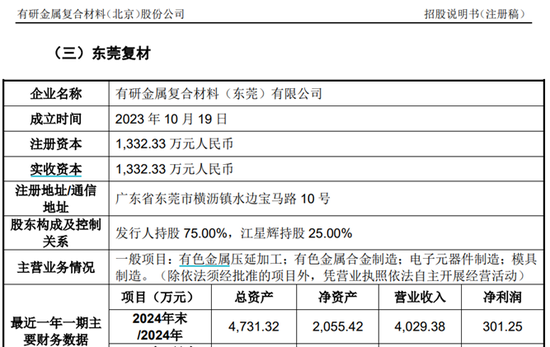
Core Viewpoint - Youyan Composite Materials (Beijing) Co., Ltd. is applying for an IPO, with CITIC Securities as the sponsor. The company is a leading player in the metal composite materials industry, but its financial performance has shown mixed results, raising questions about its ability to convert its industry position into profitability and growth [1][6]. Financial Performance - In 2023, Youyan Composite reported a revenue increase of 20.18% year-on-year, but its net profit declined by 7.59%. For 2024, both revenue and net profit are expected to grow, although the first three quarters of 2024 showed a slight revenue decrease of 1.83% and a significant net profit drop of 15.48%. The full-year forecast indicates a potential change in revenue between -3.89% and 0.69% [1][6]. Subsidiary Overview - A notable subsidiary, Youyan Metal Composite Materials (Dongguan) Co., Ltd., has a net asset of 20.55 million yuan, generating revenue of 40.29 million yuan and a net profit of 3.01 million yuan in 2024, achieving a return on equity (ROE) of 15%, which is higher than the overall ROE of Youyan Composite at 11.44% [2][7]. Operational Insights - The operations in the smart terminal sector are managed jointly by Langfang Composite and Dongguan Composite. Dongguan Composite has completed the construction of a stamping production line and plans to add three hot isostatic pressing devices for smart terminal product production [2][8]. Ownership Structure - Dongguan Composite is a holding subsidiary, not a wholly-owned one, with Youyan Composite holding 75% and an individual named Jiang Xinghui holding 25%. This arrangement raises questions about the rationale behind granting significant equity to a personal shareholder [2][9]. Key Individual - Jiang Xinghui, the minority shareholder, has been noted for his contributions to cost control discussions within the company, indicating his importance despite the lack of detailed information about him in the IPO documentation [5][11].
证监会同意有研复材科创板IPO注册申请
Di Yi Cai Jing· 2025-12-25 10:16
Group 1 - The China Securities Regulatory Commission (CSRC) has approved the initial public offering (IPO) registration application of Yuyuan Metal Composite Materials (Beijing) Co., Ltd. for listing on the Sci-Tech Innovation Board [1]
天力复合成交额创上市以来新高
Zheng Quan Shi Bao Wang· 2025-12-18 07:08
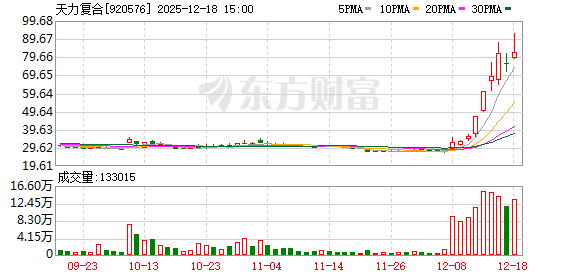
Core Insights - The stock of Xi'an Tianli Metal Composite Materials Co., Ltd. reached a record trading volume of 1.052 billion RMB, marking the highest since its listing [2] - The latest stock price increased by 10.40%, with a turnover rate of 11.60% [2] - The previous trading day's total transaction volume was 888 million RMB [2] Company Overview - Xi'an Tianli Metal Composite Materials Co., Ltd. was established on December 25, 2003, with a registered capital of 1.0895 billion RMB [2]

有研复材IPO:融资9亿,两次分红近2800万元
Sou Hu Cai Jing· 2025-12-13 01:42
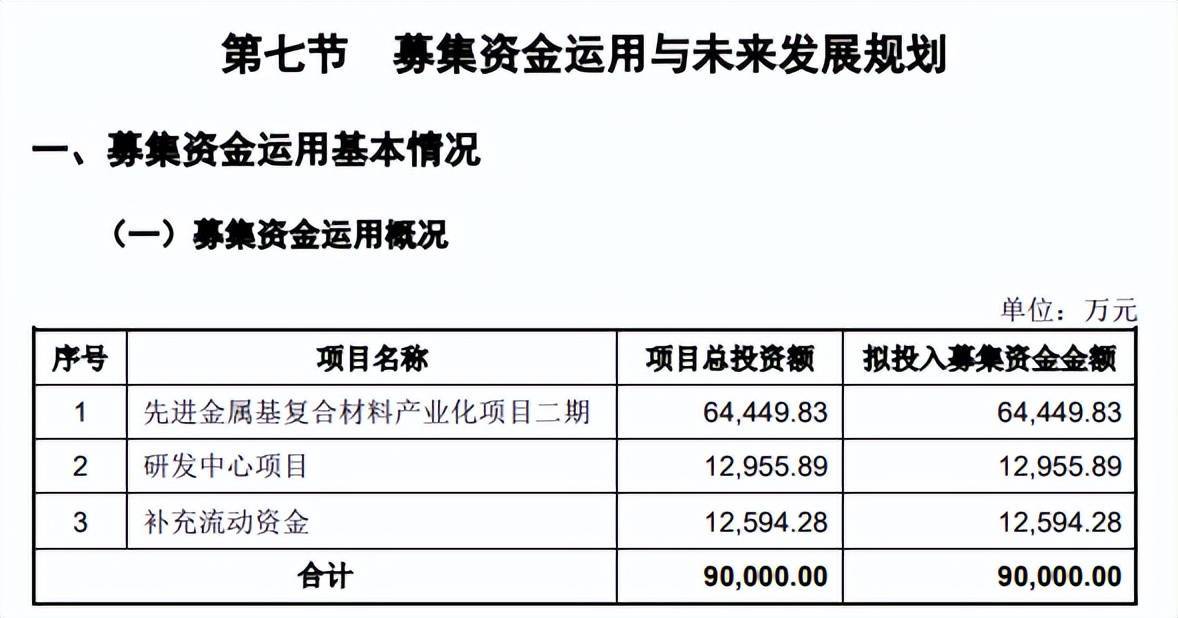
Core Viewpoint - Youyan Metal Composite Materials (Beijing) Co., Ltd. has successfully passed the listing review for its IPO on the Sci-Tech Innovation Board, with a fundraising target of 900 million yuan for various projects [1] Group 1: IPO and Fundraising - The company plans to issue up to 159 million shares and raise 900 million yuan, which will be allocated to the second phase of the advanced metal matrix composite materials industrialization project, a research and development center, and to supplement working capital [1] - The specific allocation of the raised funds includes 644 million yuan for the industrialization project, 130 million yuan for the R&D center, and 126 million yuan for working capital [2] Group 2: Production Capacity and Utilization - The second phase of the advanced metal matrix composite materials industrialization project aims to add production capacity of 5.1 million functional composite materials and devices, and 12.5 million structural composite materials and devices [2] - Current production capacity for battery compartments and mobile phone frames is set to expand by 5 million and 6 million units respectively, which represents an increase of 1.13 times and 5.66 times over existing capacities [3] - As of June, the company had orders amounting to approximately 165.89 million yuan related to the products of the fundraising projects, with capacity utilization rates for metal matrix composites and mobile phone frames at 99.3% and 99.29% respectively, although there was a noticeable decline in the first half of the year [3][4] Group 3: Financial Performance and R&D - The company reported a significant drop in asset-liability ratio from 39.35% to 24.11%, with cash reserves of 62 million yuan sufficient to cover short-term debts [7] - R&D expenses fluctuated significantly, with rates exceeding industry averages, indicating a strong commitment to innovation [8][9] - The company has a stable increase in R&D personnel, with over 10% of employees engaged in R&D, and a high proportion of patents being acquired through inheritance rather than original creation [10][11]
金属基复合材料制造商有研复材科创板IPO过会
Zheng Quan Shi Bao Wang· 2025-12-12 13:39
Core Viewpoint - The company, Youyan Composites, is a leading player in the metal matrix composite materials industry in China, focusing on aerospace and military applications, and aims to enhance its market position through an IPO to raise funds for expansion and R&D projects [3][5]. Group 1: Company Overview - Youyan Composites was established in 1992 and has developed the first domestic production line for aluminum-based composite materials with an annual capacity of 400 tons [3]. - The company specializes in high-strength and high-toughness aluminum-based composite materials, meeting the urgent needs of national defense and aerospace sectors [3]. - Youyan Composites has become the sole supplier of aluminum alloy components for helicopters and fixed-wing aircraft in China, achieving significant import substitution [3]. Group 2: Product Development - The company has innovatively developed ultra-thin battery compartments for smartphones, marking a large-scale application of aluminum-based composite materials in the consumer electronics sector [3]. - In the field of special non-ferrous metal alloys, Youyan Composites has created competitive special aluminum and copper alloy products, with applications in aerospace and military systems [4]. - The company has successfully implemented advanced manufacturing techniques for large-diameter, thin-walled nickel-based alloy seamless pipes, serving critical needs in the nuclear industry [4]. Group 3: Financial Performance - In the first three quarters of 2023, Youyan Composites reported revenues of 498 million yuan, 610 million yuan, and 342 million yuan, with net profits of 53.88 million yuan, 65.55 million yuan, and 23.13 million yuan respectively [4]. Group 4: IPO and Future Plans - The company plans to raise 900 million yuan through its IPO to fund the second phase of its advanced metal matrix composite materials project, enhance R&D capabilities, and improve liquidity [5]. - The funds will support capacity expansion, product diversification, and market development, aiming to strengthen the company's market share and brand presence [5].
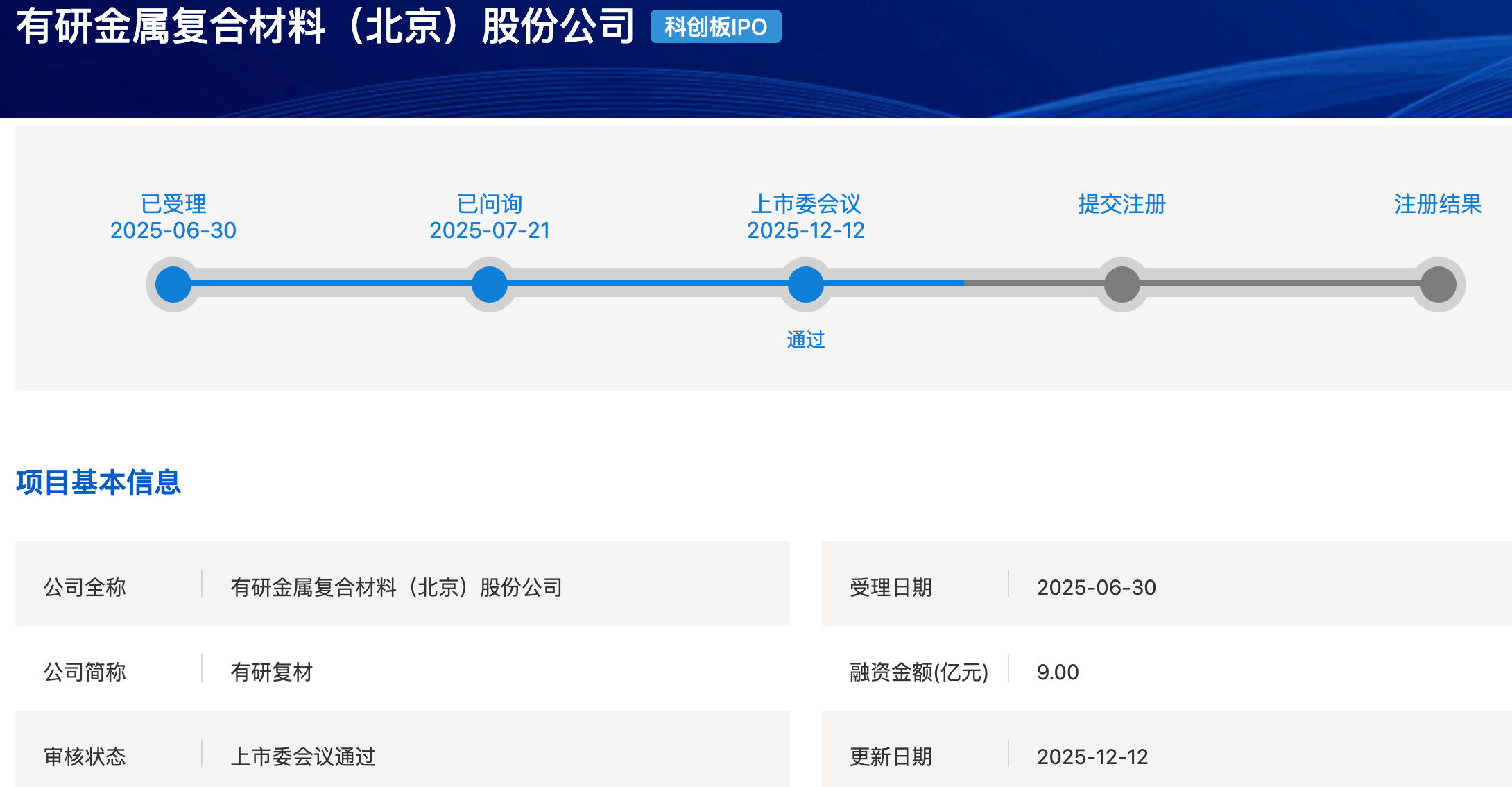
上交所:有研金属复合材料(北京)股份有限公司科创板IPO获得上市委审议通过
Ge Long Hui· 2025-12-12 09:29
Group 1 - The core point of the article is that Youyan Metal Composite Materials (Beijing) Co., Ltd. has received approval from the listing committee for its IPO on the Sci-Tech Innovation Board [1] Group 2 - The company is referred to as "Youyan Composite Materials" in the context of its IPO [1] - The approval signifies a step forward for the company in its efforts to raise capital and expand its operations [1] - The listing on the Sci-Tech Innovation Board is expected to enhance the company's visibility and credibility in the market [1]