锌矿及锌制品

Search documents
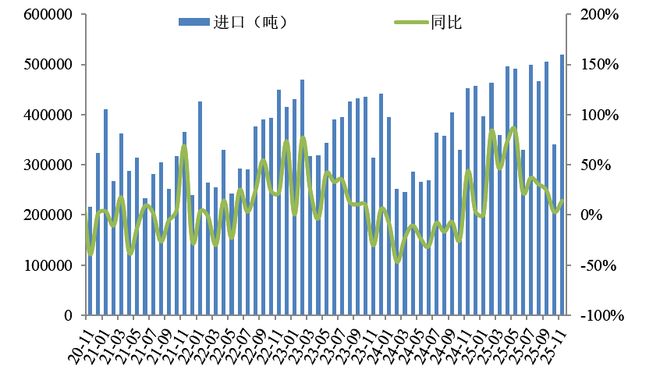
锌精矿进口增量明显,精锌出口量符合预期——2025年12月中国锌贸易浅析
Xin Lang Cai Jing· 2025-12-29 09:32
Core Viewpoint - The import of zinc concentrate has significantly increased, while the export of refined zinc and zinc alloys has shown mixed trends, indicating a dynamic shift in the zinc market landscape for 2025. Group 1: Zinc Concentrate Imports - In November 2025, the import volume of zinc concentrate reached 519,000 tons, representing a year-on-year increase of 13.8% and a month-on-month increase of 52.3% [1] - From January to November 2025, the cumulative import of zinc concentrate totaled 4.862 million tons, reflecting a year-on-year increase of 33.8%, with a narrowing growth rate of 2.8 percentage points compared to the previous ten months [1] - Major sources of zinc concentrate imports include Australia, Peru, Russia, and Kazakhstan, with significant increases in imports from these countries [3] Group 2: Refined Zinc Imports and Exports - In November 2025, China imported 18,000 tons of refined zinc, marking a year-on-year decline of 48.1% and a month-on-month decrease of 2.9% [4] - Cumulatively, from January to November 2025, refined zinc imports totaled 295,000 tons, down 28.7% year-on-year [4] - The export volume of refined zinc in November was 43,000 tons, showing a remarkable month-on-month increase of 402.6% and a cumulative export of 67,000 tons from January to November, which is a year-on-year increase of 437.5% [6] Group 3: Zinc Alloy Trade - In November 2025, China imported 3,343 tons of zinc alloy, a year-on-year decrease of 25.9% but a month-on-month increase of 8.0% [8] - The cumulative import of zinc alloy from January to November 2025 was 40,222 tons, down 11.0% year-on-year [8] - The export volume of zinc alloy in November was 1,792.8 tons, which is a year-on-year increase of 103.3% and a month-on-month increase of 567.2% [8] Group 4: Zinc Material Exports - In November 2025, the import of zinc materials was 513.3 tons, reflecting a year-on-year decrease of 43.1% but a month-on-month increase of 34.9% [10] - The export of zinc materials in November was 1,257.7 tons, showing a year-on-year increase of 26.6% and a cumulative export of 12,000 tons from January to November, which is a year-on-year increase of 11.9% [10] - The cumulative net export of zinc materials from January to November 2025 was 4,209.5 tons, representing a year-on-year increase of 13.4% [10]

锌供应链企业巧用基差增利润
Qi Huo Ri Bao Wang· 2025-07-08 00:59
Group 1 - In March 2024, strong expectations for a Federal Reserve interest rate cut in June and favorable domestic policy expectations led to a rise in zinc prices, with the main contract reaching a two-year high of 25,365 yuan/ton [1] - By the second quarter of 2024, the trading logic shifted from interest rate cuts to concerns about secondary inflation in Europe and the U.S., causing further increases in zinc prices [1] - The volatility in zinc prices significantly increased operational risks for companies, making futures hedging essential [1] Group 2 - As of the end of March 2024, despite a rapid increase in zinc prices, downstream demand did not improve significantly, leading to a continuous accumulation of social inventory [2] - From July 2024, the spot premium in South China began to rise, peaking at 240 yuan/ton in mid-September before falling back to 15 yuan/ton [2] - The fluctuation of basis affects the effectiveness of futures hedging, making it crucial for companies to determine the basis accurately [2] Group 3 - In 2023, several overseas mines faced production halts, exacerbating the tight supply of zinc concentrate and leading to a decline in processing fees [3] - The supply issues for zinc concentrate worsened in 2024, resulting in a significant reduction in smelting profits and subsequent production cuts by smelters [3] Group 4 - A supply chain management company established in April 2023 focuses on zinc concentrate and zinc ingot procurement and sales, facing challenges due to price volatility [6] - The company engages in high-frequency trading to improve capital turnover and mitigate risks associated with price fluctuations [6] Group 5 - A futures company developed a hedging strategy for the supply chain company, prioritizing spot purchases and short futures when the basis is negative, and pre-selling spot and long futures when the basis is positive [7] - This strategy effectively hedges against single-sided risks in spot trading while capturing basis profits [7] Group 6 - On October 14, 2024, the supply chain company purchased 30 tons of spot zinc at an average price of 24,953 yuan/ton and sold futures at an average price of 25,250 yuan/ton, resulting in a total profit of 4,560 yuan [8] - On October 28, 2024, the company pre-sold 30 tons of zinc ingots at an average price of 24,860 yuan/ton and established long futures, achieving a total profit of 11,010 yuan [8] Group 7 - The case study illustrates that companies should not mechanically follow procurement and sales plans but should anticipate spot premiums or basis changes to enhance hedging effectiveness and increase trade profits [9]