食品添加剂生产

Search documents
《食品添加剂生产许可审查细则(2025版)》发布
Xin Lang Cai Jing· 2025-12-30 04:36
Core Points - The article discusses the release of the "Food Additive Production License Review Guidelines (2025 Edition)" by the State Administration for Market Regulation, aimed at standardizing food additive production licensing and enhancing supervision of production enterprises [1][2] Group 1: Licensing Requirements - The guidelines consist of 10 chapters and 57 articles, detailing specific requirements for production access, including conditions related to production sites, facilities, and processes [1] - Enterprises are required to establish and implement a series of food safety management systems, including raw material procurement, production process control, sanitation, food safety traceability, and label management [1] Group 2: Risk Management - The guidelines categorize food additive production licenses into six specific types, including single variety food additives and food flavorings, to implement targeted licensing reviews [1] - Additional review requirements are specified for high-risk products such as compound food additives and food flavorings, focusing on formula development management and quality control [2] - The guidelines will take effect immediately upon publication, replacing the previous 2010 version [2]
从农田到餐桌:全链条治理食品添加剂,守护舌尖上的安全
Yang Shi Wang· 2025-05-11 03:30
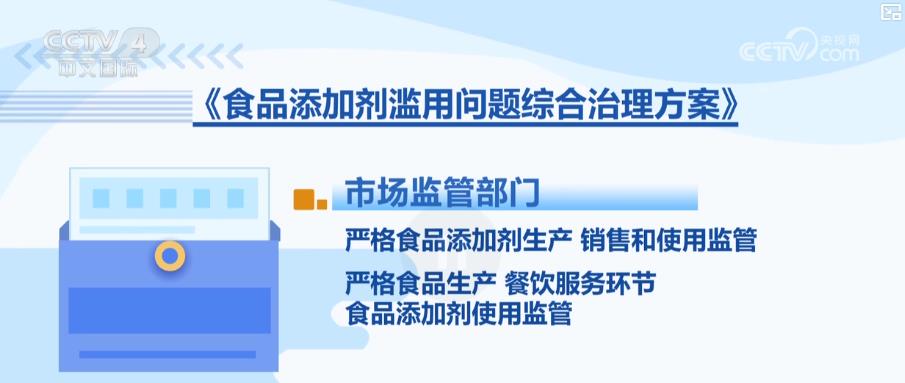
Core Viewpoint - The misuse of food additives has become a significant concern for consumers, prompting the Chinese government to implement a comprehensive governance plan to address the issue across the entire food supply chain [1][3]. Group 1: Governance Actions - The State Council's food safety office and six other departments have issued a comprehensive governance plan to combat the misuse of food additives [1]. - The plan includes strict enforcement against illegal practices in agricultural production, management of chemical products, and enhanced customs inspections for imported food additives [3]. - Market regulatory authorities will enforce strict supervision over the production, sale, and use of food additives, including penalties for exceeding permissible limits [3]. Group 2: Regulatory Focus Areas - The governance action emphasizes a full-chain and full-process supervision approach, from agricultural production to food consumption [5]. - Inspections will focus on key production areas, including raw material storage and production processes, ensuring compliance with supplier management and ingredient verification [5]. - Specific attention will be given to the food production sector, where certain food categories, such as canned goods and baked products, are prohibited from using preservatives [7]. Group 3: Prohibited Substances - In the food service sector, there are strict prohibitions against the use of certain harmful substances, including industrial oxalic acid, nitrite preservatives, and illegal additives like poppy husk [7]. - Regulatory bodies are actively encouraging food service businesses to verify the safety and compliance of their food additives [7]. Group 4: Proper Use of Additives - Food additives are not inherently harmful; their safety depends on correct usage and adherence to specified limits [9]. - Each food additive is required to indicate its permissible food categories and maximum allowable amounts, with misuse defined as exceeding these limits [9].