食材零售

Search documents
一年狂卖78亿,下沉市场又爆“金矿”,净利涨超80%
3 6 Ke· 2026-02-08 01:21
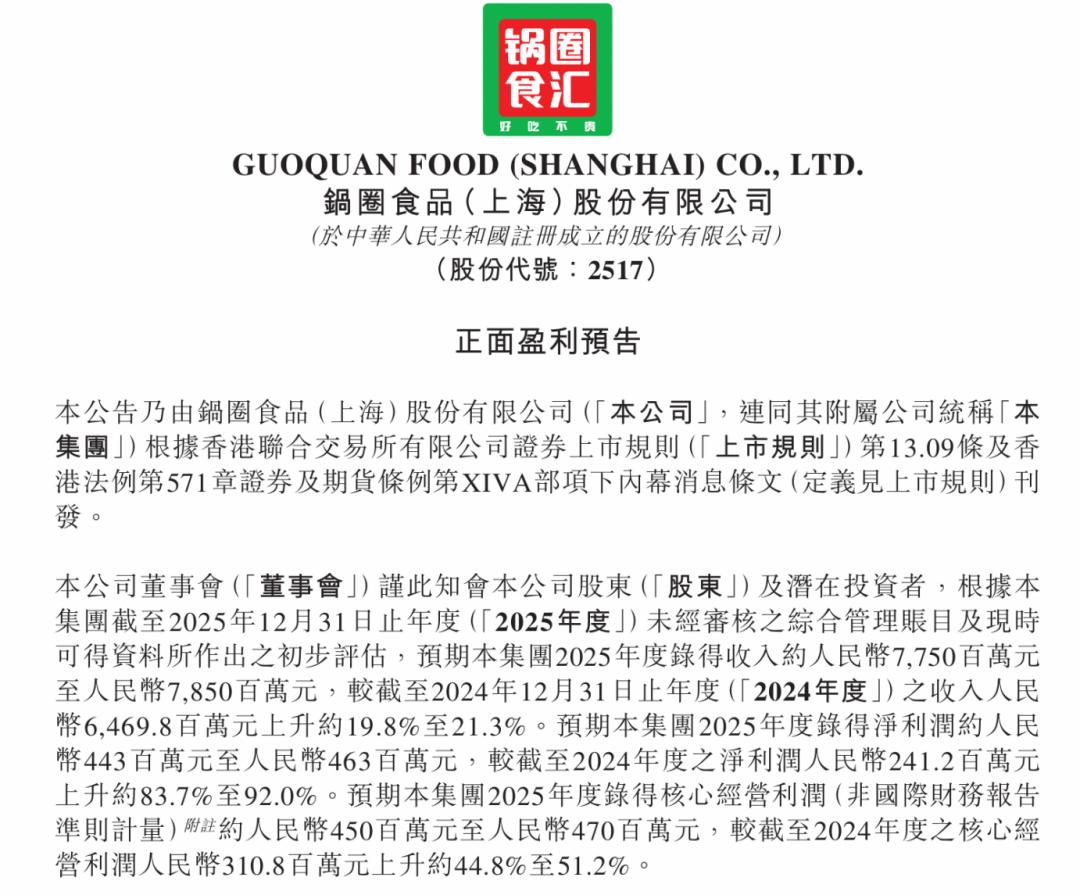
Core Insights - The core viewpoint of the articles highlights the impressive growth of Guoquan Foods, which has successfully expanded its market presence and profitability despite challenges in the broader restaurant industry [1][3][12]. Financial Performance - Guoquan Foods is projected to achieve revenues between 7.75 billion to 7.85 billion yuan for the year ending December 31, 2025, representing a year-on-year growth of 19.8% to 21.3% [1]. - The expected net profit is between 443 million to 463 million yuan, showing a significant year-on-year increase of 83.7% to 92.0% [1]. Market Strategy - The company has expanded its store network to 11,566 locations by the end of 2025, with over 1,400 new stores added in the year, focusing on lower-tier markets [3][8]. - Guoquan's strategy includes creating a "new type of township store" that caters to both individual consumers and small businesses, enhancing its market penetration [3]. Product Offering - Guoquan has diversified its product range to include eight categories, such as hot pot, barbecue, beverages, and ready-to-cook meal kits, addressing various consumer needs [5]. - The company emphasizes health and new consumption scenarios, responding to trends in consumer preferences [5]. Operational Efficiency - The company has implemented a vertical integration strategy in its supply chain, controlling costs by owning or holding stakes in factories for key products [6][10]. - Guoquan's digital platform supports over 60 million members, enhancing customer engagement and reducing acquisition costs [6]. Challenges and Risks - The company faces scrutiny over food safety issues, highlighted by a recent incident involving expired tofu, which raises questions about its franchise model and quality control [7][10]. - With over 99.9% of its stores being franchises, maintaining consistent quality and safety standards across its vast network poses a significant challenge [8][10]. Competitive Landscape - Guoquan has positioned itself as a leading player in the food retail sector, benefiting from the decline of competitors in the market [14]. - The company must navigate competition from both direct rivals in the food supply space and indirect competitors like fresh e-commerce platforms and traditional supermarkets [14][15]. Future Outlook - The company is expected to continue its growth trajectory by balancing expansion with maintaining store quality and exploring new business models [15]. - Guoquan's ability to adapt and innovate in response to market dynamics will be crucial for its long-term success [15].

体验即购买:社区火锅烧烤食材店的沉浸式消费升级方法论
Sou Hu Cai Jing· 2025-07-02 09:41
Core Insights - The article highlights the transformation of traditional community ingredient stores into immersive experience centers, emphasizing the importance of sensory engagement in driving consumer purchasing decisions [3][4]. Group 1: Immersive Experience - The concept of "experience-driven purchasing" is introduced, where stores create an interactive environment that enhances consumer trust and satisfaction [3][4]. - A specific community ingredient store, after upgrading to an "experience store," saw a nearly 70% increase in average customer dwell time and a 40% rise in average transaction value [4]. Group 2: Product Transparency - The implementation of visible product sourcing through electronic displays or labels helps establish a trustworthy supply chain from farm to table [5]. - The store features multi-sensory areas, such as tasting stations and live cooking, to create a compelling quality representation of the products [5]. Group 3: Thematic Solutions - The store shifts from merely selling ingredients to offering lifestyle proposals by organizing products into themed collections for various culinary experiences [5]. - The ambiance is enhanced through props and lighting to simulate inviting dining scenarios, which stimulates consumer desire for a better lifestyle [5]. Group 4: Community Engagement - The store fosters community interaction through events like cooking demonstrations and group tasting sessions, which build knowledge and product recommendations among customers [5]. - Initiatives like "neighborhood group tasting plans" and themed social nights encourage customer gatherings, enhancing loyalty and repeat purchases [5].