Asset Securitization

Search documents
【学习园地】《党的二十届四中全会〈建议〉学习辅导百问》(三十五)
Sou Hu Cai Jing· 2026-02-24 03:50
Core Viewpoint - The development of futures, derivatives, and asset securitization is essential for establishing a well-structured financial market system and accelerating the construction of a strong financial nation, which will enhance financial product diversity, improve market completeness, and strengthen financial services for the real economy and risk management capabilities [1] Group 1: Derivatives Market - Derivatives, including futures, are crucial financial tools in modern markets, serving functions such as price discovery and risk management. In 2024, the trading scale of derivatives in China's interbank market is expected to exceed 230 trillion yuan [2] - Interest rate derivatives are primarily used for hedging and risk management, helping institutions mitigate risks during periods of declining interest rates. For instance, they have prevented potential net value declines and asset sell-offs [2] - The development of the derivatives market in China is lagging, with the daily trading volume of interest rate derivatives compared to the outstanding balance of government bonds at only about 0.8%, while the same ratio for USD and EUR is approximately 8%-9% [2] Group 2: Regulatory and Market Development - To address inherent risks in economic and financial activities, it is necessary to enhance the management level of financial services and foster robust financial institutions, promoting a more complete, inclusive, and efficient derivatives market [3] - Optimizing regulatory methods by allowing more qualified entities, such as insurance companies and banks, to access derivatives qualifications will diversify participants and trading scenarios [3] - Strengthening regulatory capabilities is essential to avoid systemic risks, improve transaction reporting, central clearing, and margin management, thereby enhancing transparency and regulatory effectiveness [3] Group 3: Asset Securitization - Asset securitization plays a vital role in revitalizing existing assets, stabilizing macro leverage ratios, optimizing asset-liability structures, and broadening financing channels [4] - It allows the conversion of existing assets into liquid financial products, enhancing market depth and meeting investor demand while helping financial institutions provide financing without expanding their balance sheets [4] - Since 2014, China's asset securitization market has entered a phase of normalized development, with annual issuance reaching around 2 trillion yuan, although issues such as unclear underlying legal relationships and high issuance management costs hinder market depth [4] Group 4: Future Development of Asset Securitization - The asset securitization market has significant potential during China's economic transformation, necessitating a focus on serving key sectors of the real economy and enhancing market infrastructure for long-term healthy development [5] - It is crucial to improve the legal structure and supporting arrangements of the market, ensuring clear legal relationships and optimizing issuance management mechanisms [5] - Strengthening investor participation and cultivating the secondary market are essential, with efforts to diversify investors and enhance the asset securitization valuation system [5]
年内企业ABS发行规模破万亿元,公募基金两年内首次环比增持
Xin Lang Cai Jing· 2025-09-30 08:08
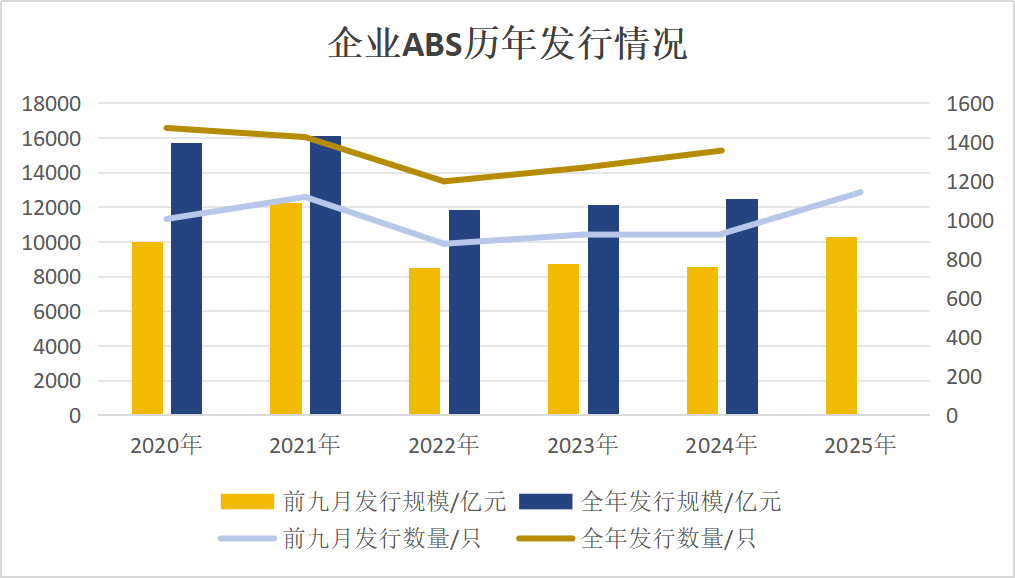
Core Insights - The issuance scale of corporate Asset-Backed Securities (ABS) has exceeded 1 trillion yuan in 2023, reaching 10,321 billion yuan by the end of September, marking a year-on-year increase of over 20% [1][8] - This level is approaching the total issuance scale for the entire year of 2024, which is projected to be 12,483 billion yuan, and represents the first time since 2022 that the number of corporate ABS issued has surpassed 1,000 in September [1][8] Issuance Trends - A total of 1,142 corporate ABS have been issued as of September 2023, with significant growth in large-scale issuances, particularly those exceeding 2 billion yuan, which have seen a year-on-year increase of 17.65% [1][5] - The largest single issuance this year is the "CITIC Financial Asset Yunfan Phase 1" plan, with a scale of 10.01 billion yuan, achieving the lowest cost and narrowest spread among similar products [6][8] Types of ABS - Corporate ABS is primarily issued by non-financial enterprises and is regulated by the China Securities Regulatory Commission, while credit ABS is issued by financial institutions and circulates mainly in the interbank market [5][8] - Traditional underlying assets for ABS include accounts receivable, lease rentals, trust loan rights, small loans, and consumer loans, with over 800 products issued in these categories, accounting for more than 70% of total corporate ABS issuance [6][8] Innovation in ABS - New types of ABS based on data assets, intellectual property, and low-altitude economy have emerged, with the recent issuance of the "Huaxin-Xinxin Data Asset Phase 1" plan marking a significant development in data asset securitization [7][8] - Data asset ABS allows companies to convert dormant data resources into financing, particularly benefiting technology firms with insufficient collateral [7][8] Market Dynamics - The ABS market is experiencing a surge in both issuance and secondary market activity, driven by strong demand from small and medium-sized enterprises seeking to optimize their financing structures [8][9] - Regulatory support and the introduction of new fundraising mechanisms are expected to further expand the ABS market [8][10] Investor Participation - Institutional investors, including trust institutions and banks, are the primary participants in the ABS market, with trust institutions increasing their holdings significantly [10][11] - Public funds have also begun to increase their ABS holdings, with a notable rise in the number of funds participating [11][12] Yield and Risk - ABS products typically offer higher yields compared to standard bonds, with the average coupon rates for different tiers of ABS varying significantly, reflecting the risk-return profile of the underlying assets [14][16] - The current low-interest-rate environment has made ABS an attractive investment option for institutional investors, providing a unique opportunity for yield enhancement [14][16]

“知识就是财富”照进现实,超200亿知识产权ABS行至何处|新产业金融观察③
2 1 Shi Ji Jing Ji Bao Dao· 2025-06-08 04:55
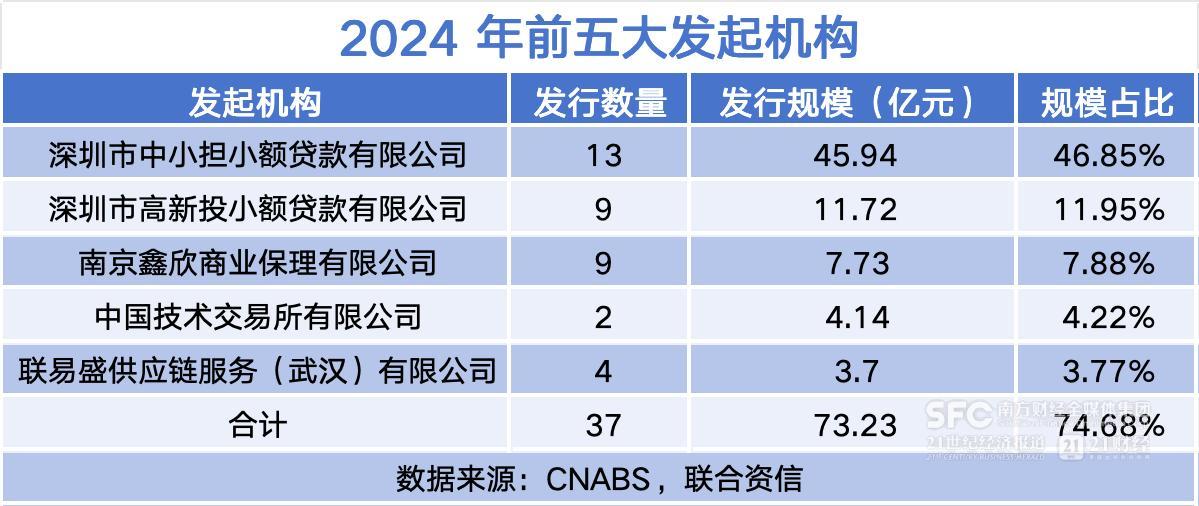
Core Insights - The article discusses the evolution and current state of intellectual property asset-backed securities (ABS) in China, highlighting its significance in financing for small and medium-sized technology enterprises [1][2][10] - It emphasizes the growth of the market, with a cumulative issuance scale exceeding 200 billion yuan by June 2025, and the increasing recognition of intellectual property as a valuable asset [1][10] Market Development - The first intellectual property ABS in China was approved in December 2018, and as of June 5, 2023, at least 12 intellectual property ABS have been issued this year, totaling 1.356 billion yuan [1] - In 2024, the issuance of intellectual property ABS products reached 57, with a total scale of 9.806 billion yuan, marking a year-on-year increase of 25.97% [2] Institutional Concentration - The majority of intellectual property ABS issuers are small loan companies, commercial factoring companies, and financing leasing companies, with a high concentration among the top five issuers, accounting for 74.68% of the total issuance [2][4] - Shenzhen's small loan companies dominate the market, with Shenzhen Zhongxiaodang and Shenzhen Gaoxin Investment holding a combined market share of 58.80% [2][4] Product Characteristics - Intellectual property ABS typically have smaller issuance sizes, around 100 million yuan, and primarily serve smaller enterprises, reflecting a certain degree of inclusive finance [4][8] - The underlying asset types for intellectual property ABS are diversifying, including agricultural IP, new energy vehicle IP, and digital currency IP [5] Financing Channels - The article highlights the exploration of cross-border financing channels for intellectual property ABS, particularly in the Greater Bay Area, allowing companies to leverage their intellectual property for overseas financing [5][6] Operational Standards - The operational model for intellectual property ABS has become more standardized, with established processes for small loan companies to provide funding and guarantee enhancements [7][8] - The Shenzhen model of intellectual property ABS is characterized by state-owned enterprises leading the initiative, government subsidies reducing financing costs, and active market participation [10][12] Market Challenges - Despite the growth, the intellectual property ABS market is still in its early stages, with limited investor recognition and liquidity issues affecting issuance and trading [13][14] - Challenges include the lack of unified standards for intellectual property valuation and the need for improved risk management practices [14][15]