
Brokerages

Search documents
X @Bloomberg
Bloomberg· 2026-03-12 02:53
Hong Kong regulators raided the offices of two leading Chinese brokerages and a prominent investment firm this week, marking one of the most significant enforcement actions against the city’s financial sector in almost a decade https://t.co/6ormYUVdvl ...
Week’s Best: Banks’ and Brokerage Firms’ Very Bad Day
Barrons· 2026-03-06 18:45
Core Viewpoint - Recent trading days have been challenging for banks, brokerage, and wealth management stocks, primarily due to investor concerns regarding artificial intelligence disruptions and issues in private credit [1] Group 1: Market Reactions - Last week's stock declines were attributed to fears surrounding the impact of war in Iran, which is expected to drive inflation as oil prices increase [1] - A disappointing U.S. jobs report contributed to the negative sentiment in the market [1] Group 2: Sector Concerns - Ongoing worries about the health of private credit markets are intensifying, adding to the overall market anxiety [1]
As Stocks Slide, Here’s Where to Put $10K—Or More—for Safer but Solid Returns
Investopedia· 2026-02-28 01:00
Core Insights - Current market conditions have led savers to seek safe cash options that provide solid returns without market risk [3][10] - High-yield savings accounts can offer rates up to 5.00% under certain conditions, while CDs provide a best nationwide rate of 4.50% [4][10] - The article emphasizes the importance of utilizing idle cash effectively to earn meaningful interest during periods of market volatility [5][6] Cash Yield Opportunities - The article outlines potential earnings on various cash balances over six months, showing that a $10,000 deposit at a 5.00% APY could yield $247, while $50,000 could earn $1,235 [9][8] - Different APYs are detailed, indicating that even lower rates (e.g., 3.25%) can still generate significant earnings, with $10,000 earning $161 over six months [9][8] Categories of Cash Products - The top cash options are categorized into three main types: bank and credit union products, brokerage and robo-advisor products, and U.S. Treasury products [18][13] - Each category has distinct characteristics and trade-offs, allowing savers to choose based on their financial goals and timelines [13][14] Rate Tracking and Analysis - The article mentions that rates are tracked daily from over 200 banks and credit unions, ensuring that the information reflects the most competitive offerings available [15][17] - It highlights the variability of rates, particularly for savings accounts and money market funds, while CDs and Treasuries offer fixed yields for set periods [12][16]


Bank, Brokerage Stocks Suffer Their Worst Day in Months. Here’s Why.
Barrons· 2026-02-27 21:47
Core Viewpoint - Financial stocks, including banks, brokerages, and wealth management firms, experienced significant declines due to investor concerns over potential disruptions from artificial intelligence, the impact of rising inflation, and issues in private credit markets [1]. Group 1: Market Reaction - Bank, brokerage, and wealth management stocks faced their worst day in months, indicating a strong negative market reaction [1]. - Investors are increasingly weighing the implications of AI-related disruptions on the financial sector [1]. Group 2: Economic Concerns - Resurgent inflation is causing anxiety among investors, contributing to the downturn in financial stocks [1]. - Potential troubles in private credit markets are also raising concerns, further impacting investor sentiment [1].
Say goodbye to the 4 p.m. closing bell: Your stocks are becoming 24/7 digital cash
MarketWatch· 2026-02-19 12:55
Core Viewpoint - Tokenized equities, which are real shares of stock represented as blockchain tokens, pose a significant threat to traditional brokerages [1] Group 1 - The rise of tokenized equities is transforming the investment landscape by providing a more accessible and efficient way to trade shares [1] - Traditional brokerages may face challenges in adapting to the new technology and business model introduced by tokenized equities [1] - The integration of blockchain technology in equity trading could lead to increased competition and innovation within the financial services industry [1]

Markets are down Tuesday on AI disruption fears
Yahoo Finance· 2026-02-17 16:11
Market Overview - Wall Street is experiencing a defensive posture against AI, with major indices like the Nasdaq Composite down nearly 1%, S&P 500 down 0.8%, and Dow Jones down 0.4% [1] - There is broad weakness across the AI sector, affecting chipmakers and platforms as investors assess the beneficiaries of the AI boom [2] Company Performance - Major companies in the AI space are seeing declines: Nvidia down 1.6%, Microsoft down 1.3%, Palantir Technologies down 1.2%, and Advanced Micro Devices down almost 5% [3] - Amazon, a significant player in cloud and AI, is also trading lower, indicating that AI's impact on revenue is becoming more immediate [3] Industry Impact - The market is focusing on businesses that rely on expensive human processes, as AI's capabilities in end-to-end work could threaten the profitability of companies acting as intermediaries [4] - Recent product launches, such as AI-enabled tax planning by Altruist and a ChatGPT-style tool by Insurify, have intensified concerns about the future of fee-based services in various sectors, including fintech [5] Broader Market Behavior - The "AI scare trade" is affecting a wide range of industries, including private credit, financial intermediaries, real estate services, and logistics, indicating a shift in market behavior beyond individual stocks [6] - The S&P software and services group has lost approximately $2 trillion since its peak in October, with significant losses occurring recently [7] Analyst Perspectives - Analysts are divided on future market movements, with some viewing the current situation as a rotation of capital among winners and losers rather than a complete exit from equities [8] - Others suggest that markets may be overreacting to potential disruptions, presenting rebound opportunities in higher-quality software [8]
Tech stocks fall as AI disruption fears hit more companies
Yahoo Finance· 2026-02-17 16:11
Core Viewpoint - Wall Street is experiencing a defensive reaction to AI developments, leading to a broad market decline, particularly affecting technology stocks [1][2]. Group 1: Market Reaction - The Nasdaq Composite fell nearly 1%, while the S&P 500 and Dow Jones Industrial Average decreased by 0.8% and 0.4%, respectively [1]. - There is widespread weakness across the AI sector, impacting companies from chipmakers to platforms as investors assess the beneficiaries of AI advancements [2]. - Major companies like Nvidia, Microsoft, Palantir Technologies, and Advanced Micro Devices saw declines in their stock prices, indicating investor concerns about AI's impact on revenue [3]. Group 2: AI's Impact on Business Models - The market is increasingly focused on businesses that rely on expensive human processes, as AI capabilities threaten traditional revenue models [4]. - Recent product launches, such as AI-enabled tax planning and comparison tools, have intensified fears regarding the future of fee-based services in various sectors, including fintech [5]. - The "AI scare trade" has expanded beyond software to affect private credit, financial intermediaries, real estate services, and logistics, indicating a broader market behavior shift [6]. Group 3: Financial Implications - The S&P software and services sector has lost approximately $2 trillion since its peak in October, with significant losses occurring recently [7]. - Analysts estimate that around 20% of private credit exposure is linked to software, contributing to the turbulence faced by alternative asset managers [7]. Group 4: Strategic Perspectives - Strategists are divided on future market movements, with some viewing the current situation as a rotation of capital rather than a complete exit from equities [8]. - There are suggestions that markets may be overreacting to potential disruptions, creating opportunities for rebounds in higher-quality software [8]. - The phenomenon of "disruption hysteria" is being noted, indicating a potential bull market in this narrative [8].

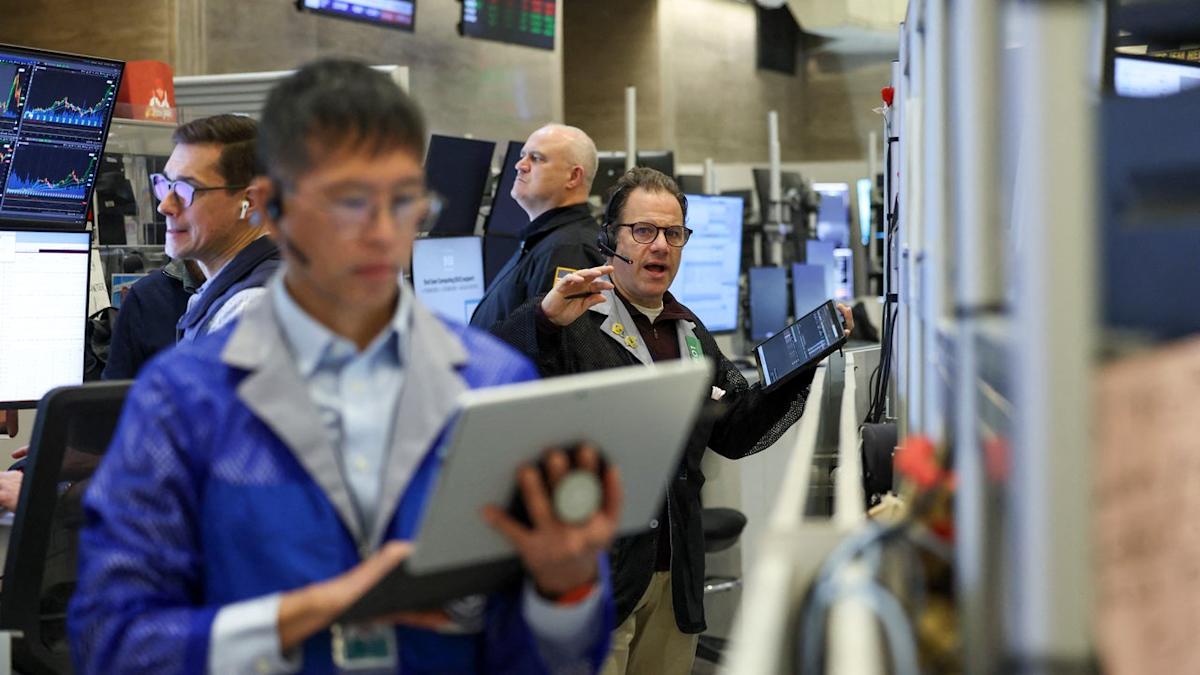
US Stock Market S&P 500 Dow Jones Nasdaq: S&P 500, Nasdaq, Dow Jones set for red opening at U.S. Stock Market as Wall Street investors worry over AI disruptions
The Economic Times· 2026-02-17 11:50
Market Overview - U.S. stock index futures are set for a lower opening, with S&P 500 futures down by 0.42%, Dow Jones futures down by 0.20%, and Nasdaq futures down by 0.93% [1][10] - Concerns over AI-driven disruption have unsettled investors, leading to a selloff in software firms, brokerages, and trucking companies, resulting in the steepest weekly declines for Wall Street's three main indexes since mid-November [1][10] Corporate Earnings - More than 73% of S&P 500 companies reported earnings this quarter, with 74.5% exceeding analysts' estimates, compared to 67% in a typical quarter [7][10] - Companies such as Constellation Energy, eToro, and Labcorp are expected to report earnings results soon [6][10] AI Developments - Alibaba introduced a new AI model, Qwen 3.5, which is designed to independently execute complex tasks, leading to a 1% increase in its U.S.-listed shares during premarket trading [2][10] - Most U.S. tech stocks experienced declines, with Nvidia down 1%, and Microsoft and Apple each down 0.4% [2][10] Economic Indicators - The personal consumption expenditure report, the Federal Reserve's preferred inflation gauge, will be closely monitored for insights into inflation and potential impacts on interest rate cuts [5][10] - Following a cooler-than-expected consumer inflation reading, traders are pricing in a 25-basis-point reduction in June, with odds at 52%, up from nearly 49% a week ago [6][10] Notable Stock Movements - Norwegian Cruise Line shares jumped 10% in premarket trading after activist investor Elliott acquired over a 10% stake [8][10] - U.S.-listed shares of Zim Integrated Shipping soared approximately 35% after Hapag-Lloyd agreed to acquire the company for $4.2 billion [8][10] - Masimo shares surged about 37% following reports of Danaher nearing a nearly $10 billion acquisition deal, while Danaher shares fell by 4.8% [9][10]


US stock index futures muted, inflation data on tap - The Economic Times
The Economic Times· 2026-02-13 12:10
Market Overview - All three major indexes are on track for their worst week since November due to AI-related concerns affecting various sectors, including brokerages and trucking [1] - U.S. stock index futures were trading flat after an AI-led selloff, with investors cautious ahead of inflation data that may influence the Federal Reserve's rate-cut outlook [9] Economic Indicators - The Consumer Price Index report for January is expected to show steady price increases, following a stronger-than-expected jobs report that raised concerns about prolonged interest rates [2] - Fed fund futures indicate a 70% chance of a rate cut in June and a total easing of 60 basis points this year [4] Company Performance - The S&P 500 and Dow dropped over 1% on Thursday, while the Nasdaq fell 2%. In premarket trading, Dow E-minis fell 103 points (0.21%), S&P 500 E-minis were down 6 points (0.09%), and Nasdaq 100 E-minis lost 9.25 points (0.04%) [5][6] - Applied Materials saw an 11.5% increase in premarket trading after forecasting second-quarter revenue and profit above Wall Street expectations [10] - Networking equipment provider Arista Networks gained 11% after forecasting annual revenue above expectations [8] Investment Trends - AI capital expenditures (capex) are a significant theme among the "Magnificent Seven" companies, with cumulative investments projected to reach approximately $650 billion [6][10] - Investors are increasingly demanding tangible returns as they react to fears of competition impacting certain sectors [10] - The upcoming earnings report from chip leader Nvidia is anticipated to be a critical test for the AI investment narrative [7][10] Trade Developments - The U.S. and Taiwan signed a reciprocal agreement confirming a 15% levy on imports from Taiwan while committing to eliminate or lower tariffs on nearly all U.S. goods [9][10] - U.S. President Donald Trump plans to reduce some tariffs on steel and aluminum goods, as reported by the Financial Times [9]

Analysis-For stock market, AI turns from lifting all boats to sinking ships
Yahoo Finance· 2026-02-12 16:09
Group 1 - The artificial intelligence landscape is seen as both a promising investment opportunity and a source of risk, with enthusiasm driving stock gains in technology and related sectors [1][2] - Concerns over AI's disruptive potential are causing investors to reassess valuations in industries such as software, legal services, and wealth management, impacting major companies like Amazon and Microsoft [2][3] - The S&P 500 software and services index has declined by 15% since the end of January, indicating a shift in market dynamics as investors react to perceived winners and losers in the AI sector [3] Group 2 - U.S. brokerages experienced significant stock declines after the introduction of AI-enabled features by wealth management startup Altruist, with major firms like LPL Financial and Charles Schwab dropping at least 7% [4] - The volatility in the market is expected to be driven by headline stories that are focused on individual companies, leading to fluctuations in stock prices [5] - Concerns regarding high capital spending in the software sector have led to declines in shares of major companies, with Microsoft down 16% and Amazon down over 11% this year [6]

