
Duty - Free Retail

Search documents
开门红!海南零关税政策落地首周,免税店销售额超过276万元【附海南自贸港分析】
Sou Hu Cai Jing· 2026-02-19 03:47
Core Insights - The implementation of the "zero tariff" policy for imported consumer goods in Hainan Free Trade Port has shown promising results in its first week, with sales reaching 2.768 million yuan and over 16,000 shopping tickets issued [2] - The policy is expected to further enhance consumer demand and economic activity as the network of duty-free shops expands and product categories diversify [2][10] Group 1: Policy Implementation and Economic Impact - The "zero tariff" policy officially took effect on February 5, 2026, with the first five duty-free shops opening on February 11 in Haikou, Sanya, and Danzhou, focusing on essential goods such as food, beverages, and daily necessities [2] - During the Spring Festival, Hainan experienced a significant increase in cross-border travel, with over 302,000 inbound and outbound travelers recorded in January, marking a 31.8% year-on-year increase [3] - The influx of foreign tourists and the rise in cross-border travel during the Spring Festival highlight the effectiveness of the combined effects of the visa-free policy and the "zero tariff" initiative [3][10] Group 2: Strategic Development of Hainan Free Trade Port - The Central Government's support and strategic planning have facilitated the steady progress of Hainan Free Trade Port, with a clear roadmap for development outlined in the overall plan released on June 1, 2020 [4][7] - The plan aims to establish a comprehensive policy and institutional framework for the free trade port by 2025, focusing on trade and investment facilitation, with a vision for a high-level free trade port by the mid-21st century [4][7] - Tax incentives, such as a reduced corporate income tax rate of 15% for encouraged industries and tax exemptions for new foreign direct investments in tourism and modern services, are designed to attract quality enterprises and talent to Hainan [7][8] Group 3: Competitive Positioning - Hainan's tax regime is notably more favorable than that of mainland China and offers competitive advantages compared to Hong Kong, which may enhance its attractiveness as a business destination [8] - The duty-free market in Hainan has rapidly grown, with the share of offshore duty-free sales in China's overall duty-free market soaring from 26.51% in 2018 to 95.29% in 2022, establishing Hainan as a dominant player in this sector [8]

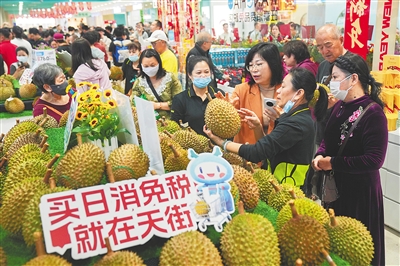
海南岛民乐购免税年货
Hai Nan Ri Bao· 2026-02-12 09:08
Core Viewpoint - The opening of five duty-free stores in Hainan marks a significant shift in local consumer behavior, allowing residents to purchase global products at zero tariff prices, enhancing the festive shopping experience for the Lunar New Year [1][4]. Group 1: Store Openings and Consumer Response - Five duty-free stores opened simultaneously in Haikou, Sanya, and Danzhou, attracting large crowds and boosting the local consumption market ahead of the Spring Festival [3]. - Consumers expressed excitement over the availability of imported goods for their New Year shopping lists, highlighting the convenience and cost savings associated with purchasing duty-free items locally [3][4]. Group 2: Policy and Benefits - The duty-free stores are designed to serve local residents, allowing them to purchase imported goods without paying import duties, VAT, or consumption tax, effectively providing a "three-tax exemption" [4]. - The initiative not only benefits local residents but also foreign nationals in Hainan, who can enjoy the same duty-free shopping experience, reflecting the openness and inclusivity of Hainan's free trade port [5]. Group 3: Future Plans and Enhancements - Store managers indicated plans to expand product offerings and improve customer service, including the introduction of consumer vouchers and promotional packages to enhance shopping experiences [6]. - The initial product focus includes essential items such as food, daily necessities, and baby products, with intentions to diversify and introduce more premium global products in the future [6].
海南春运首周免税购物额超11亿元,岛民成消费新势力
Sou Hu Cai Jing· 2026-02-09 15:34
Core Insights - The first week of the Spring Festival travel season saw Haikou Customs supervise duty-free shopping amounting to 1.106 billion yuan, with 191,900 shoppers and 895,000 items purchased, reflecting increases of 6.3%, 26%, and 9.4% respectively compared to the previous period [1][3] Group 1: Duty-Free Shopping Trends - The first Spring Festival after the full closure of Hainan Free Trade Port has led to a shift in consumer behavior from "returning home" to "traveling," making Hainan a popular destination for family reunions [1] - Duty-free stores are capitalizing on this opportunity by offering promotions such as gifts for purchases and double points, while also expanding their product offerings to include festive items like high-end alcohol and limited edition cosmetics [3] Group 2: Local Consumer Engagement - Local residents are increasingly participating in duty-free shopping, utilizing the "immediate purchase and pick-up" method for buying New Year goods, indicating a shift towards everyday consumption of duty-free products [3] - Starting November 1, 2025, Hainan residents will be able to purchase duty-free items without limit on the number of times, further enhancing their shopping experience and product variety [3] Group 3: Regulatory Support - Haikou Customs is optimizing regulatory services to ensure smooth supply of popular duty-free products during the Spring Festival, enhancing logistics efficiency and improving the shopping experience for travelers [4]
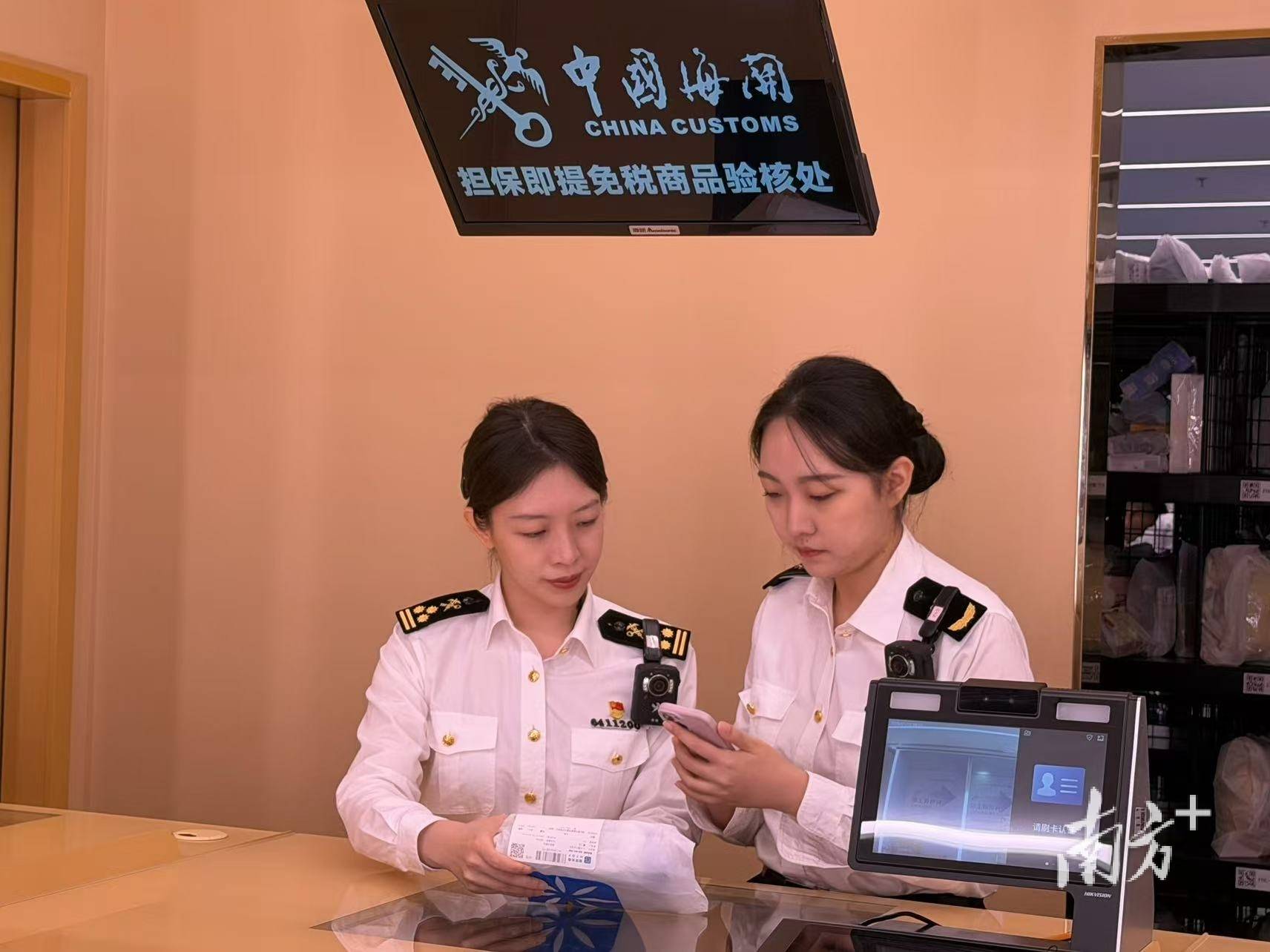
海南发布岛内居民消费“零关税”进境商品经营主体及免税店管理办法
Hai Nan Ri Bao· 2026-02-06 07:23
Core Viewpoint - The Hainan Provincial Government has issued the "Management Measures for Zero Tariff Imported Goods for Residents' Consumption in Hainan Free Trade Port" to regulate the operation of zero tariff daily consumer goods and duty-free shops within the Free Trade Port [1] Group 1: Regulations on Duty-Free Shops - The measures specify that duty-free shops for daily consumer goods must comply with the zero tariff policy and are subject to licensing management [1] - The application for operating qualifications requires entities to have independent civil liability, strong management capabilities, stable procurement channels, and good credit status [1][2] - The number and location of duty-free shops must be approved by the provincial government after review by relevant departments [2] Group 2: Operational Standards - Duty-free shops must be named according to the format: City/County/Autonomous County Name + Duty-Free Shop, and are prohibited from establishing branches [2] - Shops are required to maintain detailed records of inventory and sales, and implement traceability management for products sold [2] - Identity verification methods such as facial recognition must be used to ensure compliance with purchasing conditions [2] Group 3: Supervision and Enforcement - Relevant authorities are tasked with monitoring the circulation of zero tariff goods and addressing illegal activities related to their resale [3] - Individuals and entities are prohibited from reselling zero tariff goods purchased for personal use, including using others' purchasing quotas for profit [3] - Only approved duty-free shops can use terms like "zero tariff" or "duty-free" in their names to prevent public deception [3] Group 4: Legal Responsibilities - The measures outline corresponding legal responsibilities for violations of the regulations [4]
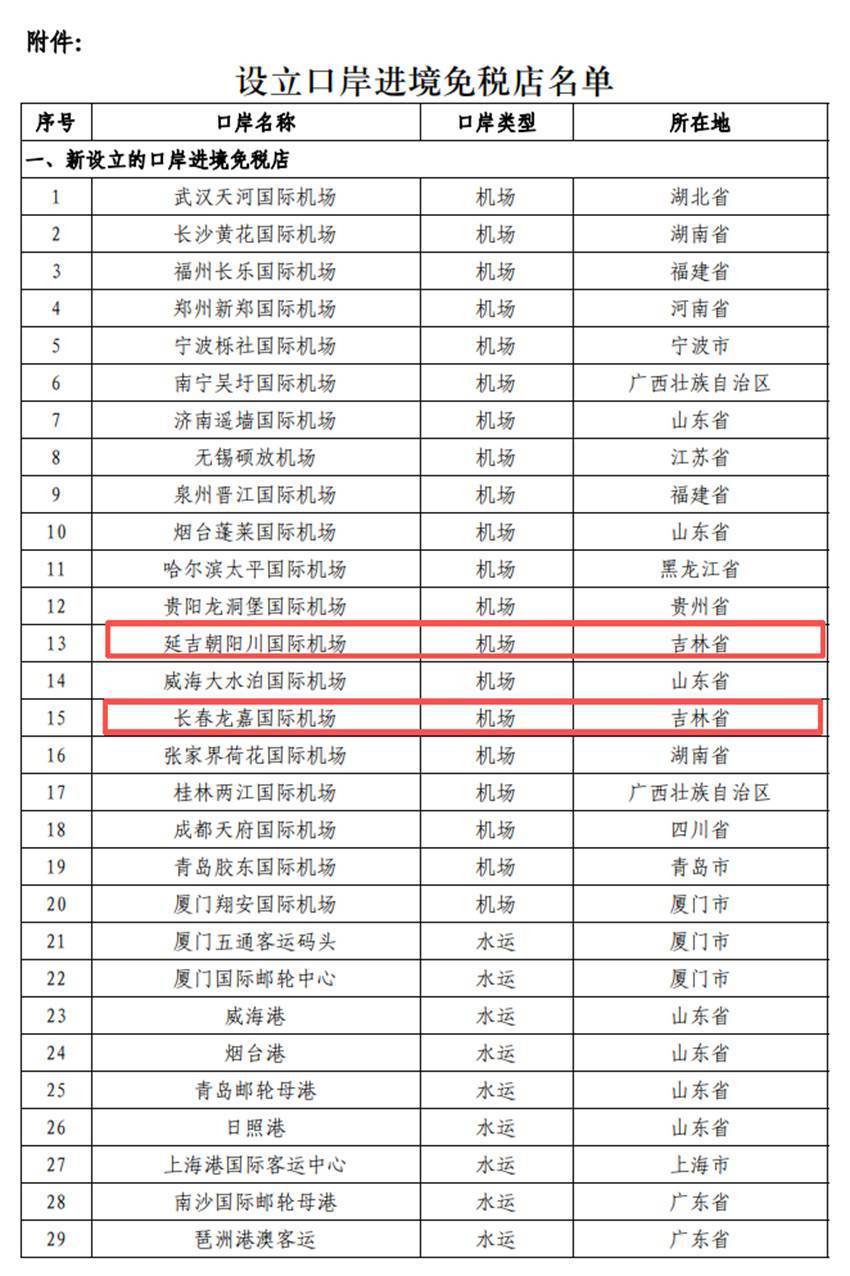
全国41个口岸将新增设进境免税店 延吉机场位列其中
Sou Hu Cai Jing· 2026-01-23 12:17
Core Viewpoint - The Chinese government has announced the establishment of new duty-free shops at 41 ports nationwide, with three located in Jilin province, including Yanji Chaoyangchuan International Airport, as part of a broader initiative to enhance the duty-free shopping experience for inbound travelers [1][5]. Group 1: New Duty-Free Shops - A total of 41 new duty-free shops will be established at various ports across China, including airports and seaports [1][2]. - Jilin province will have three new duty-free shops, specifically at Yanji Chaoyangchuan International Airport, Changchun Longjia International Airport, and Hunchun Highway [1][2]. Group 2: Policy Developments - Since 2025, the duty-free shop policy has been continuously updated, including support for the sale of domestic products, expansion of product categories, and relaxation of approval processes [5]. - The range of products available in duty-free shops has diversified, now including traditional Chinese brands and cultural products, which can be sold as exports, allowing for VAT and consumption tax refunds [5].
长春将新增1家免税店
Sou Hu Cai Jing· 2026-01-23 01:25
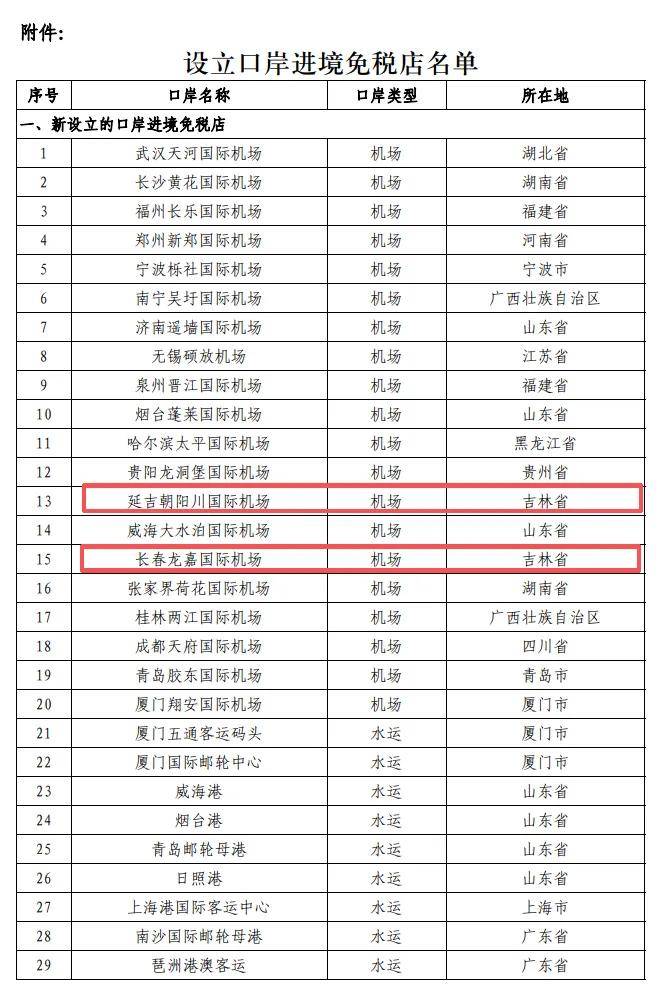
Core Viewpoint - The Chinese government has announced the establishment of new duty-free shops at 41 ports across the country, including one at Changchun Longjia International Airport, aimed at enhancing the duty-free shopping experience for inbound travelers [1][2]. Group 1: New Duty-Free Shops - A total of 41 new duty-free shops will be set up at various ports, including airports and seaports, to facilitate duty-free shopping for incoming travelers [2][3]. - The list of new duty-free shops includes locations such as Wuhan Tianhe International Airport, Changsha Huanghua International Airport, and others across multiple provinces [2][3]. Group 2: Policy Background - Since 2025, the duty-free shop policy has been continuously updated, including support for the sale of domestic products, expansion of product categories, and improvements in approval processes and regulatory measures [3]. - The current trend shows a shift from primarily international brands to include domestic products, such as traditional Chinese brands and cultural creative products, which can now be sold in duty-free shops [4].
海南离岛免税购物金额破2000亿
Sou Hu Cai Jing· 2025-09-13 12:17
Core Points - The Ministry of Finance, General Administration of Customs, and State Taxation Administration announced a new duty-free shopping policy for Hainan Island travelers, increasing the annual duty-free shopping limit from 30,000 yuan to 100,000 yuan per person starting from July 1, 2020 [1] - The new policy also removes the single item duty-free limit and expands the categories of duty-free goods to include seven types of consumer-favored products, such as electronic consumer products [1] Industry Impact - Since the implementation of the new policy on July 1, 2020, Haikou Customs has reported that the total amount of duty-free shopping has exceeded 200 billion yuan, with 30 million travelers participating in duty-free shopping and a total of 247 million items purchased as of September 11 [1]
A Duty-Free Tale of Two Cities丨CBN Perspective
2 1 Shi Ji Jing Ji Bao Dao· 2025-08-29 12:39
Core Insights - Guangzhou and Shenzhen have launched their first in-city duty-free stores, enhancing outbound travel convenience for residents and providing streamlined access to duty-free shopping before international trips [1][2] Policy and Regulatory Framework - The launch follows a policy initiative from August 2024, where five central government ministries approved eight new in-city duty-free locations nationwide, with Guangzhou and Shenzhen each receiving one [2] - Regulatory guidelines specify that all travelers departing China within 60 days are eligible to shop at these stores, using valid outbound flight or cruise tickets [7] Competitive Advantages - In-city duty-free stores offer greater flexibility compared to traditional port-based shops, allowing consumers to shop at their leisure without the pressure of tight customs clearance timelines [3] - The stores are designed to reflect the unique cultural and industrial identities of Guangzhou and Shenzhen, transforming them into showcases of local character [4][5][6] Economic Impact - Early indicators show strong consumer interest, particularly among prospective international students, leading to a significant increase in duty-free shopping activity [9] - Data from the first half of 2025 indicates a surge in cross-border travel, with Shenzhen's ports handling 130 million passengers, a 16.2% year-on-year increase, and Shenzhen Airport recording 32.57 million passengers, up 10.9% year-on-year [10] Long-term Implications - The initiative is expected to stimulate the duty-free economy, boost inbound tourism spending, and redirect domestic consumers' overseas purchases back to China [11] - By integrating consumption with culture and tourism, the stores aim to enhance the international profiles and competitiveness of both cities, contributing to their goals of becoming globally influential consumption centers [12]