Micro - drama

Search documents
千亿风口!深圳站稳短剧出海口
Shen Zhen Shang Bao· 2026-01-29 17:37
Core Viewpoint - The micro-short drama industry in China is experiencing rapid growth, with significant market potential and increasing production quality, driven by changing consumer preferences and technological advancements [1][5][7]. Industry Overview - Shenzhen is emerging as a leading hub for micro-short dramas, hosting numerous companies involved in production and distribution, such as Tencent and DataEye [1][7]. - The market value of micro-short dramas and comic dramas is projected to exceed 1.2 trillion yuan by 2026, significantly surpassing previous estimates [1][5]. - The viewing habits for micro-short dramas are well-established, with 57.4% of users frequently watching and 72.8% primarily using mobile devices [4]. Production and Talent - The production of micro-short dramas has shifted towards utilizing experienced "non-celebrities" rather than traditional stars, providing opportunities for emerging actors [2][3]. - The cost of producing a single micro-short drama has increased, with some productions now costing around 10 million yuan, reflecting a trend towards higher quality content [5][6]. Audience Engagement and Global Reach - The demand for micro-short dramas is driven by users' need for quick entertainment, with a focus on character development and innovative themes [4][5]. - The overseas market for Chinese micro-short dramas is expanding, with expectations of generating over 2.38 billion USD in revenue by 2025, particularly in Southeast Asia [7][6]. - The integration of AI technology is facilitating the translation and distribution of content across multiple languages and platforms, enhancing global accessibility [6][7].
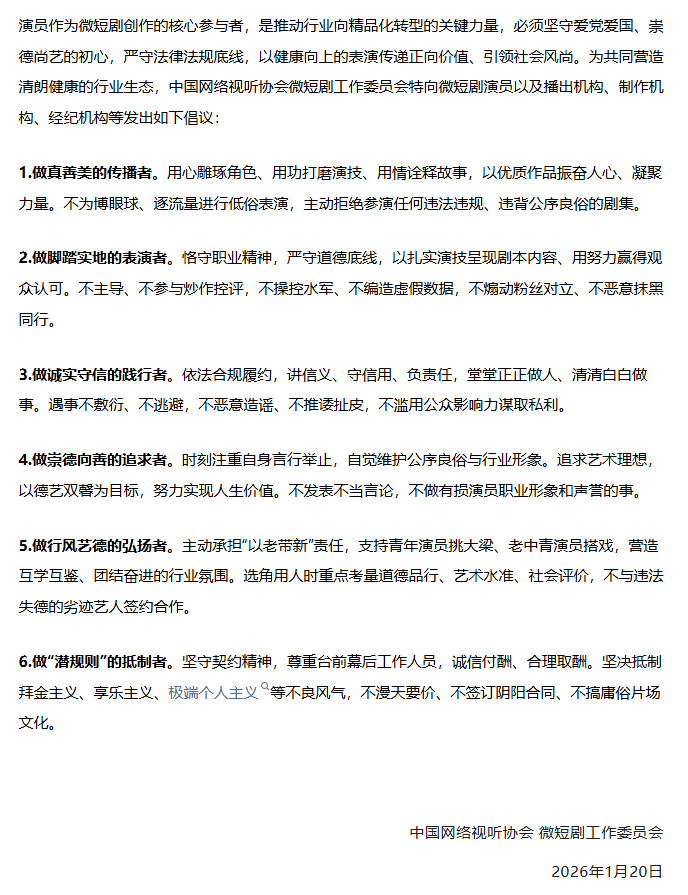
新时代微短剧演员职业操守倡议书发布,对短剧演员提出六点要求,多机构已响应
Yang Zi Wan Bao Wang· 2026-01-22 06:50
Core Viewpoint - The "New Appearance and New Atmosphere" initiative aims to establish professional ethics for micro-short drama actors, addressing the industry's current issues and promoting a healthier ecosystem in the micro-short drama sector [1][4]. Group 1: Requirements for Actors - The initiative outlines six key requirements for micro-short drama actors, emphasizing the need to be disseminators of truth, goodness, and beauty, and to reject vulgar performances aimed at gaining attention [2][3]. - Actors are urged to adhere to professional ethics, maintain moral standards, and present scripts with solid acting skills to earn audience recognition [2][3]. - The initiative calls for actors to avoid manipulating public opinion, engaging in false data creation, or inciting fan conflicts, thereby promoting honesty and integrity in their profession [3]. Group 2: Industry Context and Challenges - The micro-short drama industry has experienced explosive growth due to its "short, frequent, and fast" dissemination characteristics, but this rapid expansion has led to various issues, including low-quality content and unethical practices [4]. - There is a notable trend of prioritizing traffic over acting skills, with some actors resorting to tactics like buying followers and manipulating data to gain popularity, resulting in widespread audience dissatisfaction with acting quality [4]. - The initiative serves as a remedy for the industry's pain points, emphasizing the importance of actors' self-discipline and responsibility towards their roles, audiences, and the industry as a whole [4].

2025微短剧市场观察:产值逼近电影票房两倍,免费模式占比2/3,行业迈入存量竞争期
3 6 Ke· 2026-01-21 04:15
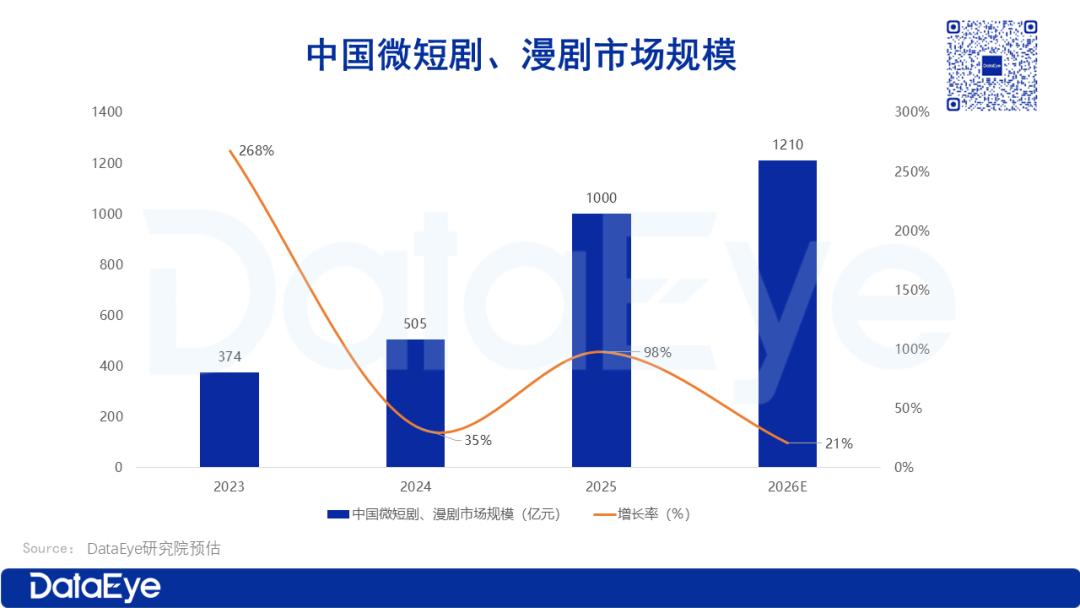
Market Overview - The market value of micro-short dramas and comic dramas in China is projected to reach 100 billion yuan by 2025, significantly exceeding the previous estimate of around 60 billion yuan [3] - The total box office revenue for films in the same year is expected to be 51.832 billion yuan, indicating that the micro-short drama and comic drama market is approaching twice the size of the film box office [3] - The explosive growth is attributed to the continuous expansion of the free micro-short drama market and the rise of comic dramas, with the free live-action micro-short drama market expected to exceed 50 billion yuan, accounting for about two-thirds of the overall market [3] Free Micro-Short Drama Market - The free micro-short drama market is estimated to reach approximately 53.3 billion yuan in 2025, representing a year-on-year growth of 113% from 2024 [6] - The growth is driven by a sluggish paid segment, leading to a focus on free distribution, and the rapid expansion of the free short drama sector attracting major platforms like Hongguo and Hema [6] User Base - By June 2025, the user base for micro-short dramas is expected to reach 696 million, accounting for nearly 70% of the total internet users in China [8] - The user base is projected to grow by approximately 34 million in the first half of 2025, reflecting a steady growth rate of 5.1% [8] User Demographics - The gender distribution of micro-short drama users is becoming more balanced, with male users accounting for about 48% and female users for about 52% in 2025 [11] - The age distribution shows a significant youth demographic, with users under 30 years old making up nearly 25% and those under 40 exceeding 60% [14] Investment Flow Analysis - The total heat value of the domestic micro-short drama market is projected to be around 24.4 billion yuan per month in 2025, with an annual total of approximately 244 billion yuan [18] - The market is experiencing a shift from explosive growth to a phase of competition among existing players, with a notable decline in the growth rate of the paid segment compared to previous years [18] Content Trends - The "revenge" genre leads the market with a heat value of 14.39 billion yuan and 5,178 short dramas, followed closely by "modern" and "face-slapping" genres, each exceeding 12.5 billion yuan [22] - The number of participating micro-short dramas in 2025 is expected to exceed 192,000, with new dramas accounting for about 84% of the total [25] Douyin Native Analysis - The Douyin native micro-short drama market is experiencing explosive growth, with monthly playback volume soaring from 34.362 billion to 219.204 billion in 2025 [34] - The number of micro-short dramas on Douyin is projected to exceed 204,800, with new dramas making up about 90% of the total [37] Platform and Production Insights - In 2025, 94 micro-short drama platforms are expected to contribute a cumulative heat value of 24.3 billion yuan, representing 99% of the overall market [29] - The top 100 micro-short drama production companies are projected to account for over 60% of the total market heat value, with significant concentration in regions like Shaanxi, Zhejiang, and Henan [30]
小鱼盈通涨超17% 国内微短剧市场规模快速起量 公司已上线AIGC创作平台 “绘小鱼”
Zhi Tong Cai Jing· 2026-01-06 02:50
Core Viewpoint - Xiaoyu Yingtong (00139) experienced a significant increase of over 17%, currently trading at 0.176 HKD with a transaction volume of 2.8744 million HKD, reflecting positive market sentiment towards the company and the micro-short drama industry [1] Industry Summary - According to iiMedia Consulting, the market size of China's micro-short drama sector is projected to reach 67.79 billion RMB by 2025, representing a year-on-year growth of 34.40%. By 2030, the market size is expected to exceed 150 billion RMB [1] - The industry has evolved from a focus on single-genre "爽剧" to a more diverse range of innovative themes, with brand IP customization becoming mainstream. Huajin Securities believes that the monetization capabilities of micro-short dramas in niche segments and brand customization scenarios will continue to strengthen [1] Company Summary - Xiaoyu Yingtong successfully held a strategic upgrade conference titled "Breaking Waves × New Journey" in Shenzhen, showcasing its comprehensive transformation towards the short drama industry and its technological advancements [1] - The company launched the AIGC creation platform "Hui Xiaoyu," which enables a full process of script writing, dialogue synthesis, and special effects integration, establishing a new infrastructure for the short drama industry [1] - Xiaoyu Yingtong initiated a new round of the "AIGC Star Plan," collaborating with leading industry partners to produce 500 AIGC micro-short dramas, aiming to lead industry upgrades and build a solid content ecosystem barrier [1]
2025年11月百强榜:榜单热力值超8亿,河马、番茄强势
3 6 Ke· 2025-12-22 11:44
Group 1 - The top three micro-dramas in November have a heat value exceeding 20 million, with "Abandon Me Like Dust, Marry You as Treasure" leading at 23.2 million, followed by "After Resignation, He is Unattainable" at 22.8 million, and "No Need to Hold on Until Old Age" at 20.3 million [11] - The top four dramas include "Recognizing Kin, I Become My Parents' Support" at 17.3 million and "Mr. Huo, Madam's Alias Dropped Again" at 17.1 million, with "Destiny" and "Entering the Game" also making the list [11] - A total of 10 production companies are associated with the top dramas, with Tomato having 41 entries, Hippo 28, and Malt 13 [11] Group 2 - In November, the top dramas saw a significant increase in viewership, with "No Need to Hold on Until Old Age" gaining 680 million views, "00s Female Engineer Restructuring Workplace" 510 million, and "Sorry, I Am Cultivating" 490 million [13] - A total of 68 new dramas entered the top 100 viewership list, with 36 making it into the top 50 [13] - The November top 100 viewership list includes 38 production companies, with Hubei Jingyue, Malt, and Tianqiao being particularly active, each having 4 entries [13] Group 3 - The Red Fruit Top 100 list is led by "Eighteen-Year-Old Great-Grandma Arrives, Restructuring Family Glory Part Three" with an average daily heat of 61.7 million, followed by "Half-Cooked Husband" at 56.7 million and "Mr. Huo, Madam's Alias Dropped Again" at 55.8 million [17] - In this list, 70 micro-dramas have an average daily heat exceeding 40 million, with 17 surpassing 50 million [17] - A total of 53 new dramas entered the Red Fruit Top 100, with 19 making it into the top 50 [17] Group 4 - The Douyin Dynamic Animation Top 100 list shows that all featured animations have a viewership increase exceeding 18 million, with 47 surpassing 30 million and 16 exceeding 50 million [18] - "No Need for Me to Guard the Border" topped the list with a viewership increase of 160 million, followed by "Confession Hidden in Time" at 150 million and "Happy Hammer 2025 Down" at 140 million [18] - A total of 48 new animations entered the top 100, with 24 making it into the top 50 [18]

11月微短剧市场观察:1157部短剧热投,新剧释放供给活力,一题材上线量暴跌
3 6 Ke· 2025-12-22 09:26
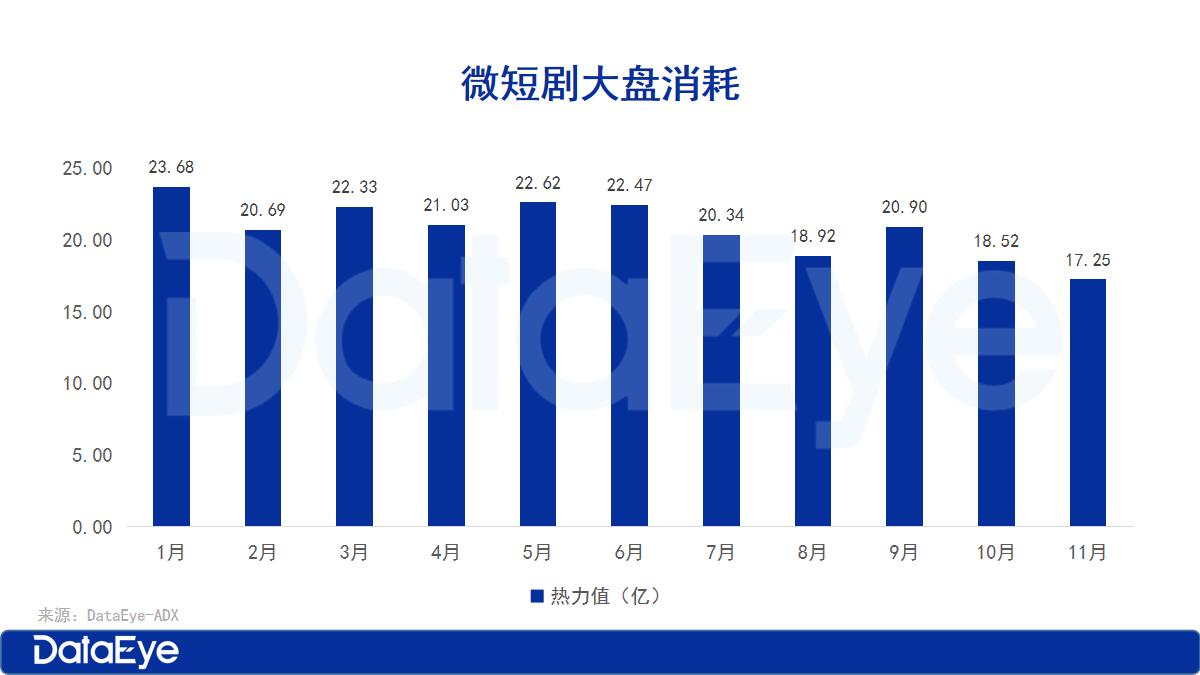
Group 1 - The core viewpoint of the article highlights the performance of micro-short dramas in November, with a total heat value of 228.75 billion, averaging 20.8 billion per month, and a recent decline in heat value observed in November [3] - The top two dramas in November were dominated by the platform "Hema," with "Abandon Me Like Dust, Marry You as a Treasure" ranking first and "After Resignation, He is Unattainable" second, showing a 31% increase in the number of new dramas [4][17] - The top three micro-short dramas had heat values exceeding 20 million, with Hema holding five out of the top ten spots, accounting for 52% of the total heat value in that segment [17][20] Group 2 - In November, 67 new dramas entered the top 100, an increase of 16 dramas compared to the previous period, indicating a growing trend in new content [17][20] - The most popular themes in November included modern, revenge, and "face-slapping" dramas, with significant increases in heat values for these categories, while family ethics and romance themes saw declines [24][25] - Regulatory scrutiny has led to the removal of dramas that promote unhealthy family conflicts, pushing the market towards more standardized and quality content [57]
From reels to real money: India’s micro-drama explosion faces tests
MINT· 2025-12-18 11:30
Core Insights - The rise of micro-dramas in India has created a new content format that appeals to younger audiences, with shows like 'Party of Two' gaining significant traction on platforms like Instagram and Meta [2][5][4] Industry Overview - Micro-dramas are short, vertical-format videos designed for mobile viewing, with episodes typically lasting between 30 seconds to three minutes [6][10] - The format has attracted millions of viewers in India, with 73.2 million viewers reported in less than a year [5] - Major players in the entertainment industry, including Balaji Telefilms and Zee Entertainment, are investing in micro-drama production to adapt to changing viewer preferences [7][8] Monetization Challenges - The primary revenue model for micro-dramas relies on advertising, with 75% of viewers coming from the advertising video-on-demand (AVoD) segment [11][12] - Companies face difficulties in monetization due to a lack of established strategies, with digital advertising in India remaining sluggish [15][19] - The Digital Personal Data Protection Act, 2023 may further complicate ad monetization by restricting targeted advertising [19] Audience Engagement - The micro-drama format requires rapid storytelling, with a plot twist expected every minute to retain viewer interest [25] - The audience demographic is broadening, with a notable increase in female viewers, indicating a wider emotional appeal for micro-drama formats [29] Content Production and Quality - The production of micro-dramas is low-cost, but this can lead to concerns about quality and originality in storytelling [10][14][27] - Companies are experimenting with hybrid monetization models that integrate brand partnerships into narratives, aiming to enhance viewer engagement [21][22] Future Directions - The industry is exploring new genres and storytelling techniques, with thrillers, fantasy, and family dramas emerging as popular categories [30] - As traditional media companies adapt to the changing landscape, there is potential for diverse programming to coexist, catering to varying viewer preferences [31][34]


新华网财经观察丨微短剧产业进阶
Xin Hua Wang· 2025-11-10 02:21
Core Insights - The micro-short drama market is projected to exceed 50 billion yuan in 2024, with significant growth expected this year compared to last year [2] - The industry is transitioning from a "traffic-oriented" model to a "value-oriented" model, emphasizing quality over quantity [4] Group 1: Quality Enhancement - The industry has shifted from being a "cost-effective" space to a "quality-centric" one, where high-quality content is essential for survival [5] - The production costs for quality micro-short dramas have increased significantly, from approximately 50,000 yuan in 2022 to 1.5 million yuan currently [5] - User expectations have risen, leading to a strong willingness to pay for high-quality content, which drives the industry's transformation towards premium offerings [5][7] Group 2: Cross-Industry Integration - The "micro-short drama+" model is creating multiplier effects across various industries, enhancing content's value beyond mere entertainment [8] - Successful case studies include collaborations with brands like Dicos and Pizza Hut, integrating product features into storylines to achieve significant exposure [8] - The integration of long and short formats is becoming crucial, with platforms developing strategies to extend IP lifecycles and maximize user value [8][10] Group 3: Technological Empowerment - AI is becoming a vital tool for enhancing quality and efficiency in micro-short drama production, with estimates suggesting a 50% increase in planning efficiency and a 30% reduction in production costs [11] - The application of AI in content creation and user engagement is reshaping the production process, making it a core component of the creative economy [11] Group 4: Cultural Resonance - The market is evolving from superficial emotional expressions to deeper emotional connections with audiences, reflecting a shift in user demands [12] - Works that portray nuanced emotional experiences are gaining popularity, indicating a trend towards content that resonates on a personal level [12][14] Group 5: Global Expansion - The micro-short drama industry is entering a "global localization" phase, with companies establishing local teams and platforms in over 200 countries [15] - The range of themes is diversifying, moving from traditional genres to urban, suspense, and realism, making micro-short dramas effective cultural carriers in global markets [15]


9月微短剧月报:红果热度再破新高、热力值大盘累计近193亿,听花岛、马厩制片厂领跑免费,一厂商All in漫剧赛道
3 6 Ke· 2025-10-15 08:43
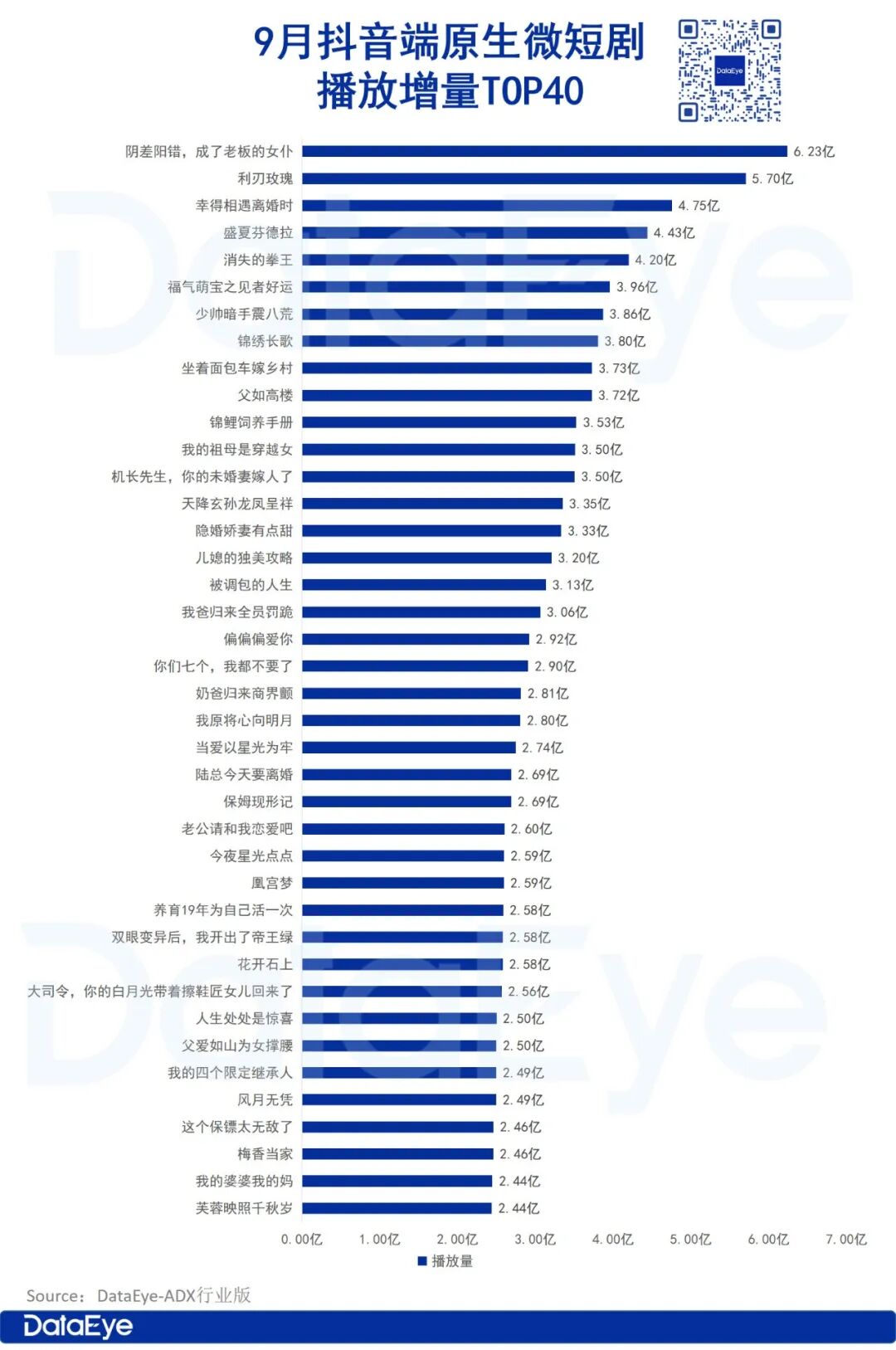
Core Insights - The micro-drama market has reached a cumulative consumption of 19.299 billion, with a monthly average of 2.144 billion, indicating a stable growth but a significant slowdown compared to the exponential growth from 2021 to 2023, transitioning from an "explosive growth phase" to a "stock competition phase" [1] - In September, the micro-drama market saw a total consumption of 2.09 billion, marking a 10.43% increase from August, driven by strong performances from new works like "Don't Mess with the Real Golden Girl" [1][2] Group 1: September Top Dramas - The top three dramas in September were "Don't Mess with the Real Golden Girl," "This Bodyguard is Too Invincible," and "The Disappearing Boxer," with the top drama exceeding a heat value of 43 million [2] - A total of 59 new dramas entered the top 100, with the top 100 dramas achieving a total heat value of 938 million, accounting for 44.88% of the market in September [2] Group 2: Performance of Key Players - Tomato led the rankings with 38 entries in the top 100, while Hema and Maiya followed with 24 and 11 entries, respectively [3] - The drama "Don't Mess with the Real Golden Girl" achieved a heat value of over 43 million, making it the only drama in the past three months to exceed 40 million in a single month [3] Group 3: Trending Themes - The "revenge" theme remained the most popular, with a total heat value of 1.401 billion across 521 dramas, while urban daily life themes dropped to fourth place [4][5] - Modern romance and family ethics themes showed resilience, with heat values of 521 million and 496 million, respectively, despite a decrease in the number of associated dramas [5] Group 4: Streaming Platforms and New Releases - On Douyin, 64 new dramas were released in September, contributing to a total playback increase of 12.839 billion across the top 40 dramas [7] - The top new drama "Yin Cha Yang Cuo, Became the Boss's Maid" achieved a playback increase of 623 million, while "Li Ren Mei Gui" and "Xing De Xiang Yu Li Hun Shi" followed closely [9] Group 5: Market Dynamics and Strategies - The market is entering a phase of stock competition, with a narrowing growth rate but still showing resilience, driven by strong content like "Don't Mess with the Real Golden Girl" [33] - The industry is shifting from a single promotional strategy to a more integrated approach, focusing on building a closed loop of "actors-content-users" to enhance visibility and reduce long-term costs [33]
中国移动咪咕多部短剧获奖,闪耀2025视听中国马栏山微短剧之夜
Huan Qiu Wang· 2025-10-15 02:35
Core Insights - The event "2025 Audiovisual China Malanshan Micro Short Drama Night" aimed to promote high-quality development in the micro short drama industry through industry exchanges and recognition of outstanding works [1] - Migu's works received multiple awards, showcasing its strong capabilities in content innovation and quality control within the micro short drama sector [1][5] - Migu Reading has a robust content production system, having incubated over 20,000 full copyright works and collaborating with Mango TV on successful IP adaptations [5][7] Industry Developments - The launch of Mango TV's "Thousand IP Joint Creation Ecological Plan" highlights a collaborative effort to enhance content creation in the industry, with Migu Reading's work "Spring Ripple" being selected [3] - The integration of AI technology in micro short drama creation is emphasized, with the announcement of the "Micro Short Drama + AIGC" initiative, indicating a shift towards innovative content production methods [7][8] - Migu is actively exploring the fusion of micro short dramas with various themes, such as non-heritage and wartime narratives, to expand the genre's application and commercial value [8][9] Future Directions - Migu plans to strengthen collaborations across the industry to promote standardization and innovation in micro short dramas, aiming to deliver more high-quality and creative works to audiences [9]