Panels

Search documents
友达、群创等6家面板厂公布2月营收
WitsView睿智显示· 2026-03-11 06:00
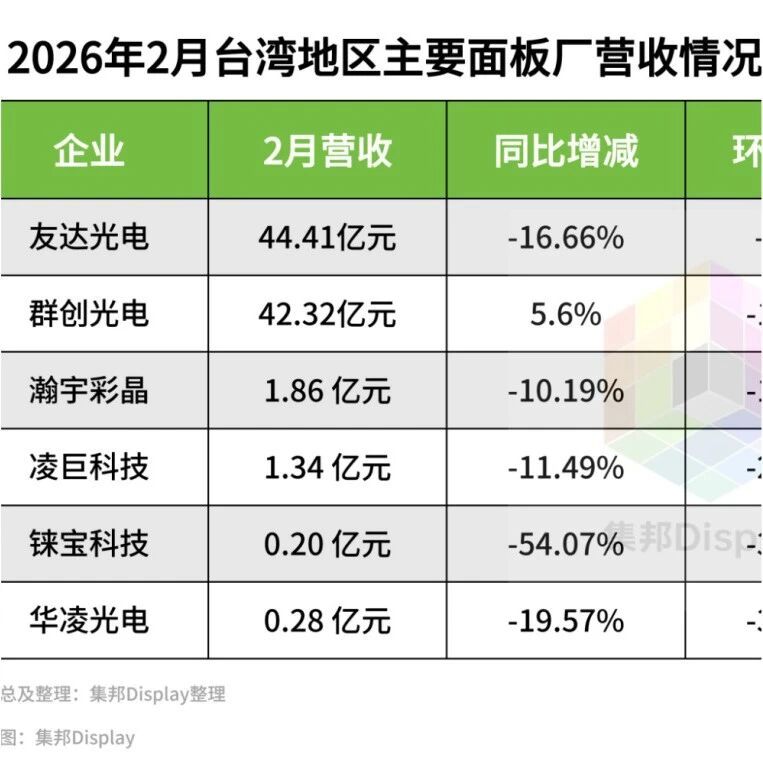
Core Viewpoint - The revenue performance of six Taiwanese panel manufacturers in February 2026 shows a mixed trend, with most companies experiencing declines due to seasonal factors and inventory adjustments, while some exhibit resilience in their operations [2][3]. Revenue Performance Summary - **AU Optronics**: February revenue was 4.441 billion, down 16.66% year-on-year and 8.89% month-on-month; cumulative revenue for 2026 reached 9.316 billion, a decrease of 7.00% year-on-year [2]. - **Innolux**: February revenue was 4.232 billion, showing a year-on-year increase of 5.6% but a month-on-month decline of 11.74%; cumulative revenue for 2026 was 9.028 billion, up 12.14% year-on-year [2]. - **HannStar Display**: February revenue was 186 million, down 10.19% year-on-year and 18.68% month-on-month; cumulative revenue for 2026 was 414 million, a slight increase of 0.78% year-on-year [2]. - **Lianjian Technology**: February revenue was 134 million, down 11.49% year-on-year and 20.42% month-on-month; cumulative revenue for 2026 was 302 million, up 3.44% year-on-year [2]. - **Rohm Semiconductor**: February revenue was 20 million, with a month-on-month decline of 54.07% and a year-on-year decrease of 32.05%; cumulative revenue for 2026 was 50 million, down 41.24% year-on-year [2]. - **Hua Ling Optoelectronics**: February revenue was 28 million, down 19.57% year-on-year and 30.03% month-on-month; cumulative revenue for 2026 was 66 million, down 11.22% year-on-year [2]. Market Dynamics - The overall revenue decline in February is attributed to traditional off-season effects, reduced working days, and ongoing inventory adjustments by end brands, indicating weak demand for small and medium-sized panels [3][4]. - AU Optronics and Innolux are accelerating their focus on high-value-added businesses, with AU Optronics developing a transparent satellite antenna module and Innolux reportedly entering the supply chain for AI data center optical communication components [5]. Future Outlook - According to TrendForce's latest panel price forecast for March 2026, the market is expected to see a mixed trend with TV and monitor prices rising while laptop panel prices stabilize [6]. - The confidence of panel manufacturers, represented by AU Optronics and Innolux, is expected to improve as they transition from traditional scale competition to high-value-added sectors, despite short-term seasonal pressures [6].

集邦咨询:2月电视面板价格预计涨势延续,笔电面板价格承压
Xin Lang Cai Jing· 2026-02-06 04:32
Core Viewpoint - TrendForce predicts that TV panel prices will continue to rise in February 2026, while monitor panel prices for certain sizes are expected to increase, and laptop panel prices are anticipated to decline [1] Group 1: TV Panel Price Trends - In February, TV panel prices are expected to show a comprehensive upward trend [1] - The price increase forecast includes a rise of $1 for 32-inch, 43-inch, and 50-inch panels, and a rise of $2 for 55-inch, 65-inch, and 75-inch panels [1] Group 2: Monitor and Laptop Panel Price Trends - Certain sizes of monitor panels are expected to see price increases [1] - Laptop panel prices are projected to decline [1]
面板产业链近期核心看点分析
2026-01-26 02:49
Summary of Panel Industry Chain Conference Call Industry Overview - The panel industry chain is experiencing price increases driven by rising costs of upstream materials such as films, which directly impacts panel prices [1][3] - The competitive landscape within the panel industry is improving, with tightening capacity further solidifying the upward price trend, potentially enhancing the gross margins of related companies [1] Core Insights - If polarizer manufacturers can successfully implement price increases, it will significantly improve their operational conditions and profitability [1][4] - Panel manufacturers can leverage the price increases from upstream materials to raise prices downstream, thereby enhancing their own profitability [1][4] - Key areas to focus on during the current price increase include segments with favorable competitive dynamics and low domestic substitution rates, such as panels themselves, TAEG膜, and OLED materials, which are expected to benefit from both price increases and domestic substitution [1][5] Future Development Directions - The future development of the panel industry chain is centered on two main areas: glass substrate packaging technology and solar wing battery technology for commercial aerospace [1][6] - Companies like Innolux and TSMC have begun mass shipments of glass-based chip packaging, while BOE is focusing on perovskite solar wing battery technology [1][6] Capital Expenditure Insights - New emerging businesses such as glass-based chip packaging and solar wing batteries require relatively low capital expenditures compared to traditional panel businesses [1][7] - These new ventures can utilize existing production lines and processes, leading to a higher return on investment, as evidenced by Innolux's successful mass production with significantly lower capital expenditures than traditional large-scale investment projects [1][7] Key Factors for 2026 - In 2026, the panel industry chain is worth monitoring due to several factors: - A favorable competitive landscape with various catalysts driving product price increases [2][8] - Upstream segments with low domestic substitution rates, such as TAEG膜 and OLED materials, are expected to benefit from accelerated domestic substitution [2][8] - New technological expansions in areas like glass-based chip packaging and commercial aerospace solar wing batteries will provide new growth trajectories for the industry [2][8]
面板行业专家会议
2025-12-11 02:16
Summary of Panel Industry Conference Call Industry Overview - The panel industry is experiencing a mixed demand situation, with brand manufacturers maintaining high procurement levels despite declining sales data. In Q4, procurement in mainland China is expected to remain flat year-on-year at 23 million units, indicating positive market demand expectations despite inventory accumulation [1][3] - The global panel shipment volume is projected to reach 246 to 247 million units in 2025, with a slight increase expected in 2026. The overall shipment area is anticipated to grow by approximately 2%, driven by sustained high levels of small and medium-sized panel shipments [1][6] Key Insights and Arguments - **Demand Drivers**: Several factors are expected to positively influence demand in the first half of next year, including potential continuation of subsidy policies in mainland China, promotional events like the 618 shopping festival, and international events such as the World Cup and Winter Olympics. If the U.S. government issues additional subsidies, consumer demand could be further stimulated [1][4] - **Price Trends**: Panel manufacturers believe current prices are near the bottom, leading to price increases starting in November. Smaller clients are already feeling the pressure, while larger clients are expected to negotiate price increases in January. The ability of panel manufacturers to coordinate production during the Chinese New Year will significantly impact price increases in Q1 [1][4] - **Supply and Production Rates**: The current supply-demand situation in the LCD market shows a slight oversupply, with an excess rate of 13%-14% without considering capacity depreciation, and 11%-12% when accounting for it. The trend towards larger sizes and the retirement of older generations may lead to a tightening of LCD capacity in the next two to three years [3][15] Additional Important Points - **Inventory Management**: Brand manufacturers are expected to increase procurement in December and January to avoid supply shortages due to delayed factory operations after the late Chinese New Year. This procurement peak is anticipated to last until April or early May [1][4] - **Market Segmentation**: The demand for large and ultra-large televisions (65, 75, 85, 98, and 100 inches) remains strong, particularly in North America where prices are very competitive. The average price for a 100-inch TV is below $1,000, making these products attractive to consumers [7][8] - **Regional Performance**: By the end of 2025, the average screen size in North America is expected to reach 52 inches, while mainland China could see an average of 63 inches. Other regions like Southeast Asia and Oceania are projected to have average sizes around 45 inches [9] - **Profitability Challenges**: Current low panel prices are making it difficult for hardware manufacturers to achieve profitability. Rising costs of other raw materials are increasing overall production costs, leading many manufacturers to rely on software platforms for advertising revenue to offset hardware losses [5] Conclusion - The panel industry is navigating a complex landscape with mixed demand signals and pricing pressures. While there are positive indicators for future demand, particularly for large screens, manufacturers must carefully manage production and inventory to optimize profitability in a challenging market environment.
LGD广州工厂易主在即,战投创维半价“贱卖”离场
Ge Long Hui· 2025-06-09 01:47
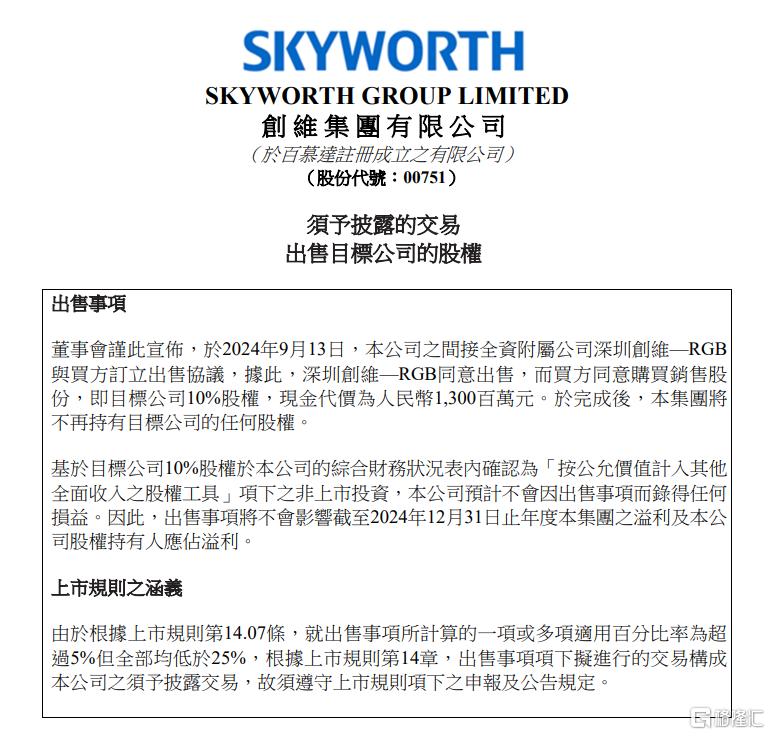
Core Viewpoint - The article discusses the sale of a 10% stake in LG Display (China) by Skyworth Group to LG Display (Guangzhou) for 1.3 billion yuan, marking Skyworth's exit from the investment, which is perceived as a "fire sale" given the significant undervaluation of the asset [1][5][13]. Group 1: Transaction Details - Skyworth's subsidiary signed an agreement to sell a 10% stake in LG Display (China) for 1.3 billion yuan, after which Skyworth will no longer hold any shares in the company [1][5]. - The sale price represents a significant discount, with the book value of the shares being approximately 740 million yuan, indicating a sale at about 55.5% and 62.7% of their book value [13][14]. - Skyworth aims to use the proceeds from the sale to improve liquidity and fund other business operations [14]. Group 2: Industry Context - LG Display's Guangzhou factory is a critical asset in the Chinese panel industry, with a total investment of 4 billion USD and a production capacity of 180K, contributing to 4% of the global TV panel market [10][11]. - The factory's operational challenges, including a drop in utilization rates to around 50%, have led to speculation about its future, with TCL and BOE expressing interest in acquiring the asset [8][10]. - The sale of the factory is seen as a reflection of the broader struggles within the global panel industry, where LG Display is shifting focus towards OLED and MLED technologies [10][11]. Group 3: Company Performance - Skyworth's revenue declined by 6.6% year-on-year to 29.83 billion yuan in the first half of the year, despite a slight increase in gross profit [19][21]. - The company has reduced its workforce by 3,000 employees while simultaneously increasing investment in facilities and equipment by over 60% to 342 million yuan [21]. - Skyworth's reliance on its home appliance segment, particularly TVs, has increased, with this segment accounting for 51.7% of total revenue, while other segments like new energy have seen significant declines [21][22].