
Special Equipment

Search documents
济南将争取国家“人工智能+工业软件”中试基地项目落地建设
Qi Lu Wan Bao· 2026-01-19 02:14
Core Viewpoint - Jinan aims to implement an industrial strong city strategy by 2026, focusing on building a modern industrial system Group 1: Strengthening Advantageous Industries - The city will focus on electronic information, automotive, high-end software, and modern medicine industries, aiming to enhance scale, extend chains, and grow enterprises [2] - In the electronic information sector, Jinan plans to achieve an industry scale of 240 billion yuan by accelerating the construction of semiconductor and micro-display projects [2] - The automotive industry aims for a scale of 180 billion yuan, supporting companies like BYD and Geely in introducing high-end models and promoting collaborative development [2] - The high-end software sector targets a scale of 130 billion yuan, emphasizing the development of industrial software and AI applications [2] - The modern medicine industry, relying on key enterprises, aims for a scale of 52 billion yuan by enhancing various pharmaceutical sectors [2] Group 2: Cultivating Characteristic Industries - Jinan will focus on high-end CNC machine tools, robotics, specialized equipment, steel, advanced materials, and food and bio-manufacturing, aiming to create competitive industrial clusters [4] - The high-end CNC machine tools and robotics sector targets a scale of 55 billion yuan, with key projects like the industrial mother machine park [4] - The specialized equipment industry aims for a scale of 115 billion yuan, with support for leading companies and project expansions [4] - The steel industry will focus on green low-carbon transformation, targeting a scale of 165 billion yuan by developing high-value products [4] - The advanced materials sector aims for a scale of 35 billion yuan, promoting innovation and expansion in chemical and metal materials [4] - The food and bio-manufacturing industry targets a scale of 77.5 billion yuan, supporting innovative development of key enterprises [4]


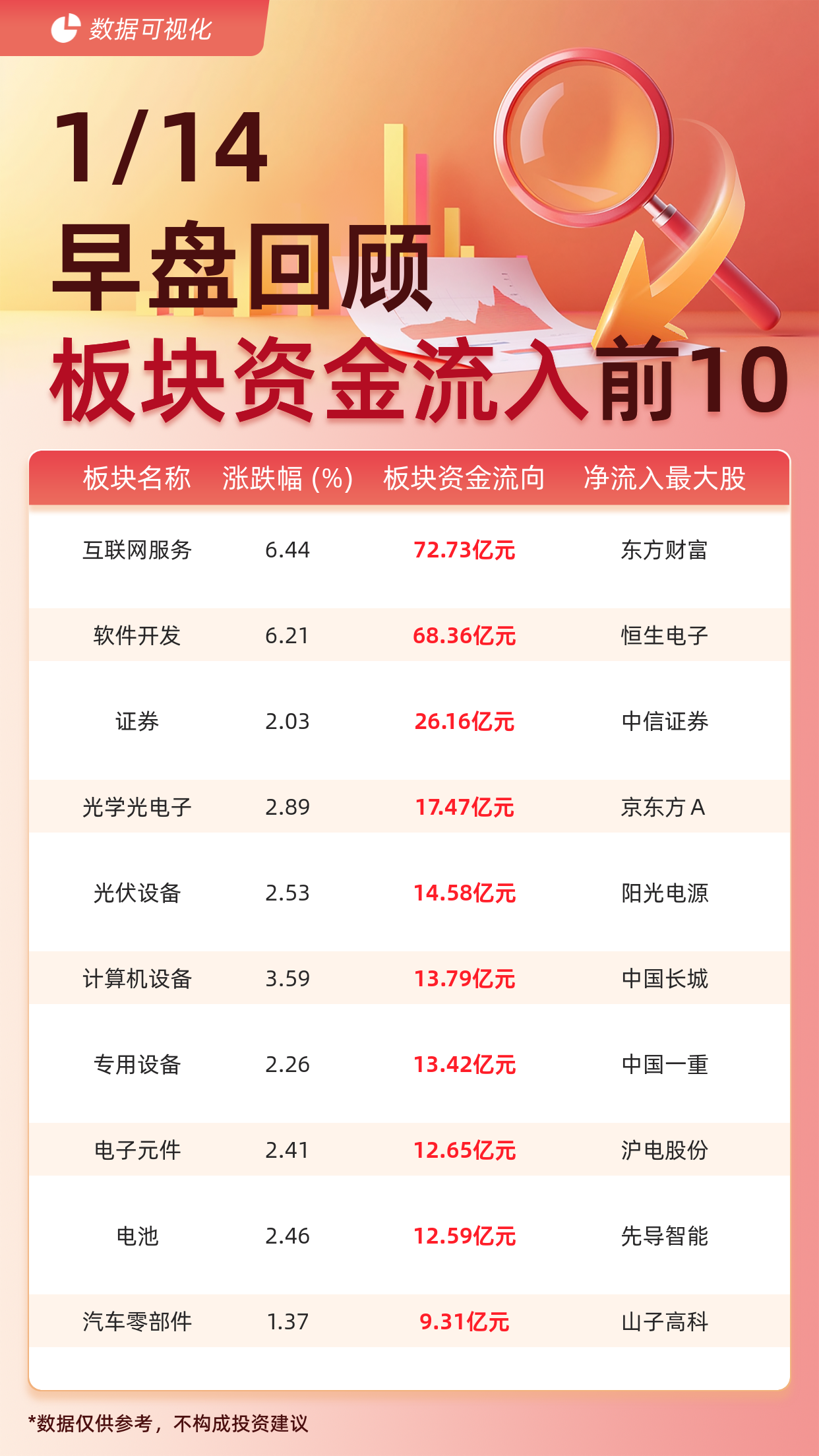
主力板块资金流入前10:互联网服务流入72.73亿元、软件开发流入68.36亿元
Jin Rong Jie· 2026-01-14 04:04
Core Insights - The main market saw a net inflow of 19.182 billion yuan as of January 14, with significant capital flowing into various sectors [1] Group 1: Sector Performance - The top sectors by net capital inflow were: - Internet Services with 7.273 billion yuan and a growth of 6.44% [2] - Software Development with 6.836 billion yuan and a growth of 6.21% [2] - Securities with 2.616 billion yuan and a growth of 2.03% [2] - Optical and Electronic with 1.747 billion yuan and a growth of 2.89% [2] - Photovoltaic Equipment with 1.458 billion yuan and a growth of 2.53% [2] - Computer Equipment with 1.379 billion yuan and a growth of 3.59% [2] - Specialized Equipment with 1.342 billion yuan and a growth of 2.26% [3] - Electronic Components with 1.265 billion yuan and a growth of 2.41% [3] - Batteries with 1.259 billion yuan and a growth of 2.46% [3] - Automotive Parts with 0.931 billion yuan and a growth of 1.37% [3]






AI明星新股创造历史!AI产业链涨停热度大涨
Mei Ri Jing Ji Xin Wen· 2025-12-17 09:19
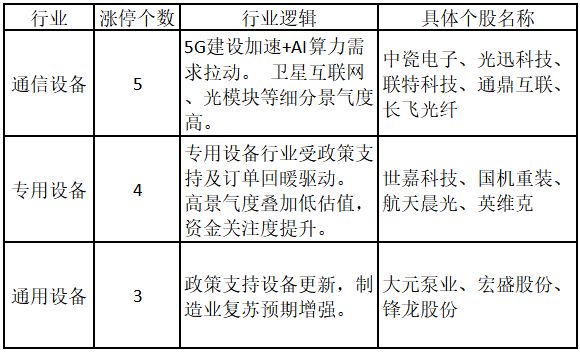
Market Overview and Sector Characteristics - The Shanghai Composite Index closed up by 1.19%, while the Shenzhen Component Index fell by 2.40%, with the median change in A-shares being an increase of 0.61% [1] - A total of 49 stocks hit the daily limit up, an increase of 7 from the previous day, while 19 stocks hit the limit down, an increase of 4 [2] Industry Characteristics - The sectors with the most limit-up stocks today were communication equipment, specialized equipment, and general equipment [3] - In the communication equipment sector, 5 stocks reached the limit up, driven by accelerated 5G construction and AI computing demand [4] - The specialized equipment sector saw 4 stocks limit up, supported by policy backing and recovering orders [4] - The general equipment sector had 3 stocks limit up, boosted by policy support for equipment upgrades and enhanced manufacturing recovery expectations [4] Concept Characteristics - The most represented concepts among limit-up stocks were optical communication, liquid cooling servers, and consumer sectors [5] - In the optical communication concept, 7 stocks hit the limit up, benefiting from the explosive demand for AI computing and the acceleration of 800G optical module shipments [5] - The liquid cooling server concept also had 7 stocks limit up, as liquid cooling technology becomes the mainstream solution for heat dissipation due to AI computing demand [5] - The consumer sector had 6 stocks limit up, supported by policy stimulus and the year-end consumption peak, with strong expectations for consumer potential [5] Limit-Up Stock List - Among the limit-up stocks, 3 reached historical highs, including Yingweike, Ping An Electric, and Huanxu Electronics [6] - 10 stocks reached near one-year highs, including Shengtong Energy, Jiamei Packaging, and others [7][8] Main Capital Flow - The top 5 stocks with the highest net inflow of main capital among limit-up stocks were Yingweike, Guojiji Heavy Industry, Guangxun Technology, ShenNan Circuit, and Meinian Health [9][10] - The stocks with the highest net inflow as a percentage of market value included Wangzi New Materials, Nanjing Business Travel, and others [10] Continuous Limit-Up Situation - There were 41 first-limit stocks today, with 5 stocks achieving a second limit up and 3 stocks achieving three or more consecutive limit ups [11] - The top 5 stocks with the most consecutive limit ups included Baida Group, Shengtong Energy, and others [11]





中国 - 11 月经济活动数据普遍不及市场预期-China_ November activity data broadly missed market expectations
2025-12-16 03:30
Summary of Key Points from the Conference Call Industry Overview - The report focuses on the economic activity data from China for November, highlighting significant misses in market expectations across various sectors, particularly retail sales and industrial production [1][2][3]. Core Insights and Arguments 1. **Industrial Production (IP)** - IP growth decreased to **4.8% year-on-year** in November from **4.9%** in October, falling short of forecasts (GS: **5.1%**, Bloomberg consensus: **5.0%**) [2][8]. - Sequentially, IP showed a **0.5% month-on-month** increase after seasonal adjustment, contrasting with a **-0.4%** decline in October [8]. - The slowdown in IP was primarily driven by reduced output in the automobile and utilities sectors, which outweighed gains in special equipment and pharmaceuticals [8]. 2. **Fixed Asset Investment (FAI)** - FAI contracted by **-2.6% year-to-date** year-on-year in November, worsening from **-1.7%** in October [3][9]. - On a single-month basis, FAI fell by **-10.7% year-on-year** in November, slightly improving from **-11.4%** in October [9]. - The decline in FAI is attributed to statistical corrections by the NBS and ongoing issues in the property sector [9]. 3. **Retail Sales** - Retail sales growth significantly slowed to **1.3% year-on-year** in November, down from **2.9%** in October, missing expectations (GS: **2.3%**, consensus: **2.9%**) [6][11]. - The decline was broad-based, with notable drops in auto sales (-8.3%) and home appliances (-19.4%) [11]. - The earlier start of the "Double 11" Online Shopping Festival distorted demand, pulling some sales from November into October [11]. 4. **Services Industry Output** - The Services Industry Output Index growth moderated to **4.2% year-on-year** in November from **4.6%** in October, indicating a slowdown in the services sector [12]. 5. **Property Market** - The property market continued to show weakness, with new home starts and completions contracting by **-27.6%** and **-25.3%** year-on-year, respectively [13]. - Property sales volume fell by **-17.0%** and value by **-24.6%** in November, reflecting ongoing challenges in the sector [13]. 6. **Labor Market** - The nationwide unemployment rate remained stable at **5.1%** in November, with the youth unemployment rate for ages 16-24 declining slightly to **17.3%** [14]. 7. **GDP Growth Forecast** - Incorporating October-November data, there is a small downside risk to the Q4 real GDP growth forecast of **4.5% year-on-year**, with a sequential improvement in December activity needed to achieve a **5%** full-year growth [15]. Additional Important Insights - The report emphasizes that the recent slump in economic indicators should not be over-interpreted, as statistical corrections have played a significant role alongside fundamental economic challenges [1][9]. - The data reflects broader economic trends in China, including the impact of "anti-involution" policies and a prolonged downturn in the property market, which are critical for investors to consider [1][9].