
TIC行业

Search documents
社保违规、海外布局遇挫,钛和检测募资海外扩张合理性存疑
凤凰网财经· 2026-02-03 12:41
Core Viewpoint - Recently, Tihe Testing and Certification Group Co., Ltd. submitted a listing application to the Hong Kong Stock Exchange, aiming to raise funds through H shares for expansion, with Everbright Securities International as the sole sponsor [1] Financial Performance - From 2023 to 2024, the company's revenue is projected to grow from 777 million RMB to 802 million RMB, reflecting a growth rate of only 3.18%, significantly lower than the 8.0% compound annual growth rate of the Chinese TIC industry during the same period [2] - In the core business segments, the performance is mixed. The communication and automotive services segment is expected to see a 36.7% year-on-year increase in revenue to 228 million RMB in the first nine months of 2025, while the industrial and facilities services segment is projected to decline by 8.3%, and the consumer and health services segment is expected to decrease by 7.4% [2] - The industrial and facilities services segment, which was once the largest revenue source, accounted for 46.0% of total revenue in 2023 but has seen both revenue shrinkage and a narrowing gross margin due to reduced income from new energy facility services [2] Compliance and Legal Issues - The company has notable deficiencies in compliance operations, posing potential operational risks. From 2023 to the first nine months of 2025, there were continuous shortfalls in social insurance and housing fund contributions, totaling 27 million RMB, 29.8 million RMB, and 26.6 million RMB respectively [4] - The company has confirmed past involvement in legal disputes related to infringement and contract issues, which could lead to financial burdens such as back payments and fines if regulatory actions are taken [5] - The company has engaged 753, 811, and 702 subcontractors in 2023, 2024, and the first nine months of 2025, with total subcontracting costs exceeding 300 million RMB [7] Expansion Plans - The funds raised from the Hong Kong listing are intended for the establishment of laboratories in Indonesia and Brazil, the setup of a 6G sensing laboratory in Hangzhou, AI technology applications, and working capital supplementation [8] - The company's past overseas expansion efforts have not been successful, with the German subsidiary established in 2023 failing to generate significant revenue and the Brazilian subsidiary still in preparation [9] - Despite the planned funding for overseas laboratory bases, the company's overseas revenue decreased from 14.675 million RMB to 13.751 million RMB in the first nine months of 2025, while domestic revenue continues to grow steadily [10] Previous Listing Attempts - The company has previously attempted to apply for A-share listings in 2021 and 2023, both of which did not progress successfully [12]


人工智能赋能中国企业“绿色竞争力”
Zhong Guo Xin Wen Wang· 2025-10-28 02:54
Core Viewpoint - The integration of new digital technologies, particularly artificial intelligence, is accelerating innovation and supporting the green transformation necessary for achieving carbon peak and carbon neutrality goals in China [1][2]. Group 1: ESG and Economic Transition - China's economy has shifted from high-speed growth to high-quality development, making ESG a critical issue for Chinese enterprises [2]. - There is a historical opportunity for companies to transform compliance costs into sustainable competitive advantages, although structural challenges remain [2]. Group 2: Technological Integration in ESG - The integration of technologies such as artificial intelligence, blockchain, and the Internet of Things is addressing issues related to the fragmentation, lag, and credibility of traditional ESG data collection [2]. - Digital twin technology can simulate and optimize energy consumption, logistics, and assets in a virtual space, contributing to carbon reduction and efficiency [2]. Group 3: Internationalization of ESG Standards - There are differences between international ESG standards and Chinese standards due to varying development stages and regulatory frameworks, which necessitates the promotion of "Chinese solutions" globally [4]. - The fusion of digital technologies with the TIC industry is at a critical stage, focusing on sectors like automotive and new energy to enhance China's participation in global ESG governance [4]. Group 4: Building ESG Support Systems - There is a need to establish an international ESG support system for Chinese enterprises to enhance their voice in global sustainable development agendas [4]. - Emphasis on top-level design and collaboration in ESG initiatives is crucial for building a systematic approach to ESG capabilities within enterprises [4].
AI战略+持续回购,力鸿检验走出“六年长牛”
Zhi Tong Cai Jing· 2025-09-30 11:41
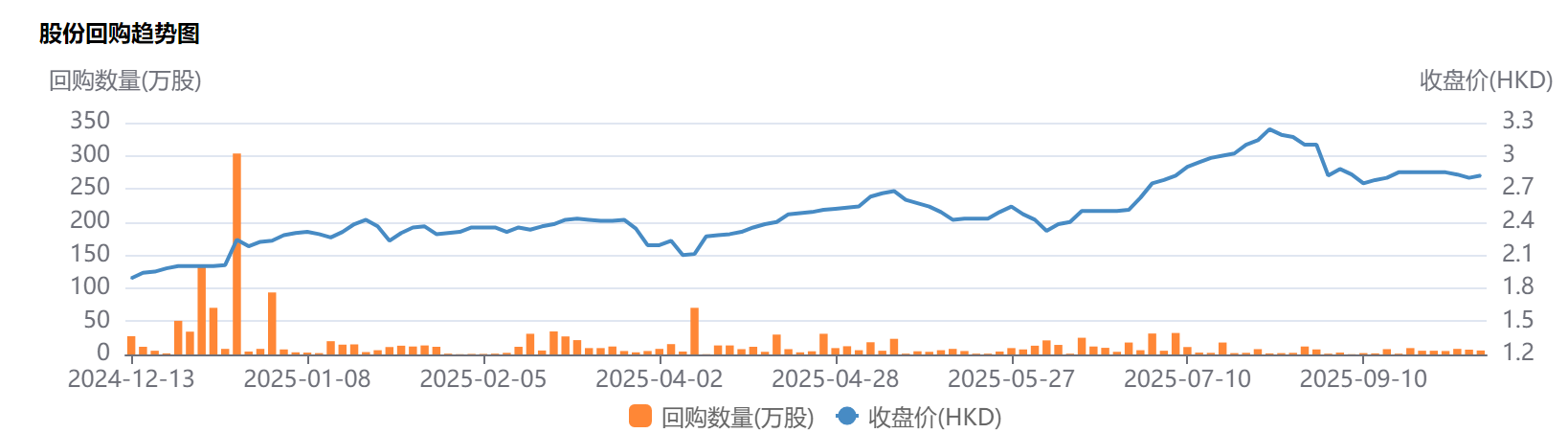
Core Viewpoint - The company, Lihong Testing (01586), has demonstrated strong performance in the Hong Kong stock market, achieving a market capitalization increase of 28.9% this year, with a long-term growth trajectory reflected in over 100% growth in the past three years and over 300% in the past six years [1][8]. Financial Performance - For the first half of 2025, Lihong Testing reported revenues of HKD 603 million, with gross profit and net profit attributable to shareholders at HKD 258 million and HKD 41 million, respectively, showcasing resilience despite external challenges [1]. - The company anticipates steady growth from 2022 to 2024, with a compound annual growth rate (CAGR) of 15.7% in revenue and 9.4% in net profit [1]. Share Buyback and Investor Confidence - Lihong Testing initiated a share buyback plan on December 19, 2022, and has conducted 116 buybacks totaling 17.64 million shares, representing 3% of total share capital, with a total expenditure of HKD 40.25 million [2]. - The company's market capitalization increased by 48.7% during the buyback period, and as of June 2025, it held cash equivalents of HKD 216 million, a 13.1% increase year-on-year [2]. Strategic Initiatives and AI Integration - The company is aligning with AI trends, establishing AI as a core strategic direction for 2025, and aims to leverage AI and robotics to enhance its service offerings [6]. - Lihong Testing is integrating IoT, big data analysis, and multimodal AI technologies to develop a safety production intelligent platform, focusing on optimizing safety management efficiency [6]. ESG and Global Expansion - The company is committed to long-term development through ESG initiatives, assisting clients in addressing climate change and contributing to green low-carbon transitions [7]. - Lihong Testing is expanding its global footprint, with overseas revenue reaching HKD 295 million in the first half of 2025, accounting for 48.92% of total revenue, and establishing a network across 19 countries [7]. Shareholder Support - The company has received strong support from shareholders, with consistent buying activity from major stakeholders since its IPO, indicating confidence in its long-term growth prospects [8]. - The ongoing buyback efforts not only support stock price stability but also significantly enhance shareholder returns, with the company maintaining a favorable valuation outlook [8].
深圳瑞捷(300977) - 2025年8月29日投资者关系活动记录表
2025-08-31 12:40
Strategic Overview - The company has launched the "X3 Strategy" to drive high growth from 2025 to 2027, focusing on three main sectors: large infrastructure, new insurance, and new industries [2][3] - The "X3 Strategy" aims to transform the company into a digital platform through advanced technology [3] Strategic Goals - Five key strategic upgrades include: 1. Transitioning from construction consulting to professional technical services (TIC) [3] 2. Expanding business model to include energy, new consumption, insurance, and large infrastructure sectors [3] 3. Shifting from a service + platform + data model to a service + platform + product integrated solution [3] 4. Moving from a labor-intensive model to a technology-driven approach [3] 5. Balancing internal growth with external mergers and acquisitions [3] Investment and R&D - The company plans to focus on investment and acquisitions under the "X3 Strategy," utilizing AI and new technologies for business enhancement [4] - R&D investment for H1 2025 was 15.23 million yuan, showing a slight increase year-on-year [5] - The company is collaborating with Hong Kong University of Science and Technology on a project that significantly improves efficiency in building inspections [5] Customer Structure and Revenue - In H1 2025, new customer contracts increased, with revenue from industrial and insurance clients rising by 13.72% and 46.79% respectively, while real estate client revenue dropped to 40.03% [6] Employee Incentives - The employee stock ownership plan has a 12-month lock-in period, while the stock incentive plan has a 36-month lock-in period, targeting different employee groups [6] - Total cost for the employee stock ownership plan is 4.78 million yuan, while the stock incentive plan's total cost over three years is 17.35 million yuan [7]