
《中国货币资金分析精要》

Search documents
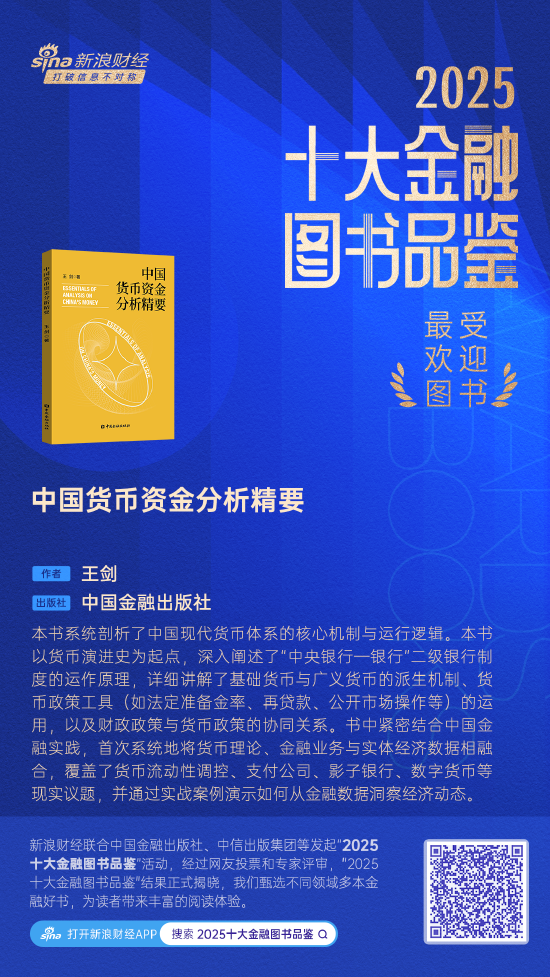
王剑《中国货币资金分析精要》获评2025十大最受欢迎金融图书
Xin Lang Cai Jing· 2026-02-05 14:14
Group 1 - The event "Top 10 Financial Books of 2025" was officially announced after two months of competition and expert evaluation, with "Analysis of Chinese Monetary Funds" by Wang Jian being awarded as one of the most popular financial books [1][2][4] - The book systematically analyzes the core mechanisms and operational logic of China's modern monetary system, starting from the history of monetary evolution [4][8] - It elaborates on the operation principles of the "Central Bank-Bank" dual banking system, the derivation mechanisms of base money and broad money, and the application of monetary policy tools such as reserve requirements, re-lending, and open market operations [4][8] Group 2 - The book integrates monetary theory, financial business, and real economic data, covering topics such as liquidity control, payment companies, shadow banking, and digital currency [4][8] - It provides practical case studies demonstrating how to gain insights into economic dynamics from financial data [4][8]

解码现代货币体系的运行与调控实践
Sou Hu Cai Jing· 2025-12-01 23:10
Core Insights - The book "Essentials of Chinese Monetary Fund Analysis" by Wang Jian provides a comprehensive review of the evolution of currency forms and systems, linking historical changes to modern monetary control and financial data [1][2] Group 1: Modern Monetary System - The author emphasizes that the core of the modern monetary system is the equilibrium among the "fiscal-central bank-bank" triad, rather than merely focusing on the "central bank-bank" dual banking system [2] - The book simplifies the complex operations of the "central bank-bank" system into a clear accounting process, using T-accounts to visualize the currency issuance and creation process, thus making the theoretical aspects more accessible [2] - Understanding the relationship between base currency liquidity, controlled by the central bank, and broad liquidity, determined by bank credit expansion, is crucial for interpreting policy intentions [2] Group 2: Analytical Framework - The book introduces a "linked thinking" analytical framework that integrates monetary policy, fiscal policy, and macro-prudential policy, along with banking behavior and decisions made by households and enterprises [3] - It addresses non-traditional factors affecting the "fiscal-central bank-bank" equilibrium, such as the impact of payment companies' reserve fund concentration and the effects of shadow banking and digital currencies on traditional systems [3] - The analysis fills gaps in traditional monetary textbooks by exploring how these emerging financial forms influence the generation, transmission, and regulation of monetary liquidity [3] Group 3: Practical Application - The book utilizes real data from the 2024 central bank balance sheet and other financial metrics to demonstrate how to assess liquidity conditions and track funding flows [4] - This practical approach provides policymakers, market participants, and researchers with useful analytical tools, achieving the goal of understanding the economy through financial data [4] - Overall, the book serves as both a guide to understanding the operation of Chinese monetary funds and a lens for observing the interaction between finance and the real economy [4]