《互联网平台反垄断合规指引》

Search documents
这项事关平台反垄断的合规指引,虽不具强制性但意义重大
Jing Ji Guan Cha Bao· 2026-02-15 03:42
Core Viewpoint - The release of the "Internet Platform Antitrust Compliance Guidelines" by the State Administration for Market Regulation is a significant step in refining antitrust compliance rules for internet platforms, providing clearer guidance for platform operators, although it is not mandatory [1][2]. Summary by Sections Antitrust Compliance Guidelines - The guidelines consist of five chapters and 38 articles, focusing on identifying antitrust risks, risk management, and compliance mechanisms for internet platforms [1][2]. - They aim to provide general guidance for platform operators on antitrust compliance, emphasizing the need for thorough investigation and analysis to determine whether actions constitute prohibited monopolistic behavior under antitrust laws [1][2]. Responsibilities of Platform Operators - Platform operators are identified as the primary responsible parties for antitrust compliance, required to adhere to principles of targeted, comprehensive, penetrating, and continuous compliance management [2]. - The guidelines delineate four categories of antitrust risks, including monopolistic agreements, abuse of market dominance, concentration of operators, and abuse of administrative power to exclude or restrict competition, establishing clear boundaries for platform operators [2][3]. New Types of Antitrust Risks - The guidelines enumerate eight new types of antitrust risks, such as algorithmic collusion, unfair high pricing, and "choose one from two" practices, translating core provisions of the Antitrust Law into identifiable behavioral boundaries [3][4]. - For instance, the "choose one from two" practice involves dominant platform operators coercing partners to choose between their platform and competitors, potentially harming market competition [3]. Impact on Consumers - The guidelines are significant for consumers as they regulate new pricing competition behaviors like "lowest price on the internet," addressing concerns over harmful competition and supporting consumer rights such as the right to fair trading and informed decision-making [5]. - The guidelines mark a shift in regulatory approach from post-event punishment to a comprehensive governance model that includes prevention, control, and rectification, enhancing the transparency and predictability of the market [5].
《互联网平台反垄断合规指引》发布,强化平台经济全链条监管
Jing Ji Guan Cha Wang· 2026-02-15 03:40
2月13日,国家市场监督管理总局发布了《互联网平台反垄断合规指引》(以下简称"指引"),该文件共 计五章三十八条,围绕互联网平台可能面临的垄断风险进行识别、管理和合规保障机制的构建提出了具 体要求。 作为对现有反垄断合规制度的进一步补充与细化,该指引旨在为平台经营者提供更为精准且易于理解的 行为指南,标志着我国在平台经济治理领域迈出了全链条监管的重要一步。 此次发布的文件,是对我国反垄断合规体系的进一步完善,推动了平台经济领域反垄断监管的常态化。 近年来,我国平台经济蓬勃发展,在优化资源配置、促进技术创新、推动产业升级及经济社会发展等方 面发挥了积极作用。 尽管该文件不具备法律强制力,但其重要性不容忽视。它主要面向互联网平台经营者,为其提供了一般 性的反垄断合规指导。判断某一行为是否构成《中华人民共和国反垄断法》所禁止的垄断行为,仍需依 据相关法律法规,并通过深入调查与科学分析来最终确定。 互联网平台涉及多方利益主体,包括平台自身、入驻商家、消费者及从业人员等。平台经营者通过制定 规则、运用数据、算法及技术手段等方式,能够深刻影响平台的竞争格局。一旦平台经营者实施排除或 限制竞争的行为,将直接损害多方利益。 ...
《互联网平台反垄断合规指引》发布 列举“全网最低价”等8个风险示例
Sou Hu Cai Jing· 2026-02-13 23:10
过往的执法实践显示,互联网平台具有独特的竞争特点和规律,在垄断行为类型、表现、损害等方面与 传统领域存在一定差异,平台经济新业态新模式不断涌现,竞争行为纷繁复杂,平台经营者对识别垄断 风险、明晰行为边界充满期待。 《指引》共五章38条,针对互联网平台相关垄断风险识别、风险管理、合规保障机制等作出规定。包括 细化四类垄断风险识别的考虑因素、列举反垄断合规风险管理的有效措施、提出反垄断合规保障机制等 内容。其中,《指引》列举了平台间算法共谋、组织帮助平台内经营者达成垄断协议、平台不公平高 价、平台低于成本销售、封禁屏蔽、"二选一"行为、"全网最低价"、平台差别待遇共8个风险示例。 经济日报北京2月13日讯(记者李思雨)市场监管总局13日发布《互联网平台反垄断合规指引》,旨在 为平台经营者提供更加明确、清晰的行为指引,进一步健全平台经济领域反垄断常态化监管制度,促进 平台经济创新和健康发展。 ...
《互联网平台反垄断合规指引》发布 列明平台“二选一”行为等风险示例
证券时报· 2026-02-13 09:25
记者从市场监管总局了解到,为支持和引导互联网平台经营者有效防范反垄断合规风险,促进平台经济创新和健康发展,《互联网平台 反垄断合规指引》今天发布。 AXITHIJ 4 L L H F H ST M F S H F S F 效防范反垄断合规风险,健全反 垄断合规管理制度,保护相关主 体合法权益,维护市场公平竞争 秩序,促进平台经济创新和健康 发展,根据《中华人民共和国反 垄断法》(以下简称《反垄断 法》)等法律规定,制定《互联 网平台反垄断合规指引》(以下 简称《指引》)。 444 近年来,我国平台经济快速 发展,在提高社会资源配置 效率、推动技术创新和产业 变革、促进经济社会发展等 互联网平台涉及平台经营者、平台内经营者、消费者和从业人员等多方主体。平台经营者能够通过平台规则、数据、算法、技术手段等影响平台竞争生 态,一旦平台经营者从事排除、限制竞争行为,将会损害多方主体利益。执法实践显示,互联网平台具有独特的竞争特点和规律,在垄断行为类型、表 现、损害等方面与传统领域存在一定差异,平台经济新业态新模式不断涌现,竞争行为纷繁复杂,平台经营者对识别垄断风险、明晰行为边界充满期待。 制定《指引》是对反垄断合规制度 ...


《互联网平台反垄断合规指引》发布,列明“全网最低价”等风险示例
21世纪经济报道· 2026-02-13 08:15
记者从市场监管总局了解到,为支持和引导互联网平台经营者有效防范反垄断合规风险,促进 平台经济创新和健康发展,《互联网平台反垄断合规指引》今天发布。 互联网平台涉及平台经营者、平台内经营者、消费者和从业人员等多方主体。平台经营者能够 通过平台规则、数据、算法、技术手段等影响平台竞争生态,一旦平台经营者从事排除、限制 竞争行为,将会损害多方主体利益。执法实践显示,互联网平台具有独特的竞争特点和规律, 在垄断行为类型、表现、损害等方面与传统领域存在一定差异,平台经济新业态新模式不断涌 现,竞争行为纷繁复杂,平台经营者对识别垄断风险、明晰行为边界充满期待。 制定《指 引》是对反垄断合规制度规则的进一步细化,有利于回应平台经营者关切,支持、引导其精准 识别、评估、防范垄断风险。 《指引》将《中华人民共和国反垄断法》的系列核心条款转化为具体可识别的行为边界。根据 平台经济行业特点、经营模式、竞争规律等,指引提出了8个场景中的新型垄断风险,包括: 平台间算法共谋、组织帮助平台内经营者达成垄断协议、平台不公平高价、平台低于成本销 售、封禁屏蔽、"二选一"行为、"全网最低价"、平台差别待遇, 为平台经营者加强反垄断合 规管理提 ...

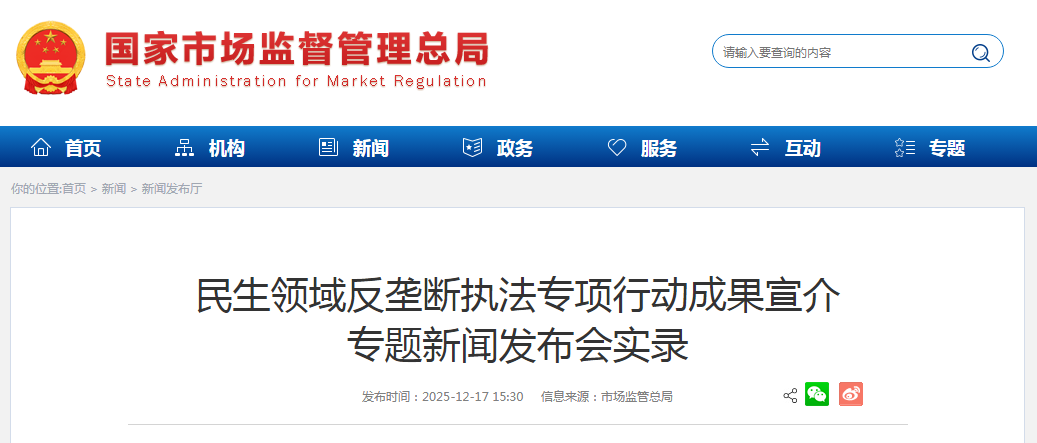
民生领域反垄断执法专项行动成果宣介专题新闻发布会实录
Zhong Guo Zhi Liang Xin Wen Wang· 2025-12-17 08:44
Core Viewpoint - The State Administration for Market Regulation (SAMR) has made significant progress in anti-monopoly enforcement in the livelihood sector over the past three years, focusing on protecting consumer rights and maintaining fair market competition [4][7]. Group 1: Major Achievements - SAMR has handled 35 cases of monopoly agreements and 25 cases of abuse of market dominance, with total fines amounting to 2.93 billion yuan [4][5]. - In the pharmaceutical sector, 12 major cases were addressed, resulting in fines exceeding 2.4 billion yuan, with price reductions for involved drugs exceeding 40%, and in some cases, up to 95% [5][9]. - The agency has completed 950 cases of business concentration in the livelihood sector, supporting mergers that enhance operational efficiency [4][25]. Group 2: Focus Areas - The enforcement actions have particularly targeted the pharmaceutical industry, with a high-pressure approach leading to significant penalties and a focus on key drugs affecting public health [9][12]. - In public utilities, 16 monopoly cases were addressed, with fines totaling 183 million yuan, aimed at correcting practices like bundled sales and limiting consumer choices [5][19]. - The platform economy has been under continuous scrutiny, with guidelines established to address new forms of monopoly risks, including algorithmic collusion and discriminatory practices [22][23]. Group 3: Regulatory Framework - SAMR has implemented several new regulations, including the revised Anti-Monopoly Law and various departmental rules to create a robust legal framework for fair competition [6][14]. - The agency has conducted 21 compliance training sessions, educating over 80,000 participants on anti-monopoly practices, particularly in the pharmaceutical and public utility sectors [6][10]. - A new compliance guideline for internet platforms has been drafted to address emerging monopoly risks, emphasizing the importance of transparency in algorithms and fair pricing practices [21][23]. Group 4: Future Directions - SAMR plans to continue strengthening anti-monopoly enforcement, particularly in the pharmaceutical sector, to ensure fair competition and protect consumer interests [12][25]. - The agency aims to enhance collaboration with other departments to improve information sharing and joint enforcement efforts against monopolistic practices [10][14]. - Future initiatives will focus on promoting compliance and preventing monopolistic behavior through proactive measures and public awareness campaigns [30][31].