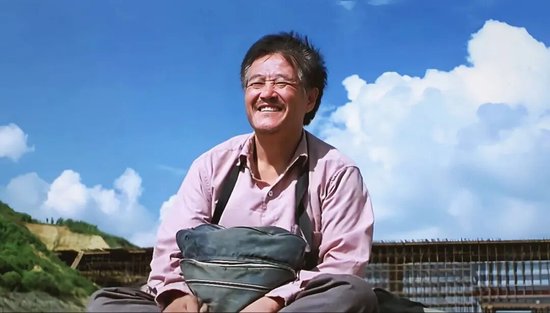
《刘老根》

Search documents
兽爷:十分想念赵本山
Xin Lang Cai Jing· 2026-02-16 14:30
Core Viewpoint - The departure of Zhao Benshan from the Spring Festival Gala marks a significant cultural shift, with no one able to replace his unique contribution to Chinese entertainment, particularly in rural-themed narratives [2][45][46] Group 1: Impact of Zhao Benshan and "Country Love" - Zhao Benshan's "Country Love" series achieved an average viewership rating of around 11% on CCTV-1, even surpassing the ratings of "News Broadcast" for individual episodes [3][47] - The series is recognized as the longest-running in China, representing the peak of Zhao Benshan's creative abilities and is considered by many as the best Chinese TV drama [4][48][49] - Over the past two decades, no other series has captured the essence of contemporary China as profoundly as "Country Love" [6][50] Group 2: Official Support and Creative Freedom - The inception of "Country Love" was backed by the National Population and Family Planning Commission, aiming to address the issue of declining birth rates through relatable rural narratives [6][50][52] - The collaboration between Zhao Benshan, director Zhang Huizhong, and screenwriter Zhang Ji was pivotal in creating a series that combined state support with artistic freedom, resulting in a unique portrayal of rural life [52][54][53] - The creative team was able to explore themes of rural life with significant freedom, leading to a blend of humor and social commentary that resonated with audiences [10][54] Group 3: Artistic Expression and Realism - "Country Love" is noted for its artistic depth, utilizing a "life flow montage" style that reflects the nuances of rural existence without relying on conventional dramatic structures [69][65] - The series is praised for its authentic representation of rural life, with actors embodying their roles in a way that feels genuine and relatable [67][66] - The cinematography and storytelling techniques employed in "Country Love" have been recognized as some of the highest artistic standards in Chinese television [65][66] Group 4: Evolution and Challenges - Over time, the character of Xie Yongqiang, the main protagonist, has seen a reduction in screen time, reflecting the series' struggle to address the realities faced by educated individuals returning to rural settings [78][29] - The narrative increasingly grapples with the challenges of modernity and the disconnect between rural life and urban opportunities, highlighting the difficulties faced by characters like Xie Yongqiang [30][78] - The series has shifted from a focus on political satire to a more comedic approach, losing some of its original critical edge in the process [39][87]

“演员闫学晶”被禁止关注,此前直播被指“哭穷”
Xin Lang Cai Jing· 2026-01-11 16:13
Core Viewpoint - The recent comments made by actress Yan Xuejing regarding her son's income have sparked controversy, as they were perceived as "crying poor" while indirectly showcasing wealth [7]. Group 1 - Yan Xuejing stated that her son earns only "tens of thousands," which is insufficient to sustain the family, indicating a need for an income of "hundreds of thousands" for proper household functioning [7]. - The actress highlighted that her son earns "dozens of thousands" per role, and both he and his partner do not have high salaries, contributing to the family's financial struggles [7]. - Yan Xuejing, born in 1972, is known for her roles in popular works such as "Liu Laogen," "Urban Outsider," and "My Mother Tian Xiaocao," and her son Lin Aofei is also an actor [7].

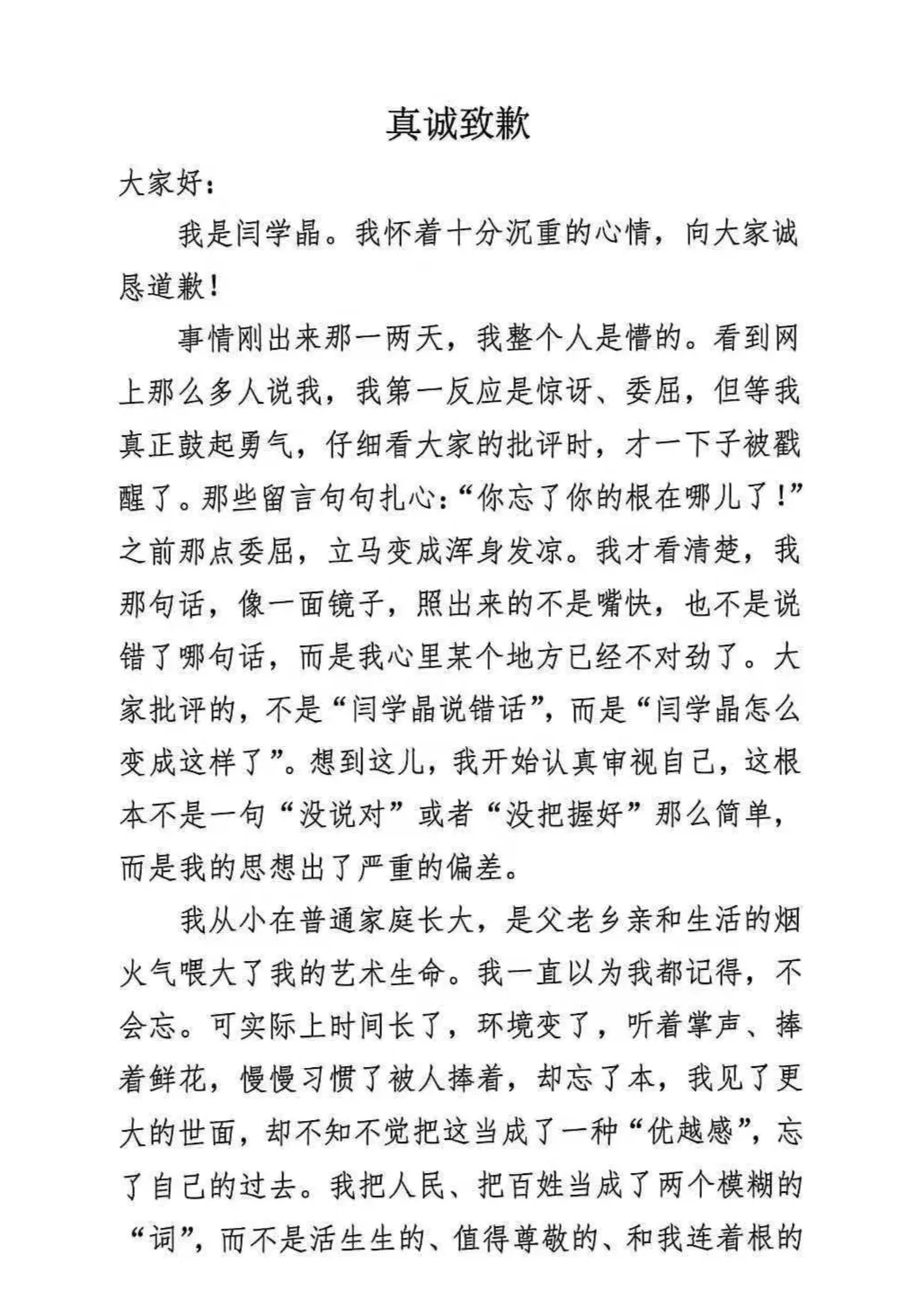
闫学晶发文致歉:我讨厌那个下意识里露出轻视的自己
Xin Lang Cai Jing· 2026-01-11 15:08
Core Viewpoint - The actor Yan Xuejing's comments about her son's earnings and family expenses sparked widespread discussion and criticism, leading her to issue a public apology for her perceived disconnect from the common people's experiences [1][2]. Group 1 - Yan Xuejing revealed in a live broadcast that her son earns "tens of thousands" for a film, and the family needs to cover annual expenses of around 1.8 million yuan, which some interpreted as "crying poor" and being out of touch with the public [1]. - Following the backlash, Yan expressed her surprise and feelings of injustice upon reading the criticisms, which prompted her to reflect on her situation and the disconnect between her current life and her humble beginnings [2][4]. - In her apology, Yan acknowledged that her comments reflected a deeper issue of having lost touch with her roots and the realities of ordinary people's lives, attributing this to her success and the changes in her environment over time [2][4].
马上评|多换位思考,就可以避免很多对立和撕裂
Xin Lang Cai Jing· 2026-01-10 10:12
Core Viewpoint - The controversy surrounding actress Yan Xuejing's comments about her family's income highlights the disconnect between her perspective and that of the general public, leading to accusations of "showing off wealth" and "crying poverty" [1][2][3] Group 1: Public Reaction - There are mixed reactions to Yan Xuejing's statements, with some believing her income level is significantly higher than that of the average person, while others argue that her financial situation is not exaggerated given the high cost of living in major cities [1] - The public discourse reflects a broader issue of empathy and understanding, as many individuals fail to consider the diverse economic realities faced by others [3] Group 2: Personal Perspective - Yan Xuejing's comments reveal a limited worldview, as she seems unable to generalize her personal experiences to the broader population, which may lead to misunderstandings and negative perceptions [2] - The need for public figures to expand their perspectives and recognize the varied circumstances of others is emphasized, suggesting that greater awareness could alter the public's response to their statements [2] Group 3: Social Commentary - The article discusses the tendency for extreme viewpoints to provoke strong emotional reactions online, often stemming from a lack of empathy and the failure to consider others' perspectives [3] - It is noted that both public figures and ordinary individuals must acknowledge the existence of diverse experiences and values in society, which is essential for fostering mutual understanding and respect [3]
神坛上的陈佩斯:九十年代的因,今日的果
Hu Xiu· 2025-07-28 04:12
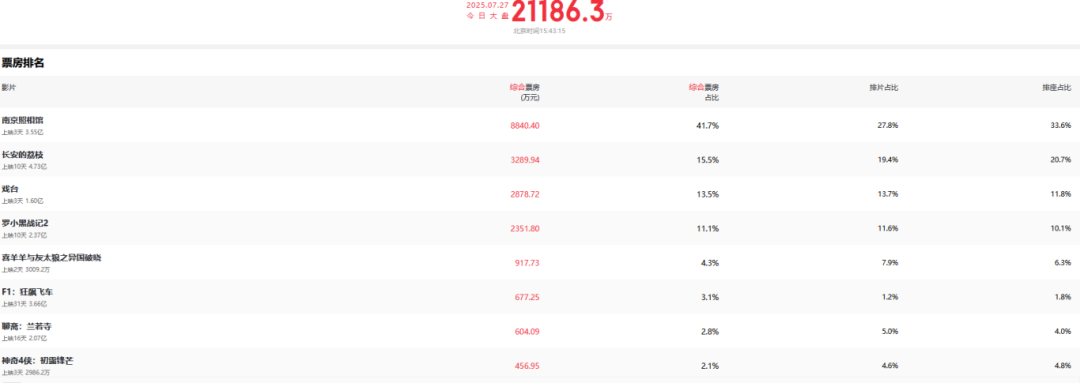
Group 1 - The overall box office market for the summer of 2025 is bleak, but Chen Peisi's film "Xitai" has grossed over 100 million in just two days, surpassing "Nihang Nihang" which took nine days to reach the same figure [1][3] - The film "Xitai" has received mixed reviews, indicating a potential decline in the long-standing "Chen Peisi myth" [1][4] - The exit of national comedy kings like Chen Peisi and Zhao Benshan from the film industry has had a profound impact on the domestic box office market, which has shifted towards urban middle-class audiences [4][5] Group 2 - The film industry in China has faced structural issues since the 1990s, with a significant reliance on a few successful directors and their works, leading to a fragile middle market [5][6] - The transition from a planned economy to a market economy in the late 1980s and early 1990s led to a crisis in the film industry, with a decline in both the quantity and quality of domestic films [6][7] - The introduction of Hollywood films in the 1990s further exacerbated the challenges faced by domestic productions, as they struggled to compete with the precision and appeal of foreign films [19][20] Group 3 - The real estate boom in the 2000s provided a temporary revival for the film industry, leading to a surge in commercial cinemas and a renewed interest in local films [22][23] - However, the current film market is highly capitalized and entertainment-driven, making it difficult for traditional artists like Chen Peisi and Zhao Benshan to participate meaningfully [24][25] - The absence of crowd-pleasing films has resulted in a weak middle market, which is crucial for sustaining the industry and nurturing talent [25][26] Group 4 - The historical context of the film industry reveals a pattern of misalignment between production and audience interests, leading to a decline in viewership and engagement [10][14] - The lack of a robust middle market has resulted in a reliance on blockbuster films, which can be risky if they fail to perform [26][27] - The current state of the film industry reflects a departure from the grassroots, community-oriented storytelling that characterized earlier successful films [24][31]