《当代中国经济讲义》

Search documents
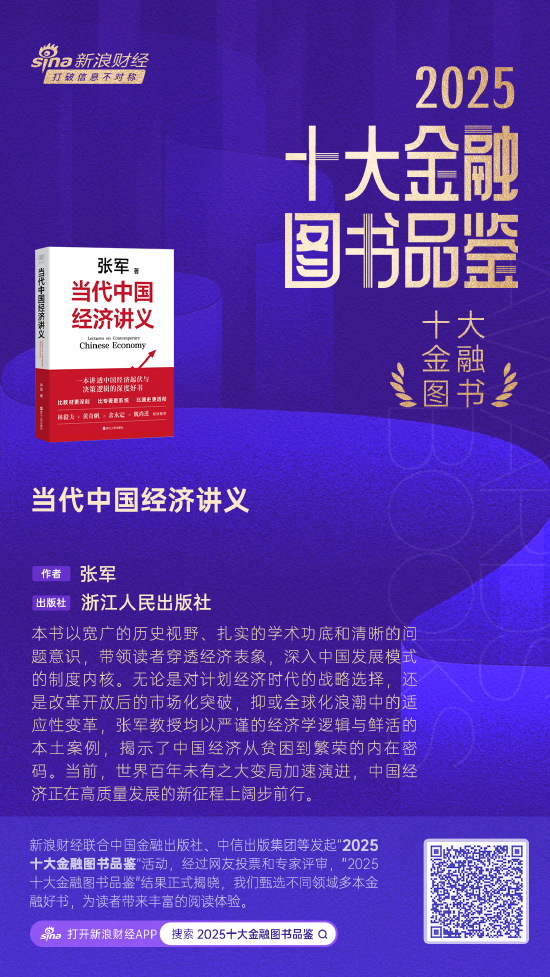
张军《当代中国经济讲义》获评2025十大金融图书
Xin Lang Cai Jing· 2026-02-05 11:23
Group 1 - The "2025 Top Ten Financial Books" event results were announced after nearly two months of competition and expert review, with Zhang Jun's book "Contemporary Chinese Economic Lectures" being awarded as one of the top ten financial books [1][9]. - The book is published by Zhejiang People's Publishing House and aims to provide a broad historical perspective, solid academic foundation, and clear problem awareness, guiding readers to penetrate economic appearances and delve into the institutional core of China's development model [4][8]. - Zhang Jun discusses strategic choices during the planned economy era, market breakthroughs after the reform and opening-up, and adaptive changes amid globalization, using rigorous economic logic and vivid local cases to reveal the internal mechanisms behind China's transition from poverty to prosperity [4][8]. Group 2 - The current global situation is characterized by unprecedented changes, and China is advancing on a new journey of high-quality economic development [4][8].

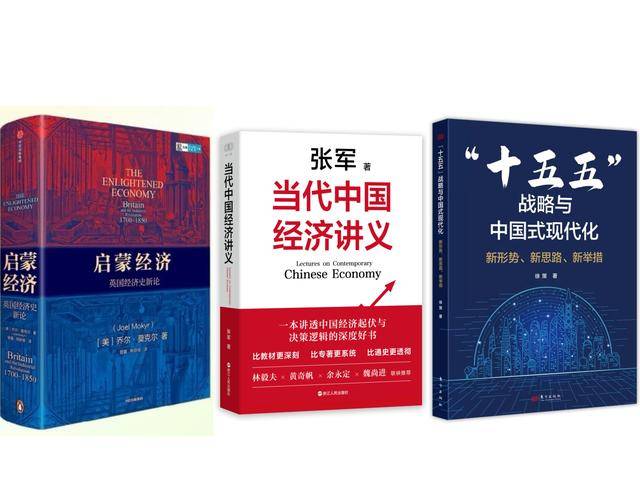
案头书|经济持续增长的真正源头
Sou Hu Cai Jing· 2026-01-09 11:14
Core Insights - The article discusses Joel Mokyr's groundbreaking work "Enlightened Economy," which challenges the "technological determinism" framework in explaining the Industrial Revolution, emphasizing the role of the Enlightenment and institutional environments in fostering economic growth [3][4]. Group 1: Industrial Revolution Insights - Mokyr argues that the Industrial Revolution was not solely a product of technological breakthroughs but rather a result of the Enlightenment's "intellectual revolution" and the resonance with institutional environments [3][4]. - He highlights the importance of "knowledge capitalization and sharing" mechanisms that transformed technological inventions from random attempts to systematic dissemination, serving as the true source of sustained economic growth [3][4]. - The article critiques the traditional view that focuses on technology alone, suggesting that the real question is why technology was created, improved, and widely applied at unprecedented speeds during this period [3][4]. Group 2: Knowledge Sharing and Economic Development - The article draws parallels between Mokyr's framework and China's rapid industrialization over 75 years, attributing it to a belief in knowledge sharing under the mission-driven leadership of the Communist Party [6]. - It emphasizes that the Chinese government's commitment to improving cultural levels and industrialization through science and technology, along with supportive industrial policies, laid the foundation for knowledge sharing and free flow [6]. - The significance of Mokyr's work is highlighted as a historical reference for understanding China's current strategy to develop "new quality productivity," which requires not just investment in R&D but also the creation of a vibrant innovation ecosystem [6].