
《救国军歌》

Search documents
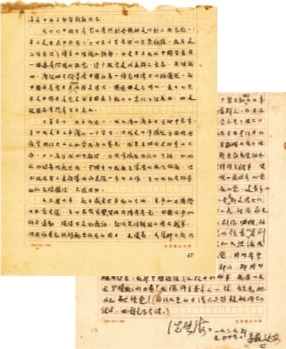
“生命上最光荣的一天”(以物鉴史)
Ren Min Ri Bao· 2025-12-12 22:00
Core Points - The article highlights the historical significance of Xian Xinghai's application to join the Communist Party of China, reflecting his commitment to the party and the nation during the anti-Japanese war [2][3][4] - It details Xian Xinghai's contributions to Chinese music and his evolution from a patriot to a communist, emphasizing his role in creating influential anti-war songs and his collaboration on the monumental "Yellow River Cantata" [3][4] Group 1 - Xian Xinghai submitted his application to join the Communist Party on May 15, 1939, expressing his desire for political guidance and his commitment to contribute to the party's strength in the new China [2] - He was a pioneer of new Chinese music, known as the "People's Musician," and actively participated in the anti-Japanese movement by creating significant songs [3] - His application was influenced by his interactions with Zhao Yimin, who encouraged him to develop his talents and embrace communist ideals [3] Group 2 - Xian Xinghai officially joined the Communist Party on June 14, 1939, marking it as the most glorious day of his life and expressing his hope to change his worldview to fight for proletarian music [4]

奔腾的旋律奏响 让人热血沸腾 上海夏季音乐节传承伟大抗战精神传递和平之声
Jie Fang Ri Bao· 2025-07-14 02:01
Core Viewpoint - The concert commemorating the 80th anniversary of the victory in the Chinese People's War of Resistance Against Japanese Aggression and the World Anti-Fascist War was held in Shanghai, featuring classic anti-war melodies and emphasizing the importance of peace and historical remembrance [1][2]. Group 1: Event Overview - The concert was conducted by Yu Long and featured the Shanghai Symphony Orchestra and Echo Festival Choir, showcasing a compilation of world classic anti-war melodies [1]. - The event was part of the Shanghai Summer Music Festival (MISA) and was broadcast live across five cities, including Beijing and Guangzhou, to spread the message of peace [1]. Group 2: Musical Selections - The concert opened with an excerpt from Shostakovich's Symphony No. 7, a widely recognized piece from World War II, symbolizing the struggle against fascism [1]. - Other notable pieces included "Song of the Dnieper," "The Song of the Long Wall," and various patriotic songs from the 1930s, reflecting the patriotic fervor of Chinese musicians during difficult times [2]. Group 3: Cultural Significance - The concert highlighted the historical significance of the "March of the Volunteers," which originated in Shanghai and serves as a symbol of national spirit and the Chinese people's desire for peace [2]. - The event concluded with a powerful moment where over a thousand attendees sang the national anthem, creating a profound atmosphere of unity and remembrance [2].