
《文心雕龙》

Search documents
刘梦溪|读书与修身
Xin Lang Cai Jing· 2026-01-08 00:26
Core Viewpoint - The importance of reading and its impact on personal development and societal contribution is emphasized, highlighting that reading is essential not only for academic pursuits but also for personal growth and cultural continuity [3][4][5]. Group 1: Importance of Reading - Reading is essential for both scholars and ordinary citizens, as it enriches life and culture [3][4]. - It is stated that reading can change one's temperament and character, as noted by historical figures like Zhu Xi [3][6]. - The act of reading is portrayed as a means to shed undesirable habits and cultivate a refined character [6][9]. Group 2: Personal Experiences and Influences - The speaker shares personal anecdotes about their educational journey and the influence of literature on their life, including early exposure to classical texts [4][23][25]. - The impact of various literary works, including Western literature, on personal development is discussed, indicating a broad appreciation for diverse literary traditions [25][26]. Group 3: Recommended Reading - A list of essential Chinese texts is provided, including "The Analects," "The Book of Songs," and "Records of the Grand Historian," which are deemed crucial for understanding Chinese culture and philosophy [10][11][12][13][14]. - The necessity of reading foreign literature alongside Chinese classics is emphasized, with specific works by philosophers and authors like Plato, Aristotle, and Tolstoy recommended [19][20]. Group 4: Reading Approaches - Different reading methods are suggested, including professional reading for academic purposes and leisurely reading for personal enjoyment, with the latter being encouraged for its enriching benefits [21][22]. - The significance of reading classical texts, such as the Six Classics, is highlighted, advocating for their inclusion in modern education [28].

钱锺书四说《文心雕龙》
Xin Lang Cai Jing· 2025-12-20 07:48
Core Viewpoint - The articles highlight the significance of Qian Zhongshu's references to Liu Xie's literary theory work "Wenxin Diaolong," emphasizing its status as a prestigious theoretical work in the study of ancient Chinese aesthetics [1][2]. Group 1: Importance of "Wenxin Diaolong" - Qian Zhongshu mentions "Wenxin Diaolong" as a "prestigious theoretical work" in the context of studying ancient Chinese aesthetics, indicating its critical role in literary theory [1]. - The work is noted for its exploration of various literary phenomena, including the relationship between different senses, which Qian critiques for its limitations [1]. Group 2: Critique and Praise of Liu Xie - Qian critiques Liu Xie's oversight in not addressing the phenomenon of "hearing shapes," suggesting a blind spot in Liu's literary analysis [1]. - Qian acknowledges Liu Xie's early recognition of the negative trend of "literary people without genuine suffering," which reflects a critical yet appreciative stance towards Liu's insights [2]. - The articles advocate for a balanced approach in academic research, emphasizing the importance of recognizing both strengths and weaknesses in literary works [2].
山东日照莒县构建古树保护体系
Huan Qiu Wang· 2025-11-19 02:14
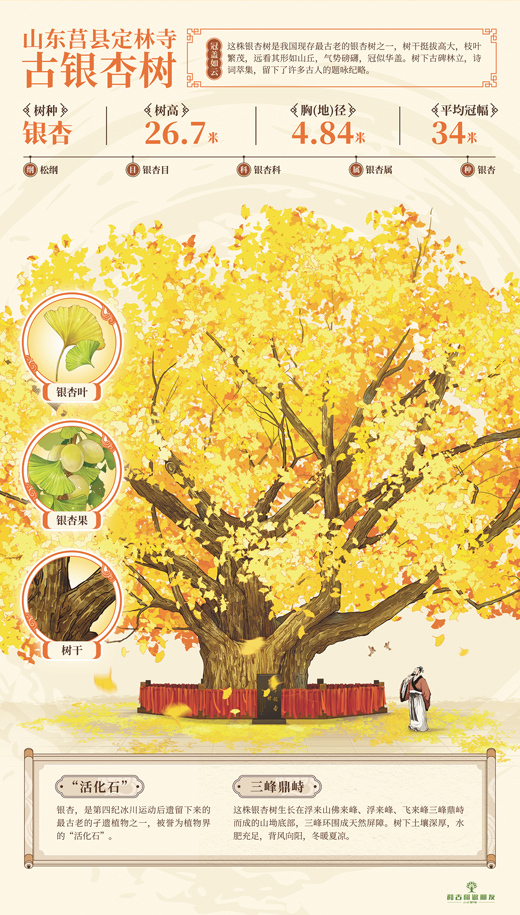
Core Viewpoint - The ancient ginkgo tree in Juxian County, Shandong, has become a cultural symbol and is being actively protected through various measures, highlighting the importance of preserving historical and natural heritage [4][5]. Group 1: Cultural and Historical Significance - The ancient ginkgo tree is located in the Fulaishan scenic area, which is a national 4A-level tourist attraction and a historical museum [3]. - The tree stands at 26.7 meters tall with an average crown width of 34 meters, surrounded by ancient steles that bear poetry from historical figures, showcasing its long-standing connection to history [4]. - The tree serves as a witness to cultural heritage, with the nearby "Xiaojing Building" commemorating Liu Xie, a significant figure in literary theory [4]. Group 2: Conservation Efforts - Juxian County has established a protection system for ancient trees, including supplementary investigations, documentation, and protective signage [4]. - Li Jianguo, a dedicated gardener, has been caring for the ginkgo tree since 2014, performing essential tasks such as watering, pest control, and fruit thinning to ensure its health [5]. - Li maintains a "Big Tree Diary" to meticulously record the tree's growth and health, which aids experts in developing care strategies [5]. Group 3: Biological Characteristics - Ginkgo biloba, also known as the maidenhair tree, is a tall tree that can reach up to 40 meters, with fan-shaped leaves that turn golden in autumn, making it highly ornamental [5]. - Ginkgo trees are ancient, dating back 345 million years, and are unique to China, with all existing ginkgo trees worldwide originating from this region [6].

古老银杏 韵传古今(和古树做朋友)
Ren Min Ri Bao· 2025-11-18 23:30
Core Viewpoint - The ancient ginkgo tree in Juxian County, Shandong, is highlighted as a cultural and historical symbol, showcasing the importance of tree preservation and the efforts made to protect it [4][5]. Group 1: Cultural Significance - The ancient ginkgo tree is located in the Dinglin Temple, which is part of a national 4A tourist attraction and serves as a historical museum [3]. - The tree is associated with historical figures, including Liu Xie, a renowned literary theorist, whose work has influenced literature for over a thousand years [4]. Group 2: Preservation Efforts - Juxian County has implemented a tree protection system that includes supplementary surveys, record-keeping, and protective signage [4]. - Li Jianguo, a dedicated caretaker, has been tending to the ginkgo tree since 2014, performing essential maintenance tasks such as watering and pest control [5]. Group 3: Detailed Monitoring - Li Jianguo maintains a "Big Tree Diary" documenting the tree's growth stages and environmental conditions, which aids in expert assessments and care strategies [5]. - The ginkgo tree has seen an increase in fruit production due to improved pollination from surrounding ginkgo trees planted in recent years [5]. Group 4: Botanical Information - Ginkgo biloba, also known as the maidenhair tree, is a large deciduous tree that can reach heights of up to 40 meters and is valued for its ornamental and economic uses [6][8]. - Ginkgo trees are ancient, dating back 345 million years, and are unique to China, with all existing ginkgo trees worldwide originating from this region [6].
浮来山银杏与刘勰的《文心雕龙》
Qi Lu Wan Bao· 2025-10-30 11:55
Core Viewpoint - The ancient ginkgo tree in Juxian Fulaishan is recognized as the oldest ginkgo tree in the world, with a trunk circumference of approximately 16 meters and a height of about 27 meters, symbolizing the passage of time and cultural heritage [1][2]. Group 1: Historical Significance - The ginkgo tree has historical importance, as it was the site of a significant alliance meeting between the rulers of the Ju and Lu states in 715 BC, as recorded in the historical text "Spring and Autumn" [1]. - The tree is estimated to be over 3,000 years old, as noted by a stele erected in 1654 during the Qing Dynasty [1]. Group 2: Cultural Impact - The ginkgo tree has inspired numerous literary works throughout history, with poets and writers praising its beauty and significance, such as Sima Xiangru's "Upper Forest Fu" and Ouyang Xiu's poetry [3][4]. - The ginkgo leaf's unique golden color in autumn has been celebrated in literature, evoking feelings of nostalgia and beauty [2][4]. Group 3: Connection to Liu Xie - Liu Xie, a prominent literary figure, is associated with the Fulaishan area, where he spent years studying and writing, leading to the creation of his influential work "Wenxin Diaolong" [5][6]. - The connection between Liu Xie and the ginkgo tree reflects the deep cultural roots of the region, as both represent the enduring legacy of Chinese literature and philosophy [8].
用阅读编织自驱自在的人生(读书有味)
Ren Min Ri Bao· 2025-10-09 22:22
Group 1 - The importance of interdisciplinary reading for professional development and creativity in architecture is emphasized, highlighting how literature and philosophy can inspire architectural design [1][2] - The influence of traditional Chinese philosophy on architectural thinking is noted, particularly the concept of interconnectedness and change, which shapes the design approach [2] - The role of literature in understanding human emotions and experiences is discussed, illustrating how this understanding can enhance architectural expression [1][2] Group 2 - The rapid changes in society and the impact of artificial intelligence on architecture are acknowledged, prompting reflection on future design challenges [2] - The pursuit of a holistic view in architectural design is advocated, suggesting that a comprehensive understanding of various factors is essential for effective design [2] - The joy and challenges of reading are highlighted, indicating that continuous exploration and thought are vital for personal and professional growth [2]
古朴之气 求实之风(读书有味)
Ren Min Ri Bao· 2025-06-19 21:51
Core Points - The article discusses the historical significance of Liu Li Chang, a cultural hub in Beijing, and its connection to prominent scholars and literary figures, particularly those associated with Zhang Taiyan and his disciples [1][2][3][4][5] Group 1: Historical Context - Liu Li Chang is noted for its numerous old bookstores, which offer a variety of antiquities, including rare books and calligraphy, attracting scholars and collectors [1] - Several notable figures, including Lu Xun, Qian Xuantong, and Zhu Xizu, frequented Liu Li Chang, indicating its importance in their academic pursuits [2][3] Group 2: Academic Influence - The writings of Zhang Taiyan's disciples reflect a deep engagement with classical Chinese literature and philosophy, showcasing their scholarly rigor and the influence of Zhang's teachings [3][4] - The article emphasizes the need for contemporary youth to reconnect with Zhang Taiyan's ideas through the works of his disciples, as they provide valuable insights into classical texts [4] Group 3: Cultural Legacy - The author reflects on the artistic qualities of the writings of Zhang Taiyan and his disciples, highlighting their unique styles and the cultural spirit they embody [5] - The article suggests that the new cultural spirit is derived from a deep understanding of classical literature, which requires thorough study and contemplation [5]